Kirjojen hintavertailu – 12 859 818 kirjaa ja 27 kauppaa

Kirjailija

Jean-Luc Nancy

Kirjat ja teokset yhdessä paikassa: 125 kirjaa, julkaisuja vuosilta 1988–2025, suosituimpiin kuuluu Nous? L'aspiration à la communauté et les arts: postscriptum de Jean-Luc Nancy. Vertaile teosten hintoja ja tarkista saatavuus suomalaisista kirjakaupoista.

Nimi esiintyy myös muodoissa: Jean–luc Nancy

125 kirjaa

Kirjojen julkaisuvuodet: 1988–2025.

Democracy in What State?

Democracy in What State?

Giorgio Agamben; Alain Badiou; Daniel Bensaid; Wendy Brown; Jean-Luc Nancy; Jacques Rancière; Kristin Ross; Slavoj Žižek

Columbia University Press
2012
pokkari
"Is it meaningful to call oneself a democrat? And if so, how do you interpret the word?" In responding to this question, eight iconoclastic thinkers prove the rich potential of democracy, along with its critical weaknesses, and reconceive the practice to accommodate new political and cultural realities. Giorgio Agamben traces the tense history of constitutions and their coexistence with various governments. Alain Badiou contrasts current democratic practice with democratic communism. Daniel Bensaid ponders the institutionalization of democracy, while Wendy Brown discusses the democratization of society under neoliberalism. Jean-Luc Nancy measures the difference between democracy as a form of rule and as a human end, and Jacques Ranciere highlights its egalitarian nature. Kristin Ross identifies hierarchical relationships within democratic practice, and Slavoj Zizek complicates the distinction between those who desire to own the state and those who wish to do without it. Concentrating on the classical roots of democracy and its changing meaning over time and within different contexts, these essays uniquely defend what is left of the left-wing tradition after the fall of Soviet communism. They confront disincentives to active democratic participation that have caused voter turnout to decline in western countries, and they address electoral indifference by invoking and reviving the tradition of citizen involvement. Passionately written and theoretically rich, this collection speaks to all facets of modern political and democratic debate.
God, Justice, Love, Beauty

God, Justice, Love, Beauty

Jean-Luc Nancy

Fordham University Press
2011
pokkari
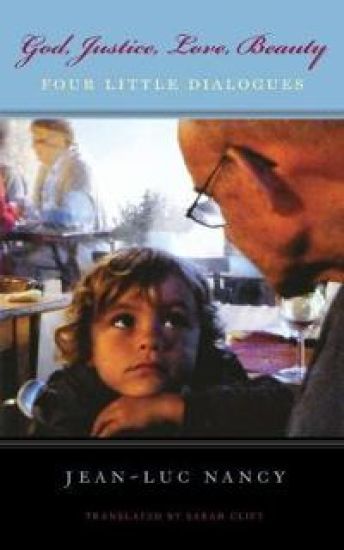
The four talks collected here transcribe lectures delivered to an audience of children between the ages of ten and fourteen, under the auspices of the "little dialogues" series at the Montreuil's center for the dramatic arts. Modeled on Walter Benjamin's "Aufklärung für Kinder" radio talks, this series aims to awaken its young audience to pressing philosophical concerns. Each talk in God, Justice, Love, Beauty explores what is at stake in these topics as essential moments in human experience. (Indeed, the book argues that they are constitutive of human experience.) Following each, Nancy's audience is given a chance to engage with him in a process of philosophical questioning; the texts of these touching and probing exchanges are included in the volume. Despite the fact that these lectures were delivered to an audience of children, the intellectual level they achieve—while remaining easily comprehensible—is astounding. No attempt is made to simplify Nancy's positions or to resolve the complexities that arise in the course of the talks or the question periods that follow. The work of opening performed here is fully in keeping with the strategy of Nancy's philosophy as a whole. Thus, for readers unfamiliar with his work, God, Justice, Love, Beauty will function as an excellent introduction to Nancy's larger corpus. As varied as the individual talks are, they share the motif of incalculability or the immeasurable. Broadly speaking, one could say that the various ways in which Nancy approaches this motif exemplify his deconstructive approach to think of human existence. As well, those treatments exemplify his conviction that the task of thinking is to develop original ways of communicating the incalculable. God, Justice, Love, Beauty is thus a skillful reminder that philosophy is important to all of us. The book is also a model of intellectual generosity and openness. Seamlessly moving from Schwarzenegger to Plato, from Kant, Roland Barthes, and Caravaggio to Caillou, Harry Potter, and the pages of Gala magazine, Nancy's wide-ranging references bear witness to his commitment to think of "culture" in its broadest sense.
God, Justice, Love, Beauty

God, Justice, Love, Beauty

Jean-Luc Nancy

Fordham University Press
2011
sidottu
The four talks collected here transcribe lectures delivered to an audience of children between the ages of ten and fourteen, under the auspices of the "little dialogues" series at the Montreuil's center for the dramatic arts. Modeled on Walter Benjamin's "Aufklärung für Kinder" radio talks, this series aims to awaken its young audience to pressing philosophical concerns. Each talk in God, Justice, Love, Beauty explores what is at stake in these topics as essential moments in human experience. (Indeed, the book argues that they are constitutive of human experience.) Following each, Nancy's audience is given a chance to engage with him in a process of philosophical questioning; the texts of these touching and probing exchanges are included in the volume. Despite the fact that these lectures were delivered to an audience of children, the intellectual level they achieve—while remaining easily comprehensible—is astounding. No attempt is made to simplify Nancy's positions or to resolve the complexities that arise in the course of the talks or the question periods that follow. The work of opening performed here is fully in keeping with the strategy of Nancy's philosophy as a whole. Thus, for readers unfamiliar with his work, God, Justice, Love, Beauty will function as an excellent introduction to Nancy's larger corpus. As varied as the individual talks are, they share the motif of incalculability or the immeasurable. Broadly speaking, one could say that the various ways in which Nancy approaches this motif exemplify his deconstructive approach to think of human existence. As well, those treatments exemplify his conviction that the task of thinking is to develop original ways of communicating the incalculable. God, Justice, Love, Beauty is thus a skillful reminder that philosophy is important to all of us. The book is also a model of intellectual generosity and openness. Seamlessly moving from Schwarzenegger to Plato, from Kant, Roland Barthes, and Caravaggio to Caillou, Harry Potter, and the pages of Gala magazine, Nancy's wide-ranging references bear witness to his commitment to think of "culture" in its broadest sense.
Democracy in What State?

Democracy in What State?

Giorgio Agamben; Alain Badiou; Daniel Bensaid; Wendy Brown; Jean-Luc Nancy; Jacques Rancière; Kristin Ross; Slavoj Žižek

Columbia University Press
2011
sidottu
"Is it meaningful to call oneself a democrat? And if so, how do you interpret the word?" In responding to this question, eight iconoclastic thinkers prove the rich potential of democracy, along with its critical weaknesses, and reconceive the practice to accommodate new political and cultural realities. Giorgio Agamben traces the tense history of constitutions and their coexistence with various governments. Alain Badiou contrasts current democratic practice with democratic communism. Daniel Bensaid ponders the institutionalization of democracy, while Wendy Brown discusses the democratization of society under neoliberalism. Jean-Luc Nancy measures the difference between democracy as a form of rule and as a human end, and Jacques Ranciere highlights its egalitarian nature. Kristin Ross identifies hierarchical relationships within democratic practice, and Slavoj Zizek complicates the distinction between those who desire to own the state and those who wish to do without it. Concentrating on the classical roots of democracy and its changing meaning over time and within different contexts, these essays uniquely defend what is left of the left-wing tradition after the fall of Soviet communism. They confront disincentives to active democratic participation that have caused voter turnout to decline in western countries, and they address electoral indifference by invoking and reviving the tradition of citizen involvement. Passionately written and theoretically rich, this collection speaks to all facets of modern political and democratic debate.
The Truth of Democracy

The Truth of Democracy

Jean-Luc Nancy

Fordham University Press
2010
pokkari
The initial provocation for The Truth of Democracy was the fortieth anniversary of May '68 and the recent criticism (some by French President Nicolas Sarkozy himself) leveled against the ideals and actors at the center of this important but still misunderstood moment in French history. Nancy here defends what he calls simply "68" without apology or equivocation, calling it an essential stage in the search for the "truth of democracy." Less a period within time than a critical moment or interruption of time, 68 needs to be understood, Nancy argues, as an "event" that provided a glimpse into the very "spirit of democracy," a spirit that is linked not to some common vision, idea, or desire (such as the nation, the republic, the people, or humanity) but to an incommensurability (the infinity of man or man's exceeding of himself ) at the origin of democracy. Written in a direct and accessible, almost manifesto-like style, The Truth of Democracy presents a forceful plea that we rethink democracy not as one political regime or form among others but as that which opens up the very experience of being in common. By rearticulating many of the themes and terms he has developed elsewhere (from community and being in common to the singular plural) in relationship to an original analysis of what was and still is at stake in May '68, The Truth of Democracy is at once an eloquent summary of much of Nancy's work and a significant development of it. It is as if, forty years after being first scrawled across university walls and storefronts in France, one of the most famous slogans of May '68 has received in The Truth of Democracy its most eloquent and poignant theoretical elaboration: "Be realistic, demand the impossible!"
The Truth of Democracy

The Truth of Democracy

Jean-Luc Nancy

Fordham University Press
2010
sidottu
The initial provocation for The Truth of Democracy was the fortieth anniversary of May '68 and the recent criticism (some by French President Nicolas Sarkozy himself) leveled against the ideals and actors at the center of this important but still misunderstood moment in French history. Nancy here defends what he calls simply "68" without apology or equivocation, calling it an essential stage in the search for the "truth of democracy." Less a period within time than a critical moment or interruption of time, 68 needs to be understood, Nancy argues, as an "event" that provided a glimpse into the very "spirit of democracy," a spirit that is linked not to some common vision, idea, or desire (such as the nation, the republic, the people, or humanity) but to an incommensurability (the infinity of man or man's exceeding of himself ) at the origin of democracy. Written in a direct and accessible, almost manifesto-like style, The Truth of Democracy presents a forceful plea that we rethink democracy not as one political regime or form among others but as that which opens up the very experience of being in common. By rearticulating many of the themes and terms he has developed elsewhere (from community and being in common to the singular plural) in relationship to an original analysis of what was and still is at stake in May '68, The Truth of Democracy is at once an eloquent summary of much of Nancy's work and a significant development of it. It is as if, forty years after being first scrawled across university walls and storefronts in France, one of the most famous slogans of May '68 has received in The Truth of Democracy its most eloquent and poignant theoretical elaboration: "Be realistic, demand the impossible!"
Tombeau of Ibn Arabi and White Traverses

Tombeau of Ibn Arabi and White Traverses

Abdelwahab Meddeb; Jean-Luc Nancy

Fordham University Press
2010
pokkari
Abdelwahab Meddeb crosses boundaries in unusual and important ways. Born in Tunis, he is now a French national. In his academic and literary work, he is concerned with the roots and history of Islam and with crossings, like his own, between Islam and Europe. He is an author of extraordinarily beautiful French; this is the first book to represent this lyrical aspect of his work in English translation. White Traverses is a poetic memoir about growing up in Tunisia and the contrasts between Islamic and European influences. In it, the intense colors and blinding whites of the Maghreb interweave with the rich traditions of French poetic discourse. In Africa as in Europe, white designates purity. Yet the complex Mediterranean streams of culture that flow together in Tunis problematize this myth. Meddeb captures their white refractions in vignettes that teach us the truth of the coincidence of contraries, of how the impure lodges in the pure. Tombeau of Ibn Arabi is a series of prose poems that draw their inspiration from the great Sufi poet of mediaeval Andalusia, Ibn Arabi, whose fervent love poetry both scandalized and transformed Islamic culture, and from Dante, who learned from Ibn Arabi a poetry of sensual love as initiation into spiritual experience. It seeks to show how a text written in the present day can maintain a link with the great dead . Ibn Arabi and Dante are two symbolic figures confirming the author's twofold spiritual genealogy--Arabic and European.
Tombeau of Ibn Arabi and White Traverses

Tombeau of Ibn Arabi and White Traverses

Abdelwahab Meddeb; Jean-Luc Nancy

Fordham University Press
2010
sidottu
Abdelwahab Meddeb crosses boundaries in unusual and important ways. Born in Tunis, he is now a French national. In his academic and literary work, he is concerned with the roots and history of Islam and with crossings, like his own, between Islam and Europe. He is an author of extraordinarily beautiful French; this is the first book to represent this lyrical aspect of his work in English translation. White Traverses is a poetic memoir about growing up in Tunisia and the contrasts between Islamic and European influences. In it, the intense colors and blinding whites of the Maghreb interweave with the rich traditions of French poetic discourse. In Africa as in Europe, white designates purity. Yet the complex Mediterranean streams of culture that flow together in Tunis problematize this myth. Meddeb captures their white refractions in vignettes that teach us the truth of the coincidence of contraries, of how the impure lodges in the pure. Tombeau of Ibn Arabi is a series of prose poems that draw their inspiration from the great Sufi poet of mediaeval Andalusia, Ibn Arabi, whose fervent love poetry both scandalized and transformed Islamic culture, and from Dante, who learned from Ibn Arabi a poetry of sensual love as initiation into spiritual experience. It seeks to show how a text written in the present day can maintain a link with the great dead . Ibn Arabi and Dante are two symbolic figures confirming the author's twofold spiritual genealogy--Arabic and European.
The Fall of Sleep

The Fall of Sleep

Jean-Luc Nancy

Fordham University Press
2009
sidottu
Philosophers have largely ignored sleep, treating it as a useless negativity, mere repose for the body or at best a source for the production of unconscious signs out of the night of the soul. In an extraordinary theoretical investigation written with lyric intensity, The Fall of Sleep puts an end to this neglect by providing a deft yet rigorous philosophy of sleep. What does it mean to "fall" asleep? Might there exist something like a "reason" of sleep, a reason at work in its own form or modality, a modality of being in oneself, of return to oneself, without the waking "self" that distinguishes "I" from "you" and from the world? What reason might exist in that absence of ego, appearance, and intention, in an abandon thanks to which one is emptied out into a non-place shared by everyone? Sleep attests to something like an equality of all that exists in the rhythm of the world. With sleep, victory is constantly renewed over the fear of night, an a confidence that we will wake with the return of day, in a return to self, to us--though to a self, an us, that is each day different, unforeseen, without any warning given in advance. To seek anew the meaning stirring in the supposed loss of meaning, of consciousness, and of control that occurs in sleep is not to reclaim some meaning already familiar in philosophy, religion, progressivism, or any other -ism. It is instead to open anew a source that is not the source of a meaning but that makes up the nature proper to meaning, its truth: opening, gushing forth, infinity. This beautiful, profound meditation on sleep is a unique work in the history of phenomenology--a lyrical phenomenology of what can have no phenomenology, since sleep shows itself to the waking observer, the subject of phenomenology, only as disappearance and concealment.
The Fall of Sleep

The Fall of Sleep

Jean-Luc Nancy

Fordham University Press
2009
pokkari
Philosophers have largely ignored sleep, treating it as a useless negativity, mere repose for the body or at best a source for the production of unconscious signs out of the night of the soul. In an extraordinary theoretical investigation written with lyric intensity, The Fall of Sleep puts an end to this neglect by providing a deft yet rigorous philosophy of sleep. What does it mean to "fall" asleep? Might there exist something like a "reason" of sleep, a reason at work in its own form or modality, a modality of being in oneself, of return to oneself, without the waking "self" that distinguishes "I" from "you" and from the world? What reason might exist in that absence of ego, appearance, and intention, in an abandon thanks to which one is emptied out into a non-place shared by everyone? Sleep attests to something like an equality of all that exists in the rhythm of the world. With sleep, victory is constantly renewed over the fear of night, an a confidence that we will wake with the return of day, in a return to self, to us--though to a self, an us, that is each day different, unforeseen, without any warning given in advance. To seek anew the meaning stirring in the supposed loss of meaning, of consciousness, and of control that occurs in sleep is not to reclaim some meaning already familiar in philosophy, religion, progressivism, or any other -ism. It is instead to open anew a source that is not the source of a meaning but that makes up the nature proper to meaning, its truth: opening, gushing forth, infinity. This beautiful, profound meditation on sleep is a unique work in the history of phenomenology--a lyrical phenomenology of what can have no phenomenology, since sleep shows itself to the waking observer, the subject of phenomenology, only as disappearance and concealment.
On the Commerce of Thinking

On the Commerce of Thinking

Jean-Luc Nancy

Fordham University Press
2009
pokkari
Jean-Luc Nancy's On the Commerce of Thinking concerns the particular communication of thoughts that takes place by means of the business of writing, producing, and selling books. His reflection is born out of his relation to the bookstore, in the first place his neighborhood one, but beyond that any such "perfumery, rotisserie, patisserie," as he calls them, dispensaries "of scents and flavors through which something like a fragrance or bouquet of the book is divined, presumed, sensed." On the Commerce of Thinking is thus not only something of a semiology of the specific cultural practice that begins with the unique character of the writer's voice and culminates in a customer crossing the bookstore threshold, package under arm, on the way home to a comfortable chair, but also an understated yet persuasive plea in favor of an endangered species. In evoking the peddler who, in times past, plied the streets with books and pamphlets literally hanging off him, Nancy emphasizes the sensuality of this commerce and reminds us that this form of consumerism is like no other, one that ends in an experience-reading-that is the beginning of a limitless dispersion, metamorphosis, and dissemination of ideas. Making, selling, and buying books has all the elements of the exchange economy that Marx analyzed--from commodification to fetishism--yet each book retains throughout an absolute and unique value, that of its subject. With reading, it gets repeatedly reprinted and rebound. For Nancy, the book thus functions only if it remains at the same time open and shut, like some Moebius strip. Closed, it represents the Idea and takes its place in a canon by means of its monumental form and the title and author's name displayed on its spine. But it also opens itself to us, indeed consents to being shaken to its core, in being read each time anew.
On the Commerce of Thinking

On the Commerce of Thinking

Jean-Luc Nancy

Fordham University Press
2009
sidottu
Jean-Luc Nancy's On the Commerce of Thinking concerns the particular communication of thoughts that takes place by means of the business of writing, producing, and selling books. His reflection is born out of his relation to the bookstore, in the first place his neighborhood one, but beyond that any such "perfumery, rotisserie, patisserie," as he calls them, dispensaries "of scents and flavors through which something like a fragrance or bouquet of the book is divined, presumed, sensed." On the Commerce of Thinking is thus not only something of a semiology of the specific cultural practice that begins with the unique character of the writer's voice and culminates in a customer crossing the bookstore threshold, package under arm, on the way home to a comfortable chair, but also an understated yet persuasive plea in favor of an endangered species. In evoking the peddler who, in times past, plied the streets with books and pamphlets literally hanging off him, Nancy emphasizes the sensuality of this commerce and reminds us that this form of consumerism is like no other, one that ends in an experience-reading-that is the beginning of a limitless dispersion, metamorphosis, and dissemination of ideas. Making, selling, and buying books has all the elements of the exchange economy that Marx analyzed--from commodification to fetishism--yet each book retains throughout an absolute and unique value, that of its subject. With reading, it gets repeatedly reprinted and rebound. For Nancy, the book thus functions only if it remains at the same time open and shut, like some Moebius strip. Closed, it represents the Idea and takes its place in a canon by means of its monumental form and the title and author's name displayed on its spine. But it also opens itself to us, indeed consents to being shaken to its core, in being read each time anew.
The Sense of the World

The Sense of the World

Jean-Luc Nancy

University of Minnesota Press
2008
nidottu
An essential exploration of sense and meaning. Is there a “world” anymore, let alone any “sense” to it? Acknowledging the lack of meaning in our time, and the lack of a world at the center of meanings we try to impose, Jean-Luc Nancy presents a rigorous critique of the many discourses-from philosophy and political science to psychoanalysis and art history-that talk and write their way around these gaping absences in our lives. In an original style befitting his search for a new mode of thought, Nancy offers fragmentary readings of writers such as Nietzsche, Hegel, Marx, Lévinas, Lacan, Derrida, and Deleuze insofar as their work reflects his concern with sense and the world. Rather than celebrate or bemoan the loss of meaning or attempt to install a new one, his book seeks to reposition both sense and the world between the presence and absence of meaning, between objectivity and subjectivity. Nancy’s project entails a reconception of the field of philosophy itself, a rearticulation of philosophical practice. Neither recondite nor abstract, it is concerned with the existence and experience of freedom-the actuality of existence as experienced by contemporary communities of citizens, readers, and writers. Combining aesthetic, political, and philosophical considerations to convey a sense of the world between meaning and reality, ideal content and material form, this book offers a new way of understanding-and responding to-“the end of the world.” Jean-Luc Nancy teaches at the University of Human Sciences in Strasbourg. His books in English include The Literary Absolute (with Philip Lacoue-Labarthe, 1988), The Inoperative Community (Minnesota, 1991), The Birth to Presence (1993), The Experience of Freedom (1993), and The Muses (1996). Jeffrey S. Librett is associate professor of modern languages and literatures at Loyola University of Chicago.
Corpus

Corpus

Jean-Luc Nancy

Fordham University Press
2008
pokkari
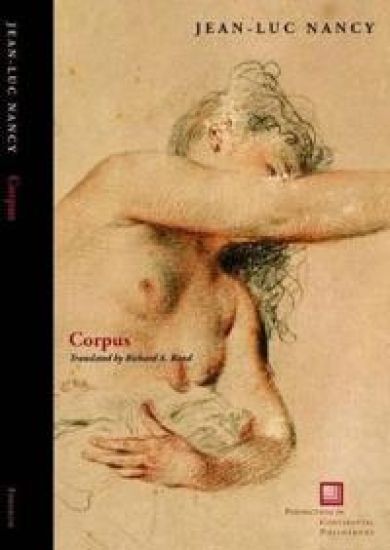
How have we thought "the body"? How can we think it anew? The body of mortal creatures, the body politic, the body of letters and of laws, the "mystical body of Christ"—all these (and others) are incorporated in the word Corpus, the title and topic of Jean-Luc Nancy's masterwork. Corpus is a work of literary force at once phenomenological, sociological, theological, and philosophical in its multiple orientations and approaches. In thirty-six brief sections, Nancy offers us at once an encyclopedia and a polemical program—reviewing classical takes on the "corpus" from Plato, Aristotle, and Saint Paul to Descartes, Hegel, Husserl, and Freud, while demonstrating that the mutations (technological, biological, and political) of our own culture have given rise to the need for a new understanding of the body. He not only tells the story of this cultural change but also explores the promise and responsibilities that such a new understanding entails. The long-awaited English translation is a bold, bravura rendering. To the title essay are added five closely related recent pieces—including a commentary by Antonia Birnbaum—dedicated in large part to the legacy of the "mind-body problem" formulated by Descartes and the challenge it poses to rethinking the ancient problems of the corpus. The last and most poignant of these essays is "The Intruder," Nancy's philosophical meditation on his heart transplant. The book also serves as the opening move in Nancy's larger project called "The deconstruction of Christianity."
Corpus

Corpus

Jean-Luc Nancy

Fordham University Press
2008
sidottu
How have we thought "the body"? How can we think it anew? The body of mortal creatures, the body politic, the body of letters and of laws, the "mystical body of Christ"—all these (and others) are incorporated in the word Corpus, the title and topic of Jean-Luc Nancy's masterwork. Corpus is a work of literary force at once phenomenological, sociological, theological, and philosophical in its multiple orientations and approaches. In thirty-six brief sections, Nancy offers us at once an encyclopedia and a polemical program—reviewing classical takes on the "corpus" from Plato, Aristotle, and Saint Paul to Descartes, Hegel, Husserl, and Freud, while demonstrating that the mutations (technological, biological, and political) of our own culture have given rise to the need for a new understanding of the body. He not only tells the story of this cultural change but also explores the promise and responsibilities that such a new understanding entails. The long-awaited English translation is a bold, bravura rendering. To the title essay are added five closely related recent pieces—including a commentary by Antonia Birnbaum—dedicated in large part to the legacy of the "mind-body problem" formulated by Descartes and the challenge it poses to rethinking the ancient problems of the corpus. The last and most poignant of these essays is "The Intruder," Nancy's philosophical meditation on his heart transplant. The book also serves as the opening move in Nancy's larger project called "The deconstruction of Christianity."
Noli Me Tangere

Noli Me Tangere

Jean-Luc Nancy

Fordham University Press
2008
pokkari
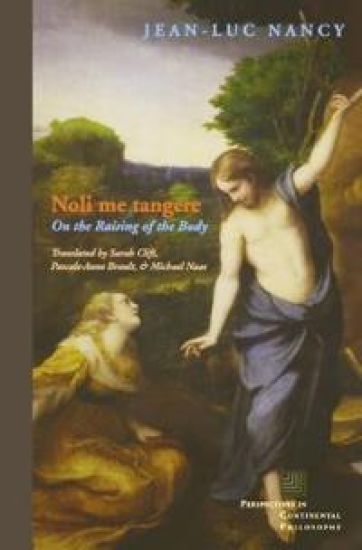
Christian parables have retained their force well beyond the sphere of religion; indeed, they share with much of modern literature their status as a form of address: "Who hath ears to hear, let him hear." There is no message without there first being—or, more subtly, without there also being in the message itself—an address to a capacity or an aptitude for listening. This is not an exhortation of the kind "Pay attention!" Rather, it is a warning: if you do not understand, the message will go away. The scene in the Gospel of John in which the newly risen Christ enjoins the Magdalene, "Noli me tangere," a key moment in the general parable made up of his life, is a particularly good example of this sudden appearance in which a vanishing plays itself out. Resurrected, he speaks, makes an appeal, and leaves. "Do not touch me." Beyond the Christ story, this everyday phrase says something important about touching in general. It points to the place where touching must not touch in order to carry out its touch (its art, its tact, its grace). The title essay of this volume is both a contribution to Nancy's project of a "deconstruction of Christianity" and an exemplum of his remarkable writings on art, in analyses of "Noli me tangere" paintings by such painters as Rembrandt, Dürer, Titian, Pontormo, Bronzino, and Correggio. It is also in tacit dialogue with Jacques Derrida's monumental tribute to Nancy's work in Le toucher—Jean-Luc Nancy. For the English-language edition, Nancy has added an unpublished essay on the Magdalene and the English translation of "In Heaven and on the Earth," a remarkable lecture he gave in a series designed to address children between six and twelve years of age. Closely aligned with his entire project of "the deconstruction of Christianity,'" this lecture may give the most accesible account of his ideas about God.
Noli Me Tangere

Noli Me Tangere

Jean-Luc Nancy

Fordham University Press
2008
sidottu
Christian parables have retained their force well beyond the sphere of religion; indeed, they share with much of modern literature their status as a form of address: "Who hath ears to hear, let him hear." There is no message without there first being—or, more subtly, without there also being in the message itself—an address to a capacity or an aptitude for listening. This is not an exhortation of the kind "Pay attention!" Rather, it is a warning: if you do not understand, the message will go away. The scene in the Gospel of John in which the newly risen Christ enjoins the Magdalene, "Noli me tangere," a key moment in the general parable made up of his life, is a particularly good example of this sudden appearance in which a vanishing plays itself out. Resurrected, he speaks, makes an appeal, and leaves. "Do not touch me." Beyond the Christ story, this everyday phrase says something important about touching in general. It points to the place where touching must not touch in order to carry out its touch (its art, its tact, its grace). The title essay of this volume is both a contribution to Nancy's project of a "deconstruction of Christianity" and an exemplum of his remarkable writings on art, in analyses of "Noli me tangere" paintings by such painters as Rembrandt, Dürer, Titian, Pontormo, Bronzino, and Correggio. It is also in tacit dialogue with Jacques Derrida's monumental tribute to Nancy's work in Le toucher—Jean-Luc Nancy. For the English-language edition, Nancy has added an unpublished essay on the Magdalene and the English translation of "In Heaven and on the Earth," a remarkable lecture he gave in a series designed to address children between six and twelve years of age. Closely aligned with his entire project of "the deconstruction of Christianity,'" this lecture may give the most accesible account of his ideas about God.
Dis-Enclosure

Dis-Enclosure

Jean-Luc Nancy; Gabriel Malenfant; Michael B. Smith

Fordham University Press
2008
pokkari

Halvin toimitettuna 35,80 €

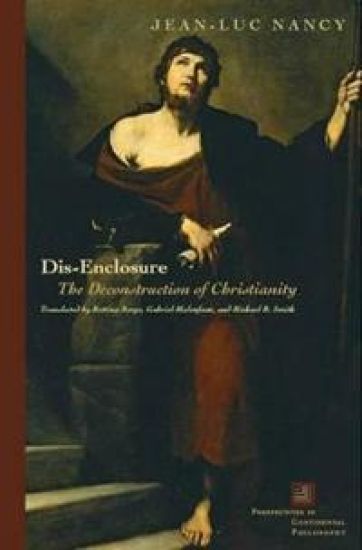
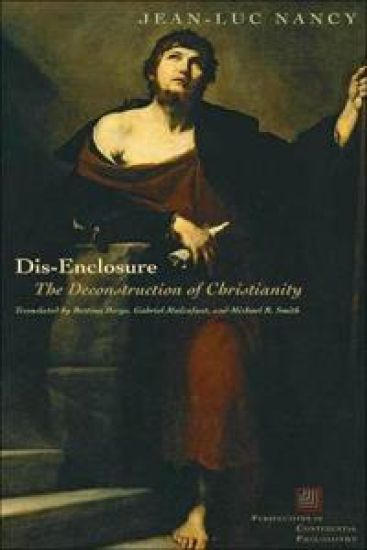
This book is a profound and eagerly anticipated investigation into what is left of a monotheistic religious spirit—notably, a minimalist faith that is neither confessional nor credulous. Articulating this faith as works and as an objectless hope, Nancy deconstructs Christianity in search of the historical and reflective conditions that provided its initial energy. Working through Blanchot and Nietzsche, re-reading Heidegger and Derrida, Nancy turns to the Epistle of Saint James rather than those of Saint Paul, discerning in it the primitive essence of Christianity as hope. The "religion that provided the exit from religion," as he terms Christianity, consists in the announcement of an end. It is the announcement that counts, however, rather than any finality. In this announcement there is a proximity to others and to what was once called parousia. But parousia is no longer presence; it is no longer the return of the Messiah. Rather, it is what is near us and does not cease to open and to close, a presence deferred yet imminent. In a demystified age where we are left with a vision of a self-enclosed world—in which humans are no longer mortals facing an immortal being, but entities whose lives are accompanied by the time of their own decline—parousia stands as a question. Can we venture the risk of a decentered perspective, such that the meaning of the world can be found both inside and outside, within and without our so-immanent world? The deconstruction of Christianity that Nancy proposes is neither a game nor a strategy. It is an invitation to imagine a strange faith that enacts the inadequation of life to itself. Our lives overflow the self-contained boundaries of their biological and sociological interpretations. Out of this excess, wells up a fragile, overlooked meaning that is beyond both confessionalism and humanism.
Dis-Enclosure

Dis-Enclosure

Jean-Luc Nancy; Gabriel Malenfant; Michael B. Smith

Fordham University Press
2008
sidottu
This book is a profound and eagerly anticipated investigation into what is left of a monotheistic religious spirit—notably, a minimalist faith that is neither confessional nor credulous. Articulating this faith as works and as an objectless hope, Nancy deconstructs Christianity in search of the historical and reflective conditions that provided its initial energy. Working through Blanchot and Nietzsche, re-reading Heidegger and Derrida, Nancy turns to the Epistle of Saint James rather than those of Saint Paul, discerning in it the primitive essence of Christianity as hope. The “religion that provided the exit from religion,” as he terms Christianity, consists in the announcement of an end. It is the announcement that counts, however, rather than any finality. In this announcement there is a proximity to others and to what was once called parousia. But parousia is no longer presence; it is no longer the return of the Messiah. Rather, it is what is near us and does not cease to open and to close, a presence deferred yet imminent. In a demystified age where we are left with a vision of a self-enclosed world—in which humans are no longer mortals facing an immortal being, but entities whose lives are accompanied by the time of their own decline—parousia stands as a question. Can we venture the risk of a decentered perspective, such that the meaning of the world can be found both inside and outside, within and without our so-immanent world? The deconstruction of Christianity that Nancy proposes is neither a game nor a strategy. It is an invitation to imagine a strange faith that enacts the inadequation of life to itself. Our lives overflow the self-contained boundaries of their biological and sociological interpretations. Out of this excess, wells up a fragile, overlooked meaning that is beyond both confessionalism and humanism.
Philosophical Chronicles

Philosophical Chronicles

Jean-Luc Nancy

Fordham University Press
2008
pokkari
In eleven brief, engaging talks originally broadcast on French public radio, Jean-Luc Nancy offers a philosopher's rough and ready account of some of the pressing questions of our day and addresses chronic issues within philosophical inquiry. The fundamental question, which recurs again and again, is whether philosophy is conditioned by the world the philosopher inhabits, or whether it must remain unconditioned by that world. Nancy discusses: terror in relation to religion and capitalism; the relevance of philosophy to life (whether philosophy can be a form of life); the status of god in monotheism; the relevance of "politics" as it is defined today; the "Heidegger affair" and its consequences for philosophy; war, especially in the context of the invasion of Iraq; the role of negativity in philosophical and cultural discourses; "art" and the variability of its meanings; the predominance of the metaphor of the sun. The essays can be read separately, but together they amount to the striking vision of a philosopher sensitive to the world of his times and attempting to open his own path within it.