Kirjojen hintavertailu – 12 859 829 kirjaa ja 27 kauppaa

Kirjailija

John Dewey

Kirjat ja teokset yhdessä paikassa: 491 kirjaa, julkaisuja vuosilta 1931–2026, suosituimpiin kuuluu Demokratia ja kasvatus. Vertaile teosten hintoja ja tarkista saatavuus suomalaisista kirjakaupoista.

491 kirjaa

Kirjojen julkaisuvuodet: 1931–2026.

Democracy And Education

Democracy And Education

John Dewey

The Free Press
1997
pokkari

Halvin toimitettuna 26,20 €

John Dewey’s Democracy and Education addresses the challenge of providing quality public education in a democratic society. In this classic work Dewey calls for the complete renewal of public education, arguing for the fusion of vocational and contemplative studies in education and for the necessity of universal education for the advancement of self and society. First published in 1916, Democracy and Education is regarded as the seminal work on public education by one of the most important scholars of the century.
The School and Society and The Child and the Curriculum

The School and Society and The Child and the Curriculum

John Dewey

University of Chicago Press
1991
nidottu
This edition brings Dewey's educational theory into sharp focus, framing his two classic works by frank assessments, past and present, of the practical applications of Dewey's ideas. In addition to a substantial introduction in which Philip W. Jackson explains why more of Dewey's ideas haven't been put into practice, this edition restores a "lost" chapter, dropped from the book by Dewey in 1915.
The Collected Works of John Dewey v. 17; 1885-1953, Miscellaneous Writings
This is the final textual volume in The Collected Works of John Dewey, 1882- 1953, published in 3 series comprising 37 volumes: The Early Works, 1882- 1898 (5 vols.); The Middle Works, 1899- 1924 (15 vols.); The Later Works, 1925- 1953 (17 vols.). Volume 17 contains Dewey's writings discovered after publication of the appropriate volume of The Collected Works and spans most of Dewey's publishing life. There are 83 items in this volume, 24 of which have not been previously published. Among works highlighted in this volume are 10 " Educational Lectures before Brigham Young Academy," early essays " War's Social Results" and " The Problem of Secondary Education after the War," and the previously unpublished " The Russian School System."
The Collected Works of John Dewey v. 16; 1949-1952, Essays, Typescripts, and Knowing and the Known
Typescripts, essays, and an authoritative edition of Knowing and the Known, Dewey's collaborative work with Arthur F. Bentley. In an illuminating Introduction T. Z. Lavine defines the collaboration's three goals-- the construction of a new language for behavioral inquiry, a critique of formal logicians, in defense of Dewey's Logic, and a critique of logical positivism. In Dewey's words: Largely due to Bentley, I've finally got the nerve inside of me to do what I should have done years ago. What Is It to Be a Linguistic Sign or Name? and Values, Valuations, and Social Facts, ' both written in 1945, are published here for the first time.
The Collected Works of John Dewey v. 15; 1942-1948, Essays, Reviews, and Miscellany
This volume republishes sixty-two of Dewey's writings from the years 1942 to 1948; four other items are published here for the first time. A focal point of this volume is Dewey's introduction to his collective volume Problems of Men. Exchanges in the Journal of Philosophy with Donald C. Mackay, Philip Blair Rice, and with Alexander Meiklejohn in Fortune appear here, along with Dewey's letters to editors of various publications and his forewords to colleagues' books. Because 1942 was the centenary of the birth of William James, four articles about James are also included in this volume.
The Collected Works of John Dewey v. 10; 1934, Art as Experience

The Collected Works of John Dewey v. 10; 1934, Art as Experience

John Dewey

Southern Illinois University Press
1989
sidottu
Art as Experience evolved from John Dewey's Willam James Lectures, delivered at Harvard University from February to May 1931. In his Introduction, Abraham Kaplan places Dewey's philosophy of art within the context of his pragmatism. Kaplan demonstrates in Dewey's esthetic theory his traditional "movement from a dualism to a monism" and discusses whether Dewey's viewpoint is that of the artist, the respondent, or the critic.
The Collected Works of John Dewey V. 13; 1938-1939, Experience and Education, Freedom and Culture, Theory of Valuation, and Essays
This volume includes all Dewey's writings for 1938 except for Logic: The Theory of Inquiry (Volume 12 of The Later Works), as well as his 1939 Freedom and Culture, Theory of Valuation, and two items from Intelligence in the Modern World. Freedom and Culture presents, as Steven M. Cahn points out, "the essence of his philosophical position: a commitment to a free society, critical intelligence, and the education required for their advance."
The Later Works of John Dewey, Volume 14, 1925 - 1953

The Later Works of John Dewey, Volume 14, 1925 - 1953

John Dewey

Southern Illinois University Press
1988
sidottu
This volume republishes forty-four essays, reviews, and miscellaneous pieces from 1939, 1940, and 1941. In his Introduction, R. W. Sleeper characterizes the contents of this volume as “vintage Dewey. Ranging widely over problems of theory and practice, they reveal him commencing his ninth decade at the peak of his intellectual powers.” “Nature in Experience,” Dewey’s reply to Morris R. Cohen and William Ernest Hocking, “is a model of clarity and responsiveness,” writes Sleeper, “perhaps his clearest statement of why it is that metaphysics does not play the fundamental role for him that it had regularly played for his predecessors.”
The Collected Works of John Dewey v. 11; 1935-1937, Essays, Reviews, Trotsky Inquiry, Miscellany, and Liberalism and Social Action
This volume includes ninety-two items from 1935, 1936, and 1937, including Dewey's 1935 Page-Barbour Lectures at the University of Virginia, published as Liberalism and Social Action. In essay after essay Dewey analyzed, criticized, and reevaluated liberalism. When his controversial Liberalism and Social Action appeared, asking whether it was still possible to be a liberal, Horace M. Kallen wrote that Dewey "restates in the language and under the conditions of his times what Jefferson's Declaration of Independence affirmed in the language and under the conditions of his." The diverse nature of the writings belies their underlying unity: some are technical philosophy; other philosophical articles shade into social and political themes; social and political issues permeate the educational articles, which in turn involve Dewey's philosophical ideas.
The Collected Works of John Dewey v. 9; 1933-1934, Essays, Reviews, Miscellany, and a Common Faith
This ninth volume in The Later Works of John Dewey, 1925--1953, brings together sixty items from 1933 and 1934, including Dewey's Terry Lec tures at Yale University, published as A Common Faith. In his introduction, Milton R. Konvitz concludes that ACommon Faith remains a provocative book, an intellectual 'teaser, ' an essay at religious philoso phy which no philosopher can wholly bypass." Dewey concentrated much of his writing in 1933 and 1934 on issues arising from the economic crises of the Great Depression. In the early 1930s Com munist activity in the New York Teachers Union in creased. The Report of the Special Grievance Committee of the Teachers Union is published in this volume, as is Dewey's impromptu address, "On the Grievance Committee's Report," made when he presented that report. Rounding out the volume are eighteen arti cles from the People's Lobby Bulletin.
The Collected Works of John Dewey v. 8; 1933, Essays and How We Think
This volume also includes a collection of essays entitled The Educational Fron tier, Dewey's articles on logic, the out lawry of war, and philosophy for the En cyclopedia of the Social Sciences, and his reviews of Alfred North Whitehead's Adventures of Ideas, Martin Schutze's Academic Illusions in the Field of Let ters and the Arts, and Rexford G. Tugwell's Industrial Discipline and the Governmental Arts.
The Collected Works of John Dewey v. 6; 1931-1932, Essays, Reviews, and Miscellany
Except for Dewey's and James H. Tufts' 1932 Ethics (Volume 7 of The Later Works), this volume brings together Dewey's writings for 1931-1932. The Great Depression presented John Dewey and the American people with a series of economic, political, and social crises in 1931 and 1932 that are reflected in most of the 86 items in this volume, even in philosophical essays such as "Human Nature." As Sidney Ratner points out in his Introduction, Dewey's interest in international peace is fea tured in the writings in this volume.
The Collected Works of John Dewey v. 7; 1932, Ethics

The Collected Works of John Dewey v. 7; 1932, Ethics

John Dewey

Southern Illinois University Press
1985
sidottu
Introduction by Abraham Edel and Elizabeth FlowerThis seventh volume provides an au thoritative edition of Dewey and James H. Tufts' 1932 Ethics. Dewey and Tufts state that the book's aim is: "To induce a habit of thoughtful consideration, of envisaging the full meaning and consequences of individual conduct and social policies," insisting throughout that ethics must be con stantly concerned with the changing problems of daily life.
The Collected Works of John Dewey V. 5; 1929-1930, Essays, the Sources of a Science of Education, Individualism, Old and New, and Construction and Criticism
With the exception of The Quest for Cer tainty (Volume 4) this fifth volume brings together Dewey's writings for the 1929-1930 period. During this time Dewey published 4 books and 50 articles on philosophical, educational, political, and social issues. His philosophical essays include "What Humanism Means to Me" and "What I Believe," both of which express Dewey's faith in man's potentialities and intel ligence, and a lively Journal of Philoso phy exchange with Ernest Nagel, Wil liam Ernest Hocking, C. I. Lewis, and F. J. E. Woodbridge. Educational writings include The Sources of a Science of Education. The contents of this volume re flect Dewey's increasing involvement in social and political problems.
The Collected Works of John Dewey v. 4; 1929, The Quest for Certainty
This volume provides an authoritative edition of Dewey's The Quest for Cer tainty: A Study of the Relation Between Knowledge and Action. The book is made up of the Gifford Lectures deliv ered April- May 1929 at the University of Edinburgh. Writing to Sidney Hook, Dewey described this work as " a criti cism of philosophy as attempting to at tain theoretical certainty." In the Philo sophical Review Max C. Otto later elaborated: " Mr. Dewey wanted, so far as lay in his power, to crumble into dust, once and for all, ' the chief fortress of the classic philosophical tradition."
The Collected Works of John Dewey v. 3; 1927-1928, Essays, Reviews, Miscellany, and ""Impressions of Soviet Russia
All of Dewey's writings for 1927and 1928 with the exception of The Public and Its Problems, which appears in Volume 2, A Modern Language Associ ation's Committee on Scholarly Editions textual edition. These essays are, as Sidorsky says in his Introduction, "framed, in great mea sure, by those two poles of his philo sophical interest: looking backward, in a sense, to the defense of naturalistic metaphysics and moving forward to the justification and to the implications for practice of an empirical theory." Dewey's five essays on education are evidence of his continued interest in that field. Among them is the frequently quoted "Why IAm a Member of the Teachers Union," which is still used by the American Federation of Teachers in its recruiting efforts. Other highlights of this volume include the famous ex change between George Santayana and Dewey on Experience and Nature; an im passioned condemnation of the mis carriage of justice Dewey saw in the Sacco-Vanzetti trial; and a series of six articles on the Soviet Union based on Dewey's trip to that country in 1928.
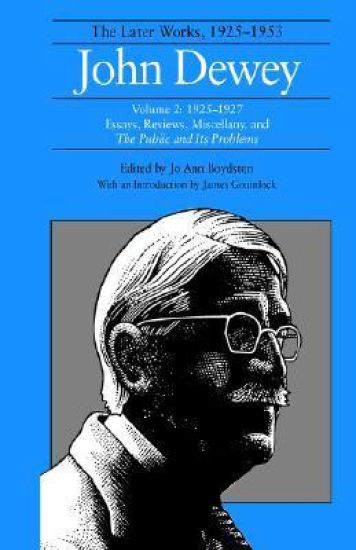
The Collected Works of John Dewey v. 2; 1925-1927, Essays, Reviews, Miscellany, and the Public and Its Problems
With the exception of Experience and Nature, (Volume 1of the Later Works), this volume contains all of Dewey's writ ings for 1925and 1926, as well as his 1927 book, The Public and Its Problems. A Modern Language Association's Com mittee on Scholarly Editions textual edi tion. The first essay in this volume, "The Development of American Pragmatism," is perhaps Dewey's best-known article of these years, emphasizing the uniquely American origins of his own philosophi cal innovations. Other essays focus on Dewey's continuing investigation of the "nature of intelligent conduct," as, for example, his debate with David Wight Prall on the underpinnings of value, his study of sense-perception, and his support for outlawing of war. Also appearing here are Dewey's final articles on the culture of the developing world, written for the New Republic after his travels to China, Turkey, and Mexico.