Kirjojen hintavertailu – 12 903 725 kirjaa ja 27 kauppaa

Kirjailija

John Maynard Keynes

Kirjat ja teokset yhdessä paikassa: 193 kirjaa, julkaisuja vuosilta 1919–2026, suosituimpiin kuuluu Les conséquences économiques de la paix. Vertaile teosten hintoja ja tarkista saatavuus suomalaisista kirjakaupoista.

193 kirjaa

Kirjojen julkaisuvuodet: 1919–2026.
The Economic Consequences of the Peace

The Economic Consequences of the Peace

John Maynard Keynes

Digireads.com
2020
pokkari
John Maynard Keynes was a British economist whose theories had a profound impact on twentieth century history and economic practice. Born and raised in Cambridge, England to highly successful, intelligent parents John and Florence Keynes, he attended Eton and King's College, Cambridge where he joined the intellectual group called "The Apostles" with the likes of Virginia Woolf, E. M. Forster, and Bertrand Russell. In 1919, after attending the Paris Peace Conference as economic advisor to Prime Minister Lloyd George, Keynes resigned from a prominent position in the Treasury and published "The Economic Consequences of the Peace", a stinging indictment of the Versailles Treaty. Keynes expressed his opposition to the political practices that were taking place, and the work gained him instant notoriety. The impact of this, and other, works on economic theory and policy led to what is now termed the "Keynesian Revolution" of the twentieth century, and helped shape modern macroeconomics. This edition is printed on premium acid-free paper.
The Economic Consequences of the Peace

The Economic Consequences of the Peace

John Maynard Keynes

Springer Nature Switzerland AG
2019
nidottu
First published in December 1919, this global bestseller attacking those who had made the peace in Paris after the First World War, sparked immediate controversy. It also made John Maynard Keynes famous overnight and soon came to define how people around the world viewed the Versailles Peace Treaty. In Germany the book, which argued against reparations, was greeted with enthusiasm; in France with dismay; and in the US as ammunition that could be (and was) used against Woodrow Wilson in his ultimately unsuccessful bid to sell the League of Nations to an increasingly sceptical American public. Meanwhile in his own country the book provoked outrage amongst establishment critics – Keynes was even refused membership of the prestigious British Academy – while admirers from Winston Churchill to the founders of the LSE, Sidney and Beatrice Webb, went on to praise Keynes for his wisdom and humanity. Keynes may have written what he thought was a reasoned critique of the economics of the peace settlement. In effect, he had penned a political bombshell whose key arguments are still being debated today. The Economic Consequences of the Peace is now reissued by Keynes’ publisher of choice with a new introduction from Michael Cox, one of the major figures in the field of International Relations today. Scholarly yet engaged and readable, Cox’s introduction to the work – written a century after the book first hit the headlines – critically appraises Keynes' polemic contextualising and bringing to life the text for a new generation of scholars and students of IR, IPE, Politics and History. The original text and this authoritative introduction provide essential reading for anyone who wishes to understand the tragedy that was the twentieth century; why making peace with former enemies can be just as hard as winning a war against them; and how and why ideas really do matter.
The General Theory of Employment, Interest, and Money

The General Theory of Employment, Interest, and Money

John Maynard Keynes

Springer International Publishing AG
2018
nidottu

Halvin toimitettuna 39,30 €

This book was originally published by Macmillan in 1936. It was voted the top Academic Book that Shaped Modern Britain by Academic Book Week (UK) in 2017, and in 2011 was placed on Time Magazine's top 100 non-fiction books written in English since 1923. Reissued with a fresh Introduction by the Nobel-prize winner Paul Krugman and a new Afterword by Keynes’ biographer Robert Skidelsky, this important work is made available to a new generation. The General Theory of Employment, Interest and Money transformed economics and changed the face of modern macroeconomics. Keynes’ argument is based on the idea that the level of employment is not determined by the price of labour, but by the spending of money. It gave way to an entirely new approach where employment, inflation and the market economy are concerned. Highly provocative at its time of publication, this book and Keynes’ theories continue to remain the subject of much support and praise, criticism and debate. Economists at any stage in their career will enjoy revisiting this treatise and observing the relevance of Keynes’ work in today’s contemporary climate.
The Economic Consequences of the Peace: John Maynard Keynes

The Economic Consequences of the Peace: John Maynard Keynes

John Maynard Keynes
Createspace Independent Publishing Platform
2018
nidottu
The Economic Consequences of the Peace by John Maynard Keynes. The Economic Consequences of the Peace (1919) is a book written and published by the British economist John Maynard Keynes. After the First World War, Keynes attended the Paris Peace Conference of 1919 as a delegate of the British Treasury. In his book, he argued for a much more generous peace, not out of a desire for justice or fairness - these are aspects of the peace that Keynes does not deal with - but for the sake of the economic well-being of all of Europe, including the Allied Powers, which the Treaty of Versailles and its associated treaties would prevent. The power to become habituated to his surroundings is a marked characteristic of mankind. Very few of us realize with conviction the intensely unusual, unstable, complicated, unreliable, temporary nature of the economic organization by which Western Europe has lived for the last half century. We assume some of the most peculiar and temporary of our late advantages as natural, permanent, and to be depended on, and we lay our plans accordingly. On this sandy and false foundation we scheme for social improvement and dress our political platforms, pursue our animosities and particular ambitions, and feel ourselves with enough margin in hand to foster, not assuage, civil conflict in the European family.
The Economic Consequences of the Peace

The Economic Consequences of the Peace

John Maynard Keynes

Wilder Publications
2018
sidottu
The Economic Consequences of the Peace was written and published by John Maynard Keynes. After World War I, Keynes attended the Versailles Conference as a delegate of the British Treasury and argued for a much more generous peace. It was a best seller throughout the world and was critical in establishing a general opinion that the Versailles Treaty was a "Carthaginian peace." It helped to consolidate American public opinion against the treaty and involvement in the League of Nations.
The Economic Consequences of the Peace

The Economic Consequences of the Peace

John Maynard Keynes

Routledge
2017
sidottu
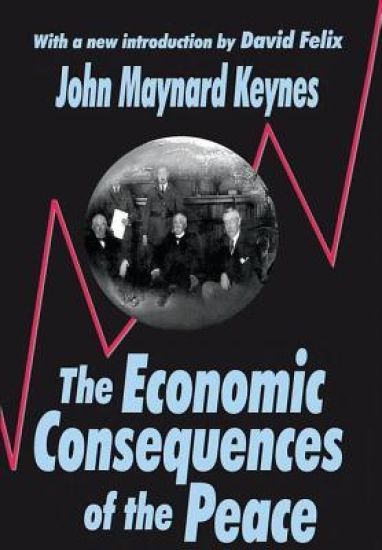
John Maynard Keynes, then a rising young economist, participated in the Paris Peace Conference in 1919 as chief representative of the British Treasury and advisor to Prime Minister David Lloyd George. He resigned after desperately trying and failing to reduce the huge demands for reparations being made on Germany. The Economic Consequences of the Peace is Keynes' brilliant and prophetic analysis of the effects that the peace treaty would have both on Germany and, even more fatefully, the world. A popular lecturer of economics at Cambridge University and editor of the Economic Journal, Keynes made The Economic Consequences of the Peace a major step in his career. It was translated into a dozen languages and sold 100,000 copies in six months. Taken seriously even by those who were opposed to his claims, the book helped lift economics to a new, higher level of recognition and acceptance. This volume, with its insightful portraits of Lloyd George, Georges Clemenceau, and Woodrow Wilson, remains one of the great works of political economy of our time. In a penetrating introduction written for this new edition, David Felix explores Keynes' reasons for writing the book, analyzes the author's arguments, and paints an historical backdrop of the period during which it was written.