Kirjojen hintavertailu – 12 903 725 kirjaa ja 27 kauppaa

Kirjailija

John Maynard Keynes

Kirjat ja teokset yhdessä paikassa: 193 kirjaa, julkaisuja vuosilta 1919–2026, suosituimpiin kuuluu Les conséquences économiques de la paix. Vertaile teosten hintoja ja tarkista saatavuus suomalaisista kirjakaupoista.

193 kirjaa

Kirjojen julkaisuvuodet: 1919–2026.

The General Theory of Employment, Interest and Money

The General Theory of Employment, Interest and Money

John Maynard Keynes

Literary Licensing, LLC
2013
sidottu

Halvin toimitettuna 57,10 €

The General Theory of Employment, Interest and Money is a seminal work of economic theory written by John Maynard Keynes. First published in 1936, the book is considered one of the most influential works of economics in the 20th century. The book is a critique of classical economics and argues that government intervention is necessary to stabilize the economy during times of recession. Keynes argues that the economy is not self-correcting and that government policies, such as fiscal and monetary policies, are necessary to stimulate demand and create jobs. The book also introduces the concept of aggregate demand and the multiplier effect, which explains how government spending can lead to increased economic activity. The General Theory of Employment, Interest and Money is a complex work that has been the subject of much debate and discussion in the field of economics. It remains a significant contribution to economic theory and continues to influence economic policy today. This is a new release of the original 1936 edition. This scarce antiquarian book is a facsimile reprint of the old original and may contain some imperfections such as library marks and notations. Because we believe this work is culturally important, we have made it available as part of our commitment for protecting, preserving, and promoting the world's literature in affordable, high quality, modern editions, that are true to their original work.

Treatise on Money, V2: The Applied Theory of Money

Treatise on Money, V2: The Applied Theory of Money

John Maynard Keynes

Literary Licensing, LLC
2013
sidottu
Treatise On Money, V2: The Applied Theory Of Money is a book written by the renowned economist John Maynard Keynes. It is the second volume of his treatise on money, which was first published in 1930. The book is a comprehensive analysis of the role of money in modern economies and is considered one of the most influential works in the field of economics. In this book, Keynes presents his theories on the nature of money and its relationship to economic activity. He argues that money is not a neutral medium of exchange but has a significant impact on economic behavior. Keynes also discusses the role of banks and financial institutions in the creation and control of money. The book is divided into three parts. The first part deals with the nature of money and its functions in the economy. The second part focuses on the demand for money and the factors that influence it. The third part examines the supply of money and the role of monetary policy in controlling it. Throughout the book, Keynes presents his ideas in a clear and concise manner, using examples and illustrations to explain complex economic concepts. He also engages with the work of other economists and critiques their theories. Overall, Treatise On Money, V2: The Applied Theory Of Money is a seminal work in the field of economics and is essential reading for anyone interested in understanding the role of money in modern economies. This is a new release of the original 1930 edition. This scarce antiquarian book is a facsimile reprint of the old original and may contain some imperfections such as library marks and notations. Because we believe this work is culturally important, we have made it available as part of our commitment for protecting, preserving, and promoting the world's literature in affordable, high quality, modern editions, that are true to their original work.
Treatise on Money, V1: The Pure Theory of Money

Treatise on Money, V1: The Pure Theory of Money

John Maynard Keynes

Literary Licensing, LLC
2013
sidottu
""Treatise on Money, V1: The Pure Theory of Money"" is a book written by the renowned economist John Maynard Keynes. The book is a detailed exploration of the nature and functions of money, and how it can be used to stabilize the economy. The book is divided into two parts, with the first part focusing on the theory of money and the second part focusing on its application. In the first part of the book, Keynes lays out his theory of money, which is based on the idea that money is not just a medium of exchange, but also a store of value and a unit of account. He explores the role of money in the economy, including how it affects prices, interest rates, and employment. He also discusses the different types of money, such as commodity money, fiat money, and credit money. In the second part of the book, Keynes applies his theory of money to real-world economic issues, such as inflation, deflation, and the business cycle. He discusses the role of government in stabilizing the economy, including the use of monetary policy and fiscal policy. He also explores the international monetary system and the role of exchange rates in the global economy. Overall, ""Treatise on Money, V1: The Pure Theory of Money"" is a comprehensive and influential work on the nature and functions of money. It remains an important reference for economists and policymakers today. This is a new release of the original 1930 edition. This scarce antiquarian book is a facsimile reprint of the old original and may contain some imperfections such as library marks and notations. Because we believe this work is culturally important, we have made it available as part of our commitment for protecting, preserving, and promoting the world's literature in affordable, high quality, modern editions, that are true to their original work.

The Collected Writings of John Maynard Keynes

The Collected Writings of John Maynard Keynes

John Maynard Keynes

Cambridge University Press
2012
pokkari
This volume, containing papers written by Keynes, in the course of his various activities, is chiefly concerned with his work down to the outbreak of war in 1914 on problems of Indian currency and especially with the part that he played in influencing and shaping the report of the (Austen Chamberlain) Royal Commission on Indian Finance and Currency. The papers show the young Keynes (he was under 30 when appointed) with a complete mastery not only of the broad and academic principles but also, as throughout his life, of the details, holding his own in debate with the acknowledged authorities and securing his main objectives, thanks largely to his indefatigable capacity for quick yet elegant and lucid draftsmanship. This volume is a necessary companion to his own Indian Currency and Finance (Volume 1 in this series).
The Collected Writings of John Maynard Keynes

The Collected Writings of John Maynard Keynes

John Maynard Keynes

Cambridge University Press
2012
pokkari
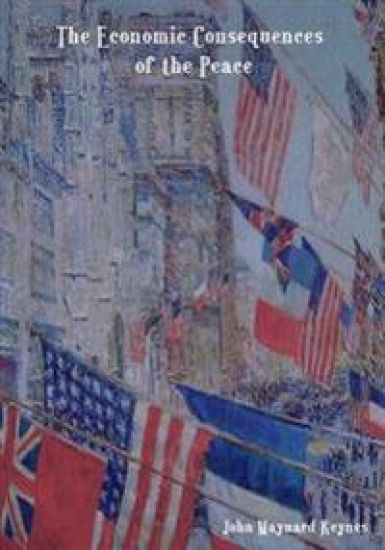
The Economic Consequences of the Peace was written by Maynard Keynes in 1919 following his resignation as Treasury representative at the Peace Conference at Versailles. It was this work that first made Maynard Keynes's name a household word, a figure of hatred and public criticism to some, a rallying point for rational thought and action to others. Written in the white heat of anger and despair, it vividly conveys to later generations Keynes's horror that clear thinking, human compassion and solemn pledges had been, in his eyes, destroyed by political opportunism.
The Collected Writings of John Maynard Keynes

The Collected Writings of John Maynard Keynes

John Maynard Keynes

Cambridge University Press
2012
pokkari
This volume contains Keynes's academic articles and reviews on a number of subjects, as well as his previously unpublished 1909 Adam Smith Prize essay on index numbers. Amongst the subjects covered are India, statistics, World War I and its financing, money and international economics. Included are his papers on the transfer problem, supplemented by related correspondence with Bertil Ohlin.
The Collected Writings of John Maynard Keynes

The Collected Writings of John Maynard Keynes

John Maynard Keynes

Cambridge University Press
2012
pokkari
This volume marks the completion of the Collected Writings. The general index to the edition is designed to allow those interested in the development of Keynes's thought, and those interested in the history of economic thought more generally, to trace the development of his ideas throughout his career. The bibliography to the edition records all the writings of Keynes published not only in English but also in translation. It provides an indication of the process by which Keynes's writings were disseminated throughout the world. In addition, this volume includes an editorial introduction describing the principles of selection used by the editors, as well as a few items that escaped them in the preparation of earlier volumes. This volume is an essential tool for the effective use of the material in the twenty-nine other volumes of this edition.
The Collected Writings of John Maynard Keynes

The Collected Writings of John Maynard Keynes

John Maynard Keynes

Cambridge University Press
2012
pokkari
Between the outbreak of war in 1939 and his death in April 1946, Keynes was closely involved in the management of Britain's war economy and the planning of the post-war world. This volume, the fifth of six dealing with this period, focuses on three aspects of his activities in planning the post-war world: the final stages of the discussions and negotiations that brought the International Monetary Fund and World Bank to birth at Bretton Woods and Savannah, the negotiations over commercial policy, and the discussions on reparations and the post-war treatment of Germany. On all of these subjects it contains Keynes's attempts to influence, often with success, the course of events in both Britain and America.
The Collected Writings of John Maynard Keynes

The Collected Writings of John Maynard Keynes

John Maynard Keynes

Cambridge University Press
2012
pokkari
This volume, the fourth of six dealing with the Second World War, is concerned with the origins of what became the International Monetary Fund and the World Bank. It traces the origins of the ideas involved, the process of argument and redrafting that occurred in Whitehall and the subsequent, primarily Anglo-American, negotiations themselves. It takes the story up to the Joint Bretton Woods Conference. As it contains copies of all drafts of Keynes's Clearing Union proposals, together with extensive sampling of discussions with economists such as Dennis Robertson, James Meade, Roy Harrod and Harry White, it combines the presentation of a set of ideas of continuing relevance with essential background material on the origins of an important post-war international institution.
The Collected Writings of John Maynard Keynes

The Collected Writings of John Maynard Keynes

John Maynard Keynes

Cambridge University Press
2012
pokkari
Once the urgent problems of reparations, which had deeply troubled Keynes at the Peace Conference at Versailles, were on their way towards solution, Keynes turned to the equally grave problems of the currencies of Europe and their adjustment to the post-war world. These issues had been discussed in the series of Reconstruction Supplements of the Manchester Guardian Commercial that he had edited during 1922. In the Tract Keynes drew heavily on his own contributions to that series. This edition makes available the variations between the texts. The Tract remains of interest in three respects. First, it shows the state of Keynes's thinking about monetary problems and the causes of inflation in the early 1920s. Second, it provides one of the clearest expositions ever written of the determination of forward exchange rates. Third, it shows Keynes already favouring flexible exchange rates as a means of allowing independence in national economic policy.
The Collected Writings of John Maynard Keynes

The Collected Writings of John Maynard Keynes

John Maynard Keynes

Cambridge University Press
2012
pokkari
This volume brings together Keynes's attempts to influence public opinion and policy concerning primarily British affairs between 1922 and 1929. During this period, his major concerns were Britain's attempt to return to the gold standard and its consequences, industrial policy (especially in the cotton textile industry) and unemployment policy, although he became briefly involved in many other subjects. Most of the volume consists of Keynes's journalism for the period, but it also contains his previously unpublished evidence to official committees, anonymous contributions to The Nation and Athenaeum and related correspondence.
The Collected Writings of John Maynard Keynes

The Collected Writings of John Maynard Keynes

John Maynard Keynes

Cambridge University Press
2012
pokkari
Keynes's first book, published in 1913, was Indian Currency and Finance. He had served briefly from 1906 to 1908 in the India Office in Whitehall; then as the administrative link between the Government of India and the British parliament. He quickly became involved in the problems of the Indian currency and the then important and fascinating issues concerning the gold-exchange standard. He continued to work on these problems, with the encouragement and help of his former colleagues, after he had returned to Cambridge. The book which resulted, and his known mastery of the problems involved, led to Keynes's first major incursion into public life as a member of the (Austen Chamberlain) Royal Commission on Indian Finance and Currency. The important contributions he made to its work are recorded in detail in Volume 15 of this series, which forms a complement to this volume.
The Collected Writings of John Maynard Keynes

The Collected Writings of John Maynard Keynes

John Maynard Keynes

Cambridge University Press
2012
pokkari
This volume brings together Keynes's attempts to influence the course of public opinion and public policy in Britain and elsewhere between the autumn of 1929 and Britain's departure from the gold standard on 21 September 1931. At its centre are Keynes's activities as a member of the Macmillan Committee on Finance and Industry (including the eight days of 'private evidence' he gave, setting out the theory of his then unpublished Treatise on Money and applying it to Britain's contemporary problems) and the Economic Advisory Council and its committees. It also includes all his related journalism and his correspondence both with senior politicians and with other men of affairs. As such, it is a companion to the volumes dealing with the development of his more formal economic theory during these years, most notably A Treatise on Money.
The Collected Writings of John Maynard Keynes

The Collected Writings of John Maynard Keynes

John Maynard Keynes

Cambridge University Press
2012
pokkari
Most of the essays in this book were first collected together in October 1931, immediately after Britain had left the gold standard. They reflected Keynes's attempts over the previous dozen years to influence public opinion and policy over the Treaty of Versailles, over which he had resigned from the Treasury in June 1919, reparations and inter-allied war debts, stabilisation policy, the gold standard and the shape of liberal politics in Britain. In 1972 the essays were reprinted with the full texts of the pamphlets - Can Lloyd George Do It?, The Economic Consequences of Mr Churchill, A Short View of Russia and The End of Laissez Faire. At that time, the full texts of his two post-1931 pamphlets - The Means to Prosperity and How to Pay for the War - were added. The book contains examples of Keynes's finest writing on economic policy and politics. This edition includes an introduction by Donald Moggridge.
The Collected Writings of John Maynard Keynes

The Collected Writings of John Maynard Keynes

John Maynard Keynes

Cambridge University Press
2012
pokkari
From 1915, when Keynes joined the Treasury, until he resigned in 1919 during the Versailles Conference, he carried a rapidly increasing load of responsibility. This volume prints all the principal papers and memoranda he wrote during those years and throws new light on the crises of inter-allied financial relations and the near exhaustion of British financial resources. It contains also his contributions to the early thinking in the Treasury about post-war reparations and inter-allied debts. It ends with his correspondence, official and private, from Paris, as he saw his hopes of a wise settlement vanishing. This is a necessary companion to The Economic Consequences of the Peace (Volume 2 in this series).
The Collected Writings of John Maynard Keynes

The Collected Writings of John Maynard Keynes

John Maynard Keynes

Cambridge University Press
2012
pokkari
This volume brings together Keynes's writings in a number of fields. It includes a full account of his experience as an investor, both for himself and for others, combined with a selection from his correspondence and memoranda on investment in which he tried to expound his beliefs to others. Also included are his writings on commodities, his early lecture notes on money and a selection of his correspondence as editor of the Economic Journal and a referee for the Macmillan Company.