Kirjojen hintavertailu – 12 903 735 kirjaa ja 27 kauppaa
Kirjailija
John Morgan
Kirjat ja teokset yhdessä paikassa: 107 kirjaa, julkaisuja vuosilta 1983–2026, suosituimpiin kuuluu Diana Inquest: How & Why Did Diana Die?. Vertaile teosten hintoja ja tarkista saatavuus suomalaisista kirjakaupoista.
This final volume of ""Death and Bereavement Around the World"" reflects on some major themes: death and after-life, religion and spirituality, rites and rituals, secularist approaches, cultural variations, suicide, and other issues. The first few chapters describe progress in end-of-life care, including some new tools to evaluate hospice care (chapter 1); what children know, when they know it, and how parents can respond to questions, with some guidelines for support by schools (chapter 2); the importance of ritual (chapter 3); and, gender differences in death customs around the world (chapter 4). The transcript of a 1997 interview of John (Jack) Morgan by Pittu Laungani is presented as chapter 5. The following chapters discuss death systems and suicide (chapter 6); HIV/AIDS, including the role of cultural and economic factors in the spread of the disease (chapter 7); and grief and bereavement in the developing world, taking the AIDS pandemic as a specific challenge (chapter 8). Chapter 9 covers issues related to dying and death in Romania. In chapter 10 the focus is on the various functions and uses of names in a cross-cultural context. Roadside memorials as a pivotal healing strategy are the topic of chapter 11. Chapters 12 and 13 focus on spiritual experience with loss. The final chapter presents some conclusions, and in the Epilogue, Mary Ann Morgan honors the life, career, dying, death, and achievements of John (Jack) Morgan. The 'Final Word' includes the words of Pittu Laungani, from a book published just weeks before his death in February 2007. This work is for anyone interested in or working in death and bereavement issues, particularly academics, educators, librarians, chaplains, clergy, funeral service directors, hospice care providers and volunteers, palliative care providers, nurses, immigration officers, psychologists, social workers, psychotherapists, and counselors, especially bereavement counselors.
This final volume of ""Death and Bereavement Around the World"" reflects on some major themes: death and after-life, religion and spirituality, rites and rituals, secularist approaches, cultural variations, suicide, and other issues. The first few chapters describe progress in end-of-life care, including some new tools to evaluate hospice care (chapter 1); what children know, when they know it, and how parents can respond to questions, with some guidelines for support by schools (chapter 2); the importance of ritual (chapter 3); and, gender differences in death customs around the world (chapter 4). The transcript of a 1997 interview of John (Jack) Morgan by Pittu Laungani is presented as chapter 5. The following chapters discuss death systems and suicide (chapter 6); HIV/AIDS, including the role of cultural and economic factors in the spread of the disease (chapter 7); and grief and bereavement in the developing world, taking the AIDS pandemic as a specific challenge (chapter 8). Chapter 9 covers issues related to dying and death in Romania. In chapter 10 the focus is on the various functions and uses of names in a cross-cultural context. Roadside memorials as a pivotal healing strategy are the topic of chapter 11. Chapters 12 and 13 focus on spiritual experience with loss. The final chapter presents some conclusions, and in the Epilogue, Mary Ann Morgan honors the life, career, dying, death, and achievements of John (Jack) Morgan. The 'Final Word' includes the words of Pittu Laungani, from a book published just weeks before his death in February 2007. This work is for anyone interested in or working in death and bereavement issues, particularly academics, educators, librarians, chaplains, clergy, funeral service directors, hospice care providers and volunteers, palliative care providers, nurses, immigration officers, psychologists, social workers, psychotherapists, and counselors, especially bereavement counselors.
Cover-up of a Royal Murder is a thorough investigation of the British inquiry - the Paget report - into the deaths of Diana, Princess of Wales and Dodi Fayed. It uses eye-witness, documentary and other evidence to prove that the conclusions drawn in the Paget report are fundamentally flawed -- yet it is the Paget report that is set to form the basis for the upcoming British inquest. This is the book that proves beyond reasonable doubt that Princess Diana was murdered and that there is a lot more to the Paris crash than the French and British investigations have revealed. "Cover-up" provides credibility to the lingering doubts of a large section of the British and international public -- doubts that remain even 10 years after the crash. This book lays down a huge challenge to those who believe the death of Diana Princess of Wales was just a tragic accident. Cover-up of a Royal Murder exposes one of the greatest cover-ups of our time.
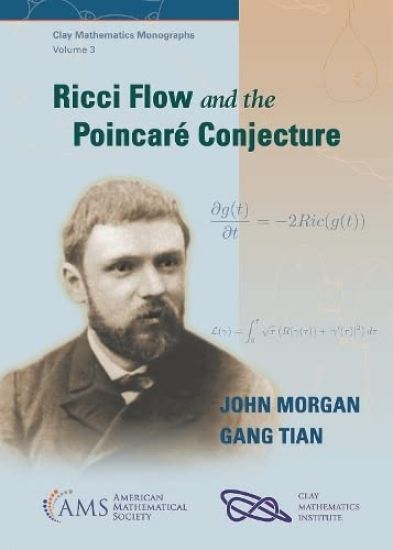
For over 100 years the Poincare Conjecture, which proposes a topological characterization of the 3-sphere, has been the central question in topology. Since its formulation, it has been repeatedly attacked, without success, using various topological methods. Its importance and difficulty were highlighted when it was chosen as one of the Clay Mathematics Institute's seven Millennium Prize Problems. In 2002 and 2003 Grigory Perelman posted three preprints showing how to use geometric arguments, in particular the Ricci flow as introduced and studied by Hamilton, to establish the Poincare Conjecture in the affirmative. This book provides full details of a complete proof of the Poincare Conjecture following Perelman's three preprints. After a lengthy introduction that outlines the entire argument, the book is divided into four parts. The first part reviews necessary results from Riemannian geometry and Ricci flow, including much of Hamilton's work. The second part starts with Perelman's length function, which is used to establish crucial non-collapsing theorems. Then it discusses the classification of non-collapsed, ancient solutions to the Ricci flow equation. The third part concerns the existence of Ricci flow with surgery for all positive time and an analysis of the topological and geometric changes introduced by surgery. The last part follows Perelman's third preprint to prove that when the initial Riemannian 3-manifold has finite fundamental group, Ricci flow with surgery becomes extinct after finite time. The proofs of the Poincare Conjecture and the closely related 3-dimensional spherical space-form conjecture are then immediate. The existence of Ricci flow with surgery has application to 3-manifolds far beyond the Poincare Conjecture. It forms the heart of the proof via Ricci flow of Thurston's Geometrization Conjecture. Thurston's Geometrization Conjecture, which classifies all compact 3-manifolds, will be the subject of a follow-up article. The organization of the material in this book differs from that given by Perelman. From the beginning the authors present all analytic and geometric arguments in the context of Ricci flow with surgery. In addition, the fourth part is a much-expanded version of Perelman's third preprint; it gives the first complete and detailed proof of the finite-time extinction theorem. With the large amount of background material that is presented and the detailed versions of the central arguments, this book is suitable for all mathematicians from advanced graduate students to specialists in geometry and topology. Clay Mathematics Institute Monograph Series The Clay Mathematics Institute Monograph Series publishes selected expositions of recent developments, both in emerging areas and in older subjects transformed by new insights or unifying ideas.
When Geography specialists decide they want to teach, it can be a daunting prospect to enter a real classroom, no matter how much subject knowledge they already possess. Geography: Teaching School Subjects 11-19 puts the subject into perspective and shows new teachers and student teachers how to make Geography accessible and interesting for their pupils. Divided into three sections the book examines the theory and practice of teaching geography:section one explores how teachers can frame their own knowledge for classroom practice section two focuses on Geography in the classroom and curriculum development as well as aspects of pedagogy and lesson design, evaluation and assessmentsection three focuses on the teachers themselves and how they can view and work on professional development within their own subject area.
When Geography specialists decide they want to teach, it can be a daunting prospect to enter a real classroom, no matter how much subject knowledge they already possess. Geography: Teaching School Subjects 11-19 puts the subject into perspective and shows new teachers and student teachers how to make Geography accessible and interesting for their pupils. Divided into three sections the book examines the theory and practice of teaching geography:section one explores how teachers can frame their own knowledge for classroom practice section two focuses on Geography in the classroom and curriculum development as well as aspects of pedagogy and lesson design, evaluation and assessmentsection three focuses on the teachers themselves and how they can view and work on professional development within their own subject area.
This title features: 118 classroom activities; four new sections including new developments such as collocations, the mother tongue, and lexis as a system; updated favourites from the original edition with texts and examples; and the companion website (www.oup.com/elt/teacher/rbt) provides regular updates to the information and ideas in the book.
"Meeting the Needs of Our Clients Creatively: The Impact of Art and Culture on Caregiving" is an important new work which integrates traditional understandings of care of the dying and bereaved with the use of arts and other forms of cultural creativity in therapy and funeralization. Twenty-one authors give us cutting-edge insights into the practical aspects of caring for the dying and bereaved as well as new understandings of creativity.
A very amusing play based on the premise that all children are born highly intelligent, but by the time they can effectively communicate, they have either forgotten the information or had it knocked out of them! The end leaves you laughing - with a lump in your throat. The children's parts are taken by adults with suitably oversized playground equipment.5 women or men
The purpose of this volume is to ask and propose a positive answer to the question: "Can we attend to the personhood of individuals within systems and cultures which are mass oriented?" One of the most interesting changes in contemporary thinking has been the emphasis on the unique person. While the distinction between a person (a unique rational being) and individual (one of several similar things) has long existed, it is in the twentieth century that we seem to have become fully conscious of this distinction. There is good reason for such as emphasis today. Repeatedly in this century the case of the person was deemed less important than some policy. Innocent persons slaughtered in the name of some "ism," political bombings and kidnappings, and mass unemployment to name but a few. The cause of our dehumanization seems to be the reduction of the individual person to a part of the political, economic or religious system.
The purpose of this volume is to ask and propose a positive answer to the question: "Can we attend to the personhood of individuals within systems and cultures which are mass oriented?" One of the most interesting changes in contemporary thinking has been the emphasis on the unique person. While the distinction between a person (a unique rational being) and individual (one of several similar things) has long existed, it is in the twentieth century that we seem to have become fully conscious of this distinction. There is good reason for such as emphasis today. Repeatedly in this century the case of the person was deemed less important than some policy. Innocent persons slaughtered in the name of some "ism," political bombings and kidnappings, and mass unemployment to name but a few. The cause of our dehumanization seems to be the reduction of the individual person to a part of the political, economic or religious system.