Kirjojen hintavertailu – 12 903 725 kirjaa ja 27 kauppaa

Kirjailija

John Sallis

Kirjat ja teokset yhdessä paikassa: 50 kirjaa, julkaisuja vuosilta 1970–2024, suosituimpiin kuuluu Sojourns. Vertaile teosten hintoja ja tarkista saatavuus suomalaisista kirjakaupoista.

50 kirjaa

Kirjojen julkaisuvuodet: 1970–2024.

Heidegger's Ontological Project

Heidegger's Ontological Project

John Sallis

INDIANA UNIVERSITY PRESS
2024
pokkari
This long-awaited volume of The Collected Writings of John Sallis presents his lectures on Martin Heidegger's monumental Being and Time. The lectures were presented during the 1985–86 academic year at Loyola University of Chicago and during the fall semester of 1999 at Pennsylvania State University. The fourteen years separating the beginning of the two courses is significant in that numerous additional volumes appeared in the Gesamtausgabe and influenced Sallis's interpretation of Being and Time. This book is a synthesis of the manuscripts of the two separate lecture courses. This volume makes Being and Time accessible to students, while the most advanced scholars will also profit from it.
Heidegger's Ontological Project

Heidegger's Ontological Project

John Sallis

INDIANA UNIVERSITY PRESS
2024
sidottu

Halvin toimitettuna 87,80 €

This long-awaited volume of The Collected Writings of John Sallis presents his lectures on Martin Heidegger's monumental Being and Time. The lectures were presented during the 1985–86 academic year at Loyola University of Chicago and during the fall semester of 1999 at Pennsylvania State University. The fourteen years separating the beginning of the two courses is significant in that numerous additional volumes appeared in the Gesamtausgabe and influenced Sallis's interpretation of Being and Time. This book is a synthesis of the manuscripts of the two separate lecture courses. This volume makes Being and Time accessible to students, while the most advanced scholars will also profit from it.
German Idealism and the Question of System

German Idealism and the Question of System

John Sallis

INDIANA UNIVERSITY PRESS
2024
sidottu
This volume in the Collected Writings of John Sallis presents his lecture course on German Idealism, tracing its development from the reception of Kant through the works of Fichte and Schelling. With insightful interpretations of key texts, John Sallis demonstrates the enduring power of post-Kantian thought—especially with respect to freedom, the relation of subject to object, and the role of the imagination. He shows that what underlies the development of German Idealism is a concern with the question of system and the nature of philosophy itself. The book begins with a treatment of Kant's philosophy and its new beginning. It then discusses the initial reception of Kant's philosophy, showing how criticisms of Kant set the stage for the subsequent development of German Idealism. The central chapters focus on Fichte, first introducing his central philosophical project (the Wissenschaftslehre) and then carefully analyzing its implementation in the 1794 Grundlage. The final chapters treat Schelling's early and middle philosophy, including the 1800 System of Transcendental Idealism and his famous 1809 treatise on freedom. Beyond its insights into the thought of German Idealism, the book is distinctive for the clarity of Sallis's exposition, his attention to the implications for philosophy today, and the sense of wonder he evokes in his readers. Because of these features, the book will be of interest to general readers as well as specialists in German philosophy.
German Idealism and the Question of System

German Idealism and the Question of System

John Sallis

INDIANA UNIVERSITY PRESS
2024
pokkari
This volume in the Collected Writings of John Sallis presents his lecture course on German Idealism, tracing its development from the reception of Kant through the works of Fichte and Schelling. With insightful interpretations of key texts, John Sallis demonstrates the enduring power of post-Kantian thought—especially with respect to freedom, the relation of subject to object, and the role of the imagination. He shows that what underlies the development of German Idealism is a concern with the question of system and the nature of philosophy itself. The book begins with a treatment of Kant's philosophy and its new beginning. It then discusses the initial reception of Kant's philosophy, showing how criticisms of Kant set the stage for the subsequent development of German Idealism. The central chapters focus on Fichte, first introducing his central philosophical project (the Wissenschaftslehre) and then carefully analyzing its implementation in the 1794 Grundlage. The final chapters treat Schelling's early and middle philosophy, including the 1800 System of Transcendental Idealism and his famous 1809 treatise on freedom. Beyond its insights into the thought of German Idealism, the book is distinctive for the clarity of Sallis's exposition, his attention to the implications for philosophy today, and the sense of wonder he evokes in his readers. Because of these features, the book will be of interest to general readers as well as specialists in German philosophy.
Nietzsche's Voices

Nietzsche's Voices

John Sallis

INDIANA UNIVERSITY PRESS
2023
pokkari
Nietzsche's Voices, a much-anticipated volume of the Collected Writings of John Sallis, presents his two-semester lecture course on Nietzsche offered in the Philosophy Department of Duquesne University during the school year 1971–72. "Nietzsche is easy to read; his is apparently the easiest of all the great philosophies. Yet the easy intelligibility is deceptive. Nietzsche's writings make us believe we have understood when in fact we have not. His philosophy is actually the exact opposite of easy," says Sallis. With this warning always in mind, Sallis first discusses Nietzsche's life and the relevance of the ancient Greeks to his thought and then analyzes Nietzsche's views on truth, history, morality, and the death of God. The entire second half of the book is devoted to Nietzsche's main work, the tragic, comedic, poetic Thus Spoke Zarathustra. Nietzsche's Voices offers a sensitive and brilliant introduction to the thought of Friedrich Nietzsche, as presented by one of today's most significant philosophers.
Nietzsche's Voices

Nietzsche's Voices

John Sallis

INDIANA UNIVERSITY PRESS
2023
sidottu
Nietzsche's Voices, a much-anticipated volume of the Collected Writings of John Sallis, presents his two-semester lecture course on Nietzsche offered in the Philosophy Department of Duquesne University during the school year 1971–72. "Nietzsche is easy to read; his is apparently the easiest of all the great philosophies. Yet the easy intelligibility is deceptive. Nietzsche's writings make us believe we have understood when in fact we have not. His philosophy is actually the exact opposite of easy," says Sallis. With this warning always in mind, Sallis first discusses Nietzsche's life and the relevance of the ancient Greeks to his thought and then analyzes Nietzsche's views on truth, history, morality, and the death of God. The entire second half of the book is devoted to Nietzsche's main work, the tragic, comedic, poetic Thus Spoke Zarathustra. Nietzsche's Voices offers a sensitive and brilliant introduction to the thought of Friedrich Nietzsche, as presented by one of today's most significant philosophers.
Ethicality and Imagination

Ethicality and Imagination

John Sallis

INDIANA UNIVERSITY PRESS
2022
sidottu
Ethicality and Imagination is the astounding conclusion to John Sallis's landmark trilogy launched with Force of Imagination and Logic of Imagination. In this new work, Sallis embarks on an unforgettable voyage spanning the cosmos and delving deep into what makes us human. If the first two works consider the question of being and thinking, respectively, the third and culminating volume takes up the question of action. In a series of highly original and always provocative meditations, Sallis articulates the way humans are rooted in their abodes yet not determined by them. Ethicality and Imagination develops a new approach to the relation of the imagination to literature, ethics, political thought, and recent discoveries in astrophysics. It represents a brilliant conclusion to one of the most exciting works of thinking in the Continental school in recent decades.
Ethicality and Imagination

Ethicality and Imagination

John Sallis

INDIANA UNIVERSITY PRESS
2022
pokkari
Ethicality and Imagination is the astounding conclusion to John Sallis's landmark trilogy launched with Force of Imagination and Logic of Imagination. In this new work, Sallis embarks on an unforgettable voyage spanning the cosmos and delving deep into what makes us human. If the first two works consider the question of being and thinking, respectively, the third and culminating volume takes up the question of action. In a series of highly original and always provocative meditations, Sallis articulates the way humans are rooted in their abodes yet not determined by them. Ethicality and Imagination develops a new approach to the relation of the imagination to literature, ethics, political thought, and recent discoveries in astrophysics. It represents a brilliant conclusion to one of the most exciting works of thinking in the Continental school in recent decades.
Delimitations

Delimitations

John Sallis

INDIANA UNIVERSITY PRESS
2022
pokkari
Since Hegel, philosophers have declared repeatedly that metaphysics is at an end, a pronouncement that has sparked much contemporary philosophical debate. What exactly does the end, or closure, of metaphysics mean, and what are the implications of this view? John Sallis characterizes the end of metaphysics as a limit, or horizon, both enclosing metaphysical thought and opening the field of thinking beyond it. He elaborates five areas in which the boundaries of thinking are extended: imagination as an opening power, the radicalizing of phenomenology's injunction to attend to the things themselves, Heidegger's shift of thinking toward an opening or clearing, archaic closure through a return to Plato and Heraclitus, and the nonidentity that takes place in the act of delimitation. This last question is developed in relation to Husserl's project of a pure phenomenology, to the debate between hermeneutics and deconstruction, and to the secluding of ground announced in Schelling's thought.
On Beauty and Measure

On Beauty and Measure

John Sallis

Indiana University Press
2021
sidottu
On Beauty and Measure features renowned philosopher John Sallis' commentaries on Plato's dialogues the Symposium and the Statesman. Drawn from two lecture courses delivered by Sallis, they represent his longest and most sustained engagement to date with either work. Brilliantly original, Sallis's close readings of Plato's dialogues are grounded in the original passages and also illuminate the overarching themes that drive the dialogues.
On Beauty and Measure

On Beauty and Measure

John Sallis

Indiana University Press
2021
pokkari
On Beauty and Measure features renowned philosopher John Sallis' commentaries on Plato's dialogues the Symposium and the Statesman. Drawn from two lecture courses delivered by Sallis, they represent his longest and most sustained engagement to date with either work. Brilliantly original, Sallis's close readings of Plato's dialogues are grounded in the original passages and also illuminate the overarching themes that drive the dialogues.
Kant and the Spirit of Critique

Kant and the Spirit of Critique

John Sallis

Indiana University Press
2020
sidottu
This volume of the Collected Writings of John Sallis presents his lecture courses on Kant. Each course was devoted respectively to one of Kant's three Critiques, and so the book as a whole treats the entirety of the Kantian critical project. Sallis displays here, as he does in all his lecture courses, an uncanny ability to open up dense philosophical texts. The matters Kant deals with—in theoretical, practical, and aesthetic philosophy—are difficult in themselves, and Kant's writings might at times seem so convoluted as to magnify the difficulty. Sallis patiently and successfully lays out the issues and the critical approach to them, such that the reader is led step by step into the very core of Kant's spirit of critique. This volume makes Kant accessible to students, while the most advanced scholars will also profit from it.
Kant and the Spirit of Critique

Kant and the Spirit of Critique

John Sallis

Indiana University Press
2020
pokkari
This volume of the Collected Writings of John Sallis presents his lecture courses on Kant. Each course was devoted respectively to one of Kant's three Critiques, and so the book as a whole treats the entirety of the Kantian critical project. Sallis displays here, as he does in all his lecture courses, an uncanny ability to open up dense philosophical texts. The matters Kant deals with—in theoretical, practical, and aesthetic philosophy—are difficult in themselves, and Kant's writings might at times seem so convoluted as to magnify the difficulty. Sallis patiently and successfully lays out the issues and the critical approach to them, such that the reader is led step by step into the very core of Kant's spirit of critique. This volume makes Kant accessible to students, while the most advanced scholars will also profit from it.
Chorology

Chorology

John Sallis

Indiana University Press
2020
sidottu
This excellent work... deserves the serious consideration of all who are interested in contemporary philosophy as well as those who concern themselves with ancient philosophy, especially Plato." —Review of Metaphysics In Chorology, John Sallis takes up one of the most enigmatic discourses in the history of philosophy. Plato's discourse on the chora—the chorology—forms the pivotal moment in the Timaeus. The implications of the chorology are momentous and communicate with many of the most decisive issues in contemporary philosophical discussions.
Chorology

Chorology

John Sallis

Indiana University Press
2020
pokkari
This excellent work... deserves the serious consideration of all who are interested in contemporary philosophy as well as those who concern themselves with ancient philosophy, especially Plato." —Review of Metaphysics In Chorology, John Sallis takes up one of the most enigmatic discourses in the history of philosophy. Plato's discourse on the chora—the chorology—forms the pivotal moment in the Timaeus. The implications of the chorology are momentous and communicate with many of the most decisive issues in contemporary philosophical discussions.
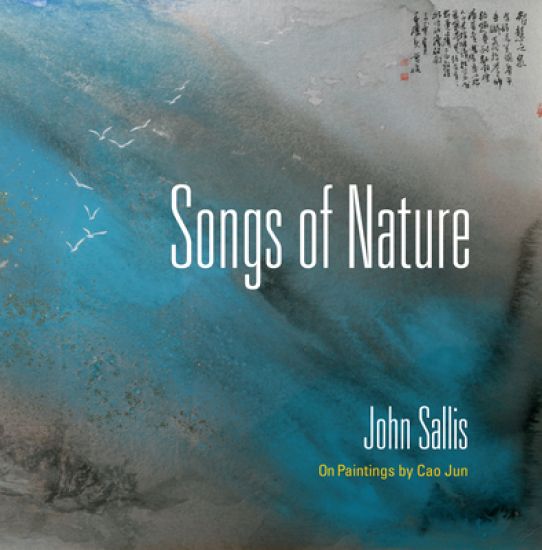
Songs of Nature

Songs of Nature

John Sallis

Indiana University Press
2020
pokkari
This latest philosophical text by John Sallis is inspired by the work of contemporary Chinese painter Cao Jun. It carries out a series of philosophical reflections on nature, art, and music by taking up Cao Jun's art and thought, with a focus on questions of the elemental. Sallis's reflections are not a matter of simply relating art works to philosophical thought, as theoretical insights and developments run throughout Cao Jun's writings and inform many of his artistic works. Sallis maintains abundant points of contact with Chinese philosophical traditions but also with Western philosophy. In these reflections on art, Sallis poses a critique of mimesis and considers the relation of painting to music. He affirms his conviction that the artist must always turn to nature, especially as reflections on the earth and sky delimit the scale and place of what is human. Full-color illustrations enhance this provocative and penetrating text.
Songs of Nature

Songs of Nature

John Sallis

Indiana University Press
2020
sidottu
This latest philosophical text by John Sallis is inspired by the work of contemporary Chinese painter Cao Jun. It carries out a series of philosophical reflections on nature, art, and music by taking up Cao Jun's art and thought, with a focus on questions of the elemental. Sallis's reflections are not a matter of simply relating art works to philosophical thought, as theoretical insights and developments run throughout Cao Jun's writings and inform many of his artistic works. Sallis maintains abundant points of contact with Chinese philosophical traditions but also with Western philosophy. In these reflections on art, Sallis poses a critique of mimesis and considers the relation of painting to music. He affirms his conviction that the artist must always turn to nature, especially as reflections on the earth and sky delimit the scale and place of what is human. Full-color illustrations enhance this provocative and penetrating text.
Being and Logos

Being and Logos

John Sallis

Indiana University Press
2019
pokkari
"Being and Logos" is . . . a philosophical adventure of rare inspiration. . . . Its power to illuminate the text . . . , its ecumenicity of inspiration, its methodological rigor, its originality, and its philosophical profundity—all together make it one of the few philosophical interpretations that the philosopher will want to re-read along with the dialogues themselves. A superadded gift is the author's prose, which is a model of lucidity and grace." —International Philosophical Quarterly "Being and Logos is highly recommended for those who wish to learn how a thoughtful scholar approaches Platonic dialogues as well as for those who wish to consider a serious discussion of some basic themes in the dialogues." —The Academic Reviewer
Logik der Imagination

Logik der Imagination

John Sallis

Mohr Siebeck
2019
sidottu
Nach der Phänomenologie von Einbildungskraft (2010) legt John Sallis eine Logik der Imagination vor. Sallis stellt sich in die Tradition Hegels, Husserls und Heideggers, wenn er versucht, den Anspruch der Logik über den Bereich der Sprache zu erweitern. Wenn wir in der Einbildungskraft aber auch Widersprüche erfahren, muss eine Logik der Imagination auch diesen gerecht werden. Nicht nur die Logik des Traums, auch die Tiefe des Erinnerns und die Uneinholbarkeit unserer Geburt erfassen wir nur in den Widersprüchen der Einbildungskraft. Mit dem Entwurf einer phänomenologischen Kosmologie erweitert Sallis die Logik der Imagination bis in die Unendlichkeit des Weltalls.
The Logos of the Sensible World

The Logos of the Sensible World

John Sallis

Indiana University Press
2019
sidottu
This volume of the collected writings of John Sallis presents a two-semester lecture course on Maurice Merleau-Ponty given at Duquesne University from 1970 to 1971. Devoted primarily to a close reading of the French philosopher's magnum opus, Phenomenology of Perception, the course begins with a detailed analysis of The Structure of Behavior. The central topics considered in the lectures include the functions of the phenomenological body; beyond realism and idealism; the structures of the lived world; spatiality, temporality, language, sexuality; and perception and knowledge. Sallis illuminates Merleau-Ponty's first two works and offers a thread to follow through developments in his later essays. Merleau-Ponty's notion of the primacy of perception and his claim that "the end of a philosophy is the account of its beginning" are woven throughout the lectures. For Sallis's part, these lectures are foundational for his extended engagement with Merleau-Ponty's The Visible and the Invisible, which was published in Sallis's Phenomenology and the Return to Beginnings.