Kirjojen hintavertailu – 12 903 735 kirjaa ja 27 kauppaa

Kirjailija

John Swinton

Kirjat ja teokset yhdessä paikassa: 46 kirjaa, julkaisuja vuosilta 2001–2025, suosituimpiin kuuluu Spiritual Caregiving as Secular Sacrament. Vertaile teosten hintoja ja tarkista saatavuus suomalaisista kirjakaupoista.

46 kirjaa

Kirjojen julkaisuvuodet: 2001–2025.

Spiritual Caregiving as Secular Sacrament

Spiritual Caregiving as Secular Sacrament

Ray Anderson; John Swinton

Jessica Kingsley Publishers
2003
pokkari
This is not a book about theory, it is a book about life. This volume is in the excellent Practical Theology Series published by Jessica Kingsley and under the general editorship of John Swinton of Aberdeen University who writes the Foreword. Ray Anderson is an American pastor and academic of many years standing. His starting point is (pre) theoretical, arguing vigorously that practical theology has a particular end in view and therefore differs from the empirical (social) sciences. It is well worth sticking with his argument to see how it works out in practice. Early chapters with phrases in their titles such as "Spiritual Praxis of Practical Theology", "Integrative Gestalt of the Human Self", "Ecological Matrix of the Human Person" and "Social Ecology of Human Spirituality" might seem heavy going at times. Don't be put off! The reader is rewarded with highly relevant contemporary understandings of spirituality illuminating and illuminated by both Scripture and modern theologians and therapists. This book comes highly recommended for anyone involved in the field of mental health care.'- Leveson Newsletter'This is a book that deserves to be read, and perhaps re-read, by those who deliver spiritual care and wish to reflect on what they do.'- Scottish Journal of Healthcare ChaplaincyBridging the gap between clinical and religious professionals, this book examines how both can understand the spiritual needs of the individual, and the importance of this spirituality in bringing about health and wholeness. With an emphasis on mental health, the author explores spirituality in the context of the individual and of society, and discusses how those practicing pastoral or health care can deal with the issues raised outside of any specific religious ideas or practice. Taking an ecological approach to understanding the needs of the individual, Ray S. Anderson shows how professionals can help people move towards a more positive state in the face of pain, distress and illness. Moving religious professionals away from the pursuit of simple edification, and those in health from purely medicalized approaches, Spiritual Caregiving as Secular Sacrament brings together professionals' roles in the context of spirituality to enable them to bring the greatest benefit to those in their care.
Seeking Sanctuary, Finding Shalom

Seeking Sanctuary, Finding Shalom

John Swinton

Baylor University Press
2025
sidottu

Halvin toimitettuna 32,20 €

What if our well-intentioned efforts to promote mental health inadvertently perpetuate systems that cause mental unwellness? What if the resilience we encourage only equips individuals to endure rather than challenge structures detrimental to their well-being? Why do mental health experiences vary so drastically across cultures, with Western societies seemingly posing the greatest challenges for certain conditions? Against the backdrop of escalating ecological dramas that devastate our world and its climate, do we ever wonder what ecological suffering might imply for our mental health? With this poignant, impassioned book, John Swinton invites us to begin exploring avenues toward addressing these daunting and interrelated issues. Seeking Sanctuary, Finding Shalom proposes that we think theologically about mental health as a matter of the collective body of human beings and the welfare of creation. Swinton contends that the ways in which we structure creation—relational, social, cultural, political, spiritual—has a profound impact on our mental health. Failing to recognize the broader dimensions of the task of mental healthcare, we might only ease the severity of a pain or a disease without removing the cause and so never offer genuine healing that brings about peaceable connection with God, self, others, and creation. Guided by the biblical concept of shalom—a form of peace crucial for our understanding of mental health(care)—Swinton takes into consideration the complex and creational roots of human psychological suffering and offers a model of human flourishing defined not by the absence of pain, suffering, and distress, but rather by the presence of God. Such a model seeks not only to deal with the immediacy of the human plight but also to view it within the context of Jesus's cosmic mission to reconcile himself with all things. And so, Swinton contends, as we broaden our conception of mental wholeness to encompass creation at large—the land under our feet, the air in our lungs, the geographical places in which we live and love, as well as the spheres of politics, economics, and culture—we begin the hard and necessary work of repairing dissonance, instability, and mental ill-health. This book does not offer a comprehensive strategy but it does gesture toward a more holistic, more Christoform theology of mental health. Every journey begins with a first step.
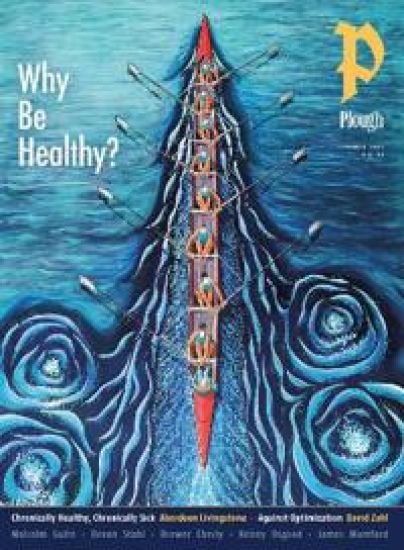
Plough Quarterly No. 44 – Why Be Healthy?

Plough Quarterly No. 44 – Why Be Healthy?

David Zahl; Malcolm Guite; Kelsey Osgood; Abraham Nussbaum; A. E. Stallings; Narine Abgaryan; John Swinton; Devan Stahl; James Mumford; Jessica T. Miskelly; Brewer Eberly; Aberdeen Livingstone; Terence Sweeney; Sam Tomlin; Hazel Thomson

PLOUGH PUBLISHING HOUSE
2025
nidottu
In an age of health care and wellness industries and near-religious pursuit of fitness and self-optimization, what does “health” mean for the chronically ill? For people with disabilities or mental health challenges or neurodiversity? For the aging and dying? This issue asks what it means to live well despite the limitations and frailties of our bodies, and what, beyond the scope of medicine, is needed for our flourishing. On this theme: Aberdeen Livingstone learns when to battle, and when to accept, chronic illness. Malcolm Guite defends the responsible use of pipe and pint. David Zahl calls out the wellness industry’s false promise of optimization. Abraham Nussbaum learns the limits of psychotherapy from his first patient. Cristiano Dennani photographs survivors of the Bhopal chemical spill in India. Heather M. Surls visits a tuberculosis hospital in Mafraq, Jordan. Brewer Eberly considers direct primary care, an attempt to reset the doctor-patient relationship. Devan Stahl considers what the wounds of the resurrected Christ mean for people with disabled bodies. Sam Tomlin wishes church and school weren’t such hurdles for children with autism. James Mumford finds the twelve steps of AA work when other approaches to addiction fail. Other articles in this issue: Jessica T. Miskelly, monitoring ocean currents on an icebreaker off Antarctica, feels the planet breathe. Kelsey Osgood visits a Jewish-Christian-Muslim interfaith center after October 7. Terence Sweeney profiles a repentant slaveholder, Bartolomé de las Casas. Plus: new poems by A. E. Stallings, short fiction by Narine Abgaryan, book reviews, and more. Plough Quarterly features stories, ideas, and culture for people eager to apply their faith to the challenges we face. Each issue includes in-depth articles, interviews, poetry, book reviews, and art.
Wayfaring

Wayfaring

Warren Kinghorn; John Swinton

WILLIAM B EERDMANS PUBLISHING CO
2024
pokkari
A theologically and scientifically engaged exploration of modern mental health care The current model of mental health care doesn't see people: it sees sets of symptoms that need fixing. While modern psychiatry has improved many patients' quality of life, it falls short in addressing their relational and spiritual needs. As a theologian and practicing psychiatrist, Warren Kinghorn shares a Christian vision of accompanying those facing mental health challenges. Kinghorn reviews the successes and limitations of modern mental health care before offering an alternative paradigm of healing. Based in the theology of Thomas Aquinas, this model of personhood affirms four truths: We are known and loved by God. We are creatures made of earth who are formed in community. We are wayfarers on a journey. We are called not to control, but to wonder, love, praise, and rest. Drawing on theological wisdom and scientific evidence, Kinghorn reframes our understanding of mental health care from fixing machines to attending fellow wayfarers on the way to the Lord's feast. With gentle guidance and practical suggestions, Wayfaring is an essential resource for pastors and practitioners as well as for Christians who seek mental health care.
BRF Lent Book: Loving My Neighbour

BRF Lent Book: Loving My Neighbour

Inderjit Bhogal; Joanna Collicutt; David Gregory; Esther Kuku; Sanjee Perera; Gemma Simmonds; John Swinton

BRF (THE BIBLE READING FELLOWSHIP)
2023
pokkari

Halvin toimitettuna 18,90 €

It’s never been more important to understand how much God loves us and how much he wants us to love each other. Loving My Neighbour takes us on a journey through the challenging terrain of how we can truly love one another, individually and in our communities. Daily Bible readings and reflections from Ash Wednesday to Easter Day explore how we can love in truth, love the vulnerable and the suffering, embrace difference, care for our world, and love ourselves as God loves us. Holy Week brings us back to reflect on Christ on the cross, who loved us to the very end.
Struggling with God

Struggling with God

Christopher C. H. Cook; Isabelle Hamley; John Swinton

SPCK PUBLISHING
2023
nidottu
'Remarkably beautiful and pastoral' JUSTIN WELBY, ARCHBISHOP OF CANTERBURY 'Brimming with wisdom and humanity' DAME SARAH MULLALLY, DBE, BISHOP OF LONDON Struggling with God gets right to the heart of a great predicament for many Christians. When it feels as if our struggles are overwhelming - and our capacity for faith and hope and love is diminished - how is it possible to maintain, never mind nourish, our relationship with God? The truth, as this deeply compassionate volume reminds us, is that Jesus came alongside people wrestling with mental health problems. Many familiar conditions, such as anxiety and depression, and more severe ones, including bipolar affective disorder and schizophrenia, are addressed by the authors here. Dispelling common myths and misconceptions, they explore the impact such mental health disorders can have on individual Christians, Church and society.. Each chapter includes biblical reflections relevant to its theme, prayers, questions to facilitate individual/group study, and pointers to further reading. In short, the book presents a Christian vision of spiritual and mental wellbeing through prayerful struggling with God.
Deliver Us from Evil

Deliver Us from Evil

John Swinton

Cascade Books
2022
pokkari
What do we mean when we call something or someone evil? The word "evil" tends to conjure up images of demons, devils, and horrifying crimes, things that you and I couldn't possibly get involved with But is that true? Is evil really something that only wicked people who are "quite unlike ourselves" get up to? Could it be that you and I are not only capable of doing evil things, but are already involved with such things? This book explores the hidden nature of evil and draws out the ways in which all of us, knowingly or otherwise, are caught up in webs of evil that bring about disastrous consequences, often to the weakest and most vulnerable amongst us. We need to find ways of learning to see evil and resisting it by all means possible. If we can't see evil, we can't resist it. If we can't resist it, we get sucked into it.
Deliver Us from Evil

Deliver Us from Evil

John Swinton

Cascade Books
2022
sidottu
What do we mean when we call something or someone evil? The word "evil" tends to conjure up images of demons, devils, and horrifying crimes, things that you and I couldn't possibly get involved with But is that true? Is evil really something that only wicked people who are "quite unlike ourselves" get up to? Could it be that you and I are not only capable of doing evil things, but are already involved with such things? This book explores the hidden nature of evil and draws out the ways in which all of us, knowingly or otherwise, are caught up in webs of evil that bring about disastrous consequences, often to the weakest and most vulnerable amongst us. We need to find ways of learning to see evil and resisting it by all means possible. If we can't see evil, we can't resist it. If we can't resist it, we get sucked into it.
Möta Jesus i stormen : om livet som kristen med psykiska hälsoutmaningar
I mötet med psykisk ohälsa, räcker det inte med ”tunna” diagnoser och förklaringar som riskerar att stigmatisera och ge människor en stämplad identitet. För en djupare förståelse behövs ”tjocka” beskrivningar. Sådana kan endast växa fram i en öppen dialogprocess där människors unika berättelser blir lyssnade på med respekt. Utifrån kvalitativa forskningsintervjuer med personer som vill ”leva med Jesus” och som samtidigt lever under någon av diagnoserna depression, schizofreni och bipolär sjukdom, strävar John Swinton i boken Möta Jesus i stormen efter just en sådan djupare förståelse. Han reflekterar teologiskt – i dialog med medicinska, psykologiska och filosofiska perspektiv – över såväl samhällets som psykiatrins och kyrkans bemötanden, och hur ett helande bortom botandet kan se ut. Resultatet är en enastående och prisbelönad bok som handlar om personer i stället för symtom, beskrivningar i stället för diagnoser och om ett livgivande hopp för de som lever mitt i stormen. Boken vänder sig till alla som på något sätt berörs av psykiska hälsoutmaningar, oavsett om man arbetar inom kyrkan eller vården, vill vara en god medvandrare eller själv lever med en sådan utmaning. John Swinton är professor i praktisk teologi vid Aberdeens universitet i Skottland, med särskild inriktning mot området teologi och funktionsvariation. Swinton har en mångårig bakgrund som sjuksköterska inom bland annat psykiatrin, har grundat Aberdeens Centre for Spirituality, Health, and Disability och är en flitigt anlitad föreläsare världen över.
God's Not Forgotten Me

God's Not Forgotten Me

'Tricia Williams; John Swinton

Wipf Stock Publishers
2022
sidottu
What happens to faith if you get dementia? Does the real "you" disappear? Does your relationship with God evaporate as neurons begin to disconnect? Will you forget God? Here, the voices of Christians from the evangelical tradition bring insight to the profound questions faith encounters amidst the disorientation of dementia: ". . . even when my brain falls apart . . . nothing can separate me from the love of God . . . faith is stronger." 'Tricia Williams seeks deeper understanding of their faith experience and practice through careful listening and theological reflection within the boundaries of a biblical agenda: who I am, knowing God, experience and practice of faith, the shadows of suffering, embodied memory, spiritual growth, and hope for now. Fresh theological insights and challenges for the church call for creative practices to nurture the faith of disciples of Jesus who live with this disease: "They must remind me." In this book, these voices reveal a growing, positive experience of faith in the light of dementia--and of hope in Christ. Faith does not end with diagnosis: "God . . . has not forgotten me."
Walking with Jesus in Strange Places

Walking with Jesus in Strange Places

John Swinton

FORTRESS PRESS
2022
nidottu
Theology doesn't come to us neatly packaged from above. There is a sense in which all theology is autobiography. We learn it as we live it, and the place where we live it out is within our own story. It's not that there is no such thing as objective truth. It's just that we come to know what we know not only as we think our way into it with our minds but as we live into it with the whole of our lives. As theologians, our own stories inevitably matter. In this book, John Swinton uses fragments of his own story to show how that story has impacted the way he sees and practices theology. His place of formation walking alongside people living with intellectual disabilities, mental health challenges, and dementia has gifted Swinton with the opportunity to ask different questions of the tradition--questions that emerge from the lives of people who see the world differently. That learning has shaped him as a theologian. It has also raised some crucial questions around the nature of faithfulness, discipleship, and exactly what kind of community the church is and should be in both theory and in practice. As we reflect on these matters, the hope is that all of us together can begin to appreciate more deeply the goodness, kindness, and love of God for all human beings. In the My Theology series, the world's leading Christian thinkers explain some of the principal tenets of their theological beliefs in concise, pocket-sized books.
My Theology

My Theology

JOHN SWINTON

Darton, LongmanTodd Ltd
2022
pokkari
John Swinton describes his place of formation walking alongside people living with intellectual disabilities, mental health challenges and dementia, and how it has gifted him with the opportunity to ask different theological questions of the Christian tradition; questions that emerge from the lives of people who see the world differently.
Kinship in the Household of God

Kinship in the Household of God

Cynthia Tam; John Swinton

Wipf Stock Publishers
2021
sidottu
This unique volume contributes a profound-autism perspective to the ongoing discussion of belonging in the church. By taking readers into two church communities, the author explores the issues of belonging from those least welcomed by the church and consider what the church should do differently. Adopting a "we" approach, she emphasizes the unity of different members in Christ. As one body in Christ, all believers share Christ's sonship and become children of God. The household concept invites readers to reconceptualize Christian relationships as covenantal kinship. The kinship relationship is established by God's covenantal commitment fulfilled in Christ. With or without autism, any person who obeys God's summons is incorporated into Christ's body by the Spirit to become God's child. Believers are thus siblings to one another. Viewing each person this way enables us to see beyond human differences and welcome one another as God's gifts and indispensable members of the community.
Kinship in the Household of God

Kinship in the Household of God

Cynthia Tam; John Swinton

Wipf Stock Publishers
2021
pokkari
This unique volume contributes a profound-autism perspective to the ongoing discussion of belonging in the church. By taking readers into two church communities, the author explores the issues of belonging from those least welcomed by the church and consider what the church should do differently. Adopting a "we" approach, she emphasizes the unity of different members in Christ. As one body in Christ, all believers share Christ's sonship and become children of God. The household concept invites readers to reconceptualize Christian relationships as covenantal kinship. The kinship relationship is established by God's covenantal commitment fulfilled in Christ. With or without autism, any person who obeys God's summons is incorporated into Christ's body by the Spirit to become God's child. Believers are thus siblings to one another. Viewing each person this way enables us to see beyond human differences and welcome one another as God's gifts and indispensable members of the community.
Finding Jesus in the Storm

Finding Jesus in the Storm

John Swinton

SCM PRESS
2020
pokkari

Halvin toimitettuna 38,70 €

By listening carefully to the lived experiences of people with severe mental health problems, Finding Jesus in the Storm will open up new understandings and perspectives that challenge current assumptions and draws out fresh perspectives for care, healing, recovery and community.
Finding Jesus in the Storm: The Spiritual Lives of Christians with Mental Health Challenges
People living with mental health challenges are not excluded from God's love or even the fullness of life promised by Jesus. Unfortunately, this hope is often lost amid the well-meaning labels and medical treatments that dominate the mental health field today. In Finding Jesus in the Storm, John Swinton makes the case for reclaiming that hope by changing the way we talk about mental health and remembering that, above all, people are people, regardless of how unconventionally they experience life. Finding Jesus in the Storm is a call for the church to be an epicenter of compassion for those experiencing depression, schizophrenia, bipolar disorder, and related difficulties. That means breaking free of the assumptions that often accompany these diagnoses, allowing for the possibility that people living within unconventional states of mental health might experience God in unique ways that are real and perhaps even revelatory. In each chapter, Swinton gives voice to those experiencing the mental health challenges in question, so readers can see firsthand what God's healing looks like in a variety of circumstances. The result is a book about people instead of symptoms, description instead of diagnosis, and lifegiving hope for everyone in the midst of the storm.