Kirjojen hintavertailu – 12 859 819 kirjaa ja 27 kauppaa

Kirjailija

Karl Marx

Kirjat ja teokset yhdessä paikassa: 1 031 kirjaa, julkaisuja vuosilta 1848–2026, suosituimpiin kuuluu The Portable Karl Marx. Vertaile teosten hintoja ja tarkista saatavuus suomalaisista kirjakaupoista.

1 031 kirjaa

Kirjojen julkaisuvuodet: 1848–2026.

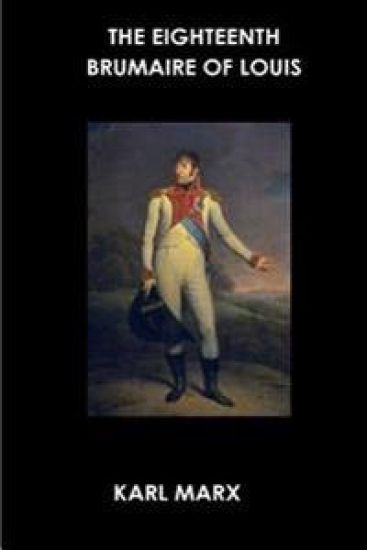
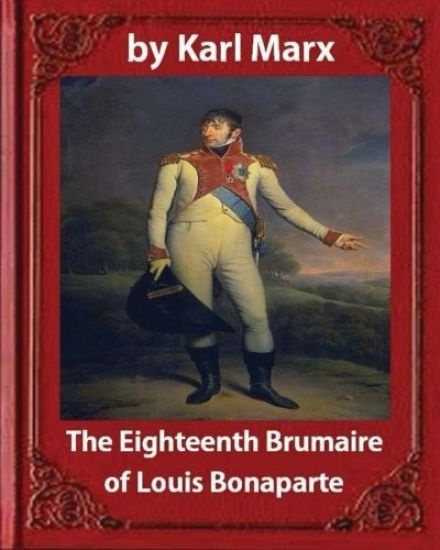
The Eighteenth Brumaire of Louis Napoleon, by Karl Marx and Daniel De Leon: translated by Daniel De Leon (December 14, 1852 - May 11, 1914)
The Eighteenth Brumaire of Louis Napoleon was written between December 1851 and March 1852, and originally published in 1852 in Die Revolution, a German-language monthly magazine. The pamphlet shows Marx in his form as a social and political historian, treating actual historical events-those leading up to Louis Bonaparte's coup d' tat of 2 December 1851-from the viewpoint of his materialist conception of history. The "Eighteenth Brumaire" refers to November 9, 1799 in the French Revolutionary Calendar-the day Louis Bonaparte's uncle Napoleon Bonaparte had made himself dictator by a coup d' tat. The work is the source of one of Marx's most quoted statements, that history repeats itself, "the first as tragedy, then as farce". Karl Marx 5 May 1818 - 14 March 1883) was a philosopher, economist, sociologist, journalist, and revolutionary socialist. Born in Prussia to a middle-class family, he later studied political economy and Hegelian philosophy. As an adult, Marx became stateless and spent much of his life in London, England, where he continued to develop his thought in collaboration with German thinker Friedrich Engels and published various works, the most well-known being the 1848 pamphlet The Communist Manifesto. His work has since influenced subsequent intellectual, economic, and political history. Marx's theories about society, economics and politics-collectively understood as Marxism-hold that human societies progress through class struggle: a conflict between ruling classes (known as the bourgeoisie) that control the means of production and working classes (known as the proletariat) that work on these means by selling their labour for wages. Employing a critical approach known as historical materialism, Marx propounded the theory of base and superstructure, asserting that the cultural and political conditions of society, as well as its notions of human nature, are largely determined by obscured economic foundations. Through his theories of alienation, value, commodity fetishism, and surplus value, Marx argued that capitalism facilitated social relations and ideology through commodification, inequality, and the exploitation of labour. These economic critiques would result in influential works such as Capital, Volume I (1867). According to Marx, states are run in the interests of the ruling class but are nonetheless represented as being in favor of the common interest of all. 6] He predicted that, like previous socioeconomic systems, capitalism produced internal tensions which would lead to its self-destruction and replacement by a new system: socialism. For Marx, class antagonisms under capitalism, owing in part to its instability and crisis-prone nature, would eventuate the working class' development of class consciousness, leading to their conquest of political power and eventually the establishment of a classless, communist society governed by a free association of producers. Marx actively fought for its implementation, arguing that the working class should carry out organised revolutionary action to topple capitalism and bring about socio-economic emancipation. Marx has been described as one of the most influential figures in human history, and his work has been both lauded and criticised. His work in economics laid the basis for much of the current understanding of labour and its relation to capital, and subsequent economic thought.
Trabajo Asalariado y Capital

Trabajo Asalariado y Capital

Karl Marx

Createspace Independent Publishing Platform
2016
nidottu
Comprender la teor a econ mica de Karl Marx, es leer sus trabajos econ micos. As como los fervientes cat licos y cristianos hacen de o dos sordos a toda persona que desmienta con demostraciones y sin que haya le do la biblia, bajo el argumento de que si no han le do la biblia no pueden poner su religi n a tela de juicio, as con esa testarudez tampoco se podr a hablar y comprender completamente la teor a econ mica de Marx, y me refiero a sus magnos trabajos: El capital, cuyos tres voluminosos vol menes pueden llevarnos a tardarnos hasta meses en leerlos, si no es que a os, tambi n est su cuarto volumen que sali a la luz bajo el nombre de Historia cr tica de las teor as de la plusval a, en 3 vol menes tambi n, que a su vez stas dos obras tienen trabajos introductorios, los cuales son Salario, precio y ganancia, Trabajo asalariado y capital ( stos dos en folletos) y la Contribuci n a la cr tica de la econom a pol tica. Y claro, no podr a faltar complementar todo el trabajo de El capital, con los Cuadernos de los Grundisse o tambi n conocida como Elementos fundamentales para la cr tica de la econom a pol tica. Y por tanto, ser a una tarea colosal el resumir todo su trabajo econ mico, sin contar con el primer y pr cticamente nico inconveniente: de que esa no es mi intenci n, ni una meta. S lo hablar del peque o folleto de Trabajo asalariado y capital en este trabajo, con la intenci n de hacerla m s asequible a la gente que est interesada
Secret Diplomatic History of the Eighteenth Century

Secret Diplomatic History of the Eighteenth Century

Karl Marx

Createspace Independent Publishing Platform
2016
nidottu
In the 1850s, while studying the foreign policies of European states and endeavouring to disclose the inner springs of these policies, Marx often turned to the history of diplomacy. Working at the British Museum, he discovered, in the collection of an English historian and writer, William Coxe, a mass of eighteenth-century documents, including letters from English ambassadors in St. Petersburg. This find served as an immediate stimulus for writing the Revelations of the Diplomatic History of the 18th Century which he conceived at the beginning of 1856, when the Crimean war was still in progress. Marx wrote later: "While looking through the diplomatic manuscripts in the possession of the British Museum I came across a series of English document's, going back from the end of the eighteenth century to the time of Peter the Great, which reveal the continuous secret collaboration between the Cabinets of London and St. Petersburg, and seem to indicate that this relationship arose at the time of Peter the Great" . Initially Marx intended to publish some of these documents, with his own comments, in the American Putnam's Monthly Magazine, but he then decided to develop the theme and write an extensive (about 20 printed sheets) work on the history of Anglo-Russian relations in the 18th century. However, his negotiations with the German publisher in London Nikolaus Tr bner in March - May 1856 on the publication of the work were fruitless. Marx failed to find another publisher and thought of printing it in one of the newspapers published by the followers of the English conservative journalist, David Urquhart, who was in opposition to the British Government and vigorously criticised its foreign policy. Marx had occasionally contributed to these papers, though he always dissociated himself from Urquhart's anti-democratic stance. It was because of Urquhart's political approach that Marx hesitated for some time before entrusting him with his work for publication. Marx wrote to Engels on August 1, 1856: "... Should Urquhart come out with his counter-revolutionary nonsense in such a way that collaboration with him would discredit me in the eyes of the revolutionaries here, I would be obliged ... to decide against it". The Revelations of the Diplomatic History of the 18th Century, which Marx wrote from June 1856 to March 1857, began to appear in instalments in The Sheffield Free Press, an Urquhartist newspaper, in late June 1856. But since the editors interfered with the text by arbitrarily making cuts without Marx's consent, he stopped publication and handed over the work to another Urquhartist periodical - the London weekly Free Press. The work was published from the very beginning without any abridgements, as the text was sent in by Marx, from August 16, 1856 to April 1, 1857. The published text was, in Marx's own words, only an introduction to a projected work that was never written. It is divided into five chapters. More than half consists of documents (reports, letters and pamphlets) concerning the history of diplomatic relations between England and Russia in the 18th century. Chapter I consists of documents and Marx's numerous comments. In Chapters II and III the proportion of Marx's text proper is insignificant. The whole of Chapter IV was written by Marx; in Chapter V, where he profusely cites the pamphlet Truth Is But Truth... Marx gives a description of Peter I's foreign policy.
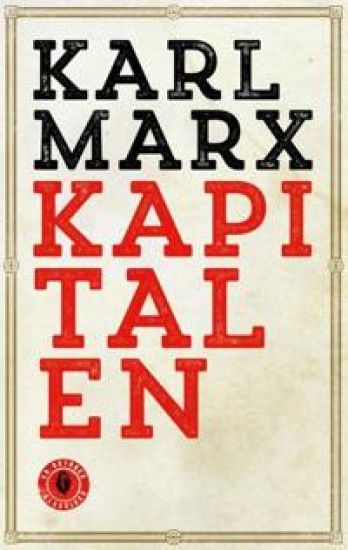
Kapitalen: Første bok

Kapitalen: Første bok

Karl Marx

Oktober
2016
pokkari
"Kapitalen, første bok" ble utgitt i 1867 og er blitt stående som et av de mest beryktede og innflytelsesrike verkene i moderne tid. Karl Marx framsetter her en flengende kritikk av den private eiendomsretten. Han argumenterer for at kapitalismen vil forårsake et stadig økende skille i velstand og velferd, men der undertrykkelsen i slavesamfunnet og føydalsamfunnet er åpenbar, er den i det kapitalistiske samfunnet skjult. Marx spår at kapitalismen vil bli avskaffet og erstattet av et system som sikrer felles eierskap til produksjonsmidlene. Politiske tenkere før Marx anså de økonomiske lovene for å ha samme status som naturlover. Marx hevdet også at den økonomiske utviklingen tok form av en lovmessig prosess, men han viste hvordan disse lovene var historisk oppstått og formet, altså skapt av mennesker, som også vil være i stand til å skape dem annerledes." Kapitalen" fikk raskt en leserkrets blant lederne i de sosial - demokratiske partiene, særlig i Russland og Tyskland. Verket som Friedrich Engels kalte arbeiderklassens bibel har beholdt sin status som en uunnværlig klassiker.
Karl Marx and Friedrich Engels

Karl Marx and Friedrich Engels

Friedrich Engels; Karl Marx

Kersplebedeb
2016
pokkari
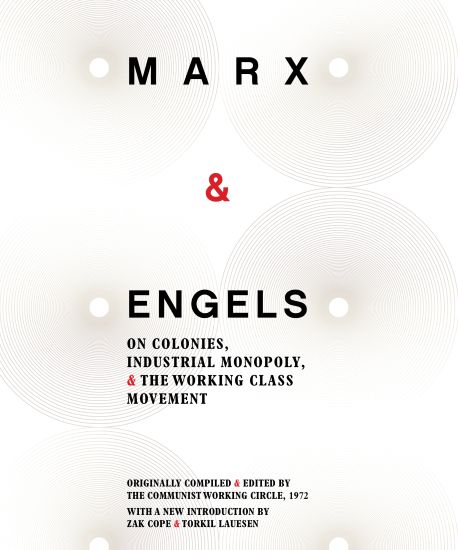
Originally compiled and edited by the Communist Working Circle (CWC) in 1972, this is a republished collection of excerpts from the corpus of Marx and Engels. These texts show the evolution of Marx and Engels's ideas about the nascent labor aristocracy, and the enervating effects of colonialism and chauvinism on the British labour movement, with a focus on the British Empire of their time. This edition of On Colonies includes a substantial introduction by Marxist economist Zak Cope and former CWC member Torkil Lauesen, centering these concepts in theory and history. Cope and Lauesen show how Marx and Engels's initial belief that capitalism would expand seamlessly around the globe in the same way as it did in Europe was proven wrong by events, as instead worldwide imperialism spread capitalism as a polarizing process, not only between the bourgeoisie and the working class, but also as a division between an imperialist center and an exploited periphery. This fundamental contradiction gave capitalism completely new conditions of growth and accounts for its tragic longevity. Both foundational and indispensable, On Colonies provides a useful introduction to "Third Worldist" analysis of global capitalism, tracing its roots back to Marxism's earliest works.