Kirjojen hintavertailu – 12 859 819 kirjaa ja 27 kauppaa

Kirjailija

Ludwig Von Mises

Kirjat ja teokset yhdessä paikassa: 64 kirjaa, julkaisuja vuosilta 1956–2025, suosituimpiin kuuluu Liberalism. Vertaile teosten hintoja ja tarkista saatavuus suomalaisista kirjakaupoista.

64 kirjaa

Kirjojen julkaisuvuodet: 1956–2025.

The Ultimate Foundation of Economic Science: An Essay on Method
The Ultimate Foundation of Economic Science: An Essay on Method is a book written by Ludwig Von Mises, one of the most influential economists of the 20th century. In this book, Mises presents his views on the methodology of economics, arguing that economic science is based on a priori principles that are independent of empirical observation. He argues that economics is a deductive science that starts with basic axioms and builds up to more complex theories and models. Mises also discusses the role of economics in society, arguing that it is a crucial tool for understanding human action and decision-making. He explores the relationship between economics and other social sciences, such as psychology and sociology, and argues that economics provides a unique perspective on human behavior that is not available from other disciplines. The book is divided into four parts. The first part provides an overview of Mises' views on economic methodology, while the second part explores the relationship between economics and other social sciences. The third part discusses the role of economics in society, and the fourth part examines the implications of Mises' views for economic policy. Overall, The Ultimate Foundation of Economic Science is a seminal work in the field of economics, providing a comprehensive and insightful exploration of the methodology and role of economics in society. It is essential reading for anyone interested in understanding the foundations of economic science and the role it plays in shaping our world. This is a new release of the original 1962 edition. This scarce antiquarian book is a facsimile reprint of the old original and may contain some imperfections such as library marks and notations. Because we believe this work is culturally important, we have made it available as part of our commitment for protecting, preserving, and promoting the world's literature in affordable, high quality, modern editions, that are true to their original work.
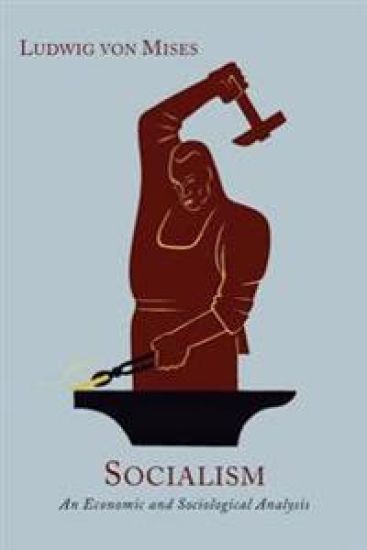
Socialism: An Economic and Sociological Analysis

Socialism: An Economic and Sociological Analysis

Ludwig Von Mises; J. Kahane

Literary Licensing, LLC
2013
sidottu

Halvin toimitettuna 66,50 €

Socialism: An Economic and Sociological Analysis is a book written by Ludwig von Mises, a prominent Austrian economist and philosopher. The book was first published in German in 1922 and later translated into English in 1936. In this book, Mises provides a critical analysis of socialism as an economic and social system. He argues that socialism is fundamentally flawed and cannot function as an efficient economic system. Mises examines the socialist theories of Karl Marx and other prominent socialist thinkers, and provides a detailed critique of their ideas. Mises also explores the social implications of socialism, arguing that it leads to the destruction of individual freedom and the growth of a powerful and oppressive state. He warns that socialism can only lead to tyranny and the suppression of dissent. Overall, Socialism: An Economic and Sociological Analysis is a seminal work in the field of economics and political philosophy, and remains a relevant and influential text today. It is a must-read for anyone interested in understanding the flaws of socialism and the importance of individual freedom and free markets. This is a new release of the original 1951 edition. This scarce antiquarian book is a facsimile reprint of the old original and may contain some imperfections such as library marks and notations. Because we believe this work is culturally important, we have made it available as part of our commitment for protecting, preserving, and promoting the world's literature in affordable, high quality, modern editions, that are true to their original work.
The Theory of Money and Credit

The Theory of Money and Credit

Ludwig von Mises

Skyhorse Publishing
2013
pokkari

Halvin toimitettuna 18,60 €

“It is impossible to grasp the meaning of the idea of sound money if one does not realize that it was devised as an instrument for the protection of civil liberties against despotic inroads on the part of governments.” – from The Theory of Money and CreditOriginally published in 1912, Ludwig von Mises’s The Theory of Money and Credit remains today one of economic theory’s most influential and controversial treatises. Von Mises’s examination into monetary theory changed forever the world of economic thought when he successfully integrated “macroeconomics” into “microeconomics” —previously deemed an impossible task —as well as offering explanations into the origin, value and future of money. One hundred years later, von Mises and the Austrian school of economic theory are still fiercely debated by world economists in their search for the solution to America’s current financial crisis. His theorems continue to inspire politicians and market experts who aim to raise up the common man and reduce the financial power of governments. In a preface added in 1952, von Mises urges the people of the world to see economic truth:“The great inflations of our age are not acts of God. They are man-made or, to say it bluntly, government-made. They are the off-shoots of doctrines that ascribe to governments the magic power of creating wealth out of nothing and of making people happy by raising the ‘national income.’”“The best book on money ever written.” —Murray Rothbard, economist and historian“The greatest economist of the twentieth century.” —Sandeep Jaitly, economist
Medelvägens motståndare : Ludwig von Mises texter i urval av Kurt Wickman
LUDWIG VON MISES (18811973) kallades en gång för liberalismens siste riddare. Från början verksam i Wien bröt han ny mark inom nationalekonomin som en av de främsta förgrundsfigurerna inom den österrikiska nationalekonomiska skolan. Nazisternas framfart fick honom att fly Europa för USA. Ändå identifierade han en annan fiende som 1900-talets största intellektuella hot: socialismen. Långt före Sovjetunionens fall visade Ludwig von Mises att marxismens idéer fallerade i teorin, och därför var omöjliga även i praktiken. Den som i dag läser hans banbrytande penningteori från 1912 finner lärdomar som är relevanta även för vår egen tids bostadsbubblor, finanskriser och statliga skuldfällor. LUDWIG VON MISES var professor i nationalekonomi, verksam i Wien, Geneve och New York. Han var medgrundare till det inflytelserika akademiska nätverket Mont Pelerin Society. Nu introduceras ett urval av Mises texter på svenska. Urvalet har gjorts av Kurt Wickman, ekonom vid Högskolan i Gävle. Han bidrar också med en fyllig biografisk introduktion till Ludwig von Mises. "I dagens Europa är Mises försvar av kapitalismen mer aktuellt än någonsin." Björn Wahlroos, styrelseordförande Nordea "När någon frågar mig vilken av mina böcker man ska läsa för att förstå den ekonomiska liberalismen svarar jag: strunta i mina böcker och läs Ludwig von Mises i stället." Johan Norberg, idéhistoriker och liberal debattör
The Theory of Money and Credit

The Theory of Money and Credit

Ludwig Von Mises

Tribeca Books
2011
nidottu

Halvin toimitettuna 19,20 €

Original 1912 Edition. (English Translation first published 1934.) Economist and philosopher, Ludwig von Mises present his "Theory of Money and Credit" by first looking at the nature and value of money, why there is a demand for money, and how it is used as currency. He goes on to explain the purchasing power of money and how it determines economic and monetary policy, often in a way that results in financial melt-downs. Ludwig Heinrich Edler von Mises (September 29, 1881 - October 10, 1973) was an Austrian-American economist, historian, philosopher, author, and classical liberal who had a significant influence on the modern free-market libertarian movement and the Austrian School. The Theory of Money and Credit is an economics book written by Ludwig von Mises, originally published in German as Theorie des Geldes und der Umlaufsmittel in 1912. Along with Carl Menger's Principles of Economics, and Eugen von B hm-Bawerk's Capital and Interest, this work was a major contribution to economic theory. Its first English translation was published in 1934, and Part Four was added by Mises to the English language edition in 1953. In this work, Mises looks at the nature and value of money, and its effect on determining monetary policy. Included is his regression theorem, that tries to explain why money is demanded in its own right, as moneys at first glance do not serve a consumable need. Mises explained that moneys only can come about after there has been a demand for the money commodity in a barter economy. The German word Umlaufsmittel literally translates as "means of circulation" and was translated into the text of the English version as "fiduciary media". However, the publisher thought the unusual terminology would irritate readers and substituted "money and credit" in the title, thereby losing the specific distinction Mises had made in selecting his original term.
Economic Planning

Economic Planning

Ludwig Von Mises; Rufus Stickney Tucker

Literary Licensing, LLC
2011
sidottu
""Economic Planning"" by Ludwig Von Mises is a seminal work on the economic theory of socialism and central planning. In this book, Mises argues that central planning is fundamentally flawed and cannot achieve the economic efficiency and prosperity that free markets can. He explains why socialist economies inevitably fail due to the lack of a price system, the absence of profit and loss incentives, and the inability to calculate economic value. Mises also discusses the role of government in a free market economy and the dangers of government intervention in the market. This book is essential reading for anyone interested in economics, political philosophy, and the debate between socialism and capitalism. This scarce antiquarian book is a facsimile reprint of the old original and may contain some imperfections such as library marks and notations. Because we believe this work is culturally important, we have made it available as part of our commitment for protecting, preserving, and promoting the world's literature in affordable, high quality, modern editions, that are true to their original work.
A Critique of Interventionism (Large Print Edition)

A Critique of Interventionism (Large Print Edition)

Ludwig Von Mises

Createspace Independent Publishing Platform
2011
nidottu

Halvin toimitettuna 16,50 €

LARGE PRINT EDITION More at LargePrintLiberty.com In the sequence of Mises's books concerning policy, this book followed Socialism, and was the first to present a new theory of interventionism. In Mises's view, interventionism is an inherently unstable policy because it creates new dislocations that would seem to cry out for further interventions, which, in turn, do not solve the problem. The end of interventionism is socialism, a fate which can be logically avoided only by a sharp turn towards free markets. Along with Socialism and the Liberalism, this book stands as a masterpiece of policy logic.
The Clash of Group Interests (Large Print Edition)

The Clash of Group Interests (Large Print Edition)

Ludwig Von Mises

Createspace Independent Publishing Platform
2011
nidottu
LARGE PRINT EDITION More at LargePrintLiberty.com In this thrilling essay written in 1945, Mises lays out a theory of social organization in response to the Marxist critique of the free society. He explains that the Marxist view is wrong concerning its claim that there is a clash of group interests in the market order. He explains the difference in the competition between producers and a Marxian-type struggle. He shows how the relationships between labor and capital are essentially cooperative in that interests coincide over the long run - and so it is with all groups in a free society. However, he goes further to map out a theory of what he calls castes that form under interventionist systems. Here the privileged group really does live at the expense of the paying group in a manner which Marx suggests - but with the key difference that it is the state and not the market that makes this possible. In this way, argues Mises, the state is the cause of social conflict; the more it intervenes in the market order, the more conflict it creates, as taxes, regulations, and legal privileges of all sorts begin to blot out the harmonious relationships that would otherwise exist on the market.
Liberty & Property (Large Print Edition)

Liberty & Property (Large Print Edition)

Ludwig Von Mises

Createspace Independent Publishing Platform
2009
nidottu
LARGE PRINT EDITION More at LargePrintLiberty.com In 1956, the Mont Pelerin Society was entering a difficult period in which its intellectual lights were drifting away from liberalism of the old school. Ludwig von Mises used his speech that year to explain why this was a terrible trend. He didn't rebuke anyone. What he did was back away from the events of the day to provide a sweeping reconstruction of economic history from the ancient world to the present. He provided a model of how to think outside one's own generation to understand the really big issues and the moral and practical urgency of embracing total freedom. The result is an essay for the ages. It is profound, visionary, and compelling beyond belief. Would that every undergraduate, or even citizen, read this piece. In here, Mises describes the revolutionary meaning of capitalism in human history, and how it was responsible for the most spectacular increases in the standard of living of the common man ever. It was mass production that lead people to live longer, healthier, and happier lives. Contemporary reports from the event in which he delivered this paper suggest that the people there were uninterested in Mises's point of view, but this is much to their shame. For what he left us with remains one of the most dazzling presentations of the case for economic liberty ever written. It is the perfect combination of high intelligence, vast historical understanding, and moral passion.