Kirjojen hintavertailu – 12 903 725 kirjaa ja 27 kauppaa
Kirjailija
Ludwig Wittgenstein
Kirjat ja teokset yhdessä paikassa: 143 kirjaa, julkaisuja vuosilta 1921–2026, suosituimpiin kuuluu Tractatus Logico-Philosophicus. Vertaile teosten hintoja ja tarkista saatavuus suomalaisista kirjakaupoista.
Voici, en reedition, les Dictees a Waismann et pour Schlick, soit la transcription vers 1931 par Waismann de reflexions de Wittgenstein dans sa periode charniere. Ils formaient alors un trio demarque du Cercle de Vienne dont Schlick n'etait plus "l'ame". Ces reflexions diffractent d'interessantes questions qui livrent au lecteur quelques aspects auto-critiques de l'auteur duTractatus, mais aussi ceux d'une evolution vers une pensee differente de l'empirisme logique, axee sur l'idee d'une grammaire philosophique en quete d'une synopsis. La methode qui n'est plus reductionniste ni clarificatrice en ce sens, est en route vers la philosophie seconde. Elle revele un Wittgenstein qui, marque par le physicien Boltzmann, rejette comme "metalogique" l'usage des concepts du vocabulaire logique, dorenavant tenus comme "magiques", du Tractatus. Critique de la visee intentionnelle selon Brentano, Wittgenstein s'achemine vers une grammaire de la regle, annoncant meme, a travers l'interet pour les jeux de langage, quelques contours de la future philosophie de la psychologie. Cependant, Waismann qui etait tant a l'affut des moindres mouvements de la pensee de Wittgenstein dont cette transcription temoigne, y occupe en creux une place qui marque une voie propre. Ce volume contient en plus des traductions, et a la difference de la premiere edition, un texte de Brian McGuinness sur le difficile parcours d'un philosophe pris entre la fidelite au maitre et l'originalite d'une pensee linguistique et mathematique en gestation.
The Tractatus Logico-Philosophicus (TLP) (Latin for "Logico-Philosophical Treatise") is the only book-length philosophical work published by the Austrian philosopher Ludwig Wittgenstein in his lifetime. The project had a broad aim - to identify the relationship between language and reality and to define the limits of science 1] - and is recognized as a significant philosophical work of the twentieth century. G. E. Moore originally suggested the work's Latin title as homage to the Tractatus Theologico-Politicus by Baruch Spinoza. 2] Wittgenstein wrote the notes for the Tractatus while he was a soldier during World War I and completed it during a military leave in the summer of 1918. 3] It was first published in German in 1921 as Logisch-Philosophische Abhandlung. The Tractatus was influential chiefly amongst the logical positivists of the Vienna Circle, such as Rudolf Carnap and Friedrich Waismann. Bertrand Russell's article "The Philosophy of Logical Atomism" is presented as a working out of ideas that he had learned from Wittgenstein. The Tractatus employs a notoriously austere and succinct literary style. The work contains almost no arguments as such, but rather consists of declarative statements, or passages, that are meant to be self-evident. The statements are hierarchically numbered, with seven basic propositions at the primary level (numbered 1-7), with each sub-level being a comment on or elaboration of the statement at the next higher level (e.g., 1, 1.1, 1.11, 1.12, 1.13). In all, the Tractatus comprises 526 numbered statements, with 1, 2, 3, 4, 5, 6 and 7 having 7, 79, 74, 109, 151, 105 and 1 associated statement(s), respectively. Wittgenstein's later works, notably the posthumously published Philosophical Investigations, criticised many of the ideas in the Tractatus. Wittgenstein concluded that the Tractatus had resolved all philosophical problems. The book was translated into English by C. K. Ogden with help from the teenaged Cambridge mathematician and philosopher Frank P. Ramsey. Ramsey later visited Wittgenstein in Austria. Translation issues make the concepts hard to pinpoint, especially given Wittgenstein's usage of terms and difficulty in translating ideas into words. 25] The Tractatus caught the attention of the philosophers of the Vienna Circle (1921-1933), especially Rudolf Carnap and Moritz Schlick. The group spent many months working through the text out loud, line by line. Schlick eventually convinced Wittgenstein to meet with members of the circle to discuss the Tractatus when he returned to Vienna (he was then working as an architect). Although the Vienna Circle's logical positivists appreciated the Tractatus, they argued that the last few passages, including Proposition 7, are confused. Carnap hailed the book as containing important insights, but encouraged people to ignore the concluding sentences. Wittgenstein responded to Schlick, commenting: "... I cannot imagine that Carnap should have so completely misunderstood the last sentences of the book and hence the fundamental conception of the entire book. A more recent interpretation comes from The New Wittgenstein family of interpretations under development since 2000. 27] This so-called "resolute reading" is controversial and much debated. citation needed] The main contention of such readings is that Wittgenstein in the Tractatus does not provide a theoretical account of language that relegates ethics and philosophy to a mystical realm of the unsayable. Rather, the book has a therapeutic aim. By working through the propositions of the book the reader comes to realize that language is perfectly suited to all his needs, and that philosophy rests on a confused relation to the logic of our language. The confusion that the Tractatus seeks to dispel is not a confused theory, such that a correct theory would be a proper way to clear the confusion, rather the need of any such theory is confused.
The most complete edition yet published of Wittgenstein’s 1929 lecture includes a never-before published first draft and makes fresh claims for its significance in Wittgenstein’s oeuvre. The first available print publication of all known drafts of Wittgenstein’s Lecture on EthicsIncludes a previously unrecognized first draft of the lecture and new transcriptions of all draftsTranscriptions preserve the philosopher’s emendations thus showing the development of the ideas in the lectureProposes a different draft as the version read by Wittgenstein in his 1929 lectureIncludes introductory essays on the origins of the material and on its meaning, content, and importance
Long awaited by the scholarly community, Wittgenstein's so-called Big Typescript (von Wright Catalog # TS 213) is presented here in an en face English–German scholar's edition. Presents scholar's edition of important material from 1933, Wittgenstein's first efforts to set out his new thoughts after the publication of the Tractatus Logico PhilosophicusIncludes indications to help the reader identify Wittgenstein's numerous corrections, additions, deletions, alternative words and phrasings, suggestions for moves within the text, and marginal comments
Filosofiska undersökningar publicerades två år efter Wittgensteins död och är det viktigaste arbetet från hans sena period. Boken har haft ett enormt inflytande och påverkat utvecklingen inom nästan alla filosofins områden. Här lägger han fram sina nya idéer om språklig mening som användning snarare än avbildning, om relationen mellan våra inre liv och våra yttre handlingar, och om filosofin som en terapi för filosofiska problem, snarare än en teoretisk verksamhet. Detta är den första svenska översättningen, av Anders Wedberg från 1978. Verket finns även i ny översättning av Martin Gustafsson och Lars Herzberg.
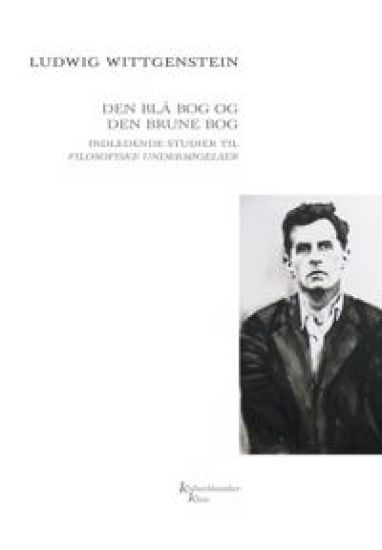
'Den blå og den brune bog' er et sæt forelæsnings-noter, som Wittgenstein dikterede til sine elever i hhv. 1933-34 og 1934-35. Notesbøgerne udkom først i 1958 og er således som alle andre Wittgenstein-udgivelser med undtagelse af Tractatus udgivet posthumt. Teksterne omhandler hovedsageligt sprogfilosofiske problemstillinger, og med udfoldelsen af nøglebegreber som filosofisk grammatik, sprogspil og regelfølge får Wittgensteins filosofi et nyt omdrejningspunkt, der giver et vigtigt fingerpeg i retning af den sene Wittgensteins absolutte hovedværk Filosofiske undersøgelser. Omdrejningspunktet for store dele af 'Den blå bog' er de interne processer i bevidstheden, der ledsager sproget. Sådanne processer er ifølge Wittgenstein en inderlighedens myte, et okkult element, som vi tyer til for at gøre sproget levende og betydningsfuldt. Men da vi i ethvert forsøg på at eksplicitere indholdet af denne proces blot støder på mere sprog, er vi bedre tjent med at frigøre os fra ideen om, at vi kan komme bag om sproget. I 'Den brune bog' kommer sprogspillenes praktiske og forskellig-artede karakter til at fremstå klarere. At lære et sprogspil er her udelukkende et spørgsmål om praktisk træning, analogt til hvordan man træner et dyr til at gøre noget. Vi får således et hint om, hvad der skal forstås ved Wittgensteins berømte formulering “Mening er brug”. Bogen er forsynet med efterskrift af Michael Vernersen, som også har oversat.
Aktueller Stand: 16. Ergänzungslieferung Oktober 2005. Mit der 12. Ergänzungs-Lieferung wurde die Loseblattsammlung (roter Ordner) IDW Prüfungsstandards (IDW PS) IDW Stellungnahmen zur Rechnungslegung (IDW RS) auf zwei Bände erweitert und neu aufgeteilt. Der blaue Ordner Fachgutachten und Stellungnahmen wird aufgelöst und der Inhalt am Schluss von Band II einsortiert. Ein blaues Trennblatt kennzeichnet den Beginn. Den Inhalt des Ordners ? Fachgutachten und Stellungnahmen? können Sie, falls noch nicht vorhanden, beim IDW Verlag nachbestellen. Neuaufteilung der Inhalte: Band I enthält: IDW PS, IDW PH Band II enthält:IDW RS, IDW RH, IDW S, Fachgutachten und Stellungnahmen Im Preis inbegriffen ist die Berechtigung für 12 Monate zur kostenlosen Online-Aktualisierung der CD-ROM mit den aktuell veröffentlichten Prüfungsstandards und Stellungnahmen. Ergänzungslieferungen erscheinen nach Bedarf ein- bis dreimal jährlich. Die Aktualisierung erfolgt über die Ordner "IDW Prüfungsstandards IDW Stellung-nahmen zur Rechnungslegung" Die Fachgutachten und Stellungnahmen sind nun in Band II enthalten.
I denne boka er det språkets faktiske bruk som står i fokus. Gjennom begreper som "regelfølging" og "språkspill" framstiller Wittgenstein sitt syn på språket som en praksissammenheng. Å forstå et begrep innebærer å beherske et språkspill som igjen henger sammen med en livsform.

![Remarks on the Foundation of Mathematics [Bemerkungen Uber Die Grundlagen Der Mathematik]](/covers/9781614276500.jpg)