
Kirjailija
Luigi Pirandello
Kirjat ja teokset yhdessä paikassa: 327 kirjaa, julkaisuja vuosilta 1957–2026, suosituimpiin kuuluu One, None And A Hundred-Thousand(Illustrated). Vertaile teosten hintoja ja tarkista saatavuus suomalaisista kirjakaupoista.
327 kirjaa
Kirjojen julkaisuvuodet: 1957–2026.

Six Characters in Search of an Author (Sei personaggi in cerca d'autore) A Comedy in the Making
Luigi Pirandello
INDOEUROPEANPUBLISHING.COM
2023
pokkari
Luigi Pirandello 28 June 1867 - 10 December 1936) was an Italian dramatist, novelist, and short story writer awarded the Nobel Prize in Literature in 1934, for his "bold and brilliant renovation of the drama and the stage". Pirandello's works include novels, hundreds of short stories, and about 40 plays, some of which are written in Sicilian. Pirandello's tragic farces are often seen as forerunners for Theatre of the Absurd.

One, None and One Hundred Thousand is a 1926 novel by the Italian writer Luigi Pirandello. It is Pirandello's last novel; his son later said that it took "more than 15 years" to write. In an autobiographical letter, published in 1924, the author refers to this work as the "...bitterest of all, profoundly humoristic, about the decomposition of life: Moscarda one, no one and one hundred thousand." The pages of the unfinished novel remained on Pirandello's desk for years and he would occasionally take out extracts and insert them into other works only to return, later, to the novel in a sort of uninterrupted compositive circle. Finally finished, Uno, Nessuno e Centomila came out in episodes between December 1925 and June 1926 in the magazine Fiera Letteraria.
In an autobiographical letter, the author refers to this work as the "...bitterest of all, profoundly humoristic, about the decomposition of life...." Vitangelo, the protagonist, discovers by way of a completely irrelevant question that his wife poses to him that everyone he knows, and everyone he has ever met, has constructed a Vitangelo persona in their own imagination and that none of these personas corresponds to the image of Vitangelo that he himself has constructed and believes himself to be. The reader is immediately immersed in a cruel game of confusing projections, mirroring the reality of social existence itself, which imperiously dictate their rules. As a result, the first, ironic "awareness" of Vitangelo consists in the knowledge of that which he definitely is not; the preliminary operation must therefore consist in the spiteful destruction of all of these fictitious masks.

During his sojourn, the Maestro kept a notebook in which he recorded everything that caught his eye, from the natives' peculiar manners and dialect to the fast-changing scenery on his walks along picturesque trails. These notes and impressions gave way to poems, illustrations, and storylines, all merging into a seemingly experimental text encompassing graphic art, fiction, and autobiography. THE COAZZE NOTEBOOK, as it came to be known, is a compendium of literary criticism, illuminating and emotionally charged personal reflections, vernacular expressions, and sharply observed geographical descriptions. The notes are fragmentary, and occasionally embellished, but they shed light on Pirandello's mode of thought and, in particular, how the ideas he gathered from real life were incorporated into his writing. Literary Nonfiction. Essay. Poetics. Italian Studies. Translation.

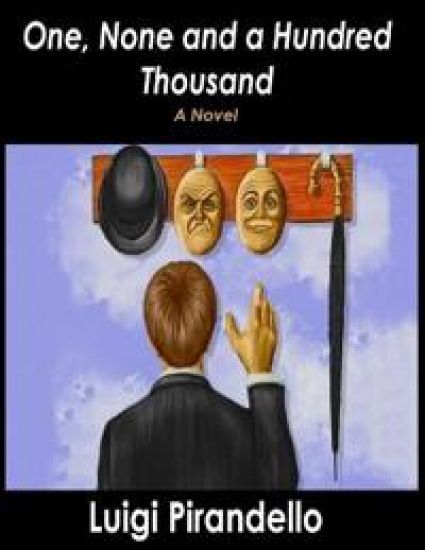
In an autobiographical letter, the author refers to this work as the "...bitterest of all, profoundly humoristic, about the decomposition of life...." Vitangelo, the protagonist, discovers by way of a completely irrelevant question that his wife poses to him that everyone he knows, and everyone he has ever met, has constructed a Vitangelo persona in their own imagination and that none of these personas corresponds to the image of Vitangelo that he himself has constructed and believes himself to be. The reader is immediately immersed in a cruel game of confusing projections, mirroring the reality of social existence itself, which imperiously dictate their rules. As a result, the first, ironic "awareness" of Vitangelo consists in the knowledge of that which he definitely is not; the preliminary operation must therefore consist in the spiteful destruction of all of these fictitious masks.