Kirjailija
Marcus Tullius Cicero
Kirjat ja teokset yhdessä paikassa: 1 147 kirjaa, julkaisuja vuosilta 1804–2026, suosituimpiin kuuluu Keskusteluja Tusculumissa. Vertaile teosten hintoja ja tarkista saatavuus suomalaisista kirjakaupoista.
1 147 kirjaa
Kirjojen julkaisuvuodet: 1804–2026.
Reproduction of the original: Letters of Cicero by Marcus Tullius Cicero
Reproduction of the original: De Amicitia, Scipio s Dream by Marcus Tullius Cicero
Reproduction of the original: Treatises on Friendship and Old Age by Marcus Tullius Cicero
Reproduction of the original: The Orations of Marcus Tullius Cicero by Marcus Tullius Cicero
Select Orations, Chronologically Arr.
Joseph Henry Allen; Marcus Tullius Cicero
Hansebooks
2018
nidottu
M. Tulli Ciceronis Scripta Quae Manserunt Omnia, Volume 1, part 4
Marcus Tullius Cicero; Carl Friedrich Wilhelm Müller; Wilhelm Friedrich
Wentworth Press
2018
sidottu
Die Tuskulanischen Gespräche
Marcus Tullius Cicero; Paul von Boltenstern
Creative Media Partners, LLC
2018
sidottu
M. Tulli Ciceronis Scripta Quae Manserunt Omnia, Volume 3, part 4
Marcus Tullius Cicero; Carl Friedrich Wilhelm Müller; Wilhelm Friedrich
Wentworth Press
2018
sidottu
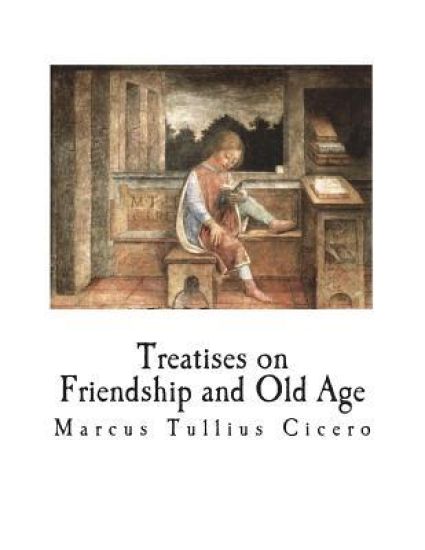
Treatises on Friendship and Old Age
Marcus Tullius Cicero
Createspace Independent Publishing Platform
2018
nidottu
Treatises on Friendship and Old Age by Marcus Tullius Cicero. Translated by E. S. Shuckburgh. MARCUS TULLIUS CICERO, the greatest of Roman orators and the chief master of Latin prose style, was born at Arpinum, Jan. 3, 106 B. C. His father, who was a man of property and belonged to the class of the "Knights," moved to Rome when Cicero was a child; and the future statesman received an elaborate education in rhetoric, law, and philosophy, studying and practising under some of the most noted teachers of the time. He began his career as an advocate at the age of twenty-five, and almost immediately came to be recognized not only as a man of brilliant talents but also as a courageous upholder of justice in the face of grave political danger. After two years of practice he left Rome to travel in Greece and Asia, taking all the opportunities that offered to study his art under distinguished masters. He returned to Rome greatly improved in health and in professional skill, and in 76 B. C. was elected to the office of quaestor. He was assigned to the province of Lilybarum in Sicily, and the vigor and justice of his administration earned him the gratitude of the inhabitants.
The Tusculan Disputations
Marcus Tullius Cicero
Createspace Independent Publishing Platform
2018
nidottu
The Tusculan Disputations by Marcus Tullius Cicero and translated by Charles Duke Yonge. The Tusculanae Disputationes (also Tusculanae Quaestiones; English: Tusculanes or Tusculan Disputations) is a series of five books written by Cicero, around 45 BC, attempting to popularise Greek philosophy in Ancient Rome, including Stoicism. It is so called as it was reportedly written at his villa in Tusculum. In the year 45 BC, when Cicero was around 61 years of age, his daughter, Tullia, died following childbirth. Her loss afflicted Cicero to such a degree that he abandoned all public business and left the city retiring to Asterra, which was a country house that he had near Antium. There he devoted himself to philosophical studies, writing several works, including De Finibus. In the year a.u.c. 708, and the 62d year of Cicero's age, his daughter, Tullia, died in childbed; and her loss afflicted Cicero to such a degree that he abandoned all public business, and, leaving the city, retired to Asterra, which was a country house that he had near Antium; where, after a while, he devoted himself to philosophical studies, and, besides other works, he published his Treatise de Finibus, and also this Treatise called the Tusculan Disputations, of which Middleton gives this concise description: - "The first book teaches us how to contemn the terrors of death, and to look upon it as a blessing rather than an evil; "The second, to support pain and affliction with a manly fortitude; "The third, to appease all our complaints and uneasinesses under the accidents of life; "The fourth, to moderate all our other passions; "And the fifth explains the sufficiency of virtue to make men happy."
Dialogue Sur l'Amitié, Expliqué Littéralement
Marcus Tullius Cicero
Hachette Livre - BNF
2018
pokkari
This comprehensive anthology of Cicero's works contains his Tuscalan Disputations, his treatises on the divine, and the 'De re Publica' - otherwise known as On the Commonwealth. Originally conceived by Cicero as a method of popularising the Stoical form of philosophy to which he subscribed, the Tusculan Disputations explain, in five books on specific topics, the principles and merits of the Stoic outlook on life. The benefits of adopting the Stoical mindset, from a rational, measured reaction to physical pain and illness, to the mental anguish of losing a loved one, are examples of what Cicero explores. Although the Disputations chiefly convey thoughts of other, prior thinkers, they contain Cicero's distinct voice on the subject. Written with the literate clarity and flair which defines the author's body of work, the Disputations persuasively identify, discuss and expound qualities of the philosophy to which Cicero ascribed his mentality in life.