Kirjojen hintavertailu – 12 859 818 kirjaa ja 27 kauppaa

Kirjailija

Michel Serres

Kirjat ja teokset yhdessä paikassa: 50 kirjaa, julkaisuja vuosilta 1987–2027, suosituimpiin kuuluu Was genau war früher besser?. Vertaile teosten hintoja ja tarkista saatavuus suomalaisista kirjakaupoista.

50 kirjaa

Kirjojen julkaisuvuodet: 1987–2027.

The Five Senses

The Five Senses

Michel Serres

Continuum International Publishing Group Ltd.
2008
sidottu
Available for the first time in English! Winner of the Prix Medicis Essai! Marginalized by the scientific age with its metaphysical and philosophical systems, the lessons of the senses have been overtaken by the dominance of language and the information revolution. Exploring the deleterious effects of the systematic downgrading of the senses in Western philosophy, Michel Serres - a member of the Academie Francaise and one of France's leading philosophers - traces a topology of human perception. Writing against the Cartesian tradition and in praise of empiricism, he demonstrates repeatedly, and lyrically, the sterility of systems of knowledge divorced from bodily experience. The fragile empirical world, long resistant to our attempts to contain and catalog it, is disappearing beneath the relentless accumulations of late capitalist society and information technology. Data has replaced sensory pleasure, we are less interested in the taste of a fine wine than in the description on the bottle's label. What are we, and what do we really know, when we have forgotten that our senses can describe a taste more accurately than language ever could?
Aufklärungen

Aufklärungen

Michel Serres; Bruno Latour

Merve Verlag GmbH
2008
nidottu
Bruno Latour unterhält sich in fünf Gesprächen mit Michel Serres über dessen Zugang zur Wissenschaft, die Geschichte der exakten Wissenschaften, die Literatur, die Philosophie, das Ende der Kritik und die Weisheit. Sie behandeln die maßgeblichen Themen der Arbeiten Serres, der sich zu seinem Leitbild die Figur des Hermes ausgewählt hat und sein Denken an den Begriffen Kommunikation, Interferenz, Übersetzung und Distribution entlang entwickelt hat. "Es gibt ein Geheimnis Michel Serres: Sie sind zugleich sehr bekannt und sehr verkannt. Und das obwohl Ihre Bücher technisch gesehen zur Philosophie gehören. Darüber möchte ich gerne Aufklärungen. Sie beschreiten einen Weg, Sie gehen überall hin, in die Wissenschaften, die Mythen, die Literatur und gleichzeitig verwischen Sie oft die Spuren, die Sie zu Ihren Resultaten gebracht haben."
The Troubadour of Knowledge

The Troubadour of Knowledge

Michel Serres

The University of Michigan Press
1997
nidottu
What do we do when we raise a child, teach a student, or educate a person as a member of society? For the French philosopher Michel Serres, all of these forms of pedagogy require painful yet exhilarating departures from home and encounters with Otherness. Like a swimmer who plunges into the river's current to reach the opposite bank, the person who wishes to learn must risk a voyage from the familiar to the strange. True education, Serres writes, takes place in the fluid middle of this crossing. To be educated is to become a harlequin, a crossbreed, a hybrid of our origins--like a newborn child, complexly produced as a mixture of maternal and paternal genes, yet an independent existence, separated from the familiar and determined. In this wide-ranging meditation on learning and difference, Serres--the scientist turned epistemologist, philosopher turned moralist, reveler of being a half-breed from every point of view--explores numerous pathways in philosophy, science, and literature to argue that the best contemporary education requires knowledge of both science's general truths and literature's singular stories. He heralds a new pedagogy which claims that from the crossbreeding of the humanities and the sciences a new educational ideal can be born: the troubadour of knowledge. With his agile and poetic voice, Serres has created a meditation of precisely this pluralistic creation, deftly recognizing it as a third party bred not of orderly dialectics but of the destabilizing multiplicity of the present age. Those who know the enormous range and clarity of this thinker will welcome this latest volume translated into English by Sheila Glaser with the assistance of William Paulson. Michel Serres has taught at Clermont-Ferrand, the University of Paris VIII [Vincennes], the Sorbonne, and Stanford University, and has served as visiting professor at Johns Hopkins University. Other works of his available in English translation include Conversations on Science, Culture, and Time (with Bruno Latour), Genesis, and The Natural Contract, also published by The University of Michigan Press. Sheila Glaser is Reviews Editor of Artforum magazine. William Paulson is Professor of French and Chair of the Department of Romance Languages and Literatures at the University of Michigan.
Genesis

Genesis

Michel Serres

The University of Michigan Press
1997
nidottu
This English translation of Michel Serres' 1982 book Genèse captures in lucid prose the startling breadth and depth of his thinking, as he probes the relations between order, disorder, knowledge, anxiety, and violence. Written in a unique blend of scientific discourse and lyrical outburst, classical philosophical idiom and conversational intimacy, by turns angry, playful, refined or discordant, Genesis is an attempt to think outside of metaphysical categories of unity or rational order and to make us hear--through both its content and form--the "noise," the "sound and the fury," that are the background of life and thought. Serres draws on a vast knowledge of such diverse disciplines as anthropology, classical history, music, theology, art history, information theory, physics, biology, dance and athletics, and Western metaphysics, and a range of cultural material that includes the writings of Plato, Kant, August Comte, Balzac, and Shakespeare, to name a few. He argues that although philosophy has been instrumental in the past in establishing laws of logic and rationality that have been crucial to our understanding of ourselves and our universe, one of the most pressing tasks of thought today is to recognize that such pockets of unity are islands of order in a sea of multiplicity--a sea which cannot really be conceived, but which perhaps can still be sensed, felt, and heard raging in chaos beneath the momentary crests of order imposed by human civilization. Philosophy of science or prose poetry, a classical meditation on metaphysics or a stream-of-consciousness polemic and veiled invective, Serres mounts a quirky, at times rhapsodical, but above all a "noisy" critique of traditional and current models in social theory, historiography, and aesthetics. The result is a work that is at once provocative, poetic, deeply personal, and ultimately religious--an apocalyptic call for the rebirth of philosophy as the art of thinking the unthinkable. About the Book:"An intensely beautiful and rigourous meditation on the birth of forms amid chaos and multiplicity from a major philosopher who is also an exquisite craftsman of the written word." --William Paulson, University of Michigan "Serres exhibits a rare, raw tendentiousness refreshing in its vitriol . . . it's the sort of light-hearted, perverse, and basically liberal tirade one hears too infrequently of late." --Word

Genesis

Genesis

Michel Serres

The University of Michigan Press
1995
sidottu
This English translation of Michel Serres' 1982 book Genèse captures in lucid prose the startling breadth and depth of his thinking, as he probes the relations between order, disorder, knowledge, anxiety, and violence. Written in a unique blend of scientific discourse and lyrical outburst, classical philosophical idiom and conversational intimacy, by turns angry, playful, refined or discordant, Genesis is an attempt to think outside of metaphysical categories of unity or rational order and to make us hear--through both its content and form--the "noise," the "sound and the fury," that are the background of life and thought. Serres draws on a vast knowledge of such diverse disciplines as anthropology, classical history, music, theology, art history, information theory, physics, biology, dance and athletics, and Western metaphysics, and a range of cultural material that includes the writings of Plato, Kant, August Comte, Balzac, and Shakespeare, to name a few. He argues that although philosophy has been instrumental in the past in establishing laws of logic and rationality that have been crucial to our understanding of ourselves and our universe, one of the most pressing tasks of thought today is to recognize that such pockets of unity are islands of order in a sea of multiplicity--a sea which cannot really be conceived, but which perhaps can still be sensed, felt, and heard raging in chaos beneath the momentary crests of order imposed by human civilization. Philosophy of science or prose poetry, a classical meditation on metaphysics or a stream-of-consciousness polemic and veiled invective, Serres mounts a quirky, at times rhapsodical, but above all a "noisy" critique of traditional and current models in social theory, historiography, and aesthetics. The result is a work that is at once provocative, poetic, deeply personal, and ultimately religious--an apocalyptic call for the rebirth of philosophy as the art of thinking the unthinkable. About the Book:"An intensely beautiful and rigourous meditation on the birth of forms amid chaos and multiplicity from a major philosopher who is also an exquisite craftsman of the written word." --William Paulson, University of Michigan "Serres exhibits a rare, raw tendentiousness refreshing in its vitriol . . . it's the sort of light-hearted, perverse, and basically liberal tirade one hears too infrequently of late." --Word

The Natural Contract

The Natural Contract

Michel Serres

The University of Michigan Press
1995
nidottu

Halvin toimitettuna 31,10 €

Global environmental change, argues Michel Serres, has forced us to reconsider our relationship to nature. In this translation of his influential 1990 book Le Contrat Naturel, Serres calls for a natural contract to be negotiated between Earth and its inhabitants. World history is often referred to as the story of human conflict. Those struggles that are seen as our history must now include the uncontrolled violence that humanity perpetrates upon the earth, and the uncontrollable menace to human life posed by the earth in reaction to this violence. Just as a social contract once brought order to human relations, Serres believes that we must now sign a "natural contract" with the earth to bring balance and reciprocity to our relations with the planet that gives us life. Our survival depends on the extent to which humans join together and act globally, on an earth now conceived as an entity. Tracing the ancient beginnings of modernity, Serres examines the origins and possibilities of a natural contract through an extended meditation on the contractual foundations of law and science. By invoking a nonhuman, physical world, Serres asserts, science frees us from the oppressive confines of a purely social existence, but threatens to become a totalitarian order in its own right. The new legislator of the natural contract must bring science and law into balance. Serres ends his meditation by retelling the story of the natural contract as a series of parables. He sees humanity as a spacecraft that with the help of science and technology has cast off from familiar moorings. In place of the ties that modernity and analytic reason have severed, we find a network of relations both stranger and stronger than any we once knew, binding us to one another and to the world. The philosopher's harrowing and joyous task, Serres tells us, is that of comprehending and experiencing the bonds of violence and love that unite us in our spacewalk to the spaceship Mother Earth. "Wise, rich and poetic . . . not simply a philosophical study of the Environment, or an ecological questioning of Philosophy . . . Nature is acknowledged as an inside force which breaks [the philosopher's] discourse, and opens it up to a vigilant poetic meditation."--Substance: A Review of Theory and Literary Criticism
The Natural Contract

The Natural Contract

Michel Serres

The University of Michigan Press
1995
sidottu
Global environmental change, argues Michel Serres, has forced us to reconsider our relationship to nature. In this translation of his influential 1990 book Le Contrat Naturel , Serres calls for a natural contract to be negotiated between Earth and its inhabitants. World history is often referred to as the story of human conflict. Those struggles that are seen as our history must now include the uncontrolled violence that humanity perpetrates upon the earth, and the uncontrollable menace to human life posed by the earth in reaction to this violence. Just as a social contract once brought order to human relations, Serres believes that we must now sign a ""natural contract"" with the earth to bring balance and reciprocity to our relations with the planet that gives us life. Our survival depends on the extent to which humans join together and act globally, on an earth now conceived as an entity. Tracing the ancient beginnings of modernity, Serres examines the origins and possibilities of a natural contract through an extended meditation on the contractual foundations of law and science. By invoking a nonhuman, physical world, Serres asserts, science frees us from the oppressive confines of a purely social existence, but threatens to become a totalitarian order in its own right. The new legislator of the natural contract must bring science and law into balance. Serres ends his meditation by retelling the story of the natural contract as a series of parables. He sees humanity as a spacecraft that with the help of science and technology has cast off from familiar moorings. In place of the ties that modernity and analytic reason have severed, we find a network of relations both stranger and stronger than any we once knew, binding us to one another and to the world. The philosopher's harrowing and joyous task, Serres tells us, is that of comprehending and experiencing the bonds of violence and love that unite us in our spacewalk to the spaceship Mother Earth. ""Wise, rich and poetic . . . not simply a philosophical study of the Environment, or an ecological questioning of Philosophy . . . Nature is acknowledged as an inside force which breaks [the philosopher's] discourse, and opens it up to a vigilant poetic meditation.""--Substance: A Review of Theory and Literary Criticism
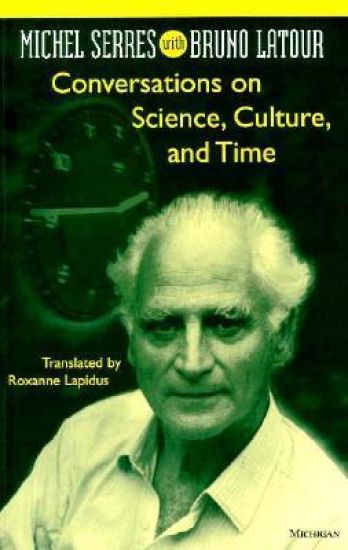
Conversations on Science, Culture, and Time

Conversations on Science, Culture, and Time

Michel Serres

The University of Michigan Press
1995
nidottu
Although elected to the prestigious French Academy in 1990, Michel Serres has long been considered a maverick--a provocative thinker whose prolific writings on culture, science and philosophy have often baffled more than they have enlightened. In these five lively interviews with sociologist Bruno Latour, this increasingly important cultural figure sheds light on the ideas that inspire his highly original, challenging, and transdisciplinary essays. Serres begins by discussing the intellectual context and historical events-- including the impact of World War II and Hiroshima, which for him marked the beginning of science's ascendancy over the humanities--that shaped his own philosophical outlook and led him to his lifelong mission of bringing together the texts of the humanities and the conceptual revolutions of modern science. He then confronts the major difficulties encountered by his readers: his methodology, his mathematician's fondness for "shortcuts" in argument, and his criteria for juxtaposing disparate elements from different epochs and cultures in extraordinary combinations. Finally, he discusses his ethic for the modern age--a time when scientific advances have replaced the natural necessities of disease and disaster with humankind's frightening new responsibility for vital things formerly beyond its control. In the course of these conversations Serres revisits and illuminates many of his themes: the chaotic nature of knowledge, the need for connections between science and the humanities, the futility of traditional criticism, and what he calls his "philosophy of prepositions"--an argument for considering prepositions, rather than the conventionally emphasized verbs and substantives, as the linguistic keys to understanding human interactions. For readers familiar with Serres's works as well as for the uninitiated, Conversations on a Life in Philosophy provides fascinating insights into the mind of this appealing, innovative and ardent thinker. Michel Serres has taught at Clermont-Ferrand, at the University of Paris VIII (Vincennes) and at the Sorbonne. He has served as visiting professor at Johns Hopkins University and has been on the faculty of Stanford University since 1984. Bruno Latour, a philosopher and anthropologist, is Professor of Sociology, L'Ecole Nationale Supérieure des Mines in Paris. He has written several books and numerous articles on the ties between the sciences and the rest of culture and society. Roxanne Lapidus is Managing Editor of SubStance: A Review of Theory and Literary Criticism. Conversations on a Life in Philosophy was originally published in France as Eclaircissements.