Kirjojen hintavertailu – 12 903 725 kirjaa ja 27 kauppaa

Kirjailija

National Academy of Sciences

Kirjat ja teokset yhdessä paikassa: 68 kirjaa, julkaisuja vuosilta 1974–2014, suosituimpiin kuuluu A Positron Named Priscilla. Vertaile teosten hintoja ja tarkista saatavuus suomalaisista kirjakaupoista.

68 kirjaa

Kirjojen julkaisuvuodet: 1974–2014.

A Positron Named Priscilla

A Positron Named Priscilla

National Academy of Sciences; Anne Simon Moffat; Elizabeth J. Maggio; David Holzman; Michelle Hoffman; T.A. Heppenheimer; Addison Greenwood; Andrew Chaikin; Barbara Burke; Marcia F. Bartusiak

National Academies Press
1994
sidottu
A Positron Named Priscilla is a book of wonder, offering a fascinating, readable overview of cutting-edge investigations by many of today's leading young scientists. Written for anyone who loves science, this volume reports on some of the most exciting recent discoveries and advances in fields from astronomy to molecular biology. This new book is from one of the world's most prestigious scientific institutions, the National Academy of Sciences. The Academy provides an annual forum for the brightest young investigators to exchange ideas across disciplines—an exchange that was the spark for A Positron Named Priscilla. Each chapter is authored by a popular science writer who offers helpful historical perspectives, clear and well-illustrated explanations of current scientific thinking, and previews of future developments. The scope of topics and breadth of discussion ensure interest at all levels. Topics include: Planetary science and the compelling glimpse through the clouded atmosphere of Venus afforded by the spacecraft Magellan. Astrophysics and the emergence of helioseismology, a new field that allows researchers to probe the interior workings of the sun. Biology and what we have learned about DNA in the 40 years since its discovery; our current understanding of protein molecules, the "building blocks" of living systems; and the high-tech search for answers to the AIDS epidemic. Physics and our new-found ability to move and manipulate individual atoms on a surface. The book also tells the remarkable story of "buckyballs," or buckminsterfullerenes, a form of carbon discovered only a few years ago, that have the potential to be used in a variety of important applications, from superconductivity to nanotechnology. Mathematics and the rise of "wavelet" theory, and how mathematicians are applying it in sometimes startling ways, from assisting the FBI with fingerprint storage to coaxing the secrets from a battered recording of Brahms playing the piano. Geosciences and the search for "clocks in the earth" to make life-saving earthquake predictions. A Positron Named Priscilla is a "must" read for anyone who wants to keep up with a broad range of scientific endeavor. Table of Contents Front Matter A Positron Named Priscilla 1 Shake, Rattle, and Shine: New Methods of Probing the Sun 2 A Positron Named Priscilla: Trapping and Manipulating Atoms 3 AIDS: Solving the Molecular Puzzle 4 Doubling Up: How the Genetic Code Replicates Itself 5 Magellan 6 Clocks in the Earth? The Science of Earthquake Prediction 7 The Mathematical Microscope: Waves, Wavelets, and Beyond 8 A Family Affair: The Top Quark and the Higgs Particle 9 Bouncing Balls of Carbon: The Discovery and Promise of Fullerences 10 Fold, Spindle, and Regulate: How Proteins Work Appendix A: Abstracts of Additional Sessions of the Frontiers of Science of Science Symposia Appendix B: Symposia Programs Appendix C: About the Authors Index
In the Light of Evolution

In the Light of Evolution

National Academy of Sciences

National Academies Press
2014
sidottu
Humans possess certain unique mental traits. Self-reflection, as well as ethic and aesthetic values, is among them, constituting an essential part of what we call the human condition. The human mental machinery led our species to have a self-awareness but, at the same time, a sense of justice, willing to punish unfair actions even if the consequences of such outrages harm our own interests. Also, we appreciate searching for novelties, listening to music, viewing beautiful pictures, or living in well-designed houses. But why is this so? What is the meaning of our tendency, among other particularities, to defend and share values, to evaluate the rectitude of our actions and the beauty of our surroundings? What brain mechanisms correlate with the human capacity to maintain inner speech, or to carry out judgments of value? To what extent are they different from other primates' equivalent behaviors? In the Light of Evolution Volume VII aims to survey what has been learned about the human "mental machinery." This book is a collection of colloquium papers from the Arthur M. Sackler Colloquium "The Human Mental Machinery," which was sponsored by the National Academy of Sciences on January 11-12, 2013. The colloquium brought together leading scientists who have worked on brain and mental traits. Their 16 contributions focus the objective of better understanding human brain processes, their evolution, and their eventual shared mechanisms with other animals. The articles are grouped into three primary sections: current study of the mind-brain relationships; the primate evolutionary continuity; and the human difference: from ethics to aesthetics. This book offers fresh perspectives coming from interdisciplinary approaches that open new research fields and constitute the state of the art in some important aspects of the mind-brain relationships. Table of ContentsFront MatterPart I: CURRENT STUDY OF THE MINDBRAIN RELATIONSHIPS1 Theory of Mind and Darwin's Legacy--John Searle2 Affiliation, Empathy, and the Origins of Theory of Mind--Robert M. Seyfarth and Dorothy L. Cheney3 Evolution of Consciousness: Phylogeny, Ontogeny, and Emergence from General Anesthesia--George A. Mashour and Michael T. AlkirePart II: THE PRIMATE EVOLUTIONARY CONTINUITY4 Similarity in Form and Function of the Hippocampus in Rodents, Monkeys, and Humans--Robert E. Clark and Larry R. Squire5 Evolution of Working Memory--Peter Carruthers6 The Evolution of Episodic Memory--Timothy A. Allen and Norbert J. Fortin7 Neuroethology of Primate Social Behavior--Steve W. C. Chang, Lauren J. N. Brent, Geoffrey K. Adams, Jeffrey T. Klein, John M. Pearson, Karli K. Watson, and Michael L. Platt8 Synaptogenesis and Development of Pyramidal Neuron Dendritic Morphology in the Chimpanzee Neocortex Resembles Humans--Serena Bianchi, Cheryl D. Stimpson, Tetyana Duka, Michael D. Larsen, William G. M. Janssen, Zachary Collins, Amy L. Bauernfeind, Steven J. Schapiro, Wallace B. Baze, Mark J. McArthur, William D. Hopkins, Derek E. Wildman, Leonard Lipovich, Christopher W. Kuzawa, Bob Jacobs, Patrick R. Hof, and Chet C. SherwoodPart III: THE HUMAN DIFFERENCE: FROM ETHICS TO AESTHETICS9 Making Lasting Memories: Remembering the Significant--James L. McGaugh10 Concepts and Implications of Altruism Bias and Pathological Altruism--Barbara A. Oakley11 Justice- and Fairness-Related Behaviors in Nonhuman Primates--Sarah F. Brosnan12 Powering Up with Indirect Reciprocity in a Large-Scale Field Experiment--Erez Yoeli, Moshe Hoffman, David G. Rand, and Martin A. Nowak13 From Perception to Pleasure: Music and Its Neural Substrates--Robert J. Zatorre and Valorie N. Salimpoor14 Learning Where to Look for a Hidden Target--Leanne Chukoskie, Joseph Snider, Michael C. Mozer, Richard J. Krauzlis, and Terrence J. Sejnowski15 Impact of Contour on Aesthetic Judgments and Approach-Avoidance Decisions in Architecture-Oshin Vartanian, Gorka Navarrete, Anjan Chatterjee, Lars Brorson Fich, Helmut Leder, Cristin Modroo, Marcos Nadal, Nicolai Rostrup, and Martin Skov16 Dynamics of Brain Networks in the Aesthetic Appreciation--Camilo J. Cela-Conde, Juan Garca-Prieto, Jos J. Ramasco, Claudio R. Mirasso, Ricardo Bajo, Enric Munar, Albert Flexas, Francisco del-Pozo, and Fernando MaestReferencesIndex
In the Light of Evolution

In the Light of Evolution

National Academy of Sciences

National Academies Press
2010
sidottu
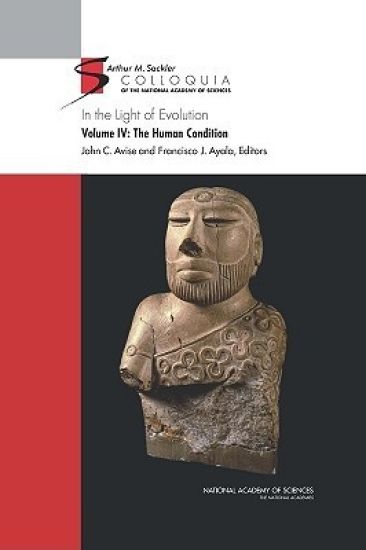
The Human Condition is a collection of papers by leading evolutionary biologists and philosophers of science that reflect on the Darwinian Revolution as it relates to the human condition at levels ranging from the molecular to the theological. The book focuses on understanding the evolutionary origin of humans and their biological and cultural traits. The Human Condition is organized into three parts: Human Phylogenetic History and the Paleontological Record; Structure and Function of the Human Genome; and Cultural Evolution and the Uniqueness of Being Human. This fourth volume from the In the Light of Evolution (ILE) series, based on a series of Arthur M. Sackler colloquia, was designed to promote the evolutionary sciences. Each volume explores evolutionary perspectives on a particular biological topic that is scientifically intriguing but also has special relevance to contemporary societal issues or challenges. Individually and collectively, the ILE series interprets phenomena in various areas of biology through the lens of evolution, addresses some of the most intellectually engaging as well as pragmatically important societal issues of our times, and fosters a greater appreciation of evolutionary biology as a consolidating foundation for the life sciences. Table of ContentsFront MatterPART I: HUMAN PHYLOGENETIC HISTORY AND THE PALEONTOLOGICAL RECORD1 Reconstructing Human Evolution: Achievements, Challenges, and Opportunities--Bernard Wood 2 Terrestrial Apes and Phylogenetic Trees--Juan Luis Arsuaga 3 Phylogenomic Evidence of Adaptive Evolution in the Ancestry of Humans-Morris Goodman and Kirstin N. Sterner 4 Human Adaptations to Diet, Subsistence, and Ecoregion Are Due to Subtle Shifts in Allele Frequency--Angela M. Hancock, David B. Witonsky, Edvard Ehler, Gorka Alkorta-Aranburu, Cynthia Beall, Amha Gebremedhin, Rem Sukernik, Gerd Utermann, Jonathan Pritchard, Graham Coop, and Anna Di Rienzo 5 Working Toward a Synthesis of Archaeological, Linguistic, and Genetic Data for Inferring African Population History--Laura B. Scheinfeldt, Sameer Soi, and Sarah A. Tishkoff PART II: STRUCTURE AND FUNCTION OF THE HUMAN GENOME6 Uniquely Human Evolution of Sialic Acid Genetics and Biology--Ajit Varki 7 Bioenergetics, the Origins of Complexity, and the Ascent of Man-Douglas C. Wallace 8 Genome-wide Patterns of Population Structure and Admixture Among Hispanic/Latino Populations--Katarzyna Bryc, Christopher Velez, Tatiana Karafet, Andres Moreno-Estrada, Andy Reynolds, Adam Auton, Michael Hammer, Carlos D. Bustamante, and Harry Ostrer9 Human Skin Pigmentation as an Adaptation to UV Radiation--Nina G. Jablonski and George Chaplin 10 Footprints of Nonsentient Design Inside the Human Genome--John C. Avise PART III: CULTURAL EVOLUTION AND THE UNIQUENESS OF BEING HUMAN11 How Grandmother Effects Plus Individual Variation in Frailty Shape Fertility and Mortality: Guidance from Human-Chimpanzee Comparisons--Kristen Hawkes 12 Gene–Culture Coevolution in the Age of Genomics--Peter J. Richerson, Robert Boyd, and Joseph Henrich 13 The Cognitive Niche: Coevolution of Intelligence, Sociality, and Language--Steven Pinker 14 A Role for Relaxed Selection in the Evolution of the Language Capacity--Terrence W. Deacon 15 Adaptive Specializations, Social Exchange, and the Evolution of Human Intelligence--Leda Cosmides, H. Clark Barrett, and John Tooby 16 The Difference of Being Human: Morality--Francisco J. Ayala ReferencesIndex
In the Light of Evolution

In the Light of Evolution

National Academy of Sciences

National Academies Press
2009
sidottu
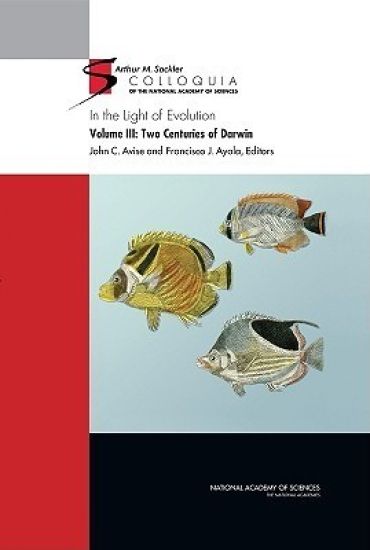
Two Centuries of Darwin is the outgrowth of an Arthur M. Sackler Colloquium, sponsored by the National Academy of Sciences on January 16-17, 2009. In the chapters of this book, leading evolutionary biologists and science historians reflect on and commemorate the Darwinian Revolution. They canvass modern research approaches and current scientific thought on each of the three main categories of selection (natural, artificial, and sexual) that Darwin addressed during his career. Although Darwin's legacy is associated primarily with the illumination of natural selection in The Origin, he also contemplated and wrote extensively about what we now term artificial selection and sexual selection. In a concluding section of this book, several science historians comment on Darwin's seminal contributions. Two Centuries of Darwin is the third book of the In the Light of Evolution series. Each installment in the series explores evolutionary perspectives on a particular biological topic that is scientifically intriguing but also has special relevance to contemporary societal issues or challenges. The ILE series aims to interpret phenomena in various areas of biology through the lens of evolution and address some of the most intellectually engaging, as well as pragmatically important societal issues of our times. Table of ContentsFront MatterPart I: NATURAL SELECTION, OR ADAPTATION TO NATURE1 Natural Selection inAction During Speciation--Sara Via2 Adaptive Radiations:From Field to Genomic Studies--Scott A. Hodges and Nathan J. Derieg3 Genetics and Ecological Speciation--Dolph Schluter and Gina L. Conte4 Cascades of Convergent Evolution: The Corresponding Evolutionary Histories of Euglenozoans and Dinoflagellates--Julius Lukeš, Brian S. Leander, and Patrick J. Keeling Part II: ARTIFICIAL SELECTION, OR ADAPTATION TO HUMAN DEMANDS5 From Wild Animals to Domestic Pets, an Evolutionary View of Domestication--Carlos A. Driscoll, David W. Macdonald, and Stephen J. O'Brien6 Tracking Footprints of Maize Domestication and Evidence for a Massive Selective Sweep on Chromosome 10--Feng Tian, Natalie M. Stevens, and Edward S. Buckler IV7 Human-Induced Evolution Caused by Unnatural Selection Through Harvest of Wild Animals--Fred W. Allendorf and Jeffrey J. Hard8 In the Light of Directed Evolution: Pathways of Adaptive Protein Evolution--Jesse D. Bloom and Frances H. ArnoldPart III: SEXUAL SELECTION, OR ADAPTATION TO MATING DEMANDS9 Mate Choice and Sexual Selection: What Have We Learned Since Darwin?--Adam G. Jones and Nicholas L. Ratterman10 Sexual Selection and Mating Systems--Stephen M. Shuster11 Reproductive Decisions Under Ecological Constraints: It's About Time--Patricia Adair Gowaty and Stephen P. Hubbell12 Postcopulatory Sexual Selection: Darwin's Omission and Its Consequences--William G. EberhardPart IV: THE DARWINIAN LEGACY, 150 YEARS LATER13 Darwin and the Scientific Method--Francisco J. Ayala14 The Darwinian Revolution: Rethinking Its Meaningand Significance--Michael Ruse15 Did Darwin Write *the Origin* Backwards?--Elliott Sober16 Darwin's Place in the History of Thought: A Reevaluation--Robert J. Richards17 Darwin's "Strange Inversion of Reasoning"--Daniel DennettReferencesIndex
Biographical Memoirs

Biographical Memoirs

National Academy of Sciences

National Academies Press
2009
sidottu
Biographic Memoirs Volume 91 contains the biographies of deceased members of the National Academy of Sciences and bibliographies of their published works. Each biographical essay was written by a member of the Academy familiar with the professional career of the deceased. For historical and bibliographical purposes, these volumes are worth returning to time and again. Table of ContentsFront MatterWILLIAM FOXWELL ALBRIGHTHANS ALBRECHT BETHECHANDLER McCUSKEY BROOKSHERBERT CHARLES BROWNGLENN WILLARD BURTONPETER ELIASSTANLEY MARION GARNNORMAN HENRY GILESCLYDE ALLEN HUTCHISON JR. KONRAD BATES KRAUSKOPFHERMANN JOSEPH MULLERDAVID DEXTER PERKINSCLIFFORD LADD PROSSERTHEODORE THOMAS PUCKPAUL KARL STUMPFCHAUNCEY GUY SUITSROGER JOHN WILLIAMSSHANG FA YANGVERNON ROBERT YOUNGBRUNO HASBROUCK ZIMM
Biographical Memoirs

Biographical Memoirs

National Academy of Sciences

National Academies Press
2009
sidottu
Biographic Memoirs Volume 90 contains the biographies of deceased members of the National Academy of Sciences and bibliographies of their published works. Each biographical essay was written by a member of the Academy familiar with the professional career of the deceased. For historical and bibliographical purposes, these volumes are worth returning to time and again. Table of ContentsFront MatterGERALD DONALD AURBACHHORACE WELCOME BABCOCKBRYCE SELIGMAN DEWITTWILLIAM FELLERJOHN DOUGLASS FERRYGEORGE McCLELLAND FOSTER JR. JOSEPH HAROLD GREENBERGJAMES BENNETT GRIFFINMALCOLM ROBERT IRWINMARIAN ELLIOTT KOSHLANDHENRY SHERWOOD LAWRENCEEDWARD CRAIG MORRISGEORGE CLAUDE PIMENTELBENJAMIN IRVING ROUSEJULIAN SCHWINGERLYMAN SPITZER JR. JULIUS ADAMS STRATTONIGOR TAMMEDWARD TELLERANTHONY L. TURKEVICH
In the Light of Evolution

In the Light of Evolution

National Academy of Sciences

National Academies Press
2009
sidottu
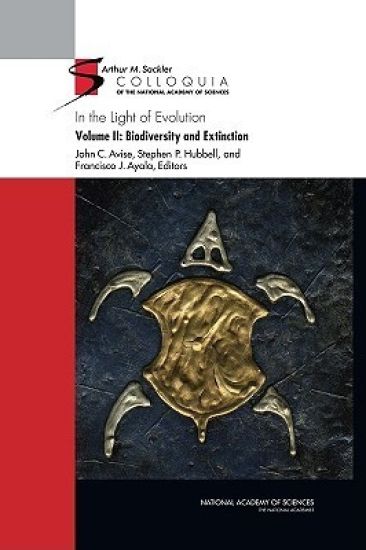
The current extinction crisis is of human making, and any favorable resolution of that biodiversity crisis—among the most dire in the 4-billion-year history of Earth—will have to be initiated by mankind. Little time remains for the public, corporations, and governments to awaken to the magnitude of what is at stake. This book aims to assist that critical educational mission, synthesizing recent scientific information and ideas about threats to biodiversity in the past, present, and projected future. This is the second volume from the In the Light of Evolution series, based on a series of Arthur M. Sackler colloquia, and designed to promote the evolutionary sciences. Each installment explores evolutionary perspectives on a particular biological topic that is scientifically intriguing but also has special relevance to contemporary societal issues or challenges. Individually and collectively, the ILE series aims to interpret phenomena in various areas of biology through the lens of evolution, address some of the most intellectually engaging as well as pragmatically important societal issues of our times, and foster a greater appreciation of evolutionary biology as a consolidating foundation for the life sciences. Table of ContentsFront MatterPart I: Contemporary Patterns and Processes in Animals1 Ecological Extinction and Evolution in the Brave New Ocean--JEREMY B. C. JACKSON2 Are We in the Midst of the Sixth Mass Extinction? A View from the World of Amphibians--DAVID B. WAKE and VANCE T. VREDENBURG3 Patterns of Biodiversity and Endemism on Indo-West Pacific Coral Reefs--MARJORIE L. REAKA, PAULA J. RODGERS, and ALEXEI U. KUDLA4 Homage to Linnaeus: How Many Parasites? How Many Hosts?--ANDY DOBSON, KEVIN D. LAFFERTY, ARMAND M. KURIS, RYAN F. HECHINGER, and WALTER JETZPart II: Contemporary Patterns and Processes in Plants and Microbes5 Species Invasions and Extinction: The Future of Native Biodiversity on Islands--DOV F. SAX and STEVEN D. GAINES6 How Many Tree Species Are There in the Amazon and How Many of Them Will Go Extinct?--STEPHEN P. HUBBELL, FANGLIANG HE, RICHARD CONDIT, LUIS BORDA-DE-ÁGUA, JAMES KELLNER, and HANS TER STEEGE7 Microbes on Mountainsides: Contrasting Elevational Patterns of Bacterial and Plant Diversity--JESSICA A. BRYANT, CHRISTINE LAMANNA, HÉLÈNE MORLON, ANDREW J. KERKHOFF, BRIAN J. ENQUIST, and JESSICA L. GREEN8 Resistance, Resilience, and Redundancy in Microbial Communities--STEVEN D. ALLISON and JENNIFER B. H. MARTINYPart III: Trends and Processes in the Paleontological Past9 Extinction as the Loss of Evolutionary History--DOUGLAS H. ERWIN10 Extinction and the Spatial Dynamics of Biodiversity--DAVID JABLONSKI11 Dynamics of Origination and Extinction in the Marine Fossil Record--JOHN ALROY12 Megafauna Biomass Tradeoff as a Driver of Quaternary and Future Extinctions--ANTHONY D. BARNOSKYPart IV: Prospects for the Future13 A Phylogenetic Perspective on the Distribution of Plant Diversity--MICHAEL J. DONOGHUE14 Phylogenetic Trees and the Future of Mammalian Biodiversity--T. JONATHAN DAVIES, SUSANNE A. FRITZ, RICHARD GRENYER, C. DAVID L. ORME, JON BIELBY, OLAF R. P. BININDA-EMONDS, MARCEL CARDILLO, KATE E. JONES, JOHN L. GITTLEMAN, GEORGINA M. MACE, and ANDY PURVIS15 Three Ambitious (and Rather Unorthodox) Assignments for the Field of Biodiversity Genetics--JOHN C. AVISE16 Engaging the Public in Biodiversity Issues--MICHAEL J. NOVACEK17 Further Engaging the Public on Biodiversity Issues--PETER J. BRYANT18 Where Does Biodiversity Go from Here? A Grim Business-as-Usual Forecast and a Hopeful Portfolio of Partial Solutions--PAUL R. EHRLICH and ROBERT M. PRINGLEReferencesIndex
Biographical Memoirs

Biographical Memoirs

National Academy of Sciences

National Academies Press
2008
sidottu
On March 3, 1863, Abraham Lincoln signed the Act of Incorporation that brought the National Academy of Sciences into being. In accordance with that original charter, the Academy is a private, honorary organization of scientists, elected for outstanding contributions to knowledge, who can be called upon to advise the federal government. As an institution the Academy's goal is to work toward increasing scientific knowledge and to further the use of that knowledge for the general good. The Biographical Memoirs, begun in 1877, are a series of volumes containing the life histories and selected bibliographies of deceased members of the Academy. Colleagues familiar with the discipline and the subject's work prepare the essays. These volumes, then, contain a record of the life and work of our most distinguished leaders in the sciences, as witnessed and interpreted by their colleagues and peers. They form a biographical history of science in America—an important part of our nation's contribution to the intellectual heritage of the world. Table of Contents Front Matter ROBERT WAYNE ALLARD ROBERT JOHN BRAIDWOOD HARMON CRAIG GEORGE KELSO DAVIS VINCENT GASTON DETHIER WALTER GORDY KENNETH LOCKE HALE CHARLES F. HOCKETT HENRY M. HOENIGSWALD WILLIAM WHITE HOWELLS HENRY G. KUNKEL HALLAM LEONARD MOVIUS JR. WILLIAM DUWAYNE NEFF DONALD OSCAR PEDERSON JAMES MATHER SPRAGUE OWSEI TEMKIN JOHN GORDON TORREY JEROME VINOGRAD AARON CLEMENT WATERS FRED LAWRENCE WHIPPLE
Biographical Memoirs

Biographical Memoirs

National Academy of Sciences

National Academies Press
2007
sidottu
Biographic Memoirs Volume 88 contains the biographies of deceased members of the National Academy of Sciences and bibliographies of their published works. Each biographical essay was written by a member of the Academy familiar with the professional career of the deceased. For historical and bibliographical purposes, these volumes are worth returning to time and again. Table of ContentsFront MatterHenry Nathaniel Andrews, Jr. Stanley Arthur Barber David Mahlon BonnerCharles Stacy FrenchHerbert FriedmanEdward Leonard GinztonThomas Gold Herbert Sander GutowskyVladimir HaenselJames Daniel HardyCharles Glen KingJohn I. LaceyFritz Albert LipmannFrancis Daniels MooreWalle J. H. NautaCharles Norwood ReilleyFrederick C. Robbins Richard Evans Schultes Thomas Dale Stewart Vladimir Kosma Zworykin
Engineering Studies at Tribal Colleges and Universities

Engineering Studies at Tribal Colleges and Universities

National Academy of Sciences

National Academies Press
2006
nidottu
This study was designed to provide expert, objective, independent advice to 11 tribal colleges that are working together to offer engineering programs. The chief data-gathering activity was a one and one-half day workshop. Reasons for establishing a four-year engineering program at a TCU were outlined in the workshopa "making it possible for American Indian students to complete a four-year engineering degree entirely within the tribal college system; reducing the high attrition rate of American Indian students who attend mainstream educational institutions; and providing an engineering program that is culturally relevant to tribal students.
Biographical Memoirs

Biographical Memoirs

National Academy of Sciences

National Academies Press
2006
sidottu
Biographic Memoirs Volume 87 contains the biographies of deceased members of the National Academy of Sciences and bibliographies of their published works. Each biographical essay was written by a member of the Academy familiar with the professional career of the deceased. For historical and bibliographical purposes, these volumes are worth returning to time and again. Table of ContentsFront MatterLars Valerian AhlforsGabriel A. AlmondThomas Foxen AndersonJulius AxelrodElso Sterrenberg Barghoorn, Jr. Herman Samuel BlochJoseph W. ChamberlainAnsley J. CoaleDonald Shard FredricksonJames Hall, Jr. Zellig Sabbatai HarrisHarold HotellingMartin Glover LarrabeeMelvin LaxLeonard MandelRichard Drummong McKelveyEugene Pleasants OdumHarrison ShullHans E. SuessRaymond Elliott Zirkle
Biographical Memoirs

Biographical Memoirs

National Academy of Sciences

National Academies Press
2005
nidottu
Biographic Memoirs Volume 86 contains the biographies of deceased members of the National Academy of Sciences and bibliographies of their published works. Each biographical essay was written by a member of the Academy familiar with the professional career of the deceased. For historical and bibliographical purposes, these volumes are worth returning to time and again. Table of Contents Front Matter Lawrence Hugh Aller Harry Beevers Frank Alden Bovey Norman Davidson Harry George Drickamer Harold Eugene Edgerton Howard E. Evans Willis H. Flygare Jesse Leonard Greenstein Donald R. Griffin Wassily Hoeffding D. Gale Johnson Robert Thomas Jones Norman Carl Rasmussen Glenn Wade Salisbury William Rees Sears Folke Karl Skoog Hiroshi Tamiya Evon Zartman Vogt, Jr. Robert M. Walker
Biographical Memoirs

Biographical Memoirs

National Academy of Sciences

National Academies Press
2005
nidottu
Biographic Memoirs Volume 85 contains the biographies of deceased members of the National Academy of Sciences and bibliographies of their published works. Each biographical essay was written by a member of the Academy familiar with the professional career of the deceased. For historical and bibliographical purposes, these volumes are worth returning to time and again. Table of Contents Front Matter D. Bernard Amos Peter Michael Blau Salomon Bochner C. Chapin Cutler John Raven Johnson Elvin A. Kabat Berwind Petersen Kaufmann Robert Alfred Laudise Boyce Dawkins McDaniel William David McElroy Edwin Theodore Mertz William Aaron Nierenberg Chaim Leib Pekeris John Robinson Pierce John H. Reynolds Louis Byrne Slichter George Ledyard Stebbins Lewis Thomas Albert Edward Whitford Walter Henry Zinn
Biographical Memoirs

Biographical Memoirs

National Academy of Sciences

National Academies Press
2004
sidottu
Biographic Memoirs Volume 84 contains the biographies of deceased members of the National Academy of Sciences and bibliographies of their published works. Each biographical essay was written by a member of the Academy familiar with the professional career of the deceased. For historical and bibliographical purposes, these volumes are worth returning to time and again. Table of Contents Front Matter H. A. BARKER ABRAM BERGSON ROBERT M. BERNE GERHARD LUDWIG CLOSS SIDNEY DARLINGTON ROBERT R. GILRUTH DAVID EZRA GREEN ERNEST GRUNWALD WILLIAM REDINGTON HEWLETT JAMES GERALD HIRSCH VERNON WILLARD HUGHES GORDON JAMES FRASER MACDONALD HORACE WINCHELL MAGOUN SANFORD LOUIS PALAY KENNETH LEE PIKE CHARLES MADERA RICK ROBERT GREEN SACHS SHERWOOD LARNED WASHBURN VICTOR FREDERICK WEISSKOPF GORDON RANDOLPH WILLEY
Biographical Memoirs

Biographical Memoirs

National Academy of Sciences

National Academies Press
2003
sidottu
Biographic Memoirs Volume 83 contains the biographies of deceased members of the National Academy of Sciences and bibliographies of their published works. Each biographical essay was written by a member of the Academy familiar with the professional career of the deceased. For historical and bibliographical purposes, these volumes are worth returning to time and again. Table of Contents Front Matter J. Desmond Clark Leopoldo Maximo Falicov Harold P. Furth Homer Dupre Hagstrum Symour S. Kety Edward F. Knipling Heinz Adolf Lowenstam Clement Lawrence Markert Peter Meyer Alfred Nisonoff Sherwin Rosen Arthur Schawlow Charles Gald Sibley Joseph Slepian George Davis Snell Sidney Udenfriend Warren H. Wagner, Jr. Selman Abraham Waksman Abel Wolman Jeffries Wyman