Kirjojen hintavertailu – 12 903 724 kirjaa ja 27 kauppaa

Kirjailija

Office of Air Force History

Kirjat ja teokset yhdessä paikassa: 219 kirjaa, julkaisuja vuosilta 1983–2015, suosituimpiin kuuluu Pearl to V-J Day: World War II in the Pacific. Vertaile teosten hintoja ja tarkista saatavuus suomalaisista kirjakaupoista.

219 kirjaa

Kirjojen julkaisuvuodet: 1983–2015.

Aircraft Nuclear Propulsion: An Annotated Bibliography

Aircraft Nuclear Propulsion: An Annotated Bibliography

U. S. Air Force; Office of Air Force History

Createspace Independent Publishing Platform
2015
nidottu
This is the fifth in a series of research studies-historical works that were not published for various reasons. Yet, the material contained therein was deemed to be of enduring value to Air Force members and scholars. These were minimally edited and printed in a limited edition to reach a small audience that may find them useful. We invite readers to provide feedback to the Air Force History and Museums Program. Beginning in 1946, the Army Air Forces (AAF) first sponsored a study on the Nuclear Energy for Propulsion (NEPA) project. The effort progressed over the next several years after reviews by the Atomic Energy Commission (AEC) and the Massachusetts Institute of Technology (MIT). From this emerged the joint USAF-AEC Aircraft Nuclear Propulsion (ANP) program. Ten more years of studies were undertaken by governmental laboratories and industrial firms until the Kennedy administration cancelled the effort in 1961. There was, however, some useful follow-on work on high temperature materials and high performance reactors under AEC direction. Also, some of the developmental work continued under space nuclear programs. Aircraft Nuclear Propulsion is a comprehensive, unclassified, annotated bibliography of the U. S. government program to develop a nuclear-powered aircraft. The contract author, Dr. Bernard J. Snyder, is president of Energy & Management Consultants Corporation, based in Potomac, Maryland. He is uniquely qualified for this task by virtue of nearly forty years' experience in the nuclear energy field, including government agencies and the private sector. Dr. Snyder earned BME and MME degrees from Cornell University and a Ph. D. in nuclear engineering from the University of Michigan. He completed the manuscript in May 1996.
Case Studies in the Use of Land-Based Aerial Forces in Maritime Operations, 1939-1990

Case Studies in the Use of Land-Based Aerial Forces in Maritime Operations, 1939-1990

U. S. Air Force; Office of Air Force History

Createspace Independent Publishing Platform
2015
nidottu
This is the fourth in a series of research studies-historical works that were not published for various reasons. Yet, the material contained therein was deemed to be of enduring value to Air Force members and scholars. These were minimally edited and printed in a limited edition to reach a small audience that may find them useful. We invite readers to provide feedback to the Air Force History and Museums Program. The author, contract historian William S. Hanable, president of Research North, based in Westport, Washington, completed the final draft manuscript two years ago, in December 1996. Through a series of case studies, spanning a period of more than fifty years, he examines in detail the development and employment of land-based air power in maritime operations. Although the emphasis is on World War II, modern examples of land-based air power, through the end of the Cold War, are also examined. His conclusions are that historically land-based air forces seldom received priority in operations against maritime targets, nor-despite their demonstrated achievements in the crucible of battle-have the land-based forces been "optimally organized, equipped, andtrained for air-sea warfare when hostilities began." Nonetheless, over the period covered inthis volume, land-based air power has clearly transformed the nature of naval warfare. Theinfluence of that change in the years ahead remains to be seen.
The Air Force Integrates 1945-1964

The Air Force Integrates 1945-1964

U. S. Air Force; Office of Air Force History

Createspace Independent Publishing Platform
2015
nidottu
This book describes the struggle to desegregate the post-World War II U. S. Army Air Forces and its successor, the U. S. Air Force, and the remarkable advances made during the next two decades to end racial segregation and move towards equality of treatment of Negro airmen. The author, Lt. Col. Alan L. Gropman, a former Instructor of History at the U. S. Air Force Academy, received his doctorate degree from Tufts University. His dissertation served as the basis for this volume. In it, the author describes the fight to end segregation within the Air Force following President Harry S. Truman's issuance of an executive order directing the integration of the armed forces. Despite resistance to this order, fueled by heated segregationist opposition, integration moved ahead somewhat slowly under the administration of President Dwight D. Eisenhower. Progress increased during the administration of President John F. Kennedy, which saw major advances toward achieving equality for Negro servicemen. Colonel Gropman's study is a detailed, comprehensive, and, in many respects, a documentary account. The crucial events itdescribes more than justify the unusually extended treatment they receive. The volume thus provides a permanent record of this turbulent period in race relations and constitutes a significant contribution to the history of the Air Force
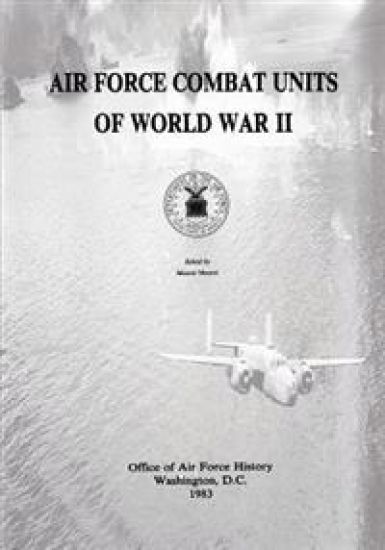
Air Force Combat Units of World War II

Air Force Combat Units of World War II

U. S. Air Force; Office of Air Force History

Createspace Independent Publishing Platform
2015
nidottu
Like all chronologies, bibliographies, and encyclopedias, Air Force Combat Units of World War II serves a very special historical function. It traces the lineage of each Army Air Corps and U. S. Air Force combat group or higher organization active in World War II, from itsorigins to 1956. It is a concise official record of those units: their assignments, subordinate organizations, stations, commanders, campaigns, aircraft, and decorations. But it is more than that. As an important source of ready information, this volume not only serves as a reference tool for historians and researchers; but it also provides commanders with a corporate memory of vital statistics. With these facts, a unit documents its heritage, the basis for unit esprit de corps. Originally this volume had been printed in 1961. Its worth has been proven, and the demand for it has been great. With this reprint, it will continue to serve the United States Air Force in all quarters in years to come.
Air Force Combat Wings: Lineage and Honors Histories 1947-1977

Air Force Combat Wings: Lineage and Honors Histories 1947-1977

U. S. Air Force; Office of Air Force History

Createspace Independent Publishing Platform
2015
nidottu
The United States Air Force Historical Research Center and its predecessor organizations have over the years received thousands of requests for brief histories of Air Force organizations. Wing commanders ask for historical data that can beused to introduce the unit to new personnel, build morale, and improve "esprit de corps". Headquarters USAF and the major commands require historical information to plan organizational changes. Officers throughout the Air Force need historical material for public affairs purposes. Former members of the Army AirForces and the Air Force are interested in the heritage and history of the organizationsin which they served. Government agencies and private individuals, for a variety of reasons, also want to know about Air Force establishments and units and their histories. Because of the interest in these lineage and honors histories, the USAF Historical Division in the late 1950s compiled a reference volume of Air Force combat organizations-groups, wings, divisions, commands, and air forces. Published in 1961, this volume focused exclusively on organizations active during World War II. Historians traced each organization from its origin to 1 January 1956. A companion volume followed, containing the histories of combat squadronsactive between 7 December 1941 and 2 September 1945. These squadron histories were carried through 5 March 1963 (the fiftieth anniversary of the 1st Aero Squadron, the first Army unit to be equipped with aircraft for tacticaloperations). This present volume, the third in the series, is devoted to the Air Force-controlled (AFCON) combat wings of the post-World War II United States Air Force. All of these wings feature numerical designations up to three digits (1through 706); only five possess history and honors from World War II. Each wing's history is traced from its origin through September 1977, when the Air Force celebrated its thirtieth anniversary as a separate service.
Services Around the World

Services Around the World

U. S. Air Force; Office of Air Force History

Createspace Independent Publishing Platform
2015
nidottu
In March 1942, President Franklin D. Roosevelt wrote to the Director of the Bureau of the Budget ordering each war agency to prepare "an accurate and objective account" of that agency's war experience. Soon after, the Army Air Forcesbegan hiring professional historians so that its history could, in the words of Brigadier General Laurence Kuter, "be recorded while it is hot and that personnel be selected and an agency set up for a clear historian's job without axe to grind or defense to prepare." An Historical Division was established in Headquarters Army Air Forces under Air Intelligence, in September 1942, and themodern Air Force historical program began. With the end of the war, Headquarters approved a plan for writing and publishing a seven-volume history. In December 1945, Lieutenant General Ira C. Eaker, Deputy Commander of Army Air Forces, asked the Chancellor of the University of Chicago to "assume the responsibility for the publication" of the history, stressing that it must "meet the highest academic standards." Lieutenant Colonel Wesley Frank Craven of New York University and Major James Lea Cate of the University of Chicago, both of whom had been assigned to the historical program, were selectedto be editors of the volumes. Between 1948 and 1958 seven were published. With publication of the last, the editors wrote that the Air Force had "fulfilled in letter and spirit" the promise ofaccess to documents and complete freedom of historical interpretation. Like all history, The Army Air Forces in World War II reflects the era when it was conceived, researched, and written.
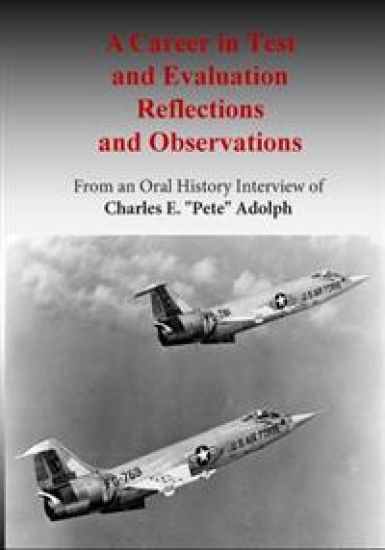
A Career in Test and Evaluation Reflections and Observations: From an Oral History Interview of Charles E. "Pete" Adolph

A Career in Test and Evaluation Reflections and Observations: From an Oral History Interview of Charles E. "Pete" Adolph

U. S. Air Force; Office of Air Force History

Createspace Independent Publishing Platform
2015
nidottu
Charles E. "Pete" Adolph retired as Director of Test and Evaluation in the Office of the Under Secretary of Defense (Acquisition and Technology) on 31January1994. This completed more than 30years of federal service-almost all of it within the challenging field of test and evaluation (T&E). Pete-as he was widely known throughout the Department of Defense testing community-enjoyeda remarkable career. It began in the late 1950s, as the heroic era of flight test in the first decade of the jet age was drawing to a close. Pete then played an increasingly prominent role in the transformation of flight testing into a systematic discipline using the latest in information technology to evaluate sophisticated weapon systems. His government career culminated as a senior director at the Office of the Secretary of Defense (OSD). There, in the Pentagon, hebrought his many years of engineering and management experience in the field to bear upon the formulation of policies for the acquisitionand testing of weapon systems in the post-cold-war era. The text that follows began as a series of five oral history interviews conductedin the Office of the Air Force Historian between 29 July 1993 and 15 April 1994. Ms. Pauline Tubbs of the United States Air Force Historical Research Agency at Maxwell Air Force Base (AFB), Alabama, expertly transcribed these interviews from approximately eight hours of audio tape. Mr. Lawrence R. Benson. the Air Force Historian's Assistant for Field Programs (and previously theDirector of Research Services at the Air Force Operational Test and Evaluation Center). organized, revised, and edited the transcript-adding explanatory material in brackets or footnotes as appropriate. Mr. Adolph was accompanied at most of the interviews by Mr. Douglas Nation of the 46th Test Wing at Eglin AFB, Florida, who was on a special assignment to the OSD T&E Directorate. Dr. James O. Young, Historian of the Air Force Flight Test Center (AFITC), and his staff at Edwards AFB, California, helped with details on flight test and provided most of the photographs. Although Mr. Adolph'sresponsibilities within the OSD encompassed testing of all types of systems throughout the four armed services, our interview focuses most sharply on Air Force flight testing at Edwards. This is where Pete spent the majority of his career, and where I first met him in 1980 after becoming the AFITC Historian.
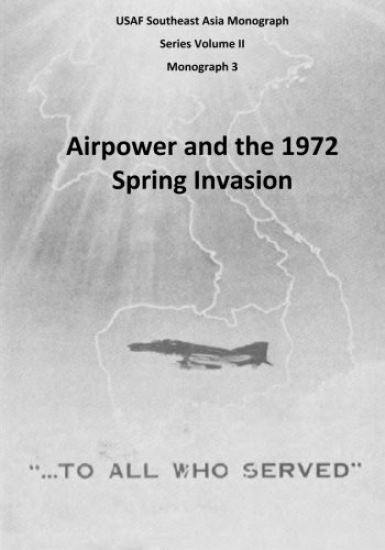
Airpower and the 1972 Spring Invasion

Airpower and the 1972 Spring Invasion

U. S. Air Force; Office of Air Force History

Createspace Independent Publishing Platform
2015
nidottu
In our continuing desire to bring to the reader an in-depth look at the use of airpower in Southeast Asia, we present in this volume a truly monumental effort at recounting the myriad of widely separate but not unrelated events and operations that took place during the Spring Invasion of 1972. In this monograph, the authors from the Air War College present an illuminating story of the people and machines that fought so gallantly during this major enemy offensive. The authors' breadth of experience in and out of combat enables them to provide a penetrating account of how airpower was brought to bear upon the enemy. The "Vietnamization" program, begun in 1969, had by March of 1972 reduced U. S. manpower involvement in Vietnam from 500,000 to 95,000. U. S. airpower involvement, however, did not decrease proportionately. Although the South Vietnamese Air Force took up the "lion's share" of the effort, U. S. airmen were still very much involved. During the offensive, their skills, courage and professionalism were tested 24 hours a day, directly contributing to the eventual successful outcome. The reader should learn from this story that not only is airpower an essential element of any major operation, but that its employment is a team effort. More so, it involves men and women on the ground as well as in the air -- one cannot function without the other.