Kirjojen hintavertailu – 12 903 725 kirjaa ja 27 kauppaa

Kirjailija

Origen

Kirjat ja teokset yhdessä paikassa: 64 kirjaa, julkaisuja vuosilta 1911–2026, suosituimpiin kuuluu 100 devocionales para mujeres. Promesas de Dios con sopa de letras / One Hundred Devotionals for Women. God's Promises with Word Search. Vertaile teosten hintoja ja tarkista saatavuus suomalaisista kirjakaupoista.

64 kirjaa

Kirjojen julkaisuvuodet: 1911–2026.

Commentary on the Gospel of John, Books 13-32

Commentary on the Gospel of John, Books 13-32

Origen

The Catholic University of America Press
2006
nidottu

Halvin toimitettuna 47,90 €

This volume contains what remains of Books 13-32 of Origen's Commentary on the Gospel according to John, and thus completes the publication of the first full English translation of this work that stands as the beginning of Christian scriptural exegesis. Ronald Heine introduces his translation with a discussion of the times and circumstances within which the commentary was composed. He also provides a survey of the major theological questions with which the commentary is concerned. These include Origen's thought on the nature of God, the person and work of Christ, his relation to the Father and to the created order, his teaching on the Holy Spirit, the Resurrection, and eschatology, and his ideas on the devil. Beginning with the conversation between Christ and the Samaritan woman at the well and ending with Christ's discourse to his disciples at the Last Supper, the commentary displays Origen's attention to the literal meaning of the passages but moves beyond them to try to grasp their spiritual significance, providing us with the opportunity to examine Origen's mystical thought. Origen also refutes the Gnostic reading of the Gospel presented by Heracleon, but this polemic is subordinate to his own investigation of the theological, philosophical, historical, and etymological questions raised by the Gospel. Because it treats many of the same passages of the Gospel of St. John for which St. Augustine provides a commentary in The Fathers of the Church, volume 88, this volume provides a worthy companion to it and invites a comparison of the thoughts of these two great exegetes upon what both regarded as the greatest of the Gospels.
Homilies on Leviticus 1-16

Homilies on Leviticus 1-16

Origen

The Catholic University of America Press
2005
nidottu
This new translation of Origen's Homilies on Leviticus may be read as a companion to Ronald E. Heine's translation of Origen's Homilies on Genesis and Exodus, volume 71 in the Fathers of the Church series. Both volumes reveal Origen's tenacious belief that, although the meaning of Scripture was threefold, that is, literal, moral, and spiritual, the most important interpretation was the spiritual. The Homilies on Leviticus were delivered during a three-year cycle between 238 and 244 in Alexandria where Origen was a brilliant teacher, theologian, churchman, and exegete until his imprisonment and torture under Decian and his reluctant death in Tyre in 253/254. They were translated by Rufinus, who admitted to having changed the text by condensing the homilies and, at the same time, expanding some of the explanations. Nevertheless they provide valuable insights on the third-century Church, touching on topics of conversion from sin, works of piety, baptism, Lent and fasting, the ordination of a priest, and the process of Christian discipline. Perhaps Origen's most significant theological contribution, however, is his doctrine of the Trinity which influenced the Trinitarian debates of the fourth and fifth centuries. Origen was the most prolific write of all the writers of the Early Church. Eusebius numbers his books at 2000, and St. Jerome writes of 786 works. But Origen's chief aim, as an interpreter of the Scriptures, was to draw out the historical meaning of the text and communicate that wisdom of perception to his flock. It was this that inspired his profound spiritual interpretation in the Homilies on Leviticus so finely translated in this volume.

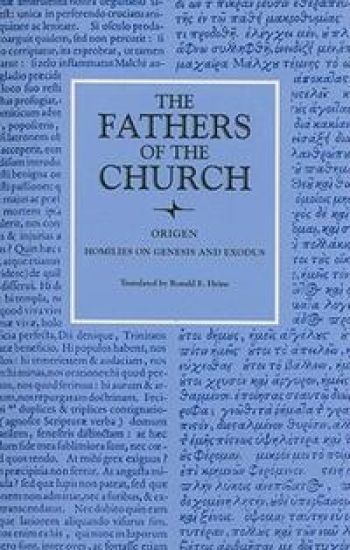
Homilies on Genesis and Exodus

Homilies on Genesis and Exodus

Origen

The Catholic University of America Press
2002
nidottu
Origen, son of the martyr Leonides, oldest in a family of seven children was born probably at Alexandria 184/85 and died probably in Tyre 253/54 after imprisonment and torture during the Decian persecution. Surnamed "man of steel" Origen was an outstanding theologian of the early Greek-speaking Church, a man of the virtue and a genius with a prodigious capacity for work, an excellent teacher to whose lectures students flocked "and did not give him time to breathe for one bath of pupils after another kept frequenting from morn till night his lecture-room" (Eusebius, H. E. 6, 15). As an author Origen surpasses all the writers of the Early Church in literary output. A list complied by Eusebius, now unfortunately lost, credited Origen with some 2000 books. Even a far shorter list known to St. Jerome and mentioned by him in his Letter To Paula giving the number of 786 works is still impressive. Jerome then goes on to add some reflections. "Do you see the Greeks and Latins outstripped by the work of one man? Who could ever read all that he wrote? What reward did he receive for this exertion? He is condemned by bishop Demetrius; except for the bishops of Palestine, Arabia, Phoenicia and Achaia the world concurs in his condemnation. Rome itself convokes an assembly against this man not because of novelty of teachings, not because of heresy as now mad dogs pretend against him, but because they could not bear the fame of his eloquence and learning and were considered speechless when he spoke". (Corpus scriptorum ecclesiasticorum latinorum, vol.54, pp.253-59) . Origen's chief aim was to be an interpreter of the Scriptures. To this end he composed scientific commentaries on various books of the Old and New Testaments, homilies, and short exegetical notes. The translations presented here belong to the second category. Though he did not reject the literal sense of Scripture Origen here is more intent upon the spiritual meanings of passages selected from Genesis and Exodus.