

Kirjailija
Peter Burke
Kirjat ja teokset yhdessä paikassa: 107 kirjaa, julkaisuja vuosilta 1899–2026, suosituimpiin kuuluu Kunskap och information : den mänskliga intelligensen potential och fara. Vertaile teosten hintoja ja tarkista saatavuus suomalaisista kirjakaupoista.
107 kirjaa
Kirjojen julkaisuvuodet: 1899–2026.
A rich, wide-ranging history of ignorance in all its forms, from antiquity to the present day A Seminary Coop Notable Book of 2023 “Ignorance: A Global History explores the myriad ways in which ‘not-knowing’ affects our lives, sometimes for good, sometimes for ill.”—Michael Dirda, Washington Post Throughout history, every age has thought of itself as more knowledgeable than the last. Renaissance humanists viewed the Middle Ages as an era of darkness, Enlightenment thinkers tried to sweep superstition away with reason, the modern welfare state sought to slay the “giant” of ignorance, and in today’s hyperconnected world seemingly limitless information is available on demand. But what about the knowledge lost over the centuries? Are we really any less ignorant than our ancestors? In this highly original account, Peter Burke examines the long history of humanity’s ignorance across religion and science, war and politics, business and catastrophes. Burke reveals remarkable stories of the many forms of ignorance—genuine or feigned, conscious and unconscious—from the willful politicians who redrew Europe’s borders in 1919 to the politics of whistleblowing and climate change denial. The result is a lively exploration of human knowledge across the ages, and the importance of recognizing its limits.


Reprint of the original, first published in 1866.

Reprint of the original, first published in 1866.
From comic verse to practical jokes, pornography to satire, acting to acrobatics, the Renaissance witnessed the flowering of play in all its forms. In the first wide-ranging and accessible introduction to play in Renaissance Italy, Peter Burke, celebrated historian of the Italian Renaissance, synthesizes over forty years’ research, explores the various forms of play in this period, and offers an overview that reveals the many connections between its different domains. While play could be rough, the Church played an increasing role in determining acceptable and unacceptable forms of play, and, after campaigns against violence and obscenity, much of the licentiousness characteristic of the early Renaissance was tamed. This entertaining study of play reveals much about the culture of Renaissance Italy, and illuminates an essential element in human life.
From comic verse to practical jokes, pornography to satire, acting to acrobatics, the Renaissance witnessed the flowering of play in all its forms. In the first wide-ranging and accessible introduction to play in Renaissance Italy, Peter Burke, celebrated historian of the Italian Renaissance, synthesizes over forty years’ research, explores the various forms of play in this period, and offers an overview that reveals the many connections between its different domains. While play could be rough, the Church played an increasing role in determining acceptable and unacceptable forms of play, and, after campaigns against violence and obscenity, much of the licentiousness characteristic of the early Renaissance was tamed. This entertaining study of play reveals much about the culture of Renaissance Italy, and illuminates an essential element in human life.
From Leonardo Da Vinci to Oliver Sacks: the first history of the western polymath, from the Renaissance to the present"An absorbing group portrait and intellectual history."—Kirkus Reviews"An admirable mixture of industry and erudition."—Robert Wilson, Wall Street Journal From Leonardo Da Vinci to John Dee and Comenius, from George Eliot to Oliver Sacks and Susan Sontag, polymaths have moved the frontiers of knowledge in countless ways. But history can be unkind to scholars with such encyclopedic interests. All too often these individuals are remembered for just one part of their valuable achievements. In this engaging, erudite account, renowned cultural historian Peter Burke argues for a more rounded view. Identifying 500 western polymaths, Burke explores their wide-ranging successes and shows how their rise matched a rapid growth of knowledge in the age of the invention of printing, the discovery of the New World and the Scientific Revolution. It is only more recently that the further acceleration of knowledge has led to increased specialization and to an environment that is less supportive of wide-ranging scholars and scientists. Spanning the Renaissance to the present day, Burke changes our understanding of this remarkable intellectual species.


This journal can help you or a loved one work through the numbness, despair and disorganization of grief, using your head (thinking), your heart (feeling), and your hands (acting). You who meant so much to me can never be replaced. What am I going to do now that you are gone? Can what happened to you happen to me? Are these thoughts on your mind? I won't share details of my personal experiences with grief, other than to say that they started when I was seven and lasted for the next twenty years. For decades after, I guarded myself against feeling grief, showing no response to any bad news - like this ... When they tell me you are dead, my skull will shrink, my eyes will burn. I'll try to moan, but my throat will close. I'll not believe that you are gonewhile I still live. That's what I'll feel. Here's what I'll do." Thank you," I'll say, "for telling me. Does this mean you'll have to move? Have you called Cousin Louise?" I'll continue setting the tablefor one less. I created this journal to help you work through numbness, despair, and disorganization by using your three basic human talents - feeling, thinking and acting; or if you like, your heart, your head and your hands. It provides pathways to accepting your emotions, dealing with your new reality, and caring for yourself. Creating it has been difficult, but it has helped me move out of the past and into the present. I hope it does the same for you. IncludedA mini-workbook to get you startedClear, useful, valid, small stepsShort practices to develop skillsSimple but profound prompts, no BS, no jargonPathways to change your way of thinking and actingRecommended reading to dig deeper
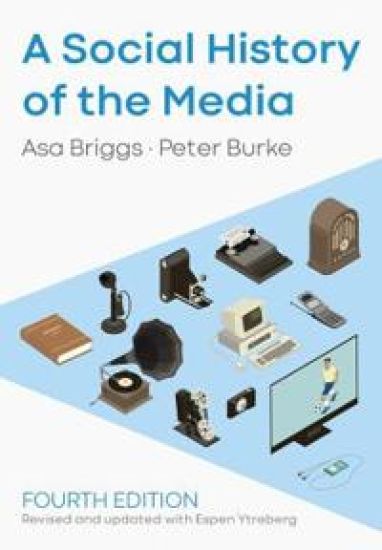
The first three editions of this bestselling book have established A Social History of the Media as a classic, providing a masterful overview of communication media and of the social and cultural contexts within which they emerged and evolved over time. This fourth edition has been revised and updated throughout to reflect the latest developments in the field. Additionally, an expanded introduction explores the wide range of secondary literature and theory that inform the study of media history today, and a new eighth chapter surveys the revolutionary media developments of the twenty-first century, including in particular the rise of social and participatory media and the penetration of these technologies into every sphere of social and private life. Avoiding technological determinism and rejecting assumptions of straightforward evolutionary progress, this book brings out the rich and varied histories of communication media. In an age of fast-paced media developments, a thorough understanding of media history is more important than ever, and this text will continue to be the first choice for students and scholars across the world.
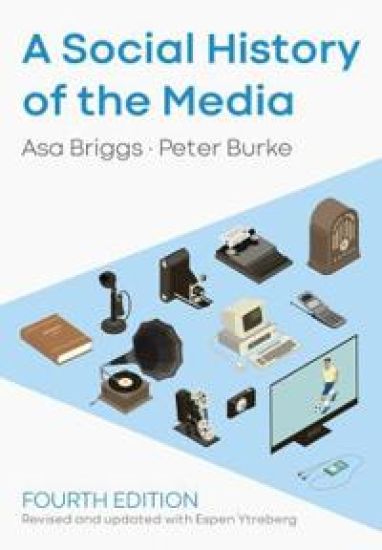
A Social History of the Media
Asa Briggs; Peter Burke; Espen Ytreberg
Polity Press
2020
nidottu
Halvin toimitettuna 31,50 €
The first three editions of this bestselling book have established A Social History of the Media as a classic, providing a masterful overview of communication media and of the social and cultural contexts within which they emerged and evolved over time. This fourth edition has been revised and updated throughout to reflect the latest developments in the field. Additionally, an expanded introduction explores the wide range of secondary literature and theory that inform the study of media history today, and a new eighth chapter surveys the revolutionary media developments of the twenty-first century, including in particular the rise of social and participatory media and the penetration of these technologies into every sphere of social and private life. Avoiding technological determinism and rejecting assumptions of straightforward evolutionary progress, this book brings out the rich and varied histories of communication media. In an age of fast-paced media developments, a thorough understanding of media history is more important than ever, and this text will continue to be the first choice for students and scholars across the world.
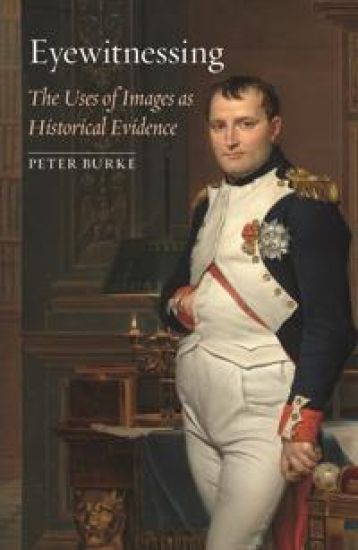
Eyewitnessing evaluates the place of images among other kinds of historical evidence. By reviewing the many varieties of images by region, period and medium, and looking at the pragmatic uses of images (e.g. the Bayeux Tapestry, an engraving of a printing press, a reconstruction of a building), Peter Burke sheds light on our assumption that these practical uses are ‘reflections’ of specific historical meanings and influences. He also shows how this assumption can be problematic. Traditional art historians have depended on two types of analysis when dealing with visual imagery: iconography and iconology. Burke describes and evaluates these approaches, concluding that they are insufficient. Focusing instead on the medium as message and on the social contexts and uses of images, he discusses both religious images and political ones, also looking at images in advertising and as commodities. Ultimately, Burke’s purpose is to show how iconographic and post-iconographic methods – psychoanalysis, semiotics, viewer response, deconstruction – are both useful and problematic to contemporary historians.

What is Cultural History? has established itself as an essential guide to what cultural historians do and how they do it. Now fully updated in its third edition, leading historian Peter Burke offers afresh his accessible account of the past, present and future of cultural history, as it has been practised not only in the English-speaking world, but also in Continental Europe, Asia, South America and elsewhere. Burke begins by discussing the ‘classic’ phase of cultural history, associated with Jacob Burckhardt and Johan Huizinga, and the Marxist reaction to it, from Frederick Antal to Edward Thompson. He then charts the rise of cultural history in more recent times, concentrating on the work of the last generation, often described as the ‘New Cultural History’. He places cultural history in its own cultural context, noting links between new approaches to historical thought and writing and the rise of feminism, postcolonial studies and an everyday discourse in which the idea of culture plays an increasingly important part. The new edition also surveys the latest developments in the field and considers the directions that cultural history has been taking in the twenty-first century and may take in the future. This landmark book will continue to be essential reading for students of history, anthropology, cultural studies and literary studies.
What is Cultural History? has established itself as an essential guide to what cultural historians do and how they do it. Now fully updated in its third edition, leading historian Peter Burke offers afresh his accessible account of the past, present and future of cultural history, as it has been practised not only in the English-speaking world, but also in Continental Europe, Asia, South America and elsewhere. Burke begins by discussing the ‘classic’ phase of cultural history, associated with Jacob Burckhardt and Johan Huizinga, and the Marxist reaction to it, from Frederick Antal to Edward Thompson. He then charts the rise of cultural history in more recent times, concentrating on the work of the last generation, often described as the ‘New Cultural History’. He places cultural history in its own cultural context, noting links between new approaches to historical thought and writing and the rise of feminism, postcolonial studies and an everyday discourse in which the idea of culture plays an increasingly important part. The new edition also surveys the latest developments in the field and considers the directions that cultural history has been taking in the twenty-first century and may take in the future. This landmark book will continue to be essential reading for students of history, anthropology, cultural studies and literary studies.
Identity, Culture & Communications in the Early Modern World
Peter Burke
Edward Everett Root
2018
sidottu
The essays on language have been inspired by the work of sociolinguists on the ways in which the same individual may use different languages or forms of language in different situations. The essays on cities are more diverse, including violence, noise and even smells, but most of them share two themes with the essays on language. The first and most obvious theme is communication, the second is identity, since language and clothes were and are a means to place unknown individuals in their social group.
This volume gathers Professor Burke's most important essays on the theory and the practice of history. In the first part, the main theme is the way in which concepts borrowed from social and cultural theory may encourage historians to ask new questions about the past or help them to answer old ones. The second part of the author's work is to illustrate some major new trends in historical practice: the use of images as evidence, for instance, the interest in different attitudes to time, and the increasing awareness of the relation, close or distant, between historians and the past that they study.