Kirjojen hintavertailu – 12 859 818 kirjaa ja 27 kauppaa

Kirjailija

Peter Weiss

Kirjat ja teokset yhdessä paikassa: 49 kirjaa, julkaisuja vuosilta 1964–2026, suosituimpiin kuuluu The Persecution and Assassination of J-P Marat As Performed by the Inmates O.T.A. O.C.U.T. Direction of the Marquis De Sade. Vertaile teosten hintoja ja tarkista saatavuus suomalaisista kirjakaupoista.

Nimi esiintyy myös muodoissa: Peter Weiß

49 kirjaa

Kirjojen julkaisuvuodet: 1964–2026.

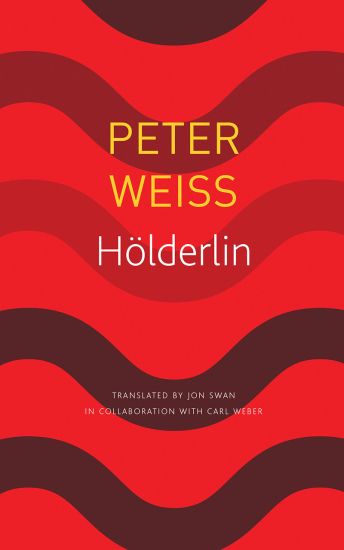
H lderlin

H lderlin

Peter Weiss

Seagull Books London Ltd
2019
pokkari
The work of German poet Frederich Hölderlin (1770–1843) has inspired countless poets and philosophers from Paul Celan to Rainer Maria Rilke to Martin Heidegger and Friedrich Nietzsche. Yet, despite the international renown and respect his hymns and elegies have since earned for their lyric style and innovative approach to Greek myth, his work was not widely celebrated during his lifetime. Diagnosed with a severe case of hypochondria at a young age, he was beset by mental illness for much of his life, living the final decades in the care of a carpenter. In Hölderlin, distinguished German playwright Peter Weiss brings to the page the life and times of one of Germany’s greatest poets. Like Trotsky in Exile, Hölderlin presents a biography in the form of a two-act drama. Following its opening in 1971 in Stuttgart, the play was staged numerous times in Germany and Switzerland, and as Robert Cohen explains in his introduction, it was “greeted by accolades as well as by intense criticism since Weiss had dared to revise the image of one of the great heroic figures of German Culture.” Weiss explains that he was motivated “to describe something of the conflict that arises in a person who suffers to the point of madness from the injustices, the humiliations in his society, who completely supports the revolutionary upheavals, and yet does not find the praxis with which the misery can be remedied.” The resulting dramatic biography is as captivating and divisive today as it was forty years ago, and it has yet to be matched by any other biographic treatment of Hölderlin. Presented here for the first time in English, Weiss’s play is a lyrical investigation of the intense and influential poems of Hölderlin and the turbulent life behind them.
The Aesthetics of Resistance

The Aesthetics of Resistance

Peter Weiss

DUKE UNIVERSITY PRESS
2025
pokkari
A major literary event, the publication of Peter Weiss’s monumental three-volume novel The Aesthetics of Resistance makes one of the towering works of twentieth-century German literature available to English-speaking readers for the first time. The crowning achievement of Peter Weiss-the internationally renowned writer best known for his play Marat/Sade-The Aesthetics of Resistance spans the period from the late 1930s to the end of World War II, dramatizing antifascist resistance and the rise and fall of proletarian political parties in Europe. Published between 1975 and 1981, the trilogy follows an unnamed narrator and his peers-sixteen- and seventeen-year-old working-class students-as they explore the affinity between political resistance and art while fighting fascist regimes in Germany and Spain. In 1937 they begin meeting in Berlin’s museums and galleries, where they engage in extended meditations on the political meanings of paintings, sculpture, and literature. Moving from the Berlin underground to the Spanish Civil War to Paris, the narrator later finds himself in Stockholm, gets a job in a factory, joins the Communist Party, and meets Bertolt Brecht. The novel teems with characters, almost all of whom are based on historical figures. By August 1942, many of the narrator’s friends, acquaintances, and fellow members of the anti-Nazi resistance in Berlin are arrested by the Gestapo and executed. Throughout this epic work, Weiss suggests that meaning lies in embracing resistance, no matter how intense the oppression, and that we must look to art for new models of political action and social understanding. The Aesthetics of Resistance is one of the truly great examples of postwar German literature and an essential resource for understanding twentieth-century German history.
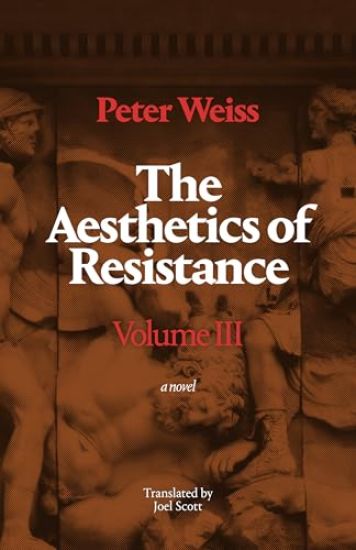
The Aesthetics of Resistance, Volume III

The Aesthetics of Resistance, Volume III

Peter Weiss

DUKE UNIVERSITY PRESS
2025
pokkari

Halvin toimitettuna 28,20 €

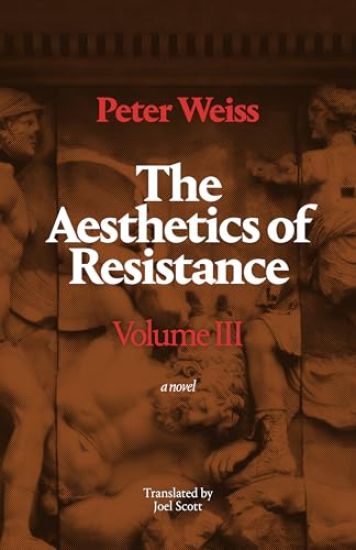
A major literary event, the publication of the final volume of Peter Weiss’s three-volume novel The Aesthetics of Resistance makes one of the towering works of twentieth-century German literature available to English-speaking readers for the first time. Weiss’s crowning achievement, The Aesthetics of Resistance spans the period from the late 1930s to the end of World War II, dramatizing antifascist resistance and the rise and fall of proletarian political parties in Europe. Volume III, initially published in 1981, teems with characters, many of whom are based on historical figures. It commences in May of 1940, as the narrator’s parents flee Nazi forces in Eastern Europe and reunite with their son in Sweden. While in Stockholm, the narrator and other Communist activists living in exile struggle to build structures in the German underground. The story then follows Communist resistance fighter Charlotte Bischoff as she is smuggled to Bremen on a freighter. In Berlin, she contacts the narrator’s friends and joins the Red Orchestra resistance group. Soon, the Gestapo cracks the underground group’s code, arrests a number of its members, and takes them to Plötzensee Prison, where most of them are executed. Featuring the narrator’s meditations on paintings, sculpture, and literature throughout, The Aesthetics of Resistance demonstrates the affinity between political resistance and art. Ultimately, Weiss argues that we must look to art for new models of political action and social understanding.
The Aesthetics of Resistance, Volume III

The Aesthetics of Resistance, Volume III

Peter Weiss

DUKE UNIVERSITY PRESS
2025
sidottu
A major literary event, the publication of the final volume of Peter Weiss’s three-volume novel The Aesthetics of Resistance makes one of the towering works of twentieth-century German literature available to English-speaking readers for the first time. Weiss’s crowning achievement, The Aesthetics of Resistance spans the period from the late 1930s to the end of World War II, dramatizing antifascist resistance and the rise and fall of proletarian political parties in Europe. Volume III, initially published in 1981, teems with characters, many of whom are based on historical figures. It commences in May of 1940, as the narrator’s parents flee Nazi forces in Eastern Europe and reunite with their son in Sweden. While in Stockholm, the narrator and other Communist activists living in exile struggle to build structures in the German underground. The story then follows Communist resistance fighter Charlotte Bischoff as she is smuggled to Bremen on a freighter. In Berlin, she contacts the narrator’s friends and joins the Red Orchestra resistance group. Soon, the Gestapo cracks the underground group’s code, arrests a number of its members, and takes them to Plötzensee Prison, where most of them are executed. Featuring the narrator’s meditations on paintings, sculpture, and literature throughout, The Aesthetics of Resistance demonstrates the affinity between political resistance and art. Ultimately, Weiss argues that we must look to art for new models of political action and social understanding.
Proschanie s roditeljami

Proschanie s roditeljami

Peter Weiss

LIBRA
2023
nidottu
Peter Vajss (Peter Weiss, 1916-1982) - nemetsko-shvedskij pisatel, dramaturg, khudozhnik, kinorezhisser. Vajss - vykhodets iz shvejtsarsko-vengerskoj semi. Mat pisatelja, Frida Khummel, blistala v spektakljakh Maksa Rajnkhardta, a otets, Jeno Vajss, sluzhil na fronte v kachestve starshego lejtenanta imperatorskoj i korolevskoj armii. Posle 1918 g. semja pereselilas v Bremen, gde byla osnovana tekstilnaja fabrika Hoppe, Weiss & Co. Nesmotrja na uvlechenie literaturoj Vajss poshel po stopam ottsa. V 1935 g. semja perebiraetsja v London. Vajss mladshij uvlekaetsja fotografiej i sozdaet pervye zhivopisnye raboty. V 1936 g. - sledujuschij etap emigratsii - Chekhoslovakija. Po sovetu Khermanna Khesse Vajss postupaet v Akademiju khudozhestv v Prage, no v 1938 g. semja vynuzhdena otpravitsja v Shvetsiju, gde Jeno Vass stanovitsja rukovoditelem tekstilnoj fabriki, a junyj Peter zarabatyvaet na zhizn, risuja shablony dlja tkanej. Samymi izvestnymi proizvedenijami Vajssa stali dramy "Presledovanie" i ubijstvo Zhana Polja Marata, predstavlennye teatralnoj truppoj gospitalja v Sharantone pod rukovodstvom gospodina de Sada", "Doznanie" i "Khjolderlin", instsenirovka romana Frantsa Kafki "Protsess", roman "Estetika soprotivlenija", "mikro-roman""Ten tela kuchera", edva li ne edinstvennoe proizvedenie nemetskogo strukturalizma. Avtobiograficheskaja povest "Proschanie s roditeljami" byla napisana i opublikovana v 1961 g. Perevod s nemetskogo Iriny Alekseevoj.
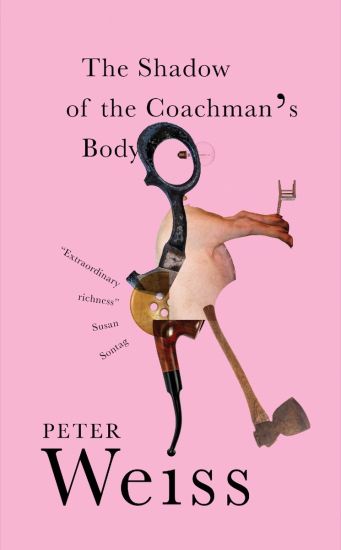
The Shadow of the Coachman's Body

The Shadow of the Coachman's Body

Peter Weiss

NEW DIRECTIONS PUBLISHING CORPORATION
2022
nidottu

Halvin toimitettuna 21,40 €

Peter Weiss’s first prose work, The Shadow of the Coachman’s Body, was unanimously praised as an original and perfect work of art by critics when it appeared in 1960. Here, in poet Rosmarie Waldrop’s stunning translation, Weiss arranges a dark, vividly alive comedy of inert objects in a dismal boarding house—stones, buttons, hooks, needles, chairs, newspapers in an outhouse, clinking tin cups, celestial orbs, sewing machines, an overwound windup music box—which have oblique characters’ shadows as their supporting cast. Described by Weiss as a “micro-novel,” The Shadow of the Coachman’s Body can be obscene, trivial and brutal, and yet it is also peculiarly intimate and offers endless possibilities—like a telescope and kaleidoscope rolled into one.
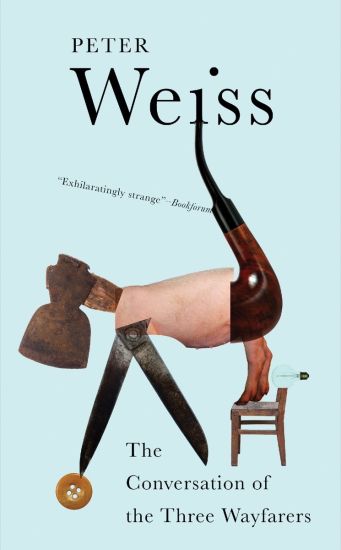
Conversation of the Three Wayfarers

Conversation of the Three Wayfarers

Peter Weiss

NEW DIRECTIONS PUBLISHING CORPORATION
2022
nidottu

Halvin toimitettuna 22,00 €

Conversation of the Three Wayfarers is a tale overheard, rather than told directly. Abel, Babel, and Cabel, the wayfarers, carry on a three-sided monologue, each reporting curious incidents—the effect is of three capers rolled into one: a steeplechase performed on a floating pontoon. But are they really three distinct individuals? Why do their lives blend in such a fantastic manner? Weiss’s strikingly original prose has an impossibly contained quality, with each sentence doing a perfect double-double backflip before neatly landing. This essential rediscovered work, from the masterful and acclaimed German modernist Peter Weiss, will be a delightful discovery for readers of Kafka, Musil, and Gombrowicz.
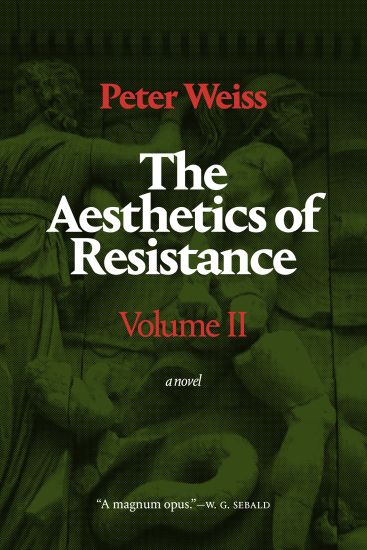
The Aesthetics of Resistance, Volume II

The Aesthetics of Resistance, Volume II

Peter Weiss

Duke University Press
2020
sidottu
A major literary event, the publication of the second volume of Peter Weiss's three-volume novel The Aesthetics of Resistance makes one of the towering works of twentieth-century German literature available to English-speaking readers for the first time. The crowning achievement of Peter Weiss, the internationally renowned writer best known for his play Marat/Sade, The Aesthetics of Resistance spans the period from the late 1930s to World War II, dramatizing antifascist resistance and the rise and fall of proletarian political parties in Europe. Volume II, initially published in 1978, opens with the unnamed narrator in Paris after having retreated from the front lines of the Spanish Civil War. From there, he moves on to Stockholm, where he works in a factory, becomes involved with the Communist Party, and meets Bertolt Brecht. Featuring the narrator's extended meditations on paintings, sculpture, and literature, the novel teems with characters, almost all of whom are based on historical figures. Throughout, the narrator explores the affinity between political resistance and art-the connection at the heart of Weiss's novel. Weiss suggests that meaning lies in embracing resistance, no matter how intense the oppression, and that we must look to art for new models of political action and social understanding. The Aesthetics of Resistance is one of the truly great works of postwar German literature and an essential resource for understanding twentieth-century German history.
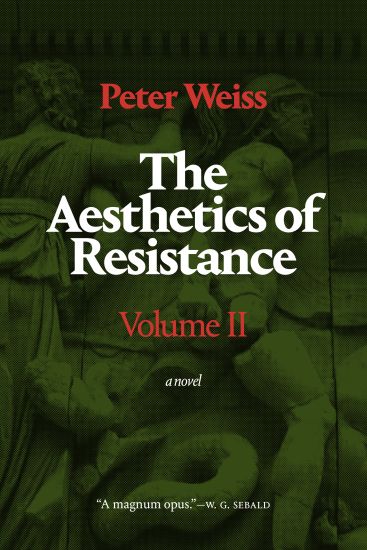
The Aesthetics of Resistance, Volume II

The Aesthetics of Resistance, Volume II

Peter Weiss

Duke University Press
2020
pokkari

Halvin toimitettuna 28,20 €

A major literary event, the publication of the second volume of Peter Weiss's three-volume novel The Aesthetics of Resistance makes one of the towering works of twentieth-century German literature available to English-speaking readers for the first time. The crowning achievement of Peter Weiss, the internationally renowned writer best known for his play Marat/Sade, The Aesthetics of Resistance spans the period from the late 1930s to World War II, dramatizing antifascist resistance and the rise and fall of proletarian political parties in Europe. Volume II, initially published in 1978, opens with the unnamed narrator in Paris after having retreated from the front lines of the Spanish Civil War. From there, he moves on to Stockholm, where he works in a factory, becomes involved with the Communist Party, and meets Bertolt Brecht. Featuring the narrator's extended meditations on paintings, sculpture, and literature, the novel teems with characters, almost all of whom are based on historical figures. Throughout, the narrator explores the affinity between political resistance and art-the connection at the heart of Weiss's novel. Weiss suggests that meaning lies in embracing resistance, no matter how intense the oppression, and that we must look to art for new models of political action and social understanding. The Aesthetics of Resistance is one of the truly great works of postwar German literature and an essential resource for understanding twentieth-century German history.
Die Slowakei Und Die Europaeische Integration

Die Slowakei Und Die Europaeische Integration

Miroslav Londák; Slavomír Michálek; Peter Weiss

Peter Lang AG
2019
sidottu
Das Buch bringt dem Leser den komplexen und schwierigen Prozess der Ausformung der modernen slowakischen Nation naher, zuerst innerhalb des Ungarischen Koenigreichs und seit 1918 in der Tschechoslowakei. Der Prozess mundete schliesslich in die staatliche Unabhangigkeit der Slowakei am 1.1.1993. Die Autoren legen die AEhnlichkeiten und Unterschiede im Empfinden der gemeinsamen Geschichte der Tschechen und Slowaken dar, einschliesslich der 44 Jahre nach dem Zweiten Weltkrieg, als die Tschechoslowakische Republik infolge des Munchner Abkommens und der spaten Eroeffnung der zweiten Front in die Sphare des Einflusses der von Stalin beherrschten Sowjetunion geriet.
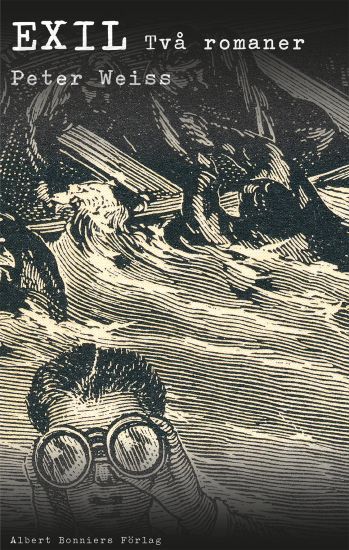
Exil : två romaner

Exil : två romaner

Peter Weiss; Magnus Bergh

Albert Bonniers Förlag
2016
sidottu
I år är det hundra år sedan Peter Weiss föddes. Albert Bonniers Förlag uppmärksammar det genom att återutge hans båda självbiografiska romaner Diagnos och Brännpunkt från 1961–1962 under titeln Exil.