Kirjailija
Plato
Kirjat ja teokset yhdessä paikassa: 1 115 kirjaa, julkaisuja vuosilta 1821–2026, suosituimpiin kuuluu Ion. Vertaile teosten hintoja ja tarkista saatavuus suomalaisista kirjakaupoista.
1 115 kirjaa
Kirjojen julkaisuvuodet: 1821–2026.
One of Plato's most enduring works, Five Dialogues (Euthyphro, Apology, Crito, Meno and Phaedo) punctuates the key moments in Socrates' life, from his trial to his death, with timeless philosophical debates about law, love, virtue, ethics and the meaning of life.
One of Plato's most enduring works, Five Dialogues (Euthyphro, Apology, Crito, Meno and Phaedo) punctuates the key moments in Socrates' life, from his trial to his death, with timeless philosophical debates about law, love, virtue, ethics and the meaning of life.

In the Meno, Anytus had parted from Socrates with the significant words: 'That in any city, and particularly in the city of Athens, it is easier to do men harm than to do them good;' and Socrates was anticipating another opportunity of talking with him. In the Euthyphro, Socrates is awaiting his trial for impiety. But before the trial begins, Plato would like to put the world on their trial, and convince them of ignorance in that very matter touching which Socrates is accused. An incident which may perhaps really have occurred in the family of Euthyphro, a learned Athenian diviner and soothsayer, furnishes the occasion of the discussion.

How you have felt, O men of Athens, at hearing the speeches of my accusers, I cannot tell; but I know that their persuasive words almost made me forget who I was - such was the effect of them; and yet they have hardly spoken a word of truth. But many as their falsehoods were, there was one of them which quite amazed me; - I mean when they told you to be upon your guard, and not to let yourselves be deceived by the force of my eloquence. They ought to have been ashamed of saying this, because they were sure to be detected as soon as I opened my lips and displayed my deficiency; they certainly did appear to be most shameless in saying this, unless by the force of eloquence they mean the force of truth; for then I do indeed admit that I am eloquent. But in how different a way from theirs Well, as I was saying, they have hardly uttered a word, or not more than a word, of truth; but you shall hear from me the whole truth: not, however, delivered after their manner, in a set oration duly ornamented with words and phrases.
Packaged in handsome, affordable trade editions, Clydesdale Classics is a new series of essential works. From the musings of intellectuals such as Thomas Paine in Common Sense to the striking personal narrative of Harriet Jacobs in Incidents in the Life of a Slave Girl, this new series is a comprehensive collection of our intellectual history through the words of the exceptional few. Originating in approximately 380 BC, Republic is a Socratic dialogue written by famed Greek philosopher Plato. Often referred to as Plato’s masterwork, Republic’s central goal is to define the ideal state. By conceptualizing this model state, Greeks believed it would lead states formed with its principles in mind to function the most efficiently and fairly, striving toward justice and the greater good of society. This edition includes a foreword by British American philosopher and Plato expert Simon Blackburn. Widely read around the world by philosophy students and academics alike, Plato’s Republic is sure to pass on its invaluable lessons and enlighten the next generation of thinkers.
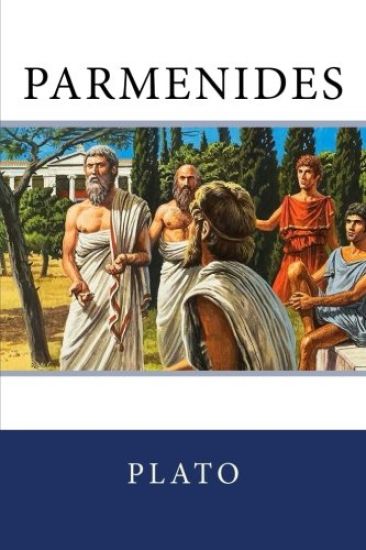
The Parmenides is, quite possibly, the most enigmatic of Plato's dialogues. The dialogue recounts an almost certainly fictitious conversation between a venerable Parmenides (the Eleatic Monist) and a youthful Socrates, followed by a dizzying array of interconnected arguments presented by Parmenides to a young and compliant interlocutor named "Aristotle" (not the philosopher, but rather a man who became one of the Thirty Tyrants after Athens' surrender to Sparta at the conclusion of the Peloponnesian War). Most commentators agree that Socrates articulates a version of the theory of forms defended by his much older namesake in the dialogues of Plato's middle period, that Parmenides mounts a number of potentially devastating challenges to this theory, and that these challenges are followed by a piece of intellectual "gymnastics" consisting of eight strings of arguments (Deductions) that are in some way designed to help us see how to protect the theory of forms against the challenges. Beyond this, there is precious little scholarly consensus. Commentators disagree about the proper way to reconstruct Parmenides' challenges, about the overall logical structure of the Deductions, about the main subject of the Deductions, about the function of the Deductions in relation to the challenges, and about the final philosophical moral of the dialogue as a whole. The Parmenides inspired the metaphysical and mystical theories of the later Neoplatonists (notably Plotinus and later, Proclus), who saw in the Deductions the key to the hierarchical ontological structure of the universe.

The Republic is a Socratic dialogue by Plato, written in approximately 380 BC. It is one of the most influential works of philosophy and political theory, and Plato's best known work. In Plato's fictional dialogues the characters of Socrates as well as various Athenians and foreigners discuss the meaning of justice and examine whether the just man is happier than the unjust man by imagining a society ruled by philosopher-kings and the guardians. The dialogue also discusses the role of the philosopher, Plato's Theory of Forms, the place of poetry, and the immortality of the soul.
The Theaetetus is one of Plato's dialogues concerning the nature of knowledge, written circa 369 BC. In this dialogue, Socrates and Theaetetus discuss three definitions of knowledge: knowledge as nothing but perception, knowledge as true judgment, and, finally, knowledge as a true judgment with an account. Each of these definitions is shown to be unsatisfactory. Socrates declares Theaetetus will have benefited from discovering what he does not know, and that he may be better able to approach the topic in the future. The conversation ends with Socrates' announcement that he has to go to court to face a criminal indictment.

Apology, Crito, and Phaedo of Socrates
Plato
Createspace Independent Publishing Platform
2017
nidottu
Apology, Crito, and Phaedo of Socrates By Plato, Henry Cary

Plato's Apology, Crito and Phaedo of Socrates: Plato
Plato
Createspace Independent Publishing Platform
2017
nidottu
Halvin toimitettuna 14,50 €
Plato's Apology, Crito And Phaedo of Socrates. Of all writers of speculative philosophy, both ancient and modern, there is probably no one who has attained so eminent a position as Plato. What Homer was to Epic poetry, what Cicero and Demosthenes were to oratory, and what Shakespeare was to the drama of England, Plato was to ancient philosophy, not unapproachable nor unapproached, but possessing an inexplicable but unquestioned supremacy. The authentic records of his life are meagre, and much that has been written concerning him is of a speculative nature. He was born at Athens in the year 427 B. C. His father's name was Ariston, and his mother's family, which claimed its descent from Solon, included among its members many Athenian notables, among whom was Oritias, one of the thirty tyrants. In his early youth Plato applied himself to poetry and painting, both of which pursuits he relinquished to become the disciple and follower of Socrates. It is said that his name was originally Aristocles, but that it was changed to Plato on account of the breadth of his shoulders and forehead. He is also said to have been an expert wrestler and to have taken part in several important battles. ContentsIntroductionThe Apology Of SocratesIntroduction to the critoCrito; Or, The Duty Of A CitizenIntroduction To The Ph doPh do; Or, The Immortality Of The Soul

In the Timaeus Plato presents an elaborately wrought account of the formation of the universe. Plato is deeply impressed with the order and beauty he observes in the universe, and his project in the dialogue is to explain that order and beauty. The universe, he proposes, is the product of rational, purposive, and beneficent agency. It is the handiwork of a divine Craftsman ("Demiurge," d miourgos, 28a6), who, imitating an unchanging and eternal model, imposes mathematical order on a preexistent chaos to generate the ordered universe (kosmos). The governing explanatory principle of the account is teleological: the universe as a whole as well as its various parts are so arranged as to produce a vast array of good effects. It strikes Plato strongly that this arrangement is not fortuitous, but the outcome of the deliberate intent of Intellect (nous), anthropomorphically represented by the figure of the Craftsman who plans and constructs a world that is as excellent as its nature permits it to be. As Plato tells it, the beautiful orderliness of the universe is not only the manifestation of Intellect; it is also the model for rational souls to understand and to emulate. Such understanding and emulation restores those souls to their original state of excellence, a state that was lost in their embodiment. There is, then, an explicit ethical and religious dimension to the discourse.


The Republic is a Socratic dialogue, written by Plato around 380 BC, concerning justice, the order and character of the just city-state and the just man. It is Plato's best-known work, and has proven to be one of the world's most influential works of philosophy and political theory, both intellectually and historically. In the book's dialogue, Socrates discusses the meaning of justice and whether or not the just man is happier than the unjust man with various Athenians and foreigners. They consider the natures of existing regimes and then propose a series of different, hypothetical cities in comparison. This culminates in the discussion of Kallipolis, a hypothetical city-state ruled by a philosopher king. They also discuss the theory of forms, the immortality of the soul, and the role of the philosopher and that of poetry in society. The dialogues may have taken place during the Peloponnesian War.