Kirjojen hintavertailu – 12 859 819 kirjaa ja 27 kauppaa

Kirjailija

Proclus

Kirjat ja teokset yhdessä paikassa: 42 kirjaa, julkaisuja vuosilta 1968–2019, suosituimpiin kuuluu Commentaires Sur Le Timee Livre 4. Vertaile teosten hintoja ja tarkista saatavuus suomalaisista kirjakaupoista.

42 kirjaa

Kirjojen julkaisuvuodet: 1968–2019.

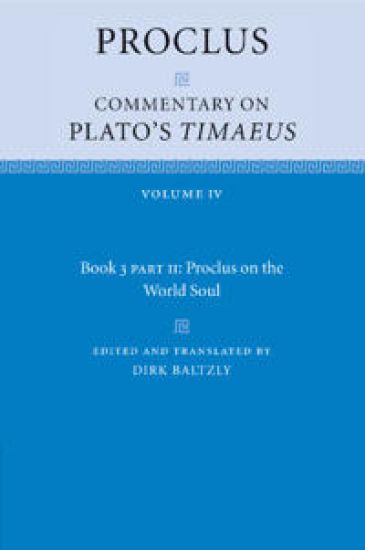
Proclus: Commentary on Plato's Timaeus, Part 2, Proclus on the World Soul
In the present volume Proclus describes the 'creation' of the soul that animates the entire universe. This is not a literal creation, for Proclus argues that Plato means only to convey the eternal dependence of the World Soul upon higher causes. In his exegesis of Plato's text, Proclus addresses a range of issues in Pythagorean harmonic theory, as well as questions about the way in which the World Soul knows both forms and the visible reality that comprises its body. This part of Proclus' Commentary is particularly responsive to the interpretive tradition that precedes it. As a result, this volume is especially significant for the study of the Platonic tradition from the earliest commentators onwards.
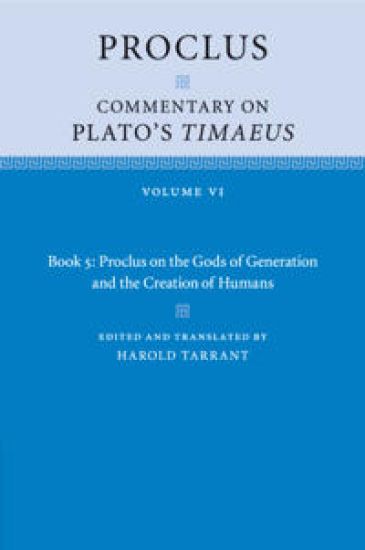
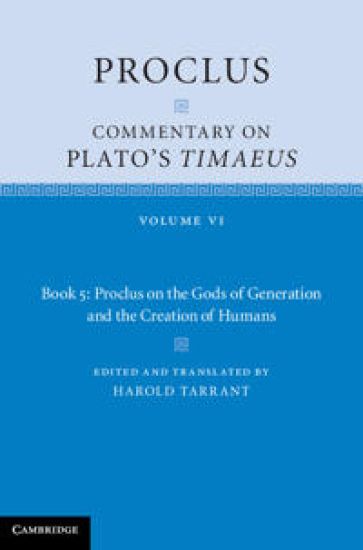
Proclus: Commentary on Plato's Timaeus: Volume 6, Book 5: Proclus on the Gods of Generation and the Creation of Humans
Proclus' Commentary on the dialogue Timaeus by Plato (d.347 BC), written in the fifth century AD, is arguably the most important commentary on a text of Plato, offering unparalleled insights into eight centuries of Platonic interpretation. It has had an enormous influence on subsequent Plato scholarship. This edition nevertheless offers the first new translation of the work for nearly two centuries, building on significant recent advances in scholarship by Neoplatonic commentators. It will provide an invaluable record of early interpretations of Plato's dialogue, while also presenting Proclus' own views on the meaning and significance of Platonic philosophy. The book presents Proclus' unrepentant account of a multitude of divinities involved with the creation of mortal life, the supreme creator's delegation to them of the creation of human life, and the manner in which they took the immortal life principle from him and wove it together with our mortal parts to produce human beings.
The Philosophical and Mathematical Commentaries of Proclus; Surnamed, Plato's Successor, on the First Book of Euclid's Elements. With a Preliminary Dissertation on the Platonic Doctrine of Ideas, Volume I. of 2; Volume 1
The 18th century was a wealth of knowledge, exploration and rapidly growing technology and expanding record-keeping made possible by advances in the printing press. In its determination to preserve the century of revolution, Gale initiated a revolution of its own: digitization of epic proportions to preserve these invaluable works in the largest archive of its kind. Now for the first time these high-quality digital copies of original 18th century manuscripts are available in print, making them highly accessible to libraries, undergraduate students, and independent scholars. The Age of Enlightenment profoundly enriched religious and philosophical understanding and continues to influence present-day thinking. Works collected here include masterpieces by David Hume, Immanuel Kant, and Jean-Jacques Rousseau, as well as religious sermons and moral debates on the issues of the day, such as the slave trade. The Age of Reason saw conflict between Protestantism and Catholicism transformed into one between faith and logic -- a debate that continues in the twenty-first century.++++The below data was compiled from various identification fields in the bibliographic record of this title. This data is provided as an additional tool in helping to insure edition identification: ++++British LibraryT143303Titlepage to vol.2 reads: 'The philosophical and mathematical commentaries of Proclus, on the first book of Euclid's elements. To which are added, a history of the restoration of the Platonic theology, by the latter Platonists: and a translation from the London: printed for the author: and sold by T. Payne and Son; B. White and Son; L. Davis; J. Robson; T. Cadell; Leigh and Co. G. Nicol; R. Faulder; and T. and J. Egerton, 1788-89. 2v.: ill.; 4
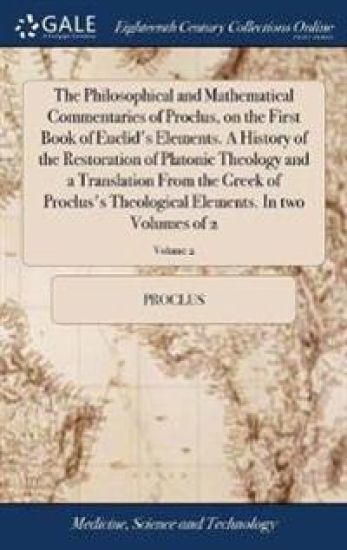
The Philosophical and Mathematical Commentaries of Proclus, on the First Book of Euclid's Elements. A History of the Restoration of Platonic Theology and a Translation From the Greek of Proclus's Theological Elements. In two Volumes of 2; Volume 1
The 18th century was a wealth of knowledge, exploration and rapidly growing technology and expanding record-keeping made possible by advances in the printing press. In its determination to preserve the century of revolution, Gale initiated a revolution of its own: digitization of epic proportions to preserve these invaluable works in the largest archive of its kind. Now for the first time these high-quality digital copies of original 18th century manuscripts are available in print, making them highly accessible to libraries, undergraduate students, and independent scholars. Medical theory and practice of the 1700s developed rapidly, as is evidenced by the extensive collection, which includes descriptions of diseases, their conditions, and treatments. Books on science and technology, agriculture, military technology, natural philosophy, even cookbooks, are all contained here.++++The below data was compiled from various identification fields in the bibliographic record of this title. This data is provided as an additional tool in helping to insure edition identification: ++++British LibraryT143304A reissue of the 1788-89 edition, with cancel titlepages, and an errata / advertisement leaf following the titlepage to vol. 1. London: printed for the author: and sold by T. Payne and Son; B. White and Son; J. Robson; T. Cadell; Leigh and Co. G. Nicol; R. Faulder; and T. and J. Egerton, 1792. 2v.: ill.; 4
The Philosophical and Mathematical Commentaries of Proclus, on the First Book of Euclid's Elements. A History of the Restoration of Platonic Theology and a Translation From the Greek of Proclus's Theological Elements. In two Volumes of 2; Volume 2
The 18th century was a wealth of knowledge, exploration and rapidly growing technology and expanding record-keeping made possible by advances in the printing press. In its determination to preserve the century of revolution, Gale initiated a revolution of its own: digitization of epic proportions to preserve these invaluable works in the largest archive of its kind. Now for the first time these high-quality digital copies of original 18th century manuscripts are available in print, making them highly accessible to libraries, undergraduate students, and independent scholars. Medical theory and practice of the 1700s developed rapidly, as is evidenced by the extensive collection, which includes descriptions of diseases, their conditions, and treatments. Books on science and technology, agriculture, military technology, natural philosophy, even cookbooks, are all contained here.++++The below data was compiled from various identification fields in the bibliographic record of this title. This data is provided as an additional tool in helping to insure edition identification: ++++British LibraryT143304A reissue of the 1788-89 edition, with cancel titlepages, and an errata / advertisement leaf following the titlepage to vol. 1. London: printed for the author: and sold by T. Payne and Son; B. White and Son; J. Robson; T. Cadell; Leigh and Co. G. Nicol; R. Faulder; and T. and J. Egerton, 1792. 2v.: ill.; 4
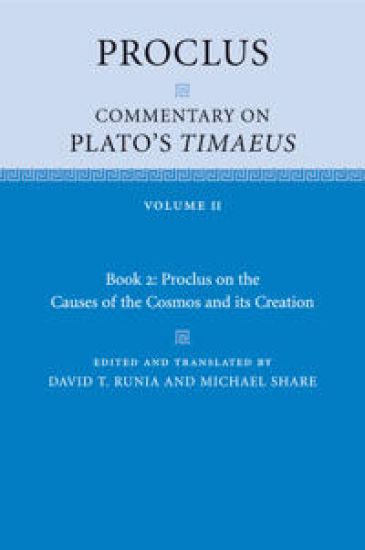
Proclus: Commentary on Plato's Timaeus: Volume 2, Book 2: Proclus on the Causes of the Cosmos and its Creation
This volume of Proclus' commentary on Plato's Timaeus records Proclus' exegesis of Timaeus 27a–31b, in which Plato first discusses preliminary matters that precede his account of the creation of the universe, and then moves to the account of the creation of the universe as a totality. For Proclus this text is a grand opportunity to reflect on the nature of causation as it relates to the physical reality of our cosmos. The commentary deals with many subjects that have been of central interest to philosophers from Plato's time onwards, such as the question whether the cosmos was created in time, and the nature of evil as it relates to physical reality and its ontological imperfection.
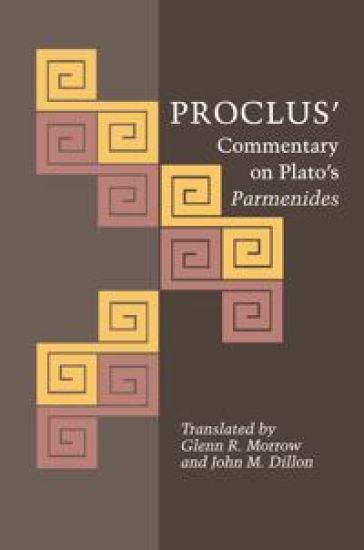
Proclus' Commentary on Plato's Parmenides

Proclus' Commentary on Plato's Parmenides

Proclus

Princeton University Press
2017
sidottu
This is the first English translation of Proclus' commentary on Plato'sParmenides. Glenn Morrow's death occurred while he was less than halfway through the translation, which was completed by John Dillon. A major work of the great Neoplatonist philosopher, the commentary is an intellectual tour de force that greatly influenced later medieval and Renaissance thought. As the notes and introductory summaries explain, it comprises a full account of Proclus' own metaphysical system, disguised, as is so much Neoplatonic philosophy, in the form of a commentary.
Proclus: Commentary on Plato's Timaeus: Volume 6, Book 5: Proclus on the Gods of Generation and the Creation of Humans
Proclus' Commentary on the dialogue Timaeus by Plato (d.347 BC), written in the fifth century AD, is arguably the most important commentary on a text of Plato, offering unparalleled insights into eight centuries of Platonic interpretation. It has had an enormous influence on subsequent Plato scholarship. This edition nevertheless offers the first new translation of the work for nearly two centuries, building on significant recent advances in scholarship by Neoplatonic commentators. It will provide an invaluable record of early interpretations of Plato's dialogue, while also presenting Proclus' own views on the meaning and significance of Platonic philosophy. The book presents Proclus' unrepentant account of a multitude of divinities involved with the creation of mortal life, the supreme creator's delegation to them of the creation of human life, and the manner in which they took the immortal life principle from him and wove it together with our mortal parts to produce human beings.
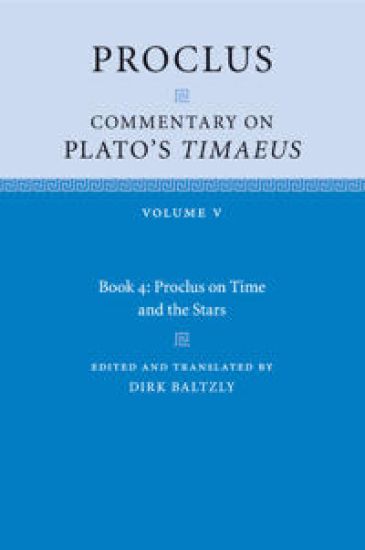
Proclus: Commentary on Plato's Timaeus: Volume 5, Book 4
Proclus' commentary on Plato's dialogue Timaeus is arguably the most important commentary on a text of Plato, offering unparalleled insights into eight centuries of Platonic interpretation. It has had an enormous influence on subsequent Plato scholarship. This edition offers the first new English translation of the work for nearly two centuries, building on significant recent advances in scholarship on Neoplatonic commentators. It provides an invaluable record of early interpretations of Plato's dialogue, while also presenting Proclus' own views on the meaning and significance of Platonic philosophy. The present volume, the fifth in the edition, presents Proclus' commentary on the Timaeus, dealing with Proclus' account of static and flowing time; we see Proclus situating Plato's account of the motions of the stars and planets in relation to the astronomical theories of his day. The volume includes a substantial introduction, as well as notes that will shed new light on the text.
Proclus, Commentaire Sur Le Parmenide de Platon: Tome V: Livre V
Le livre V du commentaire de Proclus (412-485) sur le Parmenide de Platon est consacre a Parm. 135 B 3-137 C 3, qui contient l'expose de la methode dialectique de Parmenide. Apres avoir discute, aux livres III et IV, les quatre problemes enumeres au debut du livre III (existence des idees, domaine des idees, nature des idees, mode de participation aux idees), Proclus passe ici a l'analyse de la methode que Parmenide va appliquer dans la discussion des hypotheses (Parm. 134 C 4 ss.) concernant l'existence et la non-existence de l'Un. La methode de Parmenide consiste a examiner les consequences d'une hypothese. L'hypothese initiale est "si x existe"; cette hypothese monadique engendre, par negation, une nouvelle hypothese: "si x n'existe pas"; cette dyade est multipliee par trois, parce qu'il y a trois sortes de consequences: (1) ce qui s'ensuit, (2) ce qui ne s'ensuit pas, (3) ce qui a la fois s'ensuit et ne s'ensuit pas; on parvient ainsi a six hypotheses. Chacune de ces six hypotheses est multipliee par quatre, parce que la consequence peut etre consideree sous quatre points de vue: (1) pour x par rapport a x, (2) pour x par rapport aux autres, (3) pour les autres par rapport a eux-memes, (4) pour les autres par rapport a x. On parvient ainsi a vingt-quatre hypotheses, groupees en quatre hexades. Pour illustrer le fonctionnement de la methode, Proclus l'applique a des exemples, dont les uns sont tires du texte de Platon (existence et non-existence de la pluralite, de la similitude, de la dissimilitude, du mouvement, du repos, de la generation, de la corruption, de l'etre et du non-etre), tandis que d'autres sont introduits par Proclus lui-meme (existence et non-existence de l'ame, de la providence, de l'immortalite de l'ame). Ce volume fait suite aux quatre premiers volumes parus, eux aussi, dans la Collection des Universites de France (vol. I: 2007; vol. II: 2010; vol. III: 2011; vol. IV: 2013). Il contient une introduction, l'edition critique du texte, la traduction francaise et un riche commentaire qui aborde tous les problemes souleves par le texte, aussi bien philologiques que philosophiques. Il sera complete par une serie de quatre index: (1) Index nominum, (2) Index locorum, (3) Index rerum notabilium, (4) Index des passages discutes dans les notes. Concetta Luna, chercheur aupres de la Scuola Normale Superiore de Pise (Italie), a deja publie, en collaboration avec Alain-Philippe Segonds, les quatre premiers volumes du Commentaire de Proclus sur le Parmenide de Platon. Elle a aussi collabore a l'edition du vol. IV du Commentaire de Damascius sur le Parmenide et du Proclus ou sur le bonheur de Marinus (en collaboration avec Henri Dominique Saffrey et Alain-Philippe Segonds).

Proclus: On Plato Cratylus

Proclus: On Plato Cratylus

Proclus

Bloomsbury Academic
2014
nidottu

Halvin toimitettuna 62,40 €

Proclus' commentary on Plato's Cratylus is the only ancient commentary on this work to have survived, and is illuminating in two particular respects. First, it is actually the work of two Neoplatonists. The majority of the material is supplied by the Athenian-based Proclus (c. 411-485 AD), who is well known for his magisterial commentaries on Plato's Timaeus and Parmenides, as well as for a host of other works involving the study of Plato. This material we have consists of excerpts from Proclus' commentary edited by another figure who appears to be a Platonist working somewhat later in Alexandria. Consequently it contains insights into the philosophy of both of the principal late antique centres of Platonism: Athens and Alexandria. Secondly, the material is divided between the grittier issues of language-theory, on which it engages freely with other ancient philosophies, and theological discussion, mostly involved with the etymologies of the names of Greek gods, in which Proclus is more concerned to relate his own brand of Platonism to the 'Orphic' and 'Chaldaean' theological systems, and also to Homer. This English translation, accompanied by Brian Duvick's extensive notes, explicates all these facets of the ancient text.
Proclus: Commentary on Plato's Timaeus: Volume 5, Book 4
Proclus' commentary on Plato's dialogue Timaeus is arguably the most important commentary on a text of Plato, offering unparalleled insights into eight centuries of Platonic interpretation. It has had an enormous influence on subsequent Plato scholarship. This edition offers the first new English translation of the work for nearly two centuries, building on significant recent advances in scholarship on Neoplatonic commentators. It provides an invaluable record of early interpretations of Plato's dialogue, while also presenting Proclus' own views on the meaning and significance of Platonic philosophy. The present volume, the fifth in the edition, presents Proclus' commentary on the Timaeus, dealing with Proclus' account of static and flowing time; we see Proclus situating Plato's account of the motions of the stars and planets in relation to the astronomical theories of his day. The volume includes a substantial introduction, as well as notes that will shed new light on the text.
Proclus: Commentary on Plato's Timaeus: Volume 1, Book 1: Proclus on the Socratic State and Atlantis
Proclus' Commentary on Plato's dialogue Timaeus is arguably the most important commentary on a text of Plato, offering unparalleled insights into eight centuries of Platonic interpretation. This edition offers the first new English translation of the work for nearly two centuries, building on significant recent advances in scholarship on Neoplatonic commentators. It provides an invaluable record of early interpretations of Plato's dialogue, while also presenting Proclus' own views on the meaning and significance of Platonic philosophy. The present volume, the first in the edition, deals with what may be seen as the prefatory material of the Timaeus. In it Socrates gives a summary of the political arrangements favoured in the Republic, and Critias tells the story of how news of the defeat of Atlantis by ancient Athens had been brought back to Greece from Egypt by the poet and politician Solon.
Proclus, Commentaire Sur Le Parmenide de Platon: Tome II: Livre II
Nous presentons ici la suite de l'edition complete du Commentaire sur le Parmenide de Proclus (410-485 de notre ere), qui comprend sept livres (plus une fin inedite en grec et conservee seulement en latin). Comme le premier volume, du aux memes editeurs et paru en 2007, ce nouveau volume repose sur une collation integrale et scrupuleuse de tout le materiel permettant de restituer ce chef d'oeuvre de l'Ecole d'Athenes. En effet, la tradition grecque (representee par cinq mss.) est completee par une version latine, tres litterale (mais fort intelligente) due a Guillaume de Moerbeke (XIIIe siecle), qui reflete une tradition manuscrite (grecque) tres superieure a ce qui nous a ete conserve. De la confrontation methodique de ces deux branches de la tradition nait un texte infiniment superieur a celui dont on a dispose jusqu'a aujourd'hui dans les deux editions de V. Cousin (Paris, 1821-22 et 1864). Par rapport a la nouvelle edition dont le troisieme et dernier volume vient de paraitre dans les Oxford Classical Texts, notre texte presente un tres grand nombre de divergences (plus de deux cents pour le seul livre II ) essentiellement parce que les mss. grecs et la traduction latine sont, pour la premiere fois, collationnes soigneusement et evalues scientifiquement. Le livre II est consacre au debut de la discussion des apories sur la theorie des idees (laquelle se poursuivra dans les livres III et IV). A cote d'un passage d'Alcinous et d'un autre de Syrianus dans son Commentaire sur la Metaphysique d'Aristote, il s'agit de l'expose le plus considerable concernant la theorie platonicienne des idees que nous ait laisse l'Antiquite. Cela explique, en partie, la longueur considerable de nos notes, consacrees a la discussion des rapprochements entre ces divers textes. Chemin faisant nous nous efforcons de preciser ce qui peut etre du a tel ou tel predecesseur de Proclus dans le Commentaire (essentiellement Jamblique et Porphyre, avec, peut-etre, quelques allusions a Amelius). Une bonne partie des notes est egalement consacree a expliquer et a justifier nos divers choix textuels, en montrant tres souvent comment ils permettent de comprendre philosophiquement le texte de Proclus, car avec un auteur comme Proclus tout est pense dans les moindres details, ce qui rend fascinant le travail d'editeur.