Kirjojen hintavertailu – 12 876 043 kirjaa ja 26 kauppaa

Kirjailija

Robert Samuels

Kirjat ja teokset yhdessä paikassa: 44 kirjaa, julkaisuja vuosilta 1993–2026, suosituimpiin kuuluu The Global Solution to AI. Vertaile teosten hintoja ja tarkista saatavuus suomalaisista kirjakaupoista.

44 kirjaa

Kirjojen julkaisuvuodet: 1993–2026.

Globalism, Psychoanalysis, and the Integration of Eight Global Ideologies
Globalism, Psychoanalysis, and the Integration of Eight Global Ideologies argues that psychoanalysis helps us comprehend the different ideologies shaping our world today by examining eight distinct belief systems through their psychological and rhetorical roots, moving beyond simple Left-Right political polarization. The work uses Freud's theory of psychology and politics to answer pressing contemporary questions including why people believe in conspiracy theories, why politics has become so polarized, and what drives people to join political cults. Each of the eight global ideologies is connected to specific childhood desires, relationships, and psychopathologies, offering a counter-narrative to evolutionary psychology approaches. The goal is to develop a new form of globalism that recognizes and integrates foundational human desires and different ideological frameworks rather than simply appealing to facts and reason alone. This book will be a fascinating resource for psychoanalysts, as well as faculty and graduate students interested in psychoanalysis, political theory, and cultural rhetoric.

Globalism, Psychoanalysis, and the Integration of Eight Global Ideologies
Globalism, Psychoanalysis, and the Integration of Eight Global Ideologies argues that psychoanalysis helps us comprehend the different ideologies shaping our world today by examining eight distinct belief systems through their psychological and rhetorical roots, moving beyond simple Left-Right political polarization. The work uses Freud's theory of psychology and politics to answer pressing contemporary questions including why people believe in conspiracy theories, why politics has become so polarized, and what drives people to join political cults. Each of the eight global ideologies is connected to specific childhood desires, relationships, and psychopathologies, offering a counter-narrative to evolutionary psychology approaches. The goal is to develop a new form of globalism that recognizes and integrates foundational human desires and different ideological frameworks rather than simply appealing to facts and reason alone. This book will be a fascinating resource for psychoanalysts, as well as faculty and graduate students interested in psychoanalysis, political theory, and cultural rhetoric.

The Global Solution to AI

The Global Solution to AI

Robert Samuels

Springer International Publishing AG
2026
Nidottu
This book interrogates the notion that artificial intelligence may represent a threat to the world because it lacks both empathy and reason and suggests that - if we do not intervene to limit and control AI - we are at risk of being overtaken by machines, which are not aligned with human ethics and values. To outline how we should counter the worst tendencies of automated intelligence, we must first understand the roots of morality and reason and why we have been misunderstanding the fundamental difference between humans and computers. Moreover, by critiquing the rhetoric and ideology of AI proponents, we can gain a clear understanding of the need to regulate our machines on a global basis through global treaties. Turning to Freud’s theories of empathy and reason from his Project for a Scientific Psychology, this book outlines why the human mind is different from AI, and why this difference is important to recognize.
The Global Solution to AI

The Global Solution to AI

Robert Samuels

Springer International Publishing AG
2025
sidottu
This book interrogates the notion that artificial intelligence may represent a threat to the world because it lacks both empathy and reason and suggests that - if we do not intervene to limit and control AI - we are at risk of being overtaken by machines, which are not aligned with human ethics and values. To outline how we should counter the worst tendencies of automated intelligence, we must first understand the roots of morality and reason and why we have been misunderstanding the fundamental difference between humans and computers. Moreover, by critiquing the rhetoric and ideology of AI proponents, we can gain a clear understanding of the need to regulate our machines on a global basis through global treaties. Turning to Freud’s theories of empathy and reason from his Project for a Scientific Psychology, this book outlines why the human mind is different from AI, and why this difference is important to recognize.
Trauma, Pedagogy, and the College Mental Health Crisis
Trauma, Pedagogy, and the College Mental Health Crisis argues that psychoanalytic theory and practice offers a solution to the large increase in students seeking mental health services. Robert Samuels returns to the roots of psychoanalysis, drawing from Freud’s and Lacan’s conceptions of hysteria and narcissism. This book examines the idea that the repression of psychoanalysis has resulted in a situation where students are being misdiagnosed and mistreated as the underlying structures shaping narcissism and hysteria are misrecognized. Samuels suggests that the more people are trained to focus on their own thoughts and feelings, the more they take on self-destructive thoughts and behaviors in a neurotic way and that psychoanalysis offers a solution. Trauma, Pedagogy, and the College Mental Health Crisis will be of interest to psychoanalysts in practice and in training, as well as mental health professionals working with adolescents and professionals working in higher education. It will also be relevant to readers interested in adolescent mental health, higher education, parenting, and politics.
Culture Wars, Universities, and the Political Unconscious

Culture Wars, Universities, and the Political Unconscious

Robert Samuels

Springer International Publishing AG
2024
sidottu
This book argues that whenever we are talking about cancel culture, identity politics, political correctness, antisemitism, conspiracy theories, or the alt-Right, we are dealing with a culture war, which often pits two sides against each other in a split world of good and evil. These political representations rely on a set of unconscious processes best understand through psychoanalysis. As this book argues, if you want to comprehend the rhetoric of the Right, the Left, conservatives, and centrists, it is necessary to see how these ideologies rely on unacknowledged defense mechanisms, fantasies, fears, and desires. In fact, if we do not employ psychoanalytic concepts to examine our political investments, we will be unable to get to the root causes driving these social productions. Each chapter of this book looks at a specific writer‘s or politician’s take on contemporary culture wars. One of the reoccurring themes concerns the way free speech has been weaponized by different ideological formations, and this battle over free expression is often centered on the role that universities play in balancing the demands among competing social interests. This book will not only clarify what universities should be, but it will also help us to move beyond our polarized political world.
The Politics and Psychoanalysis of Comedy

The Politics and Psychoanalysis of Comedy

Robert Samuels

BLOOMSBURY PUBLISHING PLC
2023
sidottu
This book looks at the political aspects of comedy and how humor is shaped by unconscious social and psychological factors within a particular cultural and historical context. Updating Freud’s work on jokes, Robert Samuels argues that any universal model of comedy must take into account the role played by distinct genres, which are themselves determined by particular political psychopathologies. In looking at contemporary comedy, we encounter a structure that is often seen throughout the world: in response to what is experienced as a Leftist super-ego censoring thoughts and speech and a Libertarian Right which promotes free speech as the ultimate value. Within this dynamic, comedians seeking to make their audience laugh by poking fun at sensitive and taboo subjects, intentionally and unintentionally, these humorists present an alternative to Left-wing political correctness and identity politics. Contemporary comedians then cannot help but to cater to Right-wing politics since the Right is centered on loudly rejecting the cultural dictations of the Left.
(Mis)Understanding Freud with Lacan, Zizek, and Neuroscience

(Mis)Understanding Freud with Lacan, Zizek, and Neuroscience

Robert Samuels

Springer International Publishing AG
2023
nidottu
This book sets out to clarify five key Freudian concepts (the pleasure principle, the primary processes, the unconscious, transference, and the reality principle) elaborated early on in Freud’s work but, it is argued, rarely understood—even by psychoanalysts themselves. It examines in turn the post-Freudian paradigms employed in neuropsychoanalysis, Lacan, Zizek, object relations, and psychoanalytic approaches to identity politics, and in doing so reveals the extent to which they have been distorted and repressed in these new contexts. Over the course of the book the author demonstrates how Freud’s unpublished Project for a Scientific Psychology can be seen as a complete system of core concepts that both ground psychoanalysis in neurology and also introduce a vital challenge to the brain sciences. This book will appeal to students and scholars of psychoanalysis, clinical psychology, and psychoanalytic theory.
A Working Model for Contingent Faculty

A Working Model for Contingent Faculty

Robert Samuels

University Press of Colorado
2023
pokkari
In A Working Model for Contingent Faculty, Robert Samuels offers an outline of fair and effective practices for improving the working conditions of faculty in precarious positions. Drawing on more than twenty years of union activism and university teaching, Samuels examines programs, policies, and practices that work for non-tenure-track faculty in the University of California system. His detailed analysis of facts on the ground offers a foundation upon which faculty in contingent positions can build arguments for improved working conditions. Throughout the book, Samuels focuses on the central issues of academic freedom, job security, compensation, shared governance, evaluation and promotion, benefits, and dispute resolution as well as critical but less often addressed concerns such as funding for professional development family leave policies, technology training, and summer teaching. A Working Model, as a result, offers resources that can support progress well beyond the University of California system.
Psychoanalysis and the Future of Global Politics

Psychoanalysis and the Future of Global Politics

Robert Samuels

Springer International Publishing AG
2023
sidottu
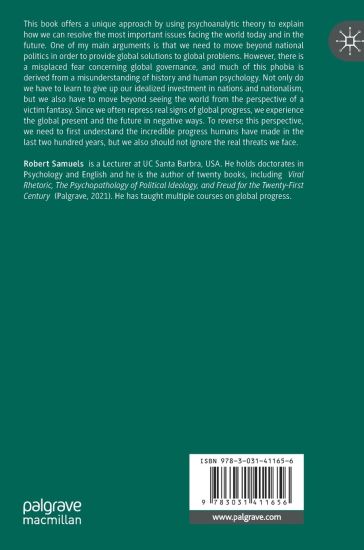
This book offers a unique approach by using psychoanalytic theory to explain how we can resolve the most important issues facing the world today and in the future. One of my main arguments is that we need to move beyond national politics in order to provide global solutions to global problems. However, there is a misplaced fear concerning global governance, and much of this phobia is derived from a misunderstanding of history and human psychology. Not only do we have to learn to give up our idealized investment in nations and nationalism, but we also have to move beyond seeing the world from the perspective of a victim fantasy. Since we often repress real signs of global progress, we experience the global present and the future in negative ways. To reverse this perspective, we need to first understand the incredible progress humans have made in the last two hundred years, but we also should not ignore the real threats we face.
The Psychopathology of Political Ideologies

The Psychopathology of Political Ideologies

Robert Samuels

TAYLOR FRANCIS LTD
2023
nidottu
Inspired by Freud’s The Psychopathology of Everyday Life, this book examines the unconscious processes shaping contemporary political ideologies. Addressing ten fundamental questions, Robert Samuels identifies four basic political ideologies: liberal, conservative, Left, and Right, which are often placed in the structure of a logical square, determined by two binary oppositions, with a fifth structure of centrism complicating the square. He turns to psychoanalysis to explain the unconscious defense mechanisms that structure these political ideologies. Each chapter uses a recent, influential title as a gateway to the analysis of the ideologies and structures identified. Through this analysis, Samuels argues that belief in ideological structures is tied to triumvirates of institutions and ideals; conservatives being tied to premodern institutions of religion, feudalism, and monarchy, while modern liberals are tied to ideals of universality, objectivity, and empiricism. He concludes that this investment in universality shapes the ethics of modern globalization and democratic liberalism. Unlike other books, conclusions are reinforced through examples drawn from current events with an integrated model of different psychopathologies. The Psychopathology of Political Ideologies moves beyond providing an understanding of what drives different political investments, to offer a more rational and conscious comprehension of subjectivity and social organization. This book will be a great resource for those interested in politics, political science psychology, social psychology, globalization, and ideology.
The Psychoanalytic Understanding of Consciousness, Free Will, Language, and Reason
The Psychoanalytic Understanding of Consciousness, Free Will, Language, and Reason examines the ways in which we can use psychoanalysis in order to better understand humanity and explores the question of what makes us human. For thousands of years, thinkers have been trying to define what makes us human. Some of the main questions they have asked is: What is consciousness? Do we have free will? Do animals use language? And what does reason mean? Samuels argues that we need to better understand the psychoanalytic approach to human nature in order to answer these questions, as well as using it to provide a new way of understanding issues such as addiction, political conflict, ideology, and destructive personal relationship. This book will be of vital interest to psychotherapists, as well as students and researchers across the fields of psychoanalysis, philosophy, and psychology.
Political Pathologies from The Sopranos to Succession
Political Pathologies from The Sopranos to Succession argues that highly praised prestige TV shows reveal the underlying fantasies and contradictions of uppermiddle-class political centrists. Through a psychoanalytic interpretation of The Sopranos, Breaking Bad, The Wire, House of Cards, Dexter, Game of Thrones, and Succession, Robert Samuels uncovers how moderate “liberals” have helped to produce and maintain the libertarian Right. Samuels’ analysis explores the difference between contemporary centrists and the foundations of liberal democracy, exposing the myth of the “liberal media” and considers the consequences of these celebrated series, including the undermining of trust in modern liberal democratic institutions. Political Pathologies from The Sopranos to Succession contributes to a greater understanding of the ways media and political ideology can circulate on a global level through the psychopathology of class consciousness. This book will be of great interest to academics and scholars considering intersections of psychoanalytic studies, television studies, and politics.
Teaching Writing, Rhetoric, and Reason at the Globalizing University
This timely intervention into composition studies presents a case for the need to teach all students a shared system of communication and logic based on the modern globalizing ideals of universality, neutrality, and empiricism. Based on a series of close readings of contemporary writing by Stanley Fish, Asao Inoue, Doug Downs and Elizabeth Wardle, Richard Rorty, Slavoj Zizek, and Steven Pinker, this book critiques recent arguments that traditional approaches to teaching writing, grammar, and argumentation foster marginalization, oppression, and the restriction of student agency. Instead, it argues that the best way to educate and empower a diverse global student body is to promote a mode of academic discourse dedicated to the impartial judgment of empirical facts communicated in an open and clear manner. It provides a critical analysis of core topics in composition studies, including the teaching of grammar; notions of objectivity and neutrality; empiricism and pragmatism; identity politics; and postmodernism. Aimed at graduate students and junior instructors in rhetoric and composition, as well as more seasoned scholars and program administrators, this polemical book provides an accessible staging of key debates that all writing instructors must grapple with.