Kirjojen hintavertailu – 12 859 827 kirjaa ja 27 kauppaa

Kirjailija

Sophocles

Kirjat ja teokset yhdessä paikassa: 343 kirjaa, julkaisuja vuosilta 1825–2026, suosituimpiin kuuluu Sophocles' Oedipus at Colonus. Vertaile teosten hintoja ja tarkista saatavuus suomalaisista kirjakaupoista.

343 kirjaa

Kirjojen julkaisuvuodet: 1825–2026.

The Three Theban Plays: Sophocles

The Three Theban Plays: Sophocles

Sophocles

Createspace Independent Publishing Platform
2018
nidottu
The Three Theban Plays: Oedipus The King - Oedipus at Colonus - Antigone by Sophocles. Sophocles is one of three ancient Greek tragedians whose plays have survived. His first plays were written later than those of Aeschylus, and earlier than or contemporary with those of Euripides. Sophocles wrote over 120 plays during the course of his life, but only seven have survived in a complete form: Ajax, Antigone, The Women of Trachis, Oedipus Rex, Electra, Philoctetes and Oedipus at Colonus. The Theban plays consist of three plays: Oedipus Rex (also called Oedipus Tyrannus or Oedipus the King), Oedipus at Colonus and Antigone. All three plays concern the fate of Thebes during and after the reign of King Oedipus. They have often been published under a single cover. Sophocles, however, wrote the three plays for separate festival competitions, many years apart. Not only are the Theban plays not a true trilogy (three plays presented as a continuous narrative) but they are not even an intentional series and contain some inconsistencies among them. He also wrote other plays having to do with Thebes, such as the Epigoni, of which only fragments have survived.
The Tragedies

The Tragedies

Sophocles

Jazzybee Verlag
2018
nidottu
Sophocles was an Athenian dramatist, born of a prosperous family at Colonus, a beautiful suburb of Athens. His long and happy life coincided with the period of the Imperial greatness of Athens and his dramas are the most perfect exemplars of Attic art. This edition contains the following works: Oedipus The King Oedipus At Colonus Antigone Ajax Electra Trachiniae Philoctete
Plays of Sophocles: Sophocles

Plays of Sophocles: Sophocles

Sophocles

Createspace Independent Publishing Platform
2018
nidottu
Plays of Sophocles: Oedipus The King - Oedipus at colonus - Antigone. Sophocles is one of three ancient Greek tragedians whose plays have survived. His first plays were written later than those of Aeschylus, and earlier than or contemporary with those of Euripides. Sophocles wrote over 120 plays during the course of his life, but only seven have survived in a complete form: Ajax, Antigone, The Women of Trachis, Oedipus Rex, Electra, Philoctetes and Oedipus at Colonus. For almost 50 years, Sophocles was the most celebrated playwright in the dramatic competitions of the city-state of Athens that took place during the religious festivals of the Lenaea and the Dionysia. The Theban plays consist of three plays: Oedipus Rex (also called Oedipus Tyrannus or Oedipus the King), Oedipus at Colonus and Antigone. All three plays concern the fate of Thebes during and after the reign of King Oedipus.
The Three Theban Plays

The Three Theban Plays

Sophocles; F Storr

Lulu.com
2018
pokkari
The Theban Trilogy consists of Oedipus the King, Oedipus at Colonus, and Antigone - together these tell the tragic story of Oedipus the king of Thebes, and his daughter Antigone. Oedipus the King (in Latin Oedipus Rex) sees the youthful Oedipus consults the Oracle at Delphi, wherein it predicts that he will ""Mate with [his] own mother, and shed/With [his] own hands the blood of [his] own sire."" Oedipus at Colonus has the elderly Oedipus, by now ostracised and distrusted by society at large for his earlier, unintended wrongdoing. Blind after gouging out his own eyes in reaction to the revelations of the first play, it is his daughter/sister Antigone who escorts him to King Theseus. The final play in the Trilogy is Antigone - this title sees Oedipus offspring navigate the drama of a Civil War in Thebes. All three compositions are superb examples of Greek drama; owing to their revelatory contents and narrative twists, Sophocles' Theban plays remain popular to this day.
The Three Theban Plays

The Three Theban Plays

Sophocles; F Storr

Lulu.com
2018
sidottu

Halvin toimitettuna 32,00 €

The Theban Trilogy consists of Oedipus the King, Oedipus at Colonus, and Antigone - together these tell the tragic story of Oedipus the king of Thebes, and his daughter Antigone. Oedipus the King (in Latin Oedipus Rex) sees the youthful Oedipus consults the Oracle at Delphi, wherein it predicts that he will ""Mate with [his] own mother, and shed/With [his] own hands the blood of [his] own sire."" Oedipus at Colonus has the elderly Oedipus, by now ostracised and distrusted by society at large for his earlier, unintended wrongdoing. Blind after gouging out his own eyes in reaction to the revelations of the first play, it is his daughter/sister Antigone who escorts him to King Theseus. The final play in the Trilogy is Antigone - this title sees Oedipus offspring navigate the drama of a Civil War in Thebes. All three compositions are superb examples of Greek drama; owing to their revelatory contents and narrative twists, Sophocles' Theban plays remain popular to this day.
Plays of Sophocles Oedipus the King; Oedipus at Colonus; Antigone

Plays of Sophocles Oedipus the King; Oedipus at Colonus; Antigone

Sophocles

Createspace Independent Publishing Platform
2018
nidottu
The legends surrounding the royal house of Thebes inspired Sophocles to create a powerful trilogy of mankind's struggle aginst fate. KING OEDIPUS tells of a man who brings pestilence to Thebes for crimes he doesn't realise he has committed, and then inflicts a brutal punishment on himself. It is a devastating portrayl of a ruler brought down by his own oath. OEDIPUS AT COLONUS provides a fitting conclusion to the life of the aged and blinded king, while ANTIGONE depicts the fall of the next generation through the conflict between a young woman ruled by her conscience and a king too confident in his own authority.
The Philoctetes of Sophocles. Translated From the Greek
The 18th century was a wealth of knowledge, exploration and rapidly growing technology and expanding record-keeping made possible by advances in the printing press. In its determination to preserve the century of revolution, Gale initiated a revolution of its own: digitization of epic proportions to preserve these invaluable works in the largest archive of its kind. Now for the first time these high-quality digital copies of original 18th century manuscripts are available in print, making them highly accessible to libraries, undergraduate students, and independent scholars. Western literary study flows out of eighteenth-century works by Alexander Pope, Daniel Defoe, Henry Fielding, Frances Burney, Denis Diderot, Johann Gottfried Herder, Johann Wolfgang von Goethe, and others. Experience the birth of the modern novel, or compare the development of language using dictionaries and grammar discourses. ++++The below data was compiled from various identification fields in the bibliographic record of this title. This data is provided as an additional tool in helping to insure edition identification: ++++Harvard University Houghton LibraryN011199Translator's preface signed: Thomas Sheridan. Titlepage in red and black. With a half-title. Dublin: printed by J. Hyde and E. Dobson, for R. Owen, 1725. 12],51, 1]p.; 8
Electra, a Tragedy. Translated From the Greek of Sophocles
The 18th century was a wealth of knowledge, exploration and rapidly growing technology and expanding record-keeping made possible by advances in the printing press. In its determination to preserve the century of revolution, Gale initiated a revolution of its own: digitization of epic proportions to preserve these invaluable works in the largest archive of its kind. Now for the first time these high-quality digital copies of original 18th century manuscripts are available in print, making them highly accessible to libraries, undergraduate students, and independent scholars. Western literary study flows out of eighteenth-century works by Alexander Pope, Daniel Defoe, Henry Fielding, Frances Burney, Denis Diderot, Johann Gottfried Herder, Johann Wolfgang von Goethe, and others. Experience the birth of the modern novel, or compare the development of language using dictionaries and grammar discourses. ++++The below data was compiled from various identification fields in the bibliographic record of this title. This data is provided as an additional tool in helping to insure edition identification: ++++British LibraryT032487A prose translation. Also issued as part of: 'A collection of plays by eminent hands;' London, 1719. London: printed for J. Watts, and sold by W. Lewis, J. Brown and W. Meares, W. Taylor, N. Cliffe and D. Jackson and 3 others in London], 1714. 8], xii, 2],60p.: ill.; 12
The Tragedies of Sophocles, From the Greek; by Thomas Francklin, ... of 2; Volume 1
The 18th century was a wealth of knowledge, exploration and rapidly growing technology and expanding record-keeping made possible by advances in the printing press. In its determination to preserve the century of revolution, Gale initiated a revolution of its own: digitization of epic proportions to preserve these invaluable works in the largest archive of its kind. Now for the first time these high-quality digital copies of original 18th century manuscripts are available in print, making them highly accessible to libraries, undergraduate students, and independent scholars. Western literary study flows out of eighteenth-century works by Alexander Pope, Daniel Defoe, Henry Fielding, Frances Burney, Denis Diderot, Johann Gottfried Herder, Johann Wolfgang von Goethe, and others. Experience the birth of the modern novel, or compare the development of language using dictionaries and grammar discourses. ++++The below data was compiled from various identification fields in the bibliographic record of this title. This data is provided as an additional tool in helping to insure edition identification: ++++British LibraryT141000Vol.1 is dated 1759, vol.2, 1758. With a list of subscribers in vol.1. London: printed for R. Francklin, 1758-59. 2v., plate; 4
Oedipus, King of Thebes, a Tragedy, From the Greek of Sophocles
The 18th century was a wealth of knowledge, exploration and rapidly growing technology and expanding record-keeping made possible by advances in the printing press. In its determination to preserve the century of revolution, Gale initiated a revolution of its own: digitization of epic proportions to preserve these invaluable works in the largest archive of its kind. Now for the first time these high-quality digital copies of original 18th century manuscripts are available in print, making them highly accessible to libraries, undergraduate students, and independent scholars. Western literary study flows out of eighteenth-century works by Alexander Pope, Daniel Defoe, Henry Fielding, Frances Burney, Denis Diderot, Johann Gottfried Herder, Johann Wolfgang von Goethe, and others. Experience the birth of the modern novel, or compare the development of language using dictionaries and grammar discourses. ++++The below data was compiled from various identification fields in the bibliographic record of this title. This data is provided as an additional tool in helping to insure edition identification: ++++British LibraryT140985With a leaf of errata between the 'Advertisement' and the 'Argument'. Oxford: printed at the Clarendon Press; and sold by J. and J. Fletcher: and by Mess. Rivington; and Mess. Payne: London, 1790. 8],93, 1]p.; 8
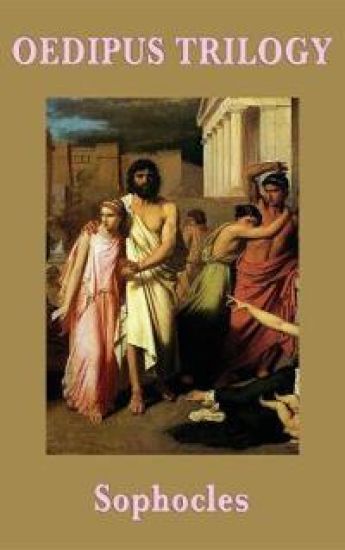
Oedipus Trilogy

Oedipus Trilogy

Sophocles

SMK Books
2018
sidottu
This work has been selected by scholars as being culturally important and is part of the knowledge base of civilization as we know it. This work is in the public domain in the United States of America, and possibly other nations. Within the United States, you may freely copy and distribute this work, as no entity (individual or corporate) has a copyright on the body of the work. Scholars believe, and we concur, that this work is important enough to be preserved, reproduced, and made generally available to the public. To ensure a quality reading experience, this work has been proofread and republished using a format that seamlessly blends the original graphical elements with text in an easy-to-read typeface. We appreciate your support of the preservation process, and thank you for being an important part of keeping this knowledge alive and relevant.
Plays of Sophocles Oedipus the King; Oedipus at Colonus; Antigone

Plays of Sophocles Oedipus the King; Oedipus at Colonus; Antigone

Sophocles

Createspace Independent Publishing Platform
2018
nidottu
The legends surrounding the royal house of Thebes inspired Sophocles to create a powerful trilogy of mankind's struggle aginst fate. KING OEDIPUS tells of a man who brings pestilence to Thebes for crimes he doesn't realise he has committed, and then inflicts a brutal punishment on himself. It is a devastating portrayl of a ruler brought down by his own oath. OEDIPUS AT COLONUS provides a fitting conclusion to the life of the aged and blinded king, while ANTIGONE depicts the fall of the next generation through the conflict between a young woman ruled by her conscience and a king too confident in his own authority.
Plays

Plays

Sophocles

Createspace Independent Publishing Platform
2018
nidottu
Sophocles (born c. 496 bc, Colonus, near Athens Greece]-died 406, Athens) was an ancient Greek tragedy playwright. Not many things are known about his life other than that he was wealthy, well educated and wrote about one hundred and twenty three plays (of which few are extant). One of his best known plays is 'Oedipus the King' (Oedipus Rex).
Oedipus at Colonus

Oedipus at Colonus

Sophocles

Createspace Independent Publishing Platform
2018
nidottu
Sophocles (born c. 496 bc, Colonus, near Athens Greece]-died 406, Athens) was an ancient Greek tragedy playwright. Not many things are known about his life other than that he was wealthy, well educated and wrote about one hundred and twenty three plays (of which few are extant). One of his best known plays is 'Oedipus the King' (Oedipus Rex).