Kirjojen hintavertailu – 12 859 818 kirjaa ja 27 kauppaa

Kirjailija

Stéphane Mallarmé

Kirjat ja teokset yhdessä paikassa: 76 kirjaa, julkaisuja vuosilta 1970–2026, suosituimpiin kuuluu Villiers de l'Isle-Adam. Vertaile teosten hintoja ja tarkista saatavuus suomalaisista kirjakaupoista.

Nimi esiintyy myös muodoissa: Stephane Mallarme, Stephane Mallarmé

76 kirjaa

Kirjojen julkaisuvuodet: 1970–2026.

Poésies

Poésies

Stéphane Mallarmé

Culturea
2022
pokkari
Avec St phane Mallarm , nous assistons en m me temps une revanche du pr cieux qu'au dix-septi me si cle le classicisme avait pens craser jamais. St phane Mallarm e t t un charmant po te de salon, un petit abb de cour, f t des dames. De la pr ciosit , il tiendra sa recherche syst matique des expressions neuves, des p riphrases qui d couvrent entre les objets des rapports tendus. Il ne tombe pas pour autant dans le ridicule, car sa pr ciosit se nuance toujours d'un sourire d'ironie qui prouve que le po te n'est pas dupe des artifices qu'il emploie. Pr cieux dans son expression, il est baudelairien par ses tats d' me, dans le sens o il est tortur par le m me d mon que Baudelaire: l'ennui. Les romantiques trouvaient des consolations dans la nature. Sa beaut n'apaise point son me. En vain, les fleurs s' panouissent, les oiseaux gazouillent dans les haies. Le po te n'est pas lib r de son tourment: Puis je tombe nerv de parfums d'arbres, las, Et creusant de ma face une fosse mon r ve, Mordant la terre chaude o poussent les lilas, J'attends, en m'ab mant que mon ennui s' l ve... Il se moquait de tout pour plaire aux d licats dont il tait, lui, le plus difficile, dira de lui Verlaine, en 1880. Et aussi: Pourvu que son vers fut nombreux, musical; rare, il consid rait la clart comme une gr ce secondaire. Texte tabli sur l' dition de 1898.
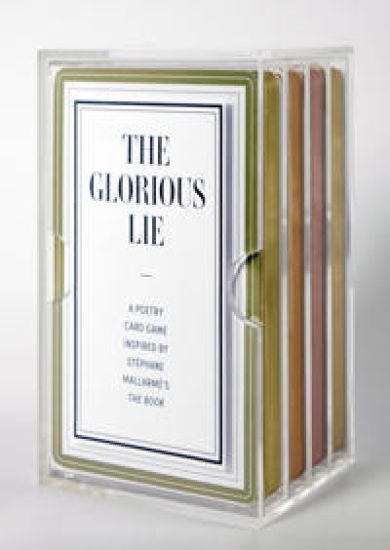
The Glorious Lie / The Glory of the Lie

The Glorious Lie / The Glory of the Lie

Stéphane Mallarmé

Marquand Books Inc
2022
muu
Mallarmé’s magnum opus rendered as an open-ended Tarot-esque card game Upon his death, Stéphane Mallarmé (1842–98) left hundreds of notes on an unrealized great work he called The Book. Housed in a clear Plexiglas box, this card-deck conception of his project draws from that material, and from other writings alluding to its possible forms, including a letter in which he describes “a book that is architectural…. The orphic explanation of the Earth, which is the sole duty of the poet, and the literary game par excellence.” The title of this game derives from another letter in which Mallarmé writes, “perhaps the title of my volume of lyric poetry will be The Glory of the Lie, or The Glorious Lie.” Each deck contains 48 cards: three with artwork on each side, and 45 with words or phrases on each side. The size of the cards, their gold edging and the physical housing of the decks in the box reflect descriptions and clues in Mallarmé’s notes. The manner of playing the game is left open, but quotes and diagrams by Mallarmé in the accompanying 20-page booklet point to the idea of pulling cards from each of the four decks and laying them out for one reading, then flipping the cards over for a second reading. The image cards function like the Arcana of Tarot, providing a visual language equal to the word cards. The readings might be used to create poetry or, like Tarot, to divine or illuminate.
Dikter

Dikter

Stéphane Mallarmé; Axel Englund

Ellerströms Förlag
2022
sidottu
”Den orfiska förklaringen av Jorden”, skrev Stéphane Mallarmé, ”är poetens enda uppgift och det högsta litterära spelet”. Det Stora Verk som han arbetade på under större delen av sitt liv lyckades han aldrig färdigställa, men vid sidan om detta skrev han dikter som revolutionerade den moderna litteraturen. Mallarmés poesi är kompromisslös i sin komplexitet, full av svävande symboler och mångtydig syntax som ställer höga krav på sin läsare. Men genom dunklet skimrar också en glasklar sinnlighet, där ordens klangfärger och betydelser speglar varandra i ett ständigt undanglidande spel. Denna tvåspråkiga utgåva innehåller för första gången på svenska Mallarmés enda diktsamling Poésies (Dikter) i sin helhet, följt av den brett upplagda, grafiskt komponerade dikten Un coup de Dés jamais n’abolira le Hasard (Ett tärningskast kan aldrig upphäva slumpen). Här finns också utförliga kommentarer som erbjuder svenska läsare en ingång till de svårtillgängliga dikterna, samt ett efterord som presenterar Mallarmés liv och verk, liksom de särskilda utmaningar hans poesi ställer sin översättare inför.
Afternoon of a Faun

Afternoon of a Faun

Stephane Mallarmé

Marquand Books Inc
2020
nidottu
The second published collaboration between Stephane Mallarme and Edouard Manet (after Mallar,e's translation of Poe's The Raven), L'apres-midi d'un faune; is one of the poet's best-known works. It provided the basis for Debussy's Prelude a l'apres-midi d'un faune; (1894), which in turn inspired Nijinsky's ballet L'apres-midi d'un faune;, first performed in Paris in 1912, with Nijinsky famously dancing the title role. Mallarme's poem unfolds in a sensual reverie as a Pan-like faun, arising from slumber, recollects his encounters with two forest nymphs in a monologue filled with pastoral and erotic allusions For Mallarme, such publications were total works, with attention paid to every detail of layout, typography, punctuation and artwork. For the original 1876 publication, Manet created four wood engravings: two drawings that open and close the poem, and a frontispiece and ex-libris sheet that the artist hand-tinted with pink wash. This volume reproduces that first edition at full size accompanied by a new translation.
The Raven / Le Corbeau / The Raven

The Raven / Le Corbeau / The Raven

Stéphane Mallarmé

Marquand Books Inc
2019
pokkari
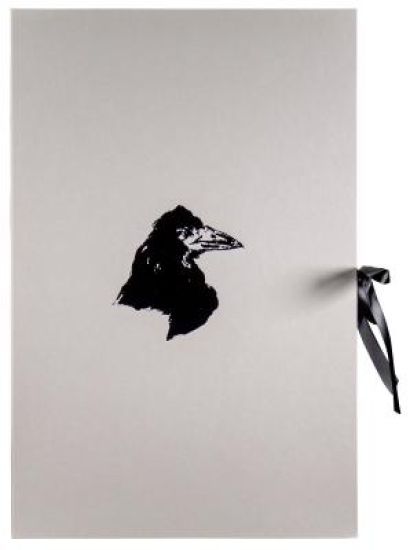
Stéphane Mallarmé (1842–98) claimed to have learned English in order to read Poe, an American poet greatly admired by the French Symbolists. This volume reproduces at full size the first-edition bilingual publication of Le Corbeau / The Raven (Richard Lesclide, Paris, 1875), Mallarmé’s prose translation of Poe’s melancholy poem, including six commissioned illustrations by Édouard Manet—four that visually interpret specific stanzas of the poem, one that serves as the ex-libris and a cover image of a raven’s head that functions as the poem’s title. In addition, a new retranslation back into English of Mallarmé’s text, which was both praised and criticized for its literalism, reveals the particular tenor and subtleties of his reading of Poe’s verse and his feel, as a fellow poet, for the emotive and evocative power of language. The result is a circular exploration of the poem and its translation. The volume also reflects Mallarmé’s specifications for layout, typeface and paper. This is the second in a series exploring Mallarmé in translation. The first, A Blow of Dice Never Will Abolish Chance, appeared in 2018; forthcoming is a translation of the second published collaboration between Mallarmé and Manet, Afternoon of a Faun (L’après-midi d’un faune).
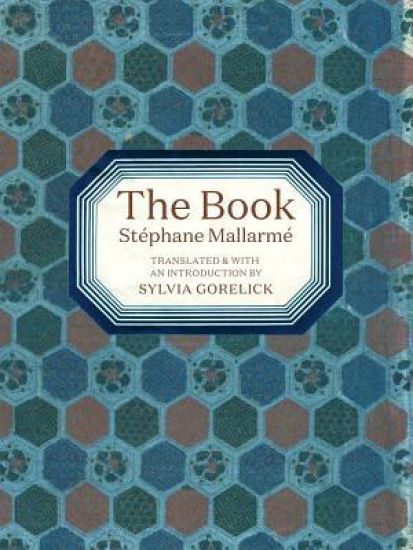
The Book

The Book

Stephane Mallarme

Exact Change,U.S.
2018
nidottu

Halvin toimitettuna 26,50 €

The French poet Stephane Mallarme (1842-1898) was modernism's great champion of the book as both a conceptual and material entity: probably his most famous pronouncement is 'everything in the world exists in order to end up as a book.' The Book was Mallarme's total artwork, a book to encompass all books. Frequently quoted, sometimes excerpted, but never before translated in its entirety, The Book is a visual poem about its own construction, the scaffolding of a cosmic architecture intended to reveal 'all existing relations between everything.'
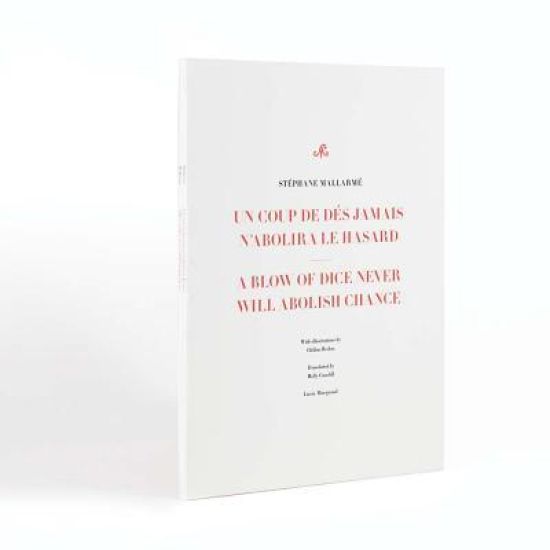
A Blow of Dice Never Will Abolish Chance: A Poem

A Blow of Dice Never Will Abolish Chance: A Poem

Stephane Mallarme

Marquand Books Inc
2018
nidottu
A deluxe, large-format publication of French poet Stéphane Mallarmé’s most influential work Among the most influential works of the French poet Stéphane Mallarmé (1842–98), Un Coup de dés jamais n'abolira le Hasard feels to this day revolutionary and resoundingly contemporary, both for the suggestive power of its unconventional free verse and for its striking visual impact. For the poet, the white spaces, or scattered "silences," are as integral to the reading as the words on the page, and the very design—the typographical layers and the arrangement of lines and words upon the page and across spreads—carries meaning and content. At the time of his death in 1898, Mallarmé was close to realizing his vision of a deluxe, large-format publication of the poem that would meet his precise specifications with regard to dimensions, typography and page design, and would include commissioned lithographs by his friend Odilon Redon, an artist he admired for the tonal richness and symbolic power of his images. This two-volume edition brings all of these elements together for the first time in an English-language edition. Separate French and English volumes allow for individual readings of the original poem and this fresh new translation (A Blow of Dice Never Will Abolish Chance), each produced at full scale, meticulously typeset and accompanied by Redon's evocative illustrations.
Variations sur un sujet

Variations sur un sujet

Stéphane Mallarmé

Createspace Independent Publishing Platform
2017
nidottu
" ... Plusieurs fois vint un Camarade, le m me, cet autre, me confier le besoin d'agir: que visait-il - comme la d marche mon endroit annon a de sa part aussi, lui, jeune, l'occupation de cr er, qui para t supr me et r ussir avec des mots; j'insiste, qu'entendait-il express ment ? Se d tendre les poings, en rupture de songe s dentaire, pour un tr pignant vis- -vis avec l'id e, ainsi qu'une envie prend ou bouger: mais la g n ration semble peu agit e, outre le d sint ressement politique, du souci d'extravaguer du corps. Except la monotonie, certes, d'enrouler, entre les jarrets, sur la chauss e, selon l'instrument en faveur, la fiction d'un blouissant rail continu. Agir, sans ceci et pour qui n'en fait commencer l'exercice fumer, signifia, visiteur, je te comprends, philosophiquement, produire sur beaucoup un mouvement qui te rendre en retour l' moi que tu en fus le principe, donc existes: dont aucun ne se croit, au pr alable, s r. Cette pratique entend deux fa ons; ou, par une volont , l'insu, qui dure une vie, jusqu' l' clat multiple - penser, cela: sinon, les d versoirs port e maintenant dans une pr voyance, sup rieure toute dilit , journaux et leur tourbillon, y d terminer une force vers un sens, quelconque de cent contrari e, avec l'immunit du r sultat nul..."
Pages

Pages

Stéphane Mallarmé

Createspace Independent Publishing Platform
2017
nidottu
" ... Le Silence il est certain qu' mon c t , ainsi que songes, tendue dans un bercement de promenade sous les roues assoupissant l'interjection de fleurs, toute femme, et j'en suis une qui voit clair ici, m'exempte de l'effort prof rer un vocable: la complimenter haut de quelque interrogatrice toilette, offre de soi presque l'homme en faveur de ce qui s'ach ve l'apr s-midi, ne pouvant l'encontre de tout ce rapprochement fortuit, que sugg rer la distance sur ses traits aboutie une fossette de spirituel sourire. Ainsi ne consent la r alit ; car ce fut impitoyablement, hors du rayon qu'on sentait avec luxe expirer aux vernis du landau, comme une vocif ration, parmi trop de tacite f licit pour une tomb e de jour sur la banlieue, avec orage, dans tous sens la fois et sans motif, du rire strident ordinaire des choses et de leur cuivrerie triomphale: au fait, la cacophonie l'ou e de quiconque, un instant cart , plut t qu'il ne s'y fond, aupr s de son id e, reste vif devant la hantise de l'existence..."
Poems and Prose Poems: with "The book, spiritual instrument" and "A throw of the dice. . ."
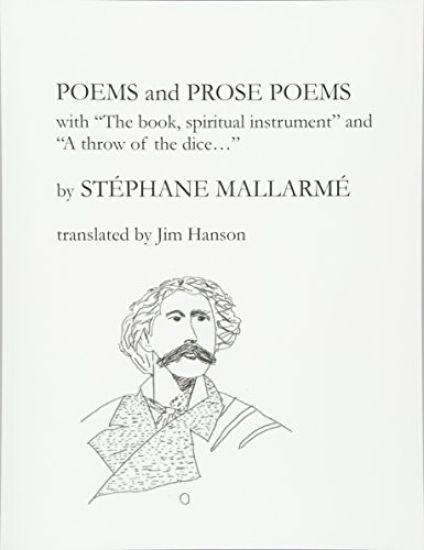
I started to translate Mallarm 's poems because I wasn't content with the English versions I could find. In translation, poets who preceded and followed Mallarm are accessible to us. Baudelaire is accessible to us, Apollinaire is accessible to us. I couldn't find a way into Mallarm in the English versions I found, and I suspected it wasn't his fault. Mallarm was an English teacher, and he did translations of the poems of his beloved Edgar Allan Poe, in prose, of course. But his poems in French were metrical and rhymed. Sometimes the meaning of his poems is guided, let us say, by the rhyme and meter he chose, "ceding the initiative to words" as he wrote in "Variations sur un sujet". There are alternate homophonic readings of some of his lines as well, that could never be rendered into another language as poetry, only as notes. My inability to reproduce the multiple layers of Mallarm 's poems in French into American verse is a disappointment, but an inevitable one. Those layers rely on sound similarities that aren't available in our language. Most translations of Mallarm into English rhyme and use traditional meters. This seemed to me to be the wrong approach. We have seen how Mallarm approached translating Poe, after all. Mallarm translated this way moves even further away from the meaning of the poem as a second rhyme scheme, this time in English, imposes an alien framework over the poem. These translations, no matter how carefully constructed, often sound academic to me. I come from a poetry tradition that learned a great deal from 20th century French poetry, Apollinaire, Reverdy, Desnos and all the rest of them. Some of the great pleasures in music in 20th century American poetry come from responses to French poetry, for instance, John Ashbery's "The Tennis Court Oath", or Charles Olson's Rimbaud takeoff "Variations done for Gerald Van Der Wiele", or Ted Berrigan's translations of French poetry in "Bean Spasms". Hopefully the music I heard there echoes a little in these versions.
Azure

Azure

Stéphane Mallarmé

Wesleyan University Press
2015
nidottu
During his lifetime, Stéphane Mallarmé (1842 - 1898) was recognized as one of the greatest living French poets. He wrote extensively on themes of reality and his desire to turn away from it, marrying form and content in revolutionary ways that departed drastically from the more tightly controlled French tradition. Despite his status as one of the first modernists, much of Mallarmé's radicalism has been lost in translation. Finally, in this new collection by Blake Bronson-Bartlett and Robert Fernandez, the magic and mastery of form and diction, so striking in Mallarmé's French verse, comes to life in English. Drawing from Poésies (1899), Un coup de dés (A Cast of Dice), and the "Livre" (the "Book" - the overarching conceptual work left unfinished at the death of the poet), this collection captures Mallarmé's true linguistic brilliance, bringing the poems into our current history while retaining the music, playfulness, and power of the originals.