Kirjojen hintavertailu – 12 859 818 kirjaa ja 27 kauppaa

Kirjailija

Stéphane Mallarmé

Kirjat ja teokset yhdessä paikassa: 76 kirjaa, julkaisuja vuosilta 1970–2026, suosituimpiin kuuluu Villiers de l'Isle-Adam. Vertaile teosten hintoja ja tarkista saatavuus suomalaisista kirjakaupoista.

Nimi esiintyy myös muodoissa: Stephane Mallarme, Stephane Mallarmé

76 kirjaa

Kirjojen julkaisuvuodet: 1970–2026.

Sonnets

Sonnets

Stephane Mallarme

Shearsman Books
2008
pokkari
A fully bilingual edition of Mallarme's Sonnets, with introduction and notes. An ideal way to find one's way into Mallarme's engagement with this particular form, which played a central part in his work in the last 15 years of his life. Stephane Mallarme (1842-1898) is among the greatest of the French poets, one whose relatively small ouvre has had a disproportionate impact on subsequent developments in theory, in the philosophy of language, and French poetry in the twentieth century. Essentially an occasional poet, Mallarme's most original and successful writing was done in the 30 years between the later 1860s, when he underwent a spiritual crisis, and 1898 when he died at the age of 56. His writings can be divided into three main areas: the longer poems of his earlier period (1860s to 1870s, including L'Herodiade and L'Apres-midi d'un faune), his various theoretical reflections on poetry, theatre and music of the 1870s, 80s and 90s (in particular those gathered under the heading Divagations) and his sonnets of the 1880s and 90s which, along with his experimental poem Un coup de Des of 1897, constitute his most original and successful poetic works. The thirty-nine sonnets presented here, with the originals and translations in parallel text, are in many ways his most typical and representative works in that they reflect a radical point of both continuity and discontinuity within a long tradition of European poetic expression and at the same time embody a uniquely modern synthesis of language's multiple potentialities.
Selected Poems of Mallarme, Bilingual edition

Selected Poems of Mallarme, Bilingual edition

Stephane Mallarme

University of California Press
2002
pokkari
The leading poet of French symbolism, Stephane Mallarme has exercised an enormous influence both on French and on English and American avant-garde writers. In this volume C. F. MacIntyre has translated forty-three of his poems, including the "Ouverture" and "Scene" from Herodiade, which was to have been a drama in verse, and the well-known L'Apres-midi d'un faune, for which Debussy composed his orchestral prelude. The French text faces the English translations, which are both true to the original and poetic. Indeed, as MacIntyre suggests, Debussy is probably "one of the best guides into the mysterious realm of Mallarme." The poet was more concerned with the music of words, their sounds and vague associations, than with their conventional meanings; one of the elements in his credo was that suggestion and evocation are of greater significance than statement. His syntax is fractious, his meaning frequently enigmatic; but the reader will find MacIntyre's notes helpful in savoring the translations and the original French verses.
Documents Stephane Mallarme - Nouvelle Serie II
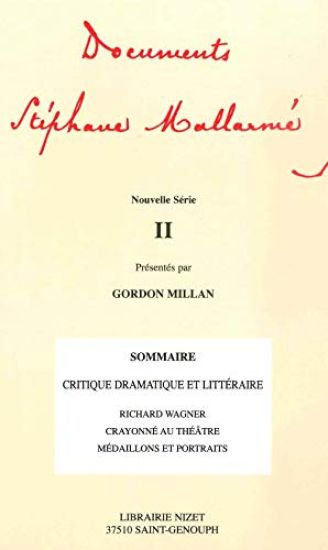
Fidele aux intentions de la premiere serie des Documents Mallarme presentee par Carl Paul Barbier, cette nouvelle serie a pour but de fournir aux specialistes et aux chercheurs un outil de travail qui leur permettra de suivre jusque dans le moindre detail l'elaboration des textes mallarmeens depuis le moment de leur conception jusqu'a l'etat imprime le plus evolue, en passant par tous les etats intermediaires, imprimes ou manuscrits, connus a l'heure actuelle. Ce deuxieme volume reunit les grands morceaux de critique dramatique et litteraire composes entre 1885 et la fin de la vie du poete dans lesquels celui-ci cherche surtout a se situer ainsi que son grand oeuvre reve par rapport a ses predecesseurs et a ses contemporains. Ce volume presente trois parties: un texte sur Richard Wagner, des etudes sur le theatre (Crayonne au theatre) et des portraits d'artistes particulierement aimes de Mallarme (Quelques medaillons et portraits en pied).
Selected Letters of Stephane Mallarme/20105

Selected Letters of Stephane Mallarme/20105

Stephane Mallarme; Rosemary Lloyd

University of Chicago Press
1988
sidottu
It is the reading world's good fortune that Stephane Mallarme's letters survived, allowing later generations an intimate look at the inner life of one of Europe's most important poets. Mallarme (1842-98), often called the father of the Symbolists, has had an immense influence on the development of modern European poetry. It was his ambition to create a poetry pure of quotidian reality autonomous, concentrated, linguistically inventive. His correspondence documents the evolution of this aim, the crafting of a poetics out of a life inescapably "real" in its pains and charms."
Documents Stephane Mallarme I

Documents Stephane Mallarme I

Stephane Mallarme

Klincksieck
1985
nidottu
Dans cette premiere livraison des Documents Stephane Mallarme, choisis et commentes par Carl Paul Barbier, on trouvera plusieurs lettres adressees au poete, et deux documents importants. Tout d'abord, a ajouter a la "Correspondance Mallarme", une lettre venimeuse (evidemment anonyme) d'un "Republicain de lettres" qui, comme beaucoup d'autres proselytes bornes des "belles lettres francaises", n'appreciait guere les libertes poetiques de Mallarme. On lira avec plaisir, cette fois, les lettres provenant des admirateurs, souvent amis de l'ombre: celles des peintres Edvard Munch et L. W. Hawkins ou celles du poete et romancier italien Luigi Gualdo. Dans la partie concernant specifiquement l'oeuvre mallarmeenne, on retiendra d'abord le splendide article que Mallarme consacra en 1876 a son ami Edouard Manet et a la peinture impressionniste naissante. Un document tres court, version initiale de Prose pour des Esseintes (1885), demontre que ce poeme n'avait a l'origine aucun lien avec Huysmans et son roman A Rebours. Enfin, les reponses que fit Mallarme a un questionnaire donne vers 1888 dans le salon tres mondain de la chere Mery Laurent, sont particulierement savoureuses.
Selected Poetry and Prose

Selected Poetry and Prose

Stephane Mallarme

New Directions Publishing Corporation
1982
nidottu
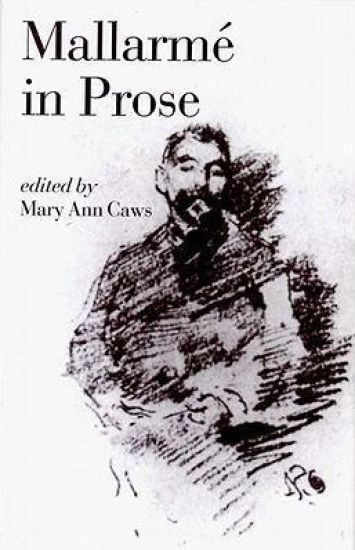
Selected Poetry and Prose of Stéphane Mallarmé presents what can be considered the essential work of the renowned “father of the Symbolists.” Mallarmé’s major elegies, sonnets, and other verse, including excerpts from the dialogue “Hériodiade,” are all assembled here with the French and English texts en face. Also included (not bilingually) are the visual poem “Dice Thrown Never Will Annul Chance” and the drama “Igitur,” as well as letters, essays, and reviews. Although his primary concern was with poetry, the aesthetics of Stéphane Mallarmé (1842-98) has touched all the arts. During the last twenty years of his life, his Paris apartment was a major literary gathering place. Every Tuesday evening, standing beneath the portrait of himself by his friend Edouard Manet, the poet addressed reverent gatherings which included at various times Paul Valery and André Gide, among many others. The American painter James Whistler was influenced by these “Mardis,” and one of the best-known poems in the present collection, “The Afternoon of a Faun,” inspired Claude Debussy’s famous musical composition. In translation, the subtle and varied shades of Mallarmé’s oeuvre may best be rendered by diverse hands. Editor Mary Ann Caws, the author of books on René Char, Robert Desnos, and various aspects of modern French writing, has brought together the work of fourteen translators, spanning a century, from the Symbolists and the Bloomsbury group (George Moore and Roger Fry) to Cid Corman, Brian Coffey, and other contemporary poets and writers.
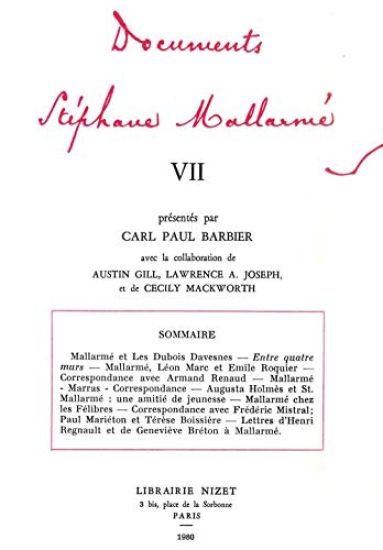
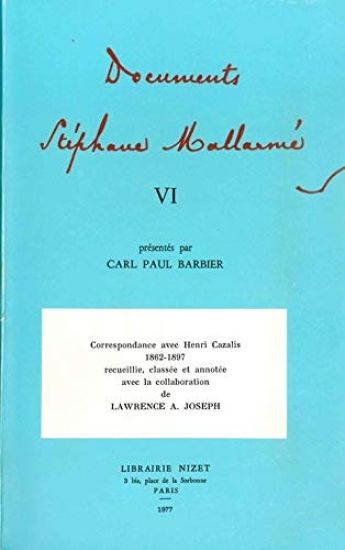
Documents Stephane Mallarme V

Documents Stephane Mallarme V

Stephane Mallarme

Klincksieck
1976
nidottu
La plus grande partie de ce cinquieme tome des Documents Stephane Mallarme est consacree a la biographie et a la genealogie du poete. Les pieces innombrables ici reproduites et commentees, sont de toutes sortes: avis de naissance, de deces, de mariage, notes de bapteme, actes et contrats notaries, et bien sur lettres de famille. Celles-ci, debutant une bonne dizaine d'annees avant la naissance de Stephane Mallarme, nous livrent une connaissance intime et tres vaste de sa famille, la correspondance englobant des parents parfois fort eloignes. La periode debutant vers 1860 est particulierement interessante: on constate a quel point le jeune Stephane eut a souffrir de l'accueil decourageant que sa famille reserva a ses projets d'avenir, pas meme encore litteraires, mais de professeur d'anglais en universite D'ailleurs, le poeme Les Fenetres, ecrit en 1863, et dont Carl Paul Barbier retrace les avatars de ses publications successives, exprime toute l'amertume et la rancoeur du jeune homme envers une famille aimante certes, mais bien trop bourgeoise, bigote et conformiste pour comprendre une nature d'artiste (Ivre, il vit, oubliant l'horreur des saintes huiles/Les tisanes, l'horloge et le lit inflige...).
Documents Stephane Mallarme II

Documents Stephane Mallarme II

Stephane Mallarme

Klincksieck
1970
nidottu
Ce second tome des Documents Stephane Mallarme revele le poete, le traducteur et surtout l'epistolier. A la nue accablante tu, ecrit en 1887 ou 1888 et publie en 1895, est l'une des compositions les plus difficiles de Mallarme. Ce sonnet a beaucoup alimente la polemique d'alors concernant la poesie des symbolistes en general, et celle de Mallarme en particulier. Quelques precisions relatives a l'historique de la publication du poeme controverse sont ici donnees. Mallarme, on le sait, a traduit plusieurs poetes anglo-saxons, notamment Edgar Allan Poe. La traduction qu'il donna de la celebre Godiva, poeme d'Alfred Tennyson (1809-1892), resta inedite jusqu'en 1970... Le brouillon de cette traduction, meticuleusement reproduit par Carl Paul Barbier, est donc bien precieux. Mais ce tome laisse la part belle a l'epistolier. On trouvera d'abord la correspondance (souvent pittoresque) avec Robert de Montesquiou, s'etalant sur vingt annees, puis le "morceau de choix" les lettres, si pleines d'affections, de charme (un ronronnement de chat) entre Mallarme et "ses Dames", sa femme et sa fille Genevieve. Echanges d'autant plus touchants qu'ils occupent les deux dernieres annees de la vie du poete. Une quinzaine de jours avant sa mort, le "Papa" ecrit a sa fille: "Un orage, que nous eussions retenu a pleins bras, a passe sur le pays (...) le travail de l'apres-midi a fondu"...