Kirjojen hintavertailu – 12 859 827 kirjaa ja 27 kauppaa

Kirjailija

Thomas Jefferson

Kirjat ja teokset yhdessä paikassa: 481 kirjaa, julkaisuja vuosilta 1901–2027, suosituimpiin kuuluu A Defence of the Revolutionary History of North Carolina from the Aspersions of Mr. Jefferson. Vertaile teosten hintoja ja tarkista saatavuus suomalaisista kirjakaupoista.

481 kirjaa

Kirjojen julkaisuvuodet: 1901–2027.

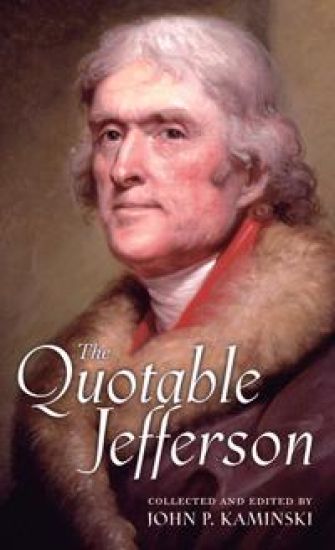
The Quotable Jefferson

The Quotable Jefferson

Thomas Jefferson

Princeton University Press
2006
sidottu
A definitive compilation of Jeffersonian writings, quotations, and other words of wisdom furnishes hundreds of pronouncements on nearly five hundred different subjects, all organized alphabetically by topic, accompanied by Jefferson's reflections on his contemporaries, his own life, and career, as well as the thoughts of his colleagues on him.
The Essential Jefferson

The Essential Jefferson

Thomas Jefferson

Hackett Publishing Co, Inc
2006
sidottu
Through substantial selections from Jefferson's writings--including his earliest writings, Notes on Virginia, and key public papers and personal correspondence--this volume traces the development of his thinking on such fundamental issues as republicanism, constitutionalism, slavery, and the separation of religion from politics. Footnotes identify Jefferson's correspondents and provide useful context.
The Essential Jefferson

The Essential Jefferson

Jean M. Yarbrough; Thomas Jefferson

Hackett Pub Co Inc
2006
pokkari
In substantial selections from his earliest writings, the "Notes on Virginia", his public papers, and his personal correspondence, this volume traces the development of Jefferson's thinking on such fundamental issues as republicanism, constitutionalism, political parties, and the separation of religion from politics. His proposals for the education of women, the emancipation of slaves, and the expatriation of Native Americans are included, along with a number of intimate letters illustrating the range of Jefferson's interests and offering a peek into his private life. Drawing on the best Jeffersonian scholarship of the last thirty years, Yarbrough's Introduction sets Jefferson's life and writing in context and illuminates the ways in which his understanding of human nature influenced his political views. A brief head note introduces each selection and provides crucial background information; footnotes offer concise biographies of Jefferson's correspondents and identify other important figures and events. An index and select bibliography are also included.
The Papers of Thomas Jefferson, Retirement Series, Volume 2

The Papers of Thomas Jefferson, Retirement Series, Volume 2

Thomas Jefferson

Princeton University Press
2006
sidottu
The definitive edition of Thomas Jefferson's papers from the end of his presidency until his death continues with Volume Two, which covers the period from 16 November 1809 to 11 August 1810. Both incoming and outgoing letters are included, totaling 518 documents printed in full. General themes include Jefferson's financial troubles, which eventually led him to loan himself a large sum of money he was managing for Tadeusz Kosciuszko; his preparations to face a lawsuit stemming from his decision as president to remove Edward Livingston from a valuable property in New Orleans; other legal complications involving his landholdings and the settlement of estates he had inherited long before; his plans to breed merino sheep and share them gratis with his fellow Virginians; and his ongoing interest in the Republican party's success. Highlights include a long list of books on agriculture that Jefferson probably compiled to guide the Library of Congress in its purchases; descriptions of inventions by Robert Fulton and more obscure figures such as the New Orleans engineer Godefroi Du Jareau; Jefferson's draft letter criticizing the Quakers as unpatriotic, much of which he later deleted; the letter in which he ordered a set of silver tumblers that have become known as the Jefferson Cups; and an important treatise on taxation by the distinguished French political economist Pierre Samuel Du Pont de Nemours, published here for the first time.
The Papers of Thomas Jefferson, Volume 32

The Papers of Thomas Jefferson, Volume 32

Thomas Jefferson

PRINCETON UNIVERSITY PRESS
2005
sidottu
"I have sometimes asked myself whether my country is the better for my having lived at all?" Jefferson muses in this volume. His answer: "I do not know that it is." Required by custom to be "entirely passive" during the presidential campaign, Jefferson, at Monticello during the summer of 1800, refrains from answering attacks on his character, responds privately to Benjamin Rush's queries about religion, and learns of rumors of his own death. Yet he is in good health, harvests a bountiful wheat crop, and maintains his belief that the American people will shake off the Federalist thrall. He counsels James Monroe, the governor of Virginia, on the mixture of leniency and firmness to be shown in the wake of the aborted revolt of slaves led by the blacksmith Gabriel. Arriving in Washington in November, Jefferson reports that the election "is the only thing of which any thing is said here." He is aware of Alexander Hamilton's efforts to undermine John Adams, and of desires by some Federalists to give interim executive powers to a president pro tem of the Senate. But the Republicans have made no provision to prevent the tie of electoral votes between Jefferson and Aaron Burr. Jefferson calls Burr's conduct "honorable & decisive" before prospects of intrigue arise as the nation awaits the decision of the House of Representatives. As the volume closes, the election is still unresolved after six long days of balloting by the House.
Light and Liberty

Light and Liberty

Thomas Jefferson

Modern Library Inc
2005
pokkari
Authoritative editions of great classics of world literature feature introductions by acclaimed writers, meticulous translations of foreign literature, commentary by distinguished writers and critics, biographical notes, and a comprehensive Reading Group Guide bound into each volume.
The Autobiography of Thomas Jefferson, 1743-1790

The Autobiography of Thomas Jefferson, 1743-1790

Thomas Jefferson

University of Pennsylvania Press
2005
pokkari
In 1821, at the age of seventy-seven, Thomas Jefferson decided to "state some recollections of dates and facts concerning myself." His ancestors, Jefferson writes, came to America from Wales in the early seventeenth century and settled in the Virginia colony. Jefferson's father, although uneducated, possessed a "strong mind and sound judgement" and raised his family in the far western frontier of the colony, an experience that contributed to his son's eventual staunch defense of individual and state rights. Jefferson attended the College of William and Mary, entered the law, and in 1775 was elected to represent Virginia at the Continental Congress in Philadelphia, an event that propelled him to all of his future political fortunes. Jefferson's autobiography continues through the entire Revolutionary War period, and his insights and information about persons, politics, and events-including the drafting of the Declaration of Independence, his service in France with Benjamin Franklin, and his observations on the French Revolution-are of immense value to both scholars and general readers. Jefferson ends this account of his life at the moment he returns to New York to become secretary of state in 1790. Complementing the other major autobiography of the period, Benjamin Franklin's, The Autobiography of Thomas Jefferson, reintroduced for this edition by historian Michael Zuckerman, gives us a glimpse into the private life and associations of one of America's most influential personalities. Alongside Jefferson's absorbing narrative of the way compromises were achieved at the Continental Congress are comments about his own health and day-to-day life that allow the reader to picture him more fully as a human being. Throughout, Jefferson states his opinions and ideas about many issues, including slavery, the death penalty, and taxation. Although Jefferson did not carry this autobiography further into his eventual presidency, the foundations for all of his thoughts are here, and it is in these pages that Jefferson lays out what to him was his most important contribution to his country, the creation of a democratic republic.

The Papers of Thomas Jefferson, Retirement Series, Volume 1

The Papers of Thomas Jefferson, Retirement Series, Volume 1

Thomas Jefferson

Princeton University Press
2005
sidottu
This volume inaugurates the definitive edition of papers from Thomas Jefferson's retirement. As the volume opens, a new president is installed and Jefferson is anticipating his return to Virginia, where he will pursue a fascinating range of personal and intellectual activities. He prepares for his final departure from Washington by settling accounts and borrowing to pay his creditors. At Monticello he tells of his efforts to restore order at his mismanaged mill complex, breed merino sheep, and otherwise resume full control of his financial and agricultural affairs. Though he is entering retirement, he still has one foot firmly planted in the world of public affairs. He acknowledges a flood of accolades on his retirement and has frequent exchanges with President James Madison. While fielding written requests for money, favors, and advice from a kaleidoscopic array of relatives, acquaintances, strangers, cranks, anonymous writers, and a blackmailer, he maintains a wide and varied correspondence with scientists and scholars on both sides of the Atlantic. The volume's highlights include first-hand accounts of Jefferson's demeanor at his successor's inauguration and one of the most detailed descriptions of life at Monticello by a visitor; Jefferson's recommendations on book purchases to a literary club and a teacher; chemical analyses of tobacco by a French scientist that first isolated nicotine; the earliest descriptions of the death of Meriwether Lewis; one of Jefferson's most eloquent calls for religious tolerance; and his modest assessment of the value of his writings in reply to a printer interested in publishing them.
Jefferson's Western Explorations

Jefferson's Western Explorations

Thomas Jefferson; Doug Erickson; Paul Merchant; Jeremy Skinner

Arthur H. Clark Company
2004
sidottu
Thomas Jefferson's 1806 Message provided the U. S. Congress, the American people, and interested parties throughout the world with a summary not only of the Lewis and Clark Expedition, but of other expeditions of the time. The value of this "Message from the President, " in addition to its rarity, is in the wealth of information it provided to individuals in the early nineteenth century about the wilderness in the unknown West, and the insights provided to today's reader. It is one of the rarest of printed items in the bibliography of early works on Lewis and Clark. Jefferson's Search for Information. The 1806 Message is an example of the Jeffersonian value of and search for information about the western lands recently acquired from France. The Message brings together the most authoritative accounts of the Louisiana Purchase, combining information from the explorations of Lewis and Clark on the Missouri, William Dunbar and George Hunter on the Ouachita, and Dr. John Sibley's researches on the Red River territory into one report, introduced by Jefferson himself. Editorial Background. The editors place the document in the context of Jefferson's interest in exploration of the West. They offer comparisons between the expeditions included in the Message and discuss the sources that assisted the leaders of these endeavors. A thorough history of the printer and his press is provided, along with an informative assessment of the location and provenance of known copies of the Natchez edition. Additional material included. The Natchez reprint of the Message, appearing after versions published in Washington and New York, also includes extracts from Dunbar's journal, as well as significant botanical observations not printed in those earlier editions. As such, the Natchez reprint is distinctly valuable in providing this unique information--a printed facsimile of this item is long overdue. Two appendices follow the text, including pages from the Washington edition not included in the Natchez edition, and a survey of correspondence of John Sibley available at the Library of Congress. The volume also includes four maps intended to accompany the original 1806 publications. Four folding maps are included in a special envelope at the rear of the book. The facsimile is augmented by an extensive introduction, two appendices, works cited, index, and seven illustrations. Printed on acid-free paper and bound in rich moss-green cloth with gold foil-stamped spine and front cover. Issued in an edition of only 750 copies.