Kirjojen hintavertailu – 12 859 828 kirjaa ja 27 kauppaa
Kirjailija
U. S. Department of Justice
Kirjat ja teokset yhdessä paikassa: 416 kirjaa, julkaisuja vuosilta 2001–2025, suosituimpiin kuuluu Drug Endangered Children: Guide for Law Enforcement. Vertaile teosten hintoja ja tarkista saatavuus suomalaisista kirjakaupoista.
Nimi esiintyy myös muodoissa: U.S. Department of Justice, U S Department of Justice
In 2009-12, 68% of victims of serious violent crime-rape or sexual assault, robbery, or aggravated assault-reported experiencing socio-emotional problems as a result of their victimization. For this report, socio-emotional problems are defined as the experience of one or more of the following: feelings of moderate to severe distress; significant problems with work or school, such as trouble with a boss, coworkers, or peers; or significant problems with family members or friends, including more arguments than before the victimization, an inability to trust, or not feeling as close after the victimization. Victims who experienced severe distress as a result of a violent victimization were more likely to report the crime to police and receive victim services than victims with no distress or mild distress. About 12% of severely distressed victims reported the crime to police and received victim services, compared to 1% of victims with no distress. However, more than a third of victims reporting severe distress and nearly half of those with moderate distress did not report to the police or receive any assistance from victim service providers. In addition, 50% of victims who experienced severe distress and reported to police did not receive victim services. It is not known if they were directed to or offered these services.
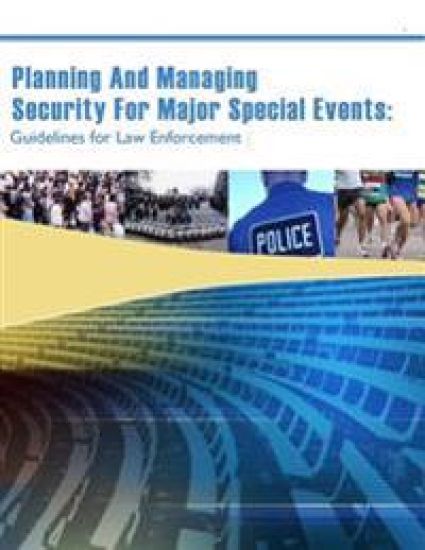
The U. S. Department of Justice Office of Community Oriented Policing Services (COPS) was directed by the Consolidated Appropriations Act, 2004, to submit a report to Congress on "best such as sporting events, concerts, and cultural exhibitions. The report, "Planning and Managing Security for Major Special Events: Guidelines for Law Enforcement," was prepared after a nationwide study that included: - Consultations with representatives of the Department of Homeland Security (DHS), U. S. Secret Service, Federal Bureau of Investigation (FBI), and other agencies charged with providing high levels of security for major national events. - Interviews with private security experts regarding such events as National Football League and National Basketball Association games. - On-site observations of security planning and management for the Republican and Democratic National Conventions, Kentucky Derby, and other major events. - Extensive telephone interviews with more than 40 local law enforcement agencies concerning best practices for securing major events in their jurisdictions. - Reviews of relevant security plans, reports, articles, guidelines, and other documents produced by experts in event security planning and management.
Department of Justice (Department) Special Agents, Deputy Marshals, and correctional personnel may use less-lethal weapons when circumstances require use of some force, but use of deadly force would not be appropriate.1 The Department's law enforcement components - the Bureau of Alcohol, Tobacco, Firearms and Explosives (ATF); Drug Enforcement Administration (DEA); Federal Bureau of Investigation (FBI); Federal Bureau of Prisons (BOP); and United States Marshals Service (USMS) - use several types of less-lethal weapons. The only less-lethal weapons provided to FBI and DEA Special Agents are batons and pepper spray. In addition to batons and pepper spray, ATF, BOP, and USMS personnel can use less-lethal weapons that include "bean bag" shotgun rounds (bean bag rounds), baton launchers, and rubber projectiles
Law enforcement officers are legally justified to utilize force in many situations to bring suspects to justice, protect others, and for personal defense. However, police training on the use of force has no single consistent method in the United States to demonstrate the best response to subject resistance levels, even though many states and individual agencies have adopted very creative use-of-force matrices and continuums. For researchers, additional problems abound in the compilation and interpretation of the data available on police use of force. Criminal justice research has persistently demonstrated that a small percentage of police encounters with the public involve use of force. While extreme uses of force often garners media attention, lesser levels of force are used regularly by police without public notice. Research in the areas of use of force, and subsequent suspect injuries, has focused on the level of force used by the police officer and the suspect, excessive force, and officer misconduct.
Overview and Priorities: The Federal Bureau of Investigation (FBI) investigates matters relating to fraud, theft, or embezzlement occurring within or against the national and international financial community. These crimes are characterized by deceit, concealment, or violation of trust and are not dependent upon the application or threat of physical force or violence. Such acts are committed by individuals and organizations to obtain personal or business advantage. The FBI focuses its financial crimes investigations on such criminal activities as corporate fraud, securities and commodities fraud, health care fraud, financial institution fraud, mortgage fraud, insurance fraud, mass marketing fraud, and money laundering. These are the identified priority crime problem areas of the Financial Crimes Section (FCS) of the FBI. Mission: The mission of the FCS is to oversee the investigation of financial fraud and to facilitate the forfeiture of assets from those engaging in federal crimes.
Convicting and incarcerating leaders of criminal enterprises often fails to close down the illegal operation. The enterprise continues because the economic infrastructure remains intact. Destruction of the financial underpinnings of crime syndicates through asset forfeiture is essential to law enforcement success. All criminal prosecutors and investigators must master the basics of financial investigations if they are to be effective. This pamphlet is designed to acquaint prosecutors and agents with basic financial investigative techniques that should be considered in every investigation. It is not enough to ask only: "What crime?" and "What defendants?" There is a third question that must be asked at the beginning of each case: "What assets?" A careful financial investigation can lead from the street dealer to the kingpins.
During fiscal year 2012, the number of suspects arrested for a federal offense declined to 172,248 after reaching a record 181,726 suspects in 2009. From 1994 to 2012, the number of suspects arrested by federal law enforcement more than doubled, from 80,450 in 1994 to 172,248 in 2012 (figure 1). In recent years, federal law enforcement activity has slowed along with the later stages of cases processing in U. S. district court (persons charged, convicted, and sentenced to prison). From 2010 to 2012, arrests decreased at an annual average rate of 1.9%. At yearend 2012, about 414,000 offenders were under some form of federal correctional control: 47% were confined by the Federal Bureau of Prisons (BOP), 15% were confined in pretrial detention, 32% were on post-conviction supervision in the community, and 6% were under pretrial supervision in the community (table 1). The number of federal arrests declined from 179,034 in 2010 to 172,248 in 2012. The decline in arrests was due to decreases across several offense types, including property (down 3,381), drug (down 2,786), and supervision violations (down 2,607). During this period, arrests for immigration offenses increased by 3,203. Illegal immigration (50%) was the most common arrest offense in 2012, followed by drug (15%) and supervision (13%) violations. From 2010 to 2012, arrests for regulatory offenses increased from 266 to 300 (average annual increase of 6%). Sex offense arrests increased at the next fastest rate (up 3% per year), followed by immigration offenses (up 2%). During this period, fraud offenses (down 10% per year) declined the most, followed by other property (down 6%) and supervision (down 5%) offenses. The five federal judicial districts along the U. S.-Mexico border (California Southern, Arizona, New Mexico, Texas Western, and Texas Southern) accounted for 60% of all federal arrests in 2012, up from 45% of all arrests in 2006 (map 1) (see Federal Justice Statistics, 2010, NCJ 239913, BJS web, December 2013). In 2012, these five districts also accounted for 53% of suspects investigated by U. S. attorneys, 54% of suspects detained prior to trial, 39% of defendants convicted, and 41% of offenders sentenced to federal prison. In 2012, about 9 in 10 defendants in cases adjudicated in U. S. district court were convicted. Ninety-one percent of felonies charged in U. S. district court were disposed by a guilty plea. Of defendants convicted, about 8 in 10 received a prison sentence. The median federal prison sentence imposed was 33 months. Between fiscal yearend 2011 and 2012, the number of persons under federal correctional control increased by 2,764 (up 0.7%). During this period, the number of federally sentenced persons in BOP confinement increased by 1,217 offenders and the number of persons under community supervision increased by 1,993. The number of persons on probation decreased from 22,866 in 2011 to 22,307 in 2012.
In October 2011, the Department of Justice Office of the Inspector General (OIG) initiated an audit of the United States Marshal Service's (USMS)management of the Witness Security (WITSEC) Program. In May 2013, the Department of Justice (Department) Office of the Inspector General (OIG) issued a report examining the Department's handling of known or suspected terrorists in theFederal Witness Security (WITSEC) Program. During that review, we identified sex offenders as another group of high-risk WITSEC Program participants (Program participants). Therefore, we conducted this audit to evaluate the Department's: (1) admission and vetting of sex offenders into the WITSEC Program; (2) handling, tracking, and monitoring of sex offenders who were Program participants; and (3) procedures for notifying states, local municipalities, and other law enforcement agencies regarding the relocation of sex offenders.