Kirjailija
Walter Benjamin
Kirjat ja teokset yhdessä paikassa: 262 kirjaa, julkaisuja vuosilta 1971–2027, suosituimpiin kuuluu Charles Baudelaire. Vertaile teosten hintoja ja tarkista saatavuus suomalaisista kirjakaupoista.
262 kirjaa
Kirjojen julkaisuvuodet: 1971–2027.

Das Kunstwerk im Zeitalter seiner technischen Reproduzierbarkeit
Walter Benjamin
SUHRKAMP VERLAG
2012
pokkari
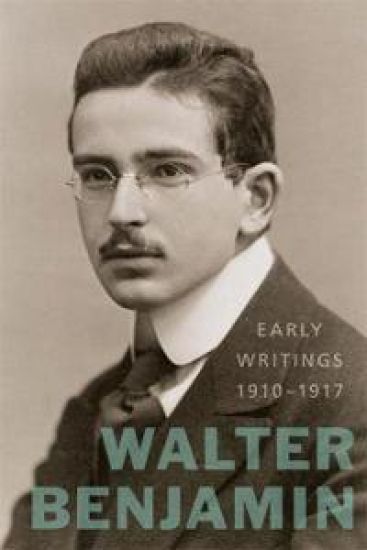
Walter Benjamin became a published writer at the age of seventeen. Yet the first stirrings of this most original of critical minds—penned during the years in which he transformed himself from the comfortable son of a haute-bourgeois German Jewish family into the nomadic, uncompromising philosopher-critic we have since come to appreciate—have until now remained largely unavailable in English. Early Writings, 1910-1917 rectifies this situation, documenting the formative intellectual experiences of one of the twentieth century's most resolutely independent thinkers. Here we see the young Benjamin in his various roles as moralist, cultural critic, school reformer, and poet-philosopher. The diversity of interest and profundity of thought characteristic of his better-known work from the 1920s and 30s are already in evidence, as we witness the emergence of critical projects that would occupy Benjamin throughout his intellectual career: the role of the present in historical remembrance, the relationship of the intellectual to political action, the idea of truth in works of art, and the investigation of language as the veiled medium of experience. Even at this early stage, a recognizably Benjaminian way of thinking comes into view—a daring, boundary-crossing enterprise that does away with classical antitheses in favor of the relentlessly-seeking critical consciousness that produced the groundbreaking works of his later years. With the publication of these early writings, our portrait of one of the most significant intellects of the twentieth century edges closer to completion.

Das Kunstwerk im Zeitalter seiner technischen Reproduzierbarkeit
Walter Benjamin
Reclam Philipp Jun.
2011
pokkari


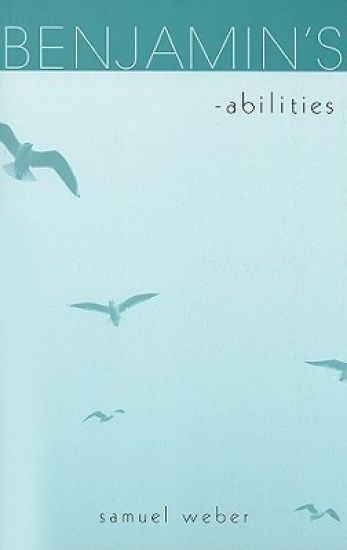
“There is no world of thought that is not a world of language,” Walter Benjamin remarked, “and one only sees in the world what is preconditioned by language.” In this book, Samuel Weber, a leading theorist on literature and media, reveals a new and productive aspect of Benjamin’s thought by focusing on a little-discussed stylistic trait in his formulation of concepts. Weber’s focus is the critical suffix “-ability” that Benjamin so tellingly deploys in his work. The “-ability” (-barkeit, in German) of concepts and literary forms traverses the whole of Benjamin’s oeuvre, from “impartibility” and “criticizability” through the well-known formulations of “citability,” “translatability,” and, most famously, the “reproducibility” of “The Work of Art in the Age of Its Technological Reproducibility.” Nouns formed with this suffix, Weber points out, refer to a possibility or potentiality, to a capacity rather than an existing reality. This insight allows for a consistent and enlightening reading of Benjamin’s writings. Weber first situates Benjamin’s engagement with the “-ability” of various concepts in the context of his entire corpus and in relation to the philosophical tradition, from Kant to Derrida. Subsequent chapters deepen the implications of the use of this suffix in a wide variety of contexts, including Benjamin’s Trauerspiel book, his relation to Carl Schmitt, and a reading of Wagner’s Ring. The result is an illuminating perspective on Benjamin’s thought by way of his language—and one of the most penetrating and comprehensive accounts of Benjamin’s work ever written.

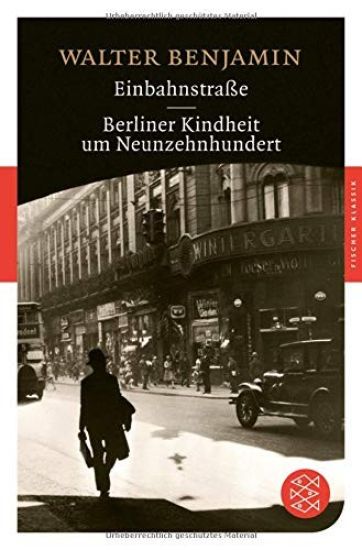
? Die Konstruktion des Lebens liegt im Augenblick weit mehr in der Gewalt von Fakten als von Überzeugungen. Und zwar von solchen Fakten, wie sie zur Grundlage von Überzeugungen fast nie noch und nirgends geworden sind. Unter diesen Umständen kann wahre literarische Aktivität nicht beanspruchen, in literarischem Rahmen sich abzuspielen - vielmehr ist das der übliche Ausdruck ihrer Unfruchtbarkeit.? Mit diesen programmatischen Worten beginnt die Einbahnstraße, eines der ungewöhnlichsten Bücher Walter Benjamins. 1928 nicht als Buch, sondern als Broschüre veröffentlicht, gestaltet in konstruktivistischer Typographie, versehen mit dem berühmten Umschlag von Sasha Stone, dazu geschrieben in der ?prompten Sprache? von Flugblättern, Annoncen und Plakaten, die allein ?sich dem Augenblick wirkend gewachsen? zeigt, nimmt diese Sammlung von Aphorismen eine auf den ersten Blick singuläre Stellung in Benjamins Werk und der Literaturgeschichte des 20. Jahrhunderts ein. Die Einbahnstraße war stilbildend und kann als Vorbild etwa für Blochs Spuren oder Adornos Minima Moralia gesehen werden. Auf den zweiten Blick und in der Rückschau offenbart sich eine weitere Besonderheit der Einbahnstraße: Sie ist eine entscheidende Gelenkstelle in Benjamins Gesamtwerk, in der Überlegungen des Frühwerks transformiert werden, um sie dann in späteren Arbeiten weiterzuführen. Dies veranschaulicht insbesondere die 43 Texte umfassende ? Nachtragsliste zur Einbahnstraße?, die Benjamin Anfang bis Mitte der dreißiger Jahre zusammenstellte. Sie wird, neben dem Erstdruck und allen handschriftlichen Vorstufen sowie zeitgenössischen Rezensionen, in der neuen Edition erstmals als Einheit zu lesen sein. Der Kommentar und das Nachwort des Herausgebers machen zudem die Verbindung der einzelnen Texte mit dem Gesamtwerk Benjamins sichtbar und zeigen, inwiefern die Einbahnstraße die Tradition der europäischen Aphoristik aufgenommen und zugleich erneuert hat.
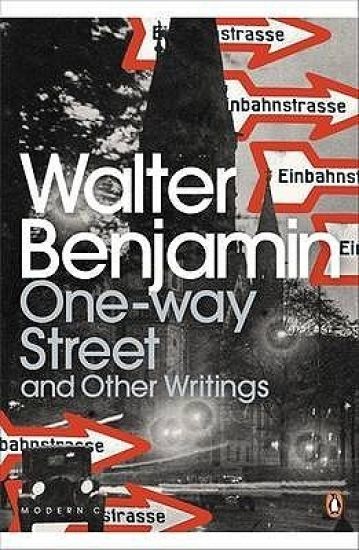
One-Way Street and Other Writings
Walter Benjamin
Penguin Classics
2009
pokkari
Halvin toimitettuna 17,00 €
Walter Benjamin - philosopher, essayist, literary and cultural theorist - was one of the most original writers and thinkers of the twentieth century. This new selection brings together Benjamin's major works, including 'One-Way Street', his dreamlike, aphoristic observations of urban life in Weimar Germany; 'Unpacking My Library', a delightful meditation on book-collecting; the confessional 'Hashish in Marseille'; and 'The Work of Art in the Age of Mechanical Reproduction', his seminal essay on how technology changes the way we appreciate art. Also including writings on subjects ranging from Proust to Kafka, violence to surrealism, this is the essential volume on one of the most prescient critical voices of the modern age. Contains: 'Unpacking My Library'; 'One-Way Street'; 'The Work of Art in the Age of Mechanical Reproduction'; 'Brief History of Photography'; 'Hashish in Marseille'; 'On the Critique of Violence'; 'The Job of the Translator'; 'Surrealism'; 'Franz Kafka' and 'Picturing Proust'.
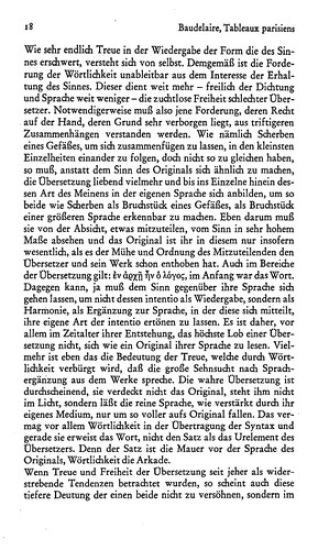
Gesammelte Schriften IV. Kleine Prosa, Baudelaire-Übertragungen. 2 Teilbände
Walter Benjamin
SUHRKAMP VERLAG
2009
pokkari

Cited by Lukács as a principal source of literary modernism, Walter Benjamin's study of the baroque stage-form called Trauerspiel (literally, "mourning play") is the most complete document of his prismatic literary and philosophical practice. Engaging with sixteenth- and seventeenth-century German playwrights as well as the plays of Shakespeare and Calderón and the engravings of Dürer, Benjamin attempts to show how the historically charged forms of the Trauerspiel broke free of tragedy's mythological timelessness. From its philosophical prologue, which offers a rare account of Benjamin's early aesthetics, to its mind-wrenching meditation on allegory, The Origin of German Tragic Drama sparkles with early insights and the seeds of Benjamin's later thought.

Unter dem Titel Träume werden hier erstmals die zu Lebzeiten publizierten und durch den Nachlaß überlieferten Traumberichte und traumtheoretischen Reflexionen Walter Benjamins in einem eigenen Band versammelt. Damit rückt eine Seite seines Werks in den Blick, die bislang wenig Beachtung gefunden hat, die aber für sein Schreiben und Denken zentrale Bedeutung hatte. Der erste Teil "Traumaufzeichnungen" enthält in erreichbarer Vollständigkeit und zeitlicher Folge Benjamins Niederschriften eigener Träume, wobei auch unpubliziertes Manuskriptmaterial herangezogen wird. Der zweite Teil "Über das Traumbewußtsein. Erwachen und Traum" enthält seine traumtheoretischen Reflexionen, die von kurzen Aphorismen über größere Darlegungen zur Traumliteratur und zur Geschichtlichkeit des Traums bis zur politischen Konzeption des "Traumkollektivs" und seines Erwachens reichen. Im Nachwort charakterisiert der Herausgeber Benjamins schriftstellerischen Umgang mit den eigenen Träumen und skizziert, in Abhebung von Freuds Traumdeutung und dem Surrealismus, dessen eigenständige und eigenwillige Bestimmung der Traumsphäre. Es liegt ein Lesebuch vor, das Benjamin sowohl als großen Träumer wie als bedeuten Theoretiker des Traums präsentiert.
The Work of Art in the Age of Mechanical Reproduction
Walter Benjamin
Penguin Books Ltd
2008
nidottu
Halvin toimitettuna 14,50 €
One of the most important works of cultural theory ever written, Walter Benjamin's groundbreaking essay explores how the age of mass media means audiences can listen to or see a work of art repeatedly – and what the troubling social and political implications of this are. Throughout history, some books have changed the world. They have transformed the way we see ourselves – and each other. They have inspired debate, dissent, war and revolution. They have enlightened, outraged, provoked and comforted. They have enriched lives – and destroyed them. Now Penguin brings you the works of the great thinkers, pioneers, radicals and visionaries whose ideas shook civilization and helped make us who we are.
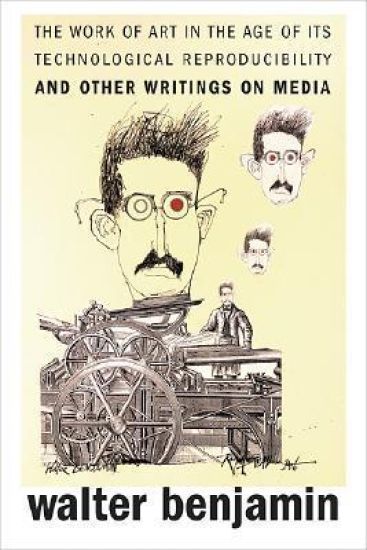
The Work of Art in the Age of Its Technological Reproducibility, and Other Writings on Media
Walter Benjamin
The Belknap Press
2008
nidottu
Walter Benjamin’s famous “Work of Art” essay sets out his boldest thoughts—on media and on culture in general—in their most realized form, while retaining an edge that gets under the skin of everyone who reads it. In this essay the visual arts of the machine age morph into literature and theory and then back again to images, gestures, and thought. This essay, however, is only the beginning of a vast collection of writings that the editors have assembled to demonstrate what was revolutionary about Benjamin’s explorations on media. Long before Marshall McLuhan, Benjamin saw that the way a bullet rips into its victim is exactly the way a movie or pop song lodges in the soul. This book contains the second, and most daring, of the four versions of the “Work of Art” essay—the one that addresses the utopian developments of the modern media. The collection tracks Benjamin’s observations on the media as they are revealed in essays on the production and reception of art; on film, radio, and photography; and on the modern transformations of literature and painting. The volume contains some of Benjamin’s best-known work alongside fascinating, little-known essays—some appearing for the first time in English. In the context of his passionate engagement with questions of aesthetics, the scope of Benjamin’s media theory can be fully appreciated.
‘We must see to it that we put the best of ourselves in our letters; for there is nothing to suggest that we shall see each other again soon.’ So wrote Walter Benjamin to Gretel Adorno in spring 1940 from the south of France, shortly before he took his own life. The correspondence between Gretel Adorno and Walter Benjamin, published here in its complete form for the first time, is the document of a great friendship that existed independently of Benjamin’s relationship with Theodor W. Adorno. While Benjamin, alongside his everyday worries, writes especially about those projects on which he worked so intensively in the last years of his life, it was Gretel Karplus-Adorno who did everything in her power to keep Benjamin in the world. She urged him to emigrate to the USA and told him about Adorno’s plans and Bloch’s movements, thus maintaining the connection between the old Berlin friends and acquaintances. She helped him through the most difficult times with regular money transfers, and organized financial support from the Saar region, which was initially still independent from the Third Reich. Once in New York, she attempted to entice Benjamin to America with her descriptions of the city and the new arrivals from Europe – though ultimately to no avail.