Kirjojen hintavertailu – 12 903 735 kirjaa ja 27 kauppaa

Kirjailija

Wolff-Michael Roth

Kirjat ja teokset yhdessä paikassa: 46 kirjaa, julkaisuja vuosilta 1995–2021, suosituimpiin kuuluu Scientific & Mathematical Bodies. Vertaile teosten hintoja ja tarkista saatavuus suomalaisista kirjakaupoista.

46 kirjaa

Kirjojen julkaisuvuodet: 1995–2021.

Adventures of Mind and Mathematics

Adventures of Mind and Mathematics

Wolff-Michael Roth

Springer Nature Switzerland AG
2021
nidottu
This monograph uses the concept and category of “event” in the study of mathematics as it emerges from an interaction between levels of cognition, from the bodily experiences to symbolism. It is subdivided into three parts. The first moves from a general characterization of the classical approach to mathematical cognition and mind toward laying the foundations for a view on the mathematical mind that differs from going approaches in placing primacy on events. The second articulates some common phenomena–mathematical thought, mathematical sign, mathematical form, mathematical reason and its development, and affect in mathematics–in new ways that are based on the previously developed ontology of events. The final part has more encompassing phenomena as its content, most prominently the thinking body of mathematics, the experience in and of mathematics, and the relationship between experience and mind. The volume is well-suited for anyone with a broad interest in educationaltheory and/or social development, or with a broad background in psychology.
Adventures of Mind and Mathematics

Adventures of Mind and Mathematics

Wolff-Michael Roth

Springer Nature Switzerland AG
2020
sidottu
This monograph uses the concept and category of “event” in the study of mathematics as it emerges from an interaction between levels of cognition, from the bodily experiences to symbolism. It is subdivided into three parts. The first moves from a general characterization of the classical approach to mathematical cognition and mind toward laying the foundations for a view on the mathematical mind that differs from going approaches in placing primacy on events. The second articulates some common phenomena–mathematical thought, mathematical sign, mathematical form, mathematical reason and its development, and affect in mathematics–in new ways that are based on the previously developed ontology of events. The final part has more encompassing phenomena as its content, most prominently the thinking body of mathematics, the experience in and of mathematics, and the relationship between experience and mind. The volume is well-suited for anyone with a broad interest in educationaltheory and/or social development, or with a broad background in psychology.
Transactional Psychology of Education

Transactional Psychology of Education

Wolff-Michael Roth

Springer Nature Switzerland AG
2019
sidottu
Toward the end of his life, the Russian psychologist L. S. Vygotsky turned away from his earlier work that he has become famous for only to sow the seeds for a new theory. In this theory, affect was to play a central role, there was to be a primacy of social relations, and anything mental (mind, thought, self, other, knowledge) was an event rather than a thing. This is essentially a transactional perspective. In this book, the author articulates a transactional psychology of education drawing on the works of G. H. Mead, J. Dewey, G. Bateson, F. Mikhailov, and E. Il’enkov. All theoretical positions are developed out of videotaped exchanges, thereby giving concrete character to every psychological concept articulated.
Dialogical Argumentation and Reasoning in Elementary Science Classrooms
Science educators have come to recognize children’s reasoning and problem solving skills as crucial ingredients of scientific literacy. As a consequence, there has been a concurrent, widespread emphasis on argumentation as a way of developing critical and creative minds. Argumentation has been of increasing interest in science education as a means of actively involving students in science and, thereby, as a means of promoting their learning, reasoning, and problem solving. Many approaches to teaching argumentation place primacy on teaching the structure of the argumentative genre prior to and at the beginning of participating in argumentation. Such an approach, however, is unlikely to succeed because to meaningfully learn the structure (grammar) of argumentation, one already needs to be competent in argumentation. This book offers a different approach to children’s argumentation and reasoning based on dialogical relations, as the origin of internal dialogue (inner speech) and higher psychological functions. In this approach, argumentation first exists as dialogical relation, for participants who are in a dialogical relation with others, and who employ argumentation for the purpose of the dialogical relation. With the multimodality of dialogue, this approach expands argumentation into another level of physicality of thinking, reasoning, and problem solving in classrooms. By using empirical data from elementary classrooms, this book explains how argumentation emerges and develops in and from classroom interactions by focusing on thinking and reasoning through/in relations with others and the learning environment.
Dialogical Argumentation and Reasoning in Elementary Science Classrooms
Science educators have come to recognize children's reasoning and problem solving skills as crucial ingredients of scientific literacy. As a consequence, there has been a concurrent, widespread emphasis on argumentation as a way of developing critical and creative minds. Argumentation has been of increasing interest in science education as a means of actively involving students in science and, thereby, as a means of promoting their learning, reasoning, and problem solving. Many approaches to teaching argumentation place primacy on teaching the structure of the argumentative genre prior to and at the beginning of participating in argumentation. Such an approach, however, is unlikely to succeed because to meaningfully learn the structure (grammar) of argumentation, one already needs to be competent in argumentation. This book offers a different approach to children's argumentation and reasoning based on dialogical relations, as the origin of internal dialogue (inner speech) and higher psychological functions. In this approach, argumentation first exists as dialogical relation, for participants who are in a dialogical relation with others, and who employ argumentation for the purpose of the dialogical relation. With the multimodality of dialogue, this approach expands argumentation into another level of physicality of thinking, reasoning, and problem solving in classrooms. By using empirical data from elementary classrooms, this book explains how argumentation emerges and develops in and from classroom interactions by focusing on thinking and reasoning through/in relations with others and the learning environment.
Geometry as Objective Science in Elementary School Classrooms
This study examines the origins of geometry in and out of the intuitively given everyday lifeworlds of children in a second-grade mathematics class. These lifeworlds, though pre-geometric, are not without model objects that denote and come to anchor geometric idealities that they will understand at later points in their lives. Roth's analyses explain how geometry, an objective science, arises anew from the pre-scientific but nevertheless methodic actions of children in a structured world always already shot through with significations. He presents a way of understanding knowing and learning in mathematics that differs from other current approaches, using case studies to demonstrate contradictions and incongruences of other theories – Immanuel Kant, Jean Piaget, and more recent forms of (radical, social) constructivism, embodiment theories, and enactivism – and to show how material phenomenology fused with phenomenological sociology provides answers to the problems that these other paradigms do not answer.
Dwelling, Building, Thinking

Dwelling, Building, Thinking

Wolff-Michael Roth

BRILL
2018
sidottu
In this book, the author presents a major challenge to (social) constructivism, which has become an ideology that few dare to critique. Transgressing the boundaries of this ideology, the author develops an alternative epistemology that takes dwelling as the starting point and ground. Dwelling enables building and thinking (‘constructing’). It is an epistemology in which there is a primacy of social relations, which are the first instantiations of the higher psychological functions ascribed to humans. Starkly contrasting constructivism, the author shows how the commonness of the senses and the existence of social relations lead to common sense, which is the foundation of everything rational and scientific. Common sense, which comes from and with dwelling, is the ground in which all education is rooted. Any attempt to eradicate it literally uproots and thus alienates students from the life and world with which they are so familiar.
Dwelling, Building, Thinking

Dwelling, Building, Thinking

Wolff-Michael Roth

BRILL
2018
nidottu
In this book, the author presents a major challenge to (social) constructivism, which has become an ideology that few dare to critique. Transgressing the boundaries of this ideology, the author develops an alternative epistemology that takes dwelling as the starting point and ground. Dwelling enables building and thinking (‘constructing’). It is an epistemology in which there is a primacy of social relations, which are the first instantiations of the higher psychological functions ascribed to humans. Starkly contrasting constructivism, the author shows how the commonness of the senses and the existence of social relations lead to common sense, which is the foundation of everything rational and scientific. Common sense, which comes from and with dwelling, is the ground in which all education is rooted. Any attempt to eradicate it literally uproots and thus alienates students from the life and world with which they are so familiar.
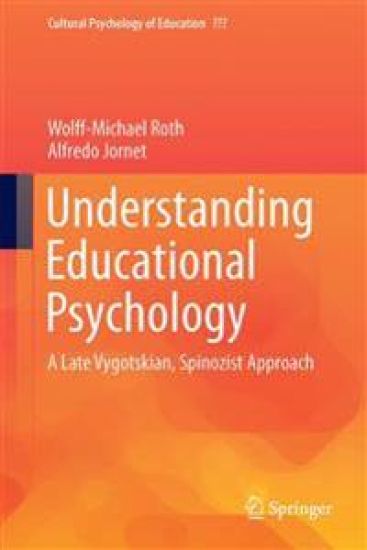
Understanding Educational Psychology

Understanding Educational Psychology

Wolff-Michael Roth; Alfredo Jornet

Springer International Publishing AG
2018
nidottu
This book takes up the agenda of the late (but unknown) L. S. Vygotsky, who had turned to the philosopher Spinoza to develop a holistic approach to psychology, an approach that no longer dichotomized the body and mind, intellect and affect, or the individual and the social. In this approach, there is only one substance, which manifests itself in different ways in the thinking body, including as biology and culture. The manifestation as culture is premised on the existence of the social. In much of current educational psychology, there are unresolved contradictions that have their origin in the opposition between body and mind, individual and collective, and structure and process—including the different nature of intellect and affect or the difference between knowledge and its application. Many of the same contradictions are repeated in constructivist approaches, which do not overcome dichotomies but rather acerbate them by individualizing and intellectualizing our knowledgeable participation in recognizably exhibiting and producing the everyday cultural world. Interestingly enough, L. S. Vygotsky, who is often used as a referent for making arguments about inter- and intrasubjective “mental” “constructions,” developed, towards the end of his life, a Spinozist approach according to which there is only one substance. This one substance manifests itself in two radically different ways: body (material, biology) and mind (society, culture). But there are not two substances that are combined into a unit; there is only one substance. Once such an approach is adopted, the classical question of cognitive scientists about how symbols are grounded in the world comes to be recognized as an artefact of the theory. Drawing on empirical materials from different learning settings—including parent-child, school, and workplace settings—this book explores the opportunities and implications that this non-dualist approach has for educational research and practice.
Uncertainty and Graphing in Discovery Work
This book deals with uncertainty and graphing in scientific discovery work from a social practice perspective. It is based on a 5-year ethnographic study in an advanced experimental biology laboratory. The book shows how, in discovery work where scientists do not initially know what to make of graphs, there is a great deal of uncertainty and scientists struggle in trying to make sense of what to make of graphs. Contrary to the belief that scientists have no problem “interpreting” graphs, the chapters in this book make clear that uncertainty about their research object is tied to uncertainty of the graphs. It may take scientists several years of struggle in their workplace before they find out just what their graphs are evidence of. Graphs turn out to stand to the entire research in a part/whole relation, where scientists not only need to be highly familiar with the context from which their data are extracted but also with the entire process by means of which the natural world comes to be transformed and represented in the graph. This has considerable implications for science, technology, engineering, and mathematics education at the secondary and tertiary level, as well as in vocational training. This book discusses and elaborates these implications.
Understanding Educational Psychology

Understanding Educational Psychology

Wolff-Michael Roth; Alfredo Jornet

Springer International Publishing AG
2016
sidottu
This book takes up the agenda of the late (but unknown) L. S. Vygotsky, who had turned to the philosopher Spinoza to develop a holistic approach to psychology, an approach that no longer dichotomized the body and mind, intellect and affect, or the individual and the social. In this approach, there is only one substance, which manifests itself in different ways in the thinking body, including as biology and culture. The manifestation as culture is premised on the existence of the social. In much of current educational psychology, there are unresolved contradictions that have their origin in the opposition between body and mind, individual and collective, and structure and process—including the different nature of intellect and affect or the difference between knowledge and its application. Many of the same contradictions are repeated in constructivist approaches, which do not overcome dichotomies but rather acerbate them by individualizing and intellectualizing our knowledgeable participation in recognizably exhibiting and producing the everyday cultural world. Interestingly enough, L. S. Vygotsky, who is often used as a referent for making arguments about inter- and intrasubjective “mental” “constructions,” developed, towards the end of his life, a Spinozist approach according to which there is only one substance. This one substance manifests itself in two radically different ways: body (material, biology) and mind (society, culture). But there are not two substances that are combined into a unit; there is only one substance. Once such an approach is adopted, the classical question of cognitive scientists about how symbols are grounded in the world comes to be recognized as an artefact of the theory. Drawing on empirical materials from different learning settings—including parent-child, school, and workplace settings—this book explores the opportunities and implications that this non-dualist approach has for educational research and practice.
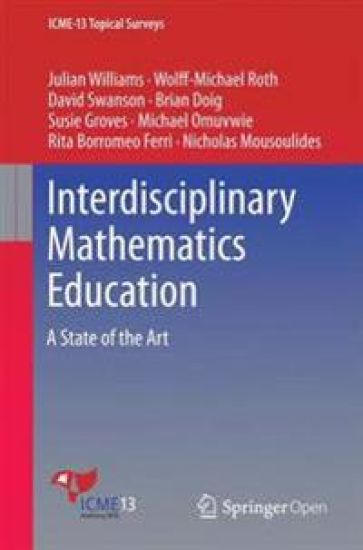
Interdisciplinary Mathematics Education

Interdisciplinary Mathematics Education

Julian Williams; Wolff-Michael Roth; David Swanson; Brian Doig; Susie Groves; Michael Omuvwie; Rita Borromeo Ferri; Nicholas Mousoulides

Springer International Publishing AG
2016
nidottu
This book provides an essential introduction to the state-of the-art in interdisciplinary Mathematics Education. First, it begins with an outline of the field’s relevant historical, conceptual and theoretical backgrounds, what “discipline” means and how inter-, trans-, and meta-disciplinary activities can be understood. Relevant theoretical perspectives from Marx, Foucault and Vygotsky are explained, along with key ideas in theory, e.g. boundaries, discourses, identity, and the division of labour in practice. Second, the book reviews research findings of mainly empirical studies on interdisciplinary work involving mathematics in education, in all stages of education that have become disciplined. For example, it reports that a common theme in studies in middle and high schools is assessing the motivational benefits for the learner of subsuming disciplinary motives and even practices to extra-academic problem-solving activities; this is counter-balanced by the effort needed to overcome the disciplinary boundaries in academic institutions, and in professional identities. These disciplinary boundaries are less obviously limitations in middle and primary schools, and in some vocational courses. Third and finally, it explores selected case studies that illustrate these concepts and findings, both in terms of the motivational benefits for learners and the institutional and other boundaries involved.
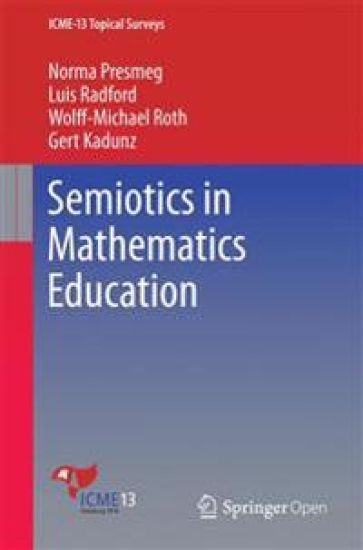
Semiotics in Mathematics Education

Semiotics in Mathematics Education

Norma Presmeg; Luis Radford; Wolff-Michael Roth; Gert Kadunz

Springer International Publishing AG
2016
nidottu
This volume discusses semiotics in mathematics education as an activity with a formal sign system, in which each sign represents something else. Theories presented by Saussure, Peirce, Vygotsky and other writers on semiotics are summarized in their relevance to the teaching and learning of mathematics. The significance of signs for mathematics education lies in their ubiquitous use in every branch of mathematics. Such use involves seeing the general in the particular, a process that is not always clear to learners. Therefore, in several traditional frameworks, semiotics has the potential to serve as a powerful conceptual lens in investigating diverse topics in mathematics education research. Topics that are implicated include (but are not limited to): the birth of signs; embodiment, gestures and artifacts; segmentation and communicative fields; cultural mediation; social semiotics; linguistic theories; chains of signification; semiotic bundles; relationships among various sign systems; intersubjectivity; diagrammatic and inferential reasoning; and semiotics as the focus of innovative learning and teaching materials.
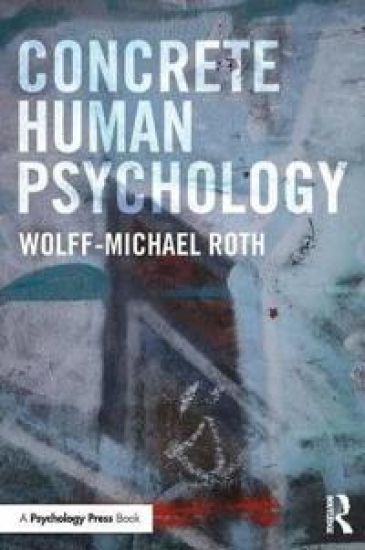
Concrete Human Psychology

Concrete Human Psychology

Wolff-Michael Roth

Routledge
2015
nidottu
Psychology, quantitative or qualitative, tends to conceive of the human person using metaphysical concepts and to separate the practical, affective, and intellectual aspects of participation in everyday life. Lev S. Vygotsky, however, was working towards a "concrete human psychology," a goal that he expresses in a small, unfinished text of the same name. This book articulates the foundation of and develops such a concrete human psychology according to which all higher psychological functions are relations between persons before being functions, and according to which personality is the ensemble of societal relations with others that a person has lived and experienced. Correlated with concern for the concreteness of human life and the psychology that theorizes it is the idea that to live means to change. However, none of the categories we currently have in psychology are categories of change as such. In this work of concrete human psychology, categories are developed on the basis of Vygotsky’s work that are suitable to theorize an ever-changing life, including the language humans use to take control over their conditions and to talk about the conditions in which they live.
Concrete Human Psychology

Concrete Human Psychology

Wolff-Michael Roth

Routledge
2015
sidottu
Psychology, quantitative or qualitative, tends to conceive of the human person using metaphysical concepts and to separate the practical, affective, and intellectual aspects of participation in everyday life. Lev S. Vygotsky, however, was working towards a "concrete human psychology," a goal that he expresses in a small, unfinished text of the same name. This book articulates the foundation of and develops such a concrete human psychology according to which all higher psychological functions are relations between persons before being functions, and according to which personality is the ensemble of societal relations with others that a person has lived and experienced. Correlated with concern for the concreteness of human life and the psychology that theorizes it is the idea that to live means to change. However, none of the categories we currently have in psychology are categories of change as such. In this work of concrete human psychology, categories are developed on the basis of Vygotsky’s work that are suitable to theorize an ever-changing life, including the language humans use to take control over their conditions and to talk about the conditions in which they live.
Science Education during Early Childhood

Science Education during Early Childhood

Wolff-Michael Roth; Maria Ines Mafra Goulart; Katerina Plakitsi

Springer
2014
nidottu
Children’s learning and understanding of science during their pre-school years has been a neglected topic in the education literature—something this volume aims to redress. Paradigmatic notions of science education, with their focus on biologically governed development and age-specific accession to scientific concepts, have perpetuated this state of affairs. This book offers a very different perspective, however. It has its roots in the work of cultural-historical activity theorists, who, since Vygotsky, have assumed that any higher cognitive function existed in and as a social relation first. Accepting this precept removes any lower limit we may deem appropriate on children’s cognitive engagement with science-related concepts. The authors describe and analyze the ways in which children aged from one to five grapple with scientific concepts, and also suggest ways in which pre-service and in-service teachers can be prepared to teach in ways that support children’s development in cultural and historical contexts. In doing so, the book affirms the value of cultural-historical activity theory as an appropriate framework for analyzing preschool children’s participation in science learning experiences, and shows that that the theory provides an appropriate framework for understanding learning, as well as for planning and conducting training for pre-school teachers.
Imagination of Science in Education

Imagination of Science in Education

Michiel van Eijck; Wolff-Michael Roth

Springer
2014
nidottu
Researchers agree that schools construct a particular image of science, in which some characteristics are featured while others end up in oblivion. The result is that although most children are likely to be familiar with images of heroic scientists such as Einstein and Darwin, they rarely learn about the messy, day-to-day practice of science in which scientists are ordinary humans. Surprisingly, the process by which this imagination of science in education occurs has rarely been theorized. This is all the more remarkable since great thinkers tend to agree that the formation of images — imagination — is at the root of how human beings modify their material world. Hence this process in school science is fundamental to the way in which scientists, being the successful agents in/of science education, actually create their own scientific enterprise once they take up their professional life. One of the first to examine the topic, this book takes a theoretical approach to understanding the process of imagining science in education. The authors utilize a number of interpretive studies in both science and science education to describe and contrast two opposing forces in the imagination of science in education: epicization and novelization. Currently, they argue, the imagination of science in education is dominated by epicization, which provides an absolute past of scientific heroes and peak discoveries. This opens a distance between students and today’s scientific enterprises, and contrasts sharply with the wider aim of science education to bring the actual world of science closer to students. To better understand how to reach this aim, the authors offer a detailed look at novelization, which is a continuous renewal of narratives that derives from dialogical interaction. The book brings together two hitherto separate fields of research in science education: psychologically informed research on students’ images of science and semioticallyinformed research on images of science in textbooks. Drawing on a series of studies in which children participate in the imagination of science in and out of the classroom, the authors show how the process of novelization actually occurs in the practice of education and outline the various images of science this process ultimately yields.
Uncertainty and Graphing in Discovery Work
This book deals with uncertainty and graphing in scientific discovery work from a social practice perspective. It is based on a 5-year ethnographic study in an advanced experimental biology laboratory. The book shows how, in discovery work where scientists do not initially know what to make of graphs, there is a great deal of uncertainty and scientists struggle in trying to make sense of what to make of graphs. Contrary to the belief that scientists have no problem “interpreting” graphs, the chapters in this book make clear that uncertainty about their research object is tied to uncertainty of the graphs. It may take scientists several years of struggle in their workplace before they find out just what their graphs are evidence of. Graphs turn out to stand to the entire research in a part/whole relation, where scientists not only need to be highly familiar with the context from which their data are extracted but also with the entire process by means of which the natural world comes to be transformed and represented in the graph. This has considerable implications for science, technology, engineering, and mathematics education at the secondary and tertiary level, as well as in vocational training. This book discusses and elaborates these implications.