Kirjojen hintavertailu – 12 903 735 kirjaa ja 27 kauppaa

Kirjailija

Wolff-Michael Roth

Kirjat ja teokset yhdessä paikassa: 46 kirjaa, julkaisuja vuosilta 1995–2021, suosituimpiin kuuluu Scientific & Mathematical Bodies. Vertaile teosten hintoja ja tarkista saatavuus suomalaisista kirjakaupoista.

46 kirjaa

Kirjojen julkaisuvuodet: 1995–2021.

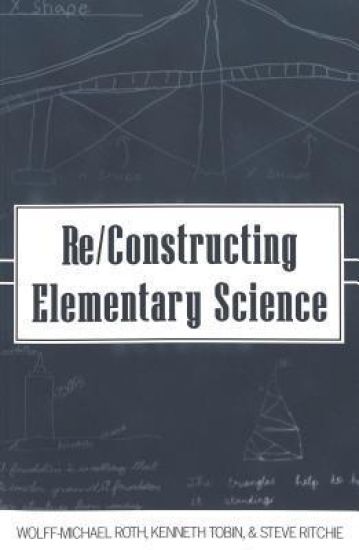
Re/Constructing Elementary Science

Re/Constructing Elementary Science

Wolff-Michael Roth; Kenneth Tobin; Steve Ritchie

Peter Lang Publishing Inc
2001
nidottu
"Re/Constructing Elementary Science" seeks to improve the way science is taught in the elementary school. There are three main contradictions that make it difficult for teachers and students to engage in meaningful activities from which understandings result. The central issues in this book are framed in terms of three dichotomies that lead to tensions arising from the dialectic of opposing aspects of teaching and learning. First, there is a tension between learning as an individual process (cultural production) and as a cultural process (cultural reproduction). Second, there is a tension between science and technology (applied science). Finally, there exists a tension between children's interaction with nature and their language for describing and explaining nature. Exemplary case studies are featured that show the tremendous capabilities of elementary students to talk about technology and, in the process, to learn to talk science. These case studies are couched in an ongoing professional dialogue among the authors and the requirements to make such exemplary science happen in other classrooms.
Designing Communities

Designing Communities

Wolff-Michael Roth

Springer
1997
sidottu
The study described in this book arose in the contextof a three-year collective effort to bring about change in science teaching at Mountain Elementary School. 1 This opportunity emerged after I contacted the school with the idea to help teachers implement student-centered science teaching. At the same time, the teachers collectively had come to realize that their science teaching was not as exciting to children as it could be. They had recognized their own teaching as textbook-based with little use of the "hands-on" approaches prescribed by the provincial curriculum. At this point, the teachers and I decided that a joint project would serve our mutual goals: they wanted assistance in changing from textbook-based approaches to student-centered activities; I wanted to collect data on learning in student-centered knowledge­ producing classroom communities. I brought to this school my new understandings about classroom communi­ ties from several earlier studies conducted in a private high school (e. g. , Roth & Bowen, 1995; Roth & Roychoudhury, 1992). I wanted to help teachers create science learning environments in which children took charge of their learning, where children learned from more competent others by participating with them in ongoing activities, and teachers were responsible for setting up and maintaining a classroom community rather than for dissem­ inating information. After I had completed the data collection for the present study, I watched a documentary about an elementary school in the small French village of Moussac (Envoye Special, TV5, September 14, 1994).

Designing Communities

Designing Communities

Wolff-Michael Roth

Springer
1997
nidottu
The study described in this book arose in the contextof a three-year collective effort to bring about change in science teaching at Mountain Elementary School. 1 This opportunity emerged after I contacted the school with the idea to help teachers implement student-centered science teaching. At the same time, the teachers collectively had come to realize that their science teaching was not as exciting to children as it could be. They had recognized their own teaching as textbook-based with little use of the "hands-on" approaches prescribed by the provincial curriculum. At this point, the teachers and I decided that a joint project would serve our mutual goals: they wanted assistance in changing from textbook-based approaches to student-centered activities; I wanted to collect data on learning in student-centered knowledge­ producing classroom communities. I brought to this school my new understandings about classroom communi­ ties from several earlier studies conducted in a private high school (e. g. , Roth & Bowen, 1995; Roth & Roychoudhury, 1992). I wanted to help teachers create science learning environments in which children took charge of their learning, where children learned from more competent others by participating with them in ongoing activities, and teachers were responsible for setting up and maintaining a classroom community rather than for dissem­ inating information. After I had completed the data collection for the present study, I watched a documentary about an elementary school in the small French village of Moussac (Envoye Special, TV5, September 14, 1994).
Authentic School Science

Authentic School Science

Wolff-Michael Roth

Springer
1995
nidottu
According to John Dewey, Seymour Papert, Donald Schon, and Allan Collins, school activities, to be authentic, need to share key features with those worlds about which they teach. This book documents learning and teaching in open-inquiry learning environments, designed with the precepts of these educational thinkers in mind. The book is thus a first-hand report of knowing and learning by individuals and groups in complex open-inquiry learning environments in science. As such, it contributes to the emerging literature in this field. Secondly, it exemplifies research methods for studying such complex learning environments. The reader is thus encouraged not only to take the research findings as such, but to reflect on the process of arriving at these findings. Finally, the book is also an example of knowledge constructed by a teacher-researcher, and thus a model for teacher-researcher activity.
Authentic School Science

Authentic School Science

Wolff-Michael Roth

Springer
1995
sidottu
According to John Dewey, Seymour Papert, Donald Schon, and Allan Collins, school activities, to be authentic, need to share key features with those worlds about which they teach. This book documents learning and teaching in open-inquiry learning environments, designed with the precepts of these educational thinkers in mind. The book is thus a first-hand report of knowing and learning by individuals and groups in complex open-inquiry learning environments in science. As such, it contributes to the emerging literature in this field. Secondly, it exemplifies research methods for studying such complex learning environments. The reader is thus encouraged not only to take the research findings as such, but to reflect on the process of arriving at these findings. Finally, the book is also an example of knowledge constructed by a teacher-researcher, and thus a model for teacher-researcher activity.