Kirjojen hintavertailu – 12 903 735 kirjaa ja 27 kauppaa

Kirjailija

Wolff-Michael Roth

Kirjat ja teokset yhdessä paikassa: 46 kirjaa, julkaisuja vuosilta 1995–2021, suosituimpiin kuuluu Scientific & Mathematical Bodies. Vertaile teosten hintoja ja tarkista saatavuus suomalaisista kirjakaupoista.

46 kirjaa

Kirjojen julkaisuvuodet: 1995–2021.

Curriculum*-in-the-Making

Curriculum*-in-the-Making

Wolff-Michael Roth

Peter Lang Publishing Inc
2014
sidottu
Curriculum*-in-the-Making theorizes about the living curriculum as an event that is in the making, for the enacted curriculum is something finished, which, only as an object, can be compared to another object. A living curriculum, understood as an event*-in-the-making, leads to a very different appreciation of just what is happening in a classroom. Events* are understood to be in the making so we cannot know the precise nature of what we witness until after completion has been achieved. This book uses lesson fragments to develop a post-constructivist perspective on curriculum that is grounded in a phenomenological approach concerned with understanding the never-ending movement of life. This leads to radically different forms of understanding of curriculum issues such as the subject, ethics, the role of passibility and passivity, the nature of the response, and the learning paradox.
Curriculum*-in-the-Making

Curriculum*-in-the-Making

Wolff-Michael Roth

Peter Lang Publishing Inc
2014
nidottu
Curriculum*-in-the-Making theorizes about the living curriculum as an event that is in the making, for the enacted curriculum is something finished, which, only as an object, can be compared to another object. A living curriculum, understood as an event*-in-the-making, leads to a very different appreciation of just what is happening in a classroom. Events* are understood to be in the making so we cannot know the precise nature of what we witness until after completion has been achieved. This book uses lesson fragments to develop a post-constructivist perspective on curriculum that is grounded in a phenomenological approach concerned with understanding the never-ending movement of life. This leads to radically different forms of understanding of curriculum issues such as the subject, ethics, the role of passibility and passivity, the nature of the response, and the learning paradox.
Passibility

Passibility

Wolff-Michael Roth

Springer
2013
nidottu
This book argues that the ‘constructivist metaphor’ has become a self-appointed overriding concept that suppresses other modes of thinking about knowing and learning science. Yet there are questions about knowledge that constructivism cannot properly answer, such as how a cognitive structure can intentionally develop a formation that is more complex than itself; how a learner can aim at a learning objective that is, by definition, itself unknown; how we learn through pain, suffering, love or passion; and the role emotion and crises play in knowing and learning. In support of the hypothesis that passibility underlies cognition, readers are provided with a collation of empirical studies and phenomenological analyses of knowing and learning science—in schools, scientific laboratories and everyday life—all of which defy a constructivist explanation. The author argues that ‘passibility’ constitutes an essential factor in the development of consciousness, with a range of essential experiences that cannot be brought into the linguistic realm. His exploration is guided by concepts such as ‘otherness’, passion, passivity and undecidability, and concludes by resituating the construction metaphor to accord it its proper place in a more comprehensive theory of learning.
Science Education during Early Childhood

Science Education during Early Childhood

Wolff-Michael Roth; Maria Ines Mafra Goulart; Katerina Plakitsi

Springer
2012
sidottu
Children’s learning and understanding of science during their pre-school years has been a neglected topic in the education literature—something this volume aims to redress. Paradigmatic notions of science education, with their focus on biologically governed development and age-specific accession to scientific concepts, have perpetuated this state of affairs. This book offers a very different perspective, however. It has its roots in the work of cultural-historical activity theorists, who, since Vygotsky, have assumed that any higher cognitive function existed in and as a social relation first. Accepting this precept removes any lower limit we may deem appropriate on children’s cognitive engagement with science-related concepts. The authors describe and analyze the ways in which children aged from one to five grapple with scientific concepts, and also suggest ways in which pre-service and in-service teachers can be prepared to teach in ways that support children’s development in cultural and historical contexts. In doing so, the book affirms the value of cultural-historical activity theory as an appropriate framework for analyzing preschool children’s participation in science learning experiences, and shows that that the theory provides an appropriate framework for understanding learning, as well as for planning and conducting training for pre-school teachers.
Imagination of Science in Education

Imagination of Science in Education

Michiel van Eijck; Wolff-Michael Roth

Springer
2012
sidottu
Researchers agree that schools construct a particular image of science, in which some characteristics are featured while others end up in oblivion. The result is that although most children are likely to be familiar with images of heroic scientists such as Einstein and Darwin, they rarely learn about the messy, day-to-day practice of science in which scientists are ordinary humans. Surprisingly, the process by which this imagination of science in education occurs has rarely been theorized. This is all the more remarkable since great thinkers tend to agree that the formation of images — imagination — is at the root of how human beings modify their material world. Hence this process in school science is fundamental to the way in which scientists, being the successful agents in/of science education, actually create their own scientific enterprise once they take up their professional life. One of the first to examine the topic, this book takes a theoretical approach to understanding the process of imagining science in education. The authors utilize a number of interpretive studies in both science and science education to describe and contrast two opposing forces in the imagination of science in education: epicization and novelization. Currently, they argue, the imagination of science in education is dominated by epicization, which provides an absolute past of scientific heroes and peak discoveries. This opens a distance between students and today’s scientific enterprises, and contrasts sharply with the wider aim of science education to bring the actual world of science closer to students. To better understand how to reach this aim, the authors offer a detailed look at novelization, which is a continuous renewal of narratives that derives from dialogical interaction. The book brings together two hitherto separate fields of research in science education: psychologically informed research on students’ images of science and semioticallyinformed research on images of science in textbooks. Drawing on a series of studies in which children participate in the imagination of science in and out of the classroom, the authors show how the process of novelization actually occurs in the practice of education and outline the various images of science this process ultimately yields.
Language, Learning, Context

Language, Learning, Context

Wolff-Michael Roth

Routledge
2012
nidottu
In what way do educators understand the language they use to make sense of the educational environment? How does language enable educators and how can they consciously make the most of its potential? Using the right language and setting the correct tone in the school classroom has repercussions for all involved; whether it affects the linguistic development of a student or the effective delivery of a lesson, language plays an important factor in any educational context. As such, this innovative book focuses right at the heart of learning, arguing that current theories of speech in classrooms do not, and cannot, capture the essentially passive aspects of talking. Until now, these verbal and physical expressions of communication have been left untheorised, leaving the potential of an entire secondary area of language untapped. Exploring his argument along three clear, but interrelated lines of investigation, the author focuses on our understanding, on language itself and finally on communication. Thus he argues: that language is unintentional and our understanding of it is limitedas soon as we speak, language appears beyond us in a highly singular, situated contextthat communication cannot be reduced to the simple production of words. Building on the work of linguistic philosophers such as Martin Heidegger, Donald Davidson, Paul Ricœur and Jacques Derrida, these salient points are further elaborated to fully develop the relationship between thinking and talk in educational settings. This invaluable book makes recommendations for the praxis of teaching and will appeal to students, researchers, and practising science and mathematics teachers, as well as those with interests in language and literacy.
Passibility

Passibility

Wolff-Michael Roth

Springer
2011
sidottu
This book argues that the ‘constructivist metaphor’ has become a self-appointed overriding concept that suppresses other modes of thinking about knowing and learning science. Yet there are questions about knowledge that constructivism cannot properly answer, such as how a cognitive structure can intentionally develop a formation that is more complex than itself; how a learner can aim at a learning objective that is, by definition, itself unknown; how we learn through pain, suffering, love or passion; and the role emotion and crises play in knowing and learning. In support of the hypothesis that passibility underlies cognition, readers are provided with a collation of empirical studies and phenomenological analyses of knowing and learning science—in schools, scientific laboratories and everyday life—all of which defy a constructivist explanation. The author argues that ‘passibility’ constitutes an essential factor in the development of consciousness, with a range of essential experiences that cannot be brought into the linguistic realm. His exploration is guided by concepts such as ‘otherness’, passion, passivity and undecidability, and concludes by resituating the construction metaphor to accord it its proper place in a more comprehensive theory of learning.
Geometry as Objective Science in Elementary School Classrooms
This study examines the origins of geometry in and out of the intuitively given everyday lifeworlds of children in a second-grade mathematics class. These lifeworlds, though pre-geometric, are not without model objects that denote and come to anchor geometric idealities that they will understand at later points in their lives. Roth's analyses explain how geometry, an objective science, arises anew from the pre-scientific but nevertheless methodic actions of children in a structured world always already shot through with significations. He presents a way of understanding knowing and learning in mathematics that differs from other current approaches, using case studies to demonstrate contradictions and incongruences of other theories – Immanuel Kant, Jean Piaget, and more recent forms of (radical, social) constructivism, embodiment theories, and enactivism – and to show how material phenomenology fused with phenomenological sociology provides answers to the problems that these other paradigms do not answer.
Language, Learning, Context

Language, Learning, Context

Wolff-Michael Roth

Routledge
2010
sidottu
In what way do educators understand the language they use to make sense of the educational environment? How does language enable educators and how can they consciously make the most of its potential? Using the right language and setting the correct tone in the school classroom has repercussions for all involved; whether it affects the linguistic development of a student or the effective delivery of a lesson, language plays an important factor in any educational context. As such, this innovative book focuses right at the heart of learning, arguing that current theories of speech in classrooms do not, and cannot, capture the essentially passive aspects of talking. Until now, these verbal and physical expressions of communication have been left untheorised, leaving the potential of an entire secondary area of language untapped. Exploring his argument along three clear, but interrelated lines of investigation, the author focuses on our understanding, on language itself and finally on communication. Thus he argues: that language is unintentional and our understanding of it is limitedas soon as we speak, language appears beyond us in a highly singular, situated contextthat communication cannot be reduced to the simple production of words. Building on the work of linguistic philosophers such as Martin Heidegger, Donald Davidson, Paul Ricœur and Jacques Derrida, these salient points are further elaborated to fully develop the relationship between thinking and talk in educational settings. This invaluable book makes recommendations for the praxis of teaching and will appeal to students, researchers, and practising science and mathematics teachers, as well as those with interests in language and literacy.
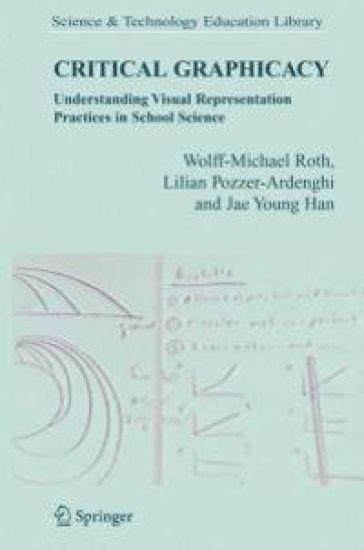
Critical Graphicacy

Critical Graphicacy

Wolff-Michael Roth; Lilian Pozzer-Ardenghi; Jae Young Han

Springer-Verlag New York Inc.
2007
nidottu
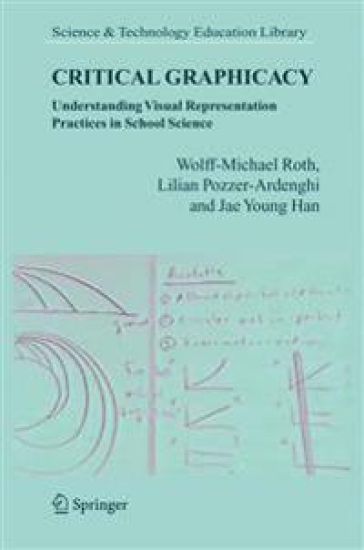
School science is dominated by textbook-oriented approaches to teaching and learning. Some surveys reveal that students have to read, depending on academic level, between ten and thirty-six pages per week from their textbook. One therefore has to ask, To what degree do textbooks introduce students to the literary practices of their domain? Few studies have addressed the quality of science curriculum materials, particularly textbooks, from a critical perspective. In this light, we are concerned in this book with better understanding the reading and interpretation practices related to visual materials - here referred to as inscriptions - that accompany texts. Our overarching questions included: ‘What practices are required for reading inscriptions?’ and ‘Do textbooks allow students to develop levels of graphicacy required to critically read scientific texts?’ Some of the more specific questions included: ‘What are the practices of relating inscriptions, captions, and main text?,’ and ‘What practices are required to read inscriptions in school textbooks?’ That is, we are interested not only in understanding what it takes to interpret, read, and understand visual materials (i.e., inscriptions), but also in understanding what it takes to engage inscriptions in a critical way. It is only when citizens can critically engage with language (texts, speech) and inscriptions that they become knowledgeable users of television, newspapers, and magazines, who can choose or leave aside particular expressions as part of the particular politics that they participate in.
Critical Graphicacy

Critical Graphicacy

Wolff-Michael Roth; Lilian Pozzer-Ardenghi; Jae Young Han

Springer-Verlag New York Inc.
2005
sidottu
School science is dominated by textbook-oriented approaches to teaching and learning. Some surveys reveal that students have to read, depending on academic level, between ten and thirty-six pages per week from their textbook. One therefore has to ask, To what degree do textbooks introduce students to the literary practices of their domain? Few studies have addressed the quality of science curriculum materials, particularly textbooks, from a critical perspective. In this light, we are concerned in this book with better understanding the reading and interpretation practices related to visual materials - here referred to as inscriptions - that accompany texts. Our overarching questions included: ‘What practices are required for reading inscriptions?’ and ‘Do textbooks allow students to develop levels of graphicacy required to critically read scientific texts?’ Some of the more specific questions included: ‘What are the practices of relating inscriptions, captions, and main text?,’ and ‘What practices are required to read inscriptions in school textbooks?’ That is, we are interested not only in understanding what it takes to interpret, read, and understand visual materials (i.e., inscriptions), but also in understanding what it takes to engage inscriptions in a critical way. It is only when citizens can critically engage with language (texts, speech) and inscriptions that they become knowledgeable users of television, newspapers, and magazines, who can choose or leave aside particular expressions as part of the particular politics that they participate in.
Talking Science

Talking Science

Wolff-Michael Roth

Rowman Littlefield Publishers
2005
nidottu
Examines the importance of talking about science in classrooms and argues that the ways instructors describe science and scientific writings influence learner outcomes the most.
Rethinking Scientific Literacy

Rethinking Scientific Literacy

Wolff-Michael Roth; Angela Calabrese Barton

Routledge
2004
sidottu
Rethinking Scientific Literacy presents a new perspective on science learning as a tool for improving communities. By focusing on case studies inside and outside of the classroom, the authors illuminate the relevance of science in students' everyday lives, offering a new vision of scientific literacy that is inextricably linked with social responsibility and community development. The goal if not tote memorization of facts and theories, but a broader competency in scientific thinking and the ability to generate positive change.
Rethinking Scientific Literacy

Rethinking Scientific Literacy

Wolff-Michael Roth; Angela Calabrese Barton

Routledge
2004
nidottu
Rethinking Scientific Literacy presents a new perspective on science learning as a tool for improving communities. By focusing on case studies inside and outside of the classroom, the authors illuminate the relevance of science in students' everyday lives, offering a new vision of scientific literacy that is inextricably linked with social responsibility and community development. The goal if not tote memorization of facts and theories, but a broader competency in scientific thinking and the ability to generate positive change.