Kirjojen hintavertailu – 12 859 829 kirjaa ja 27 kauppaa

Kirjailija

World Bank

Kirjat ja teokset yhdessä paikassa: 131 kirjaa, julkaisuja vuosilta 1985–2025, suosituimpiin kuuluu Farm Sector Restructuring in Belarus. Vertaile teosten hintoja ja tarkista saatavuus suomalaisista kirjakaupoista.

131 kirjaa

Kirjojen julkaisuvuodet: 1985–2025.

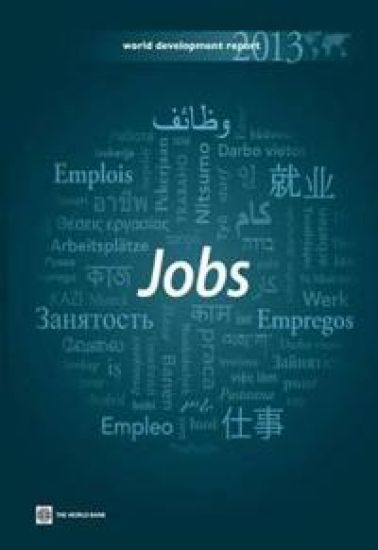
World Development Report 2013

World Development Report 2013

World Bank

World Bank Publications
2012
nidottu
Jobs provide higher earnings and better benefits as countries grow, but they are also a driver of development. Poverty falls as people work their way out of hardship and as jobs empowering women lead to greater investments in children. Efficiency increases as workers get better at what they do, as more productive jobs appear, and less productive ones disappear. Societies flourish as jobs bring together people from different ethnic and social backgrounds and provide alternatives to conflict. Jobs are thus more than a byproduct of economic growth. They are transformational —they are what we earn, what we do, and even who we are. High unemployment and unmet job expectations among youth are the most immediate concerns. But in many developing countries, where farming and self-employment are prevalent and safety nets are modest are best, unemployment rates can be low. In these countries, growth is seldom jobless. Most of their poor work long hours but simply cannot make ends meet. And the violation of basic rights is not uncommon. Therefore, the number of jobs is not all that matters: jobs with high development payoffs are needed. Confronted with these challenges, policy makers ask difficult questions. Should countries build their development strategies around growth, or should they focus on jobs? Can entrepreneurship be fostered, especially among the many microenterprises in developing countries, or are entrepreneurs born? Are greater investments in education and training a prerequisite for employability, or can skills be built through jobs? In times of major crises and structural shifts, should jobs, not just workers, be protected? And is there a risk that policies supporting job creation in one country will come at the expense of jobs in other countries? The World Development Report 2013: Jobs offers answers to these and other difficult questions by looking at jobs as drivers of development—not as derived labor demand—and by considering all types of jobs—not just formal wage employment. The Report provides a framework that cuts across sectors and shows that the best policy responses vary across countries, depending on their levels of development, endowments, demography, and institutions. Policy fundamentals matter in all cases, as they enable a vibrant private sector, the source of most jobs in the world. Labor policies can help as well, even if they are less critical than is often assumed. Development policies, from making smallholder farming viable to fostering functional cities to engaging in global markets, hold the key to success.
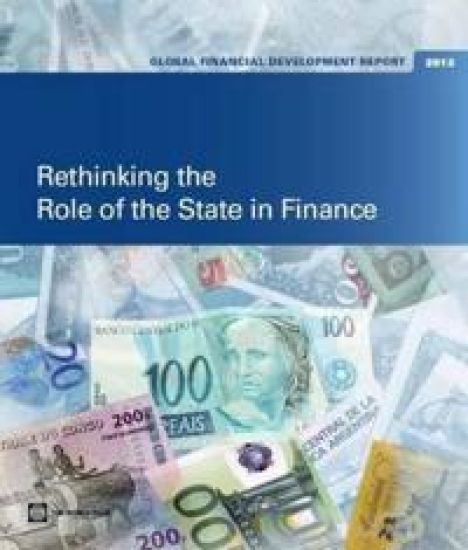
Global Financial Development Report 2013

Global Financial Development Report 2013

World Bank

World Bank Publications
2012
nidottu
Global Financial Development Report 2013 is the first in a new World Bank series. It provides a unique contribution to financial sector policy debates, building on novel data, surveys, research, and wide-ranging country experience, with emphasis on emerging-market and developing economies. The global financial crisis has challenged conventional thinking on financial sector policies. This volume re-examines a basic question: what is the proper role of the state in financial development? To address the question, this report: Synthesises new and existing evidence on the state's performance as financial sector regulator, overseer, promoter, and owner. Calls on state agencies to provide strong regulation and supervision and ensure healthy competition in the sector, and to support financial infrastructure, such as the quality and availability of credit information. Warns that direct interventions - such as lending by state-owned banks, used in many countries to counteract the crisis - may end up being harmful. The report also tracks financial systems in more than 200 economies before and during the global financial crisis. The report's findings and policy recommendations are relevant for policy makers; staff of central banks, ministries of finance, and financial regulation agencies; nongovernmental organisations and donors; academics and other researchers and analysts; and members of the finance and development community.
Global Monitoring Report 2012

Global Monitoring Report 2012

World Bank; International Monetary Fund

World Bank Publications
2012
nidottu
The rapid increases in world food prices since 2005 have raised widespread concerns about their possible impact on poverty, hunger, and general progress toward the Millennium Development Goals. This year's report summarizes the short- and long-term impact of food prices on several MDGs, explores future trends, and review policy responses, from domestic policies such as social safety nets, nutritional programs and agricultural policies, to regional trade policies to support by the international community. This year's theme is used as a filter to examine progress toward the MDGs--especially for women, children, and countries in fragile situations. The Global Monitoring Report is prepared jointly by the World Bank and International Monetary Fund.
Global Development Finance 2012

Global Development Finance 2012

World Bank

World Bank Publications
2012
muu
Global Development Finance 2012: External Debt of Developing Countries is a continuation of the World Bank’s publications Global Development Finance, Volume II (1997 through 2009) and the earlier World Debt Tables (1973 through 1996). As in previous years, Global Development Finance 2012 provides statistical tables showing the external debt of 129 developing countries that report public and publicly guaranteed external debt to the World Bank’s Debtor Reporting System (DRS). It also includes tables of key debt ratios for individual reporting countries and the composition of external debt stocks and flows for individual reporting countries and regional and income groups along with some graphical presentations. Global Development Finance 2012 draws on a database maintained by the World Bank External Debt (WBXD) system. Longer time series and more detailed data are available from the Global Development Finance 2012 on CD-ROM and the World Bank open databases, which contain more than 200 time series indicators, covering the years 1970 to 2010 for most reporting countries, and pipeline data for scheduled debt service payments on existing commitments to 2018. The database covers external debt stocks and flows, major economic aggregates, and key debt ratios, as well as average terms of new commitments, currency composition of longterm debt, and debt restructurings in greater detail than can be included in the GDF book. The CD-ROM also contains the full contents of the print version of Global Development Finance 2012. Text providing country notes, definitions, and source information is linked to each table. World Bank open databases are available through the World Bank’s website, http:// www.worldbank.org. Global Development Finance 2012: External Debt of Developing Countries is unique in its coverage of the important trends and issues fundamental to the financing of the developing world. This report is an indispensable resource for governments, economists, investors, financial consultants, academics, bankers, and the entire development community.
Doing Business 2012

Doing Business 2012

World Bank

World Bank Publications
2011
nidottu
Ninth in a series of annual reports comparing business regulations in 183 economies, Doing Business 2012 measures regulations affecting 11 areas of everyday business activity:starting a businessdealing with construction permitsemploying workersregistering propertygetting creditprotecting investorspaying taxestrading across bordersenforcing contractsclosing a businessgetting electricityThe report updates all indicators as of June 1, 2011, ranks countries on their overall 'ease of doing business', and analyzes reforms to business regulation--identifying which countries are strengthening their business environment the most. Doing Business 2012 includes a new set of indicators on the time, steps, and cost for a private business to get an electricity connection. The data on connection services can inform utilities, regulators and governments seeking to strengthen the performance of the electricity sector. Drawing on a now longer time series, this year's report introduces a measure to illustrate how the regulatory environment for business has changed in each economy since Doing Business 2006 was published in 2005. A new 'distance to frontier' measure complements the aggregate ranking on the ease of doing business, which benchmarks each economy's current performance on the indicators against that of all other economies in the sample for a given year. A fundamental premise of Doing Business is that economic activity requires good rules that are transparent and accessible to all. Such regulations should be efficient, striking a balance between safeguarding some important aspects of the business environment and avoiding distortions that impose unreasonable costs on businesses. Where business regulation is burdensome and competition limited, success depends more on whom you know than on what you can do. But where regulations are relatively easy to comply with and accessible to all who need to use them, anyone with talent and a good idea should be able to start and grow a business in the formal sector.
The Little Data Book 2011

The Little Data Book 2011

World Bank

World Bank Publications
2011
nidottu
This pocket-sized reference on key development data for over 200 countries provides profiles of each country with 54 development indicators about people, environment, economy, technology and infrastructure, trade, and finance.
Challenges to Enterprise Performance in the Face of the Financial Crisis
This report addresses the core components of enterprise activity, namely, the factors of production and the public infrastructure to support them. In the period just before the financial crisis, a number of elements, such as access to finance, skills and education of labor, and infrastructure emerged as important obstacles to enterprise growth. The aggregate level of enterprise activity and its productivity largely depend on the availability and quality of these components. The relative importance of these obstacles has evolved over time, reflecting structural reforms and progress in improving the business environment. Some of these constraints may have eased because of the crisis, but their presence during a period of economic growth suggests that there are important, unfinished structural reforms among countries in the ECA region. This report explores the impact of these constraints on firm performance in 29 Eastern European and Central Asian countries. The results show that enterprises in the region face varying levels of pressure depending on their features, location, resources directly accessible to them, and characteristics of country governance and regulatory frameworks. The report takes stock of enterprise sector performance along these three key dimensions near the end of two decades of the transition process. It is therefore critical to understand where firms in these countries stand now in terms of their relative access to finance, labor markets and quality of labor, and infrastructure capacity.
How Governments Can Engage the Private Sector to Improve Health in Africa
Since the private health sector is an important, and often dominant, provider of health services in Sub-Saharan Africa, it is the job of governments as the stewards of the health system to engage with it. Increasing the contributions that the existing private health sector is making to public health is an important, but often neglected, element of meeting the daunting health-related challenges facing African nations. This Report presents newly collected data on how and how effectively each country in the Africa region is engaging the respective private health sectors; and how the engagement compares across the region. While the approach taken by governments varies greatly between countries, there is much room for improvement in the Africa region overall to engage more effectively and room for exchange of ideas and good practices on how to do so. Improved solutions on the policy/regulatory side should be supported by effective organization of the private sector itself and by adjustments in donor programs that take the dynamics of the private health sector better into account.
World Development Indicators 2010

World Development Indicators 2010

World Bank

World Bank Publications
2011
muu
Looking for accurate, up-to-date data on development issues? World Development Indicators is the World Bank's premier annual compilation of data about development. This indispensable statistical reference allows you to consult over 900 indicators for some 150 economies and 14 country groups in more than 80 tables. It provides a current overview of the most recent data available as well as important regional data and income group analysis in six thematic sections: World View, People, Environment, Economy, States and Markets, and Global Links.
Confronting Poverty in Iraq

Confronting Poverty in Iraq

World Bank

World Bank Publications
2011
nidottu
Provides the most comprehensive and rigorous analysis of Iraqi income and expenditure in several decades. The report makes extensive use of the Iraq Household Socio-Economic Survey, the first nationwide income and expenditure survey since 1988. IHSES data is complemented by income and expenditure data from a wide range of other measures of living standards.
Natural Hazards, UnNatural Disasters

Natural Hazards, UnNatural Disasters

United Nations; World Bank

World Bank Publications
2010
nidottu
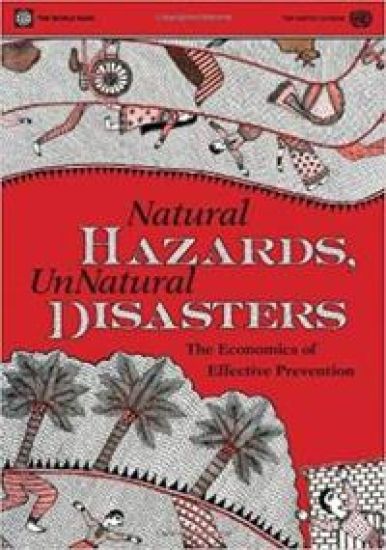
Earthquakes, droughts, floods, and storms are natural hazards, but unnatural disasters are the deaths and damages that result from human acts of omission and commission. Every disaster is unique, but each exposes actions-by individuals and governments at different levels-that, had they been different, would have resulted in fewer deaths and less damage. Prevention is possible, and this book examines what it takes to do this cost-effectively. It looks at disasters primarily through an economic lens. Economists emphasize self-interest to explain how people choose the amount of prevention, insurance, and coping. But lenses can distort as well as sharpen images, so the book also draws from other disciplines: psychology to examine how people may misperceive risks, political science to understand voting patterns, and nutrition science to see how stunting in children after a disaster impairs cognitive abilities and productivity as adults much later. Peering into the future, it shows that while urbanization and climate change will increase exposure to hazards, vulnerability can be reduced if cities are better managed. This book will be of interest to government officials, urban planners, relief agencies, NGOs, donors, and other development practitioners .
Entrepreneurship Snapshots 2010

Entrepreneurship Snapshots 2010

World Bank

World Bank Publications
2010
nidottu
The 2010 World Bank Entrepreneurship Snapshots (WBGES) provide a unique indicator of business creation around the world and facilitate the investigation of the factors that foster dynamic private sector growth. Now in its fourth year, the WBGES measure entrepreneurial activity in 115 developing and industrial countries over the six year period 2004-2009. Importantly, the data offer a distinctive and timely snapshot of the impact of the 2008-2009 financial crisis on entrepreneurial activity. There is wide variation in new business creation across countries: On average, about four new firms register every year for every 1,000 working age individuals in industrialized countries, while there is less than one new firm registered in low and low middle income countries. The data show that dynamic business creation occurs in countries that provide entrepreneurs with good governance, a strong legal and regulatory environment, and reduced red tape. The data also show that nearly all countries experienced a sharp drop in business entry during the crisis. However, industrialized countries experienced the crisis more quickly and more severely than other income groups. In addition, the degree to which the crisis impacted new firm creation is correlated with measures of crisis severity. Finally, we find that countries in which financial markets play a larger role in the domestic economy experienced sharper declines in new business registrations as a result of the crisis that paralyzed financial markets. These results can guide effective policymaking and deliver new capabilities for identifying the impact of reforms.
World Bank East Asia and Pacific Economic Update 2010
The World Bank East Asia and Pacific Economic Update 2010, Volume 2, is the latest edition of the comprehensive, twice-yearly review of the region's economies prepared by the East Asia and Pacific region of the World Bank. Entitled 'Robust Recovery, Rising Risks, ' this Update notes that output and trade flows have recovered to above pre-crisis levels throughout developing East Asia. Confidence is on the rise, and private sector investment is once again driving growth. Yet greater confidence in the region s growth prospects and concerns about tepid economic expansion in advanced economies are confronting policy makers with a delicate balancing act. In particular, the return of large capital inflows to East Asia has caused currencies to appreciate substantially, and is leading to concerns about asset price bubbles. Countries need to address emerging risks at the same time as medium-term challenges to sustain strong growth. The need for China to rebalance the economy by altering the pattern of growth and investment is increasingly critical for sustainability. Commodity exporters in the region need to ensure a transparent framework to use resource-related revenues for development. The middle-income countries of the region, excluding China, need to raise investment in physical and human capital and encourage innovation if they are to eventually attain high-income status. Presenting unique perspectives along with the latest data on the region, the World Bank East Asia and Pacific Economic Update is a valued resource for policymakers, researchers, businesspersons, students, and anyone else with a serious interest in this dynamic region."
Doing Business

Doing Business

World Bank

World Bank Publications
2010
nidottu
Eighth in a series of annual reports comparing business regulations in 183 economies, Doing Business 2011 measures regulations affecting 10 areas of everyday business activity: starting a business, dealing with construction permits, employing workers, registering property, getting credit, protecting investors, paying taxes, trading across borders, enforcing contracts, and closing a business. The report updates all 10 sets of indicators, ranks countries on their overall ease of doing business and analyses reforms to business regulation- identifying which countries are improving strengthening their business environment the most and which ones slipped. Doing Business 2011 includes results on the ongoing research in the area of "getting electricity" and illustrates how reforms in business regulations can translate into better outcomes for domestic entrepreneurs and the wider economy. It also focuses on how women in particular are affected by complex business regulations.
World Development Report 2010

World Development Report 2010

World Bank

World Bank Publications
2009
sidottu
Rising densities of human settlements, migration and transport to reduce distances to market, and specialization and trade facilitated by fewer international divisions are central to economic development. The transformations along these three dimensions - density, distance, and division - are most noticeable in North America, Western Europe, and Japan, but countries in Asia and Eastern Europe are changing in ways similar in scope and speed. "World Development Report 2009: Reshaping Economic Geography" concludes that these spatial transformations are essential, and should be encouraged. The conclusion is not without controversy. Slum-dwellers now number a billion, but the rush to cities continues. Globalization is believed to benefit many, but not the billion people living in lagging areas of developing nations. High poverty and mortality persist among the world's 'bottom billion', while others grow wealthier and live longer lives. Concern for these three billion often comes with the prescription that growth must be made spatially balanced. "The WDR" has a different message: economic growth is seldom balanced, and efforts to spread it out prematurely will jeopardize progress.
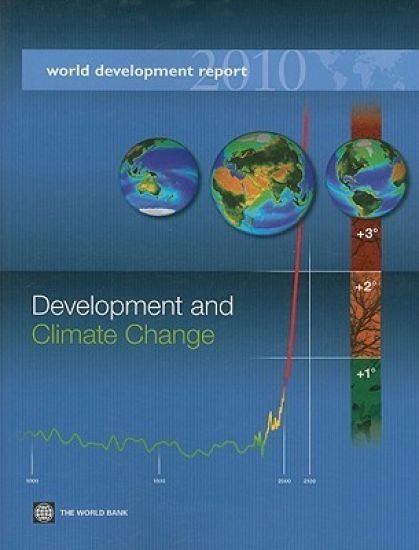
World Development Report 2010

World Development Report 2010

World Bank

World Bank Publications
2009
nidottu
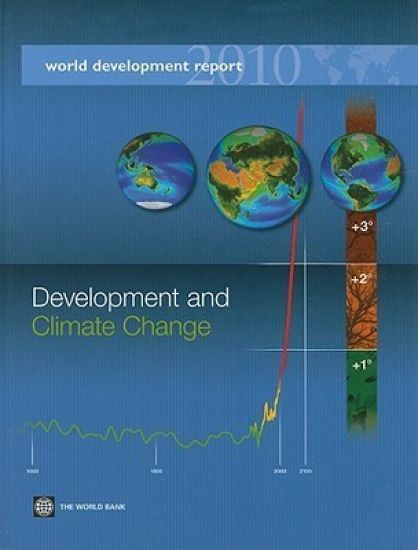
Today's enormous development challenges are complicated by the reality of climate change-the two are inextricably linked and together demand immediate attention. Climate change threatens all countries, but particularly developing ones. Understanding what climate change means for development policy is the central aim of the World Development Report 2010. Estimates are that developing countries would bear some 75 to 80 percent of the costs of anticipated damages caused by the changing climate. Developing countries simply cannot afford to ignore climate change, nor can they focus on adaptation alone. So action to reduce vulnerability and lay the groundwork for a transition to low-carbon growth paths is imperative. The World Development Report 2010 explores how public policy can change to better help people cope with new or worsened risks, how land and water management must adapt to better protect a threatened natural environment while feeding an expanding and more prosperous population, and how energy systems will need to be transformed. The authors examine how to integrate development realities into climate policy-in international agreements, in instruments to generate carbon finance, and in steps to promote innovation and the diffusion of new technologies. The World Development Report 2010 is an urgent call for action, both for developing countries who are striving to ensure policies are adapted to the realities and dangers of a hotter planet, and for high-income countries who need to undertake ambitious mitigation while supporting developing countries efforts. The authors argue that a climate-smart world is within reach if we act now to tackle the substantial inertia in the climate, in infrastructure, and in behaviors and institutions; if we act together to reconcile needed growth with prudent and affordable development choices; and if we act differently by investing in the needed energy revolution and taking the steps required to adapt to a rapidly changing planet.
Combating Money Laundering and the Financing of Terrorism

Combating Money Laundering and the Financing of Terrorism

World Bank; International Monetary Fund

World Bank Publications
2009
muu
Combating Money Laundering and the Financing of Terrorism has been developed by the Financial Market Integrity Unit of the World Bank to support the World Bank's Capacity Enhancement Program on Anti-Money Laundering and Combatting the Financing of Terrorism (AML/CFT). The guide is comprised of the following eight Modules: Effects on Economic Development and International Standards; Legal Requirements to meet International Standards; Regulatory and Institutional Requirements; Compliance Requirements for Financial Institutions; Building an Effective Financial Intelligence Unit; Domestic (inter-agency) and International Cooperation; Combating the Financing of Terrorism; and, Investigating Money Laundering and Terrorist Financing. The program offers countries the tools, skills and knowledge to build and strengthen their institutional, and regulatory frameworks for developing a robust AML/CFT regime.
Le Systeme Educatif Centrafricain

Le Systeme Educatif Centrafricain

World Bank

World Bank Publications
2008
nidottu
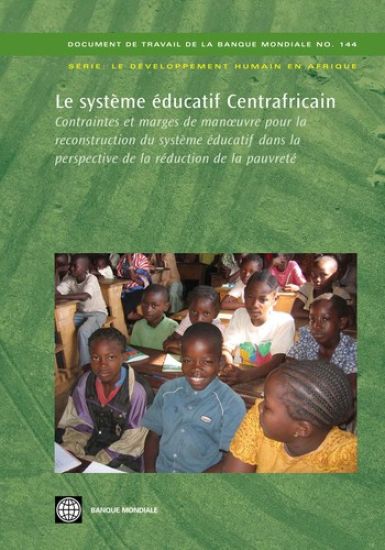
Cette analyse sectorielle de l'education en Republique Centrafricaine (RCA) s'ajoute a la liste croissante des Rapports d'Etat des Systemes Educatifs Nationaux (RESEN) que la Banque Mondiale a soutenu dans la region Afrique. Comme dans les rapports similaires, le RESEN de la RCA est le produit de la collaboration entre une equipe nationale composee de cadres du Ministere de l'Education et d'autres ministeres et une equipe d'appui de la Banque Mondiale et des partenaires au developpement, en particulier le Pole de Dakar en analyse sectorielle (UNESCO-BREDA). Le rapport est destine a etablir une photographie precise de l'etat actuel de l'education en RCA, et ainsi d'offrir aux decideurs nationaux et a leurs partenaires au developpement une base analytique solide pour instruire le dialogue politique et le processus de prise de decision. En ce qui concerne la PCA, ce rapport constitue use base importante pour la preparation d'un plan sectoriel d'education visant a etre endosse et donc a recevoir l'appui financier des partenaires de I'IOMA-EPT. Un tel appui est particulierement urgent et important pour le pays du fait des effets devastateurs des conflits armes, mutineries et coups d'Etats ayant eu lieu lors des 10-15 dernieres annees et qui ont paralyse l'economie et degrade fortement l'offre des services sociaux, y compris l'education. L'insecurite et l'instabilite politique ont provoque l'arret de l'appui des principaux bailleurs de fonds, ce qui ne permet pas au pays de faire face aux contraintes financieres et penalise la reconstruction et le developpement du systeme educatif.
Doing Business - An Independent Evaluation

Doing Business - An Independent Evaluation

World Bank

World Bank Publications
2008
nidottu
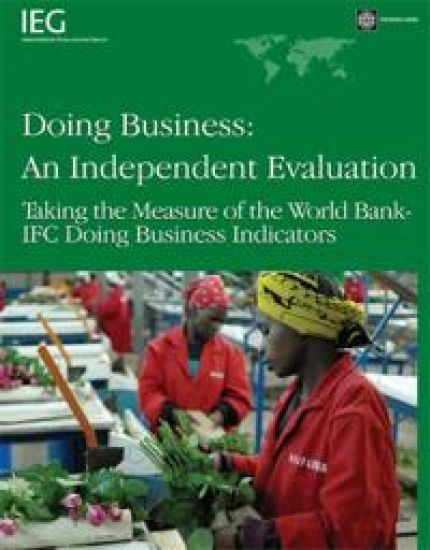
This independent evaluation of the Doing Business Indicators assesses the methods and processes used to construct the indicators, their relevance to development outcomes, and their usefulness to policy makers and other stakeholders. It makes recommendations for improving the collection and presentation of data and for greater clarity in communicating what the indicators can and cannot capture.