Kirjojen hintavertailu – 12 859 829 kirjaa ja 27 kauppaa

Kirjailija

World Bank

Kirjat ja teokset yhdessä paikassa: 131 kirjaa, julkaisuja vuosilta 1985–2025, suosituimpiin kuuluu Farm Sector Restructuring in Belarus. Vertaile teosten hintoja ja tarkista saatavuus suomalaisista kirjakaupoista.

131 kirjaa

Kirjojen julkaisuvuodet: 1985–2025.

Global Monitoring Report 2008

Global Monitoring Report 2008

World Bank

World Bank Publications
2008
nidottu
This report is essential reading for those who wish to follow the global development agenda and debate in 2008. It provides a comprehensive assessment of progress and priorities for achievement of the Millennium Development Goals at the midpoint in the MDG calendar. And it links the development agenda to meeting the challenge of climate change and environmental sustainability, to ensure sustainable progress. Both are highly topical issues in 2008.
The Welfare Impact of Rural Electrification

The Welfare Impact of Rural Electrification

World Bank

World Bank Publications
2008
nidottu
Rural electrification can have many benefits-not only bringing lighting, but improving the quality of health care, spreading information and supporting productive enterprises. The extent of these benefits has been questioned, arguing that they may be insufficient to justify the investment costs. This book quantifies these benefits. It finds that the benefits can indeed be high, substantially outweighing the costs, and that consumer willingness to pay is generally sufficient to achieve financial sustainability. However, benefits could be increased further by providing smart subsidies to assist connections for poorer households, promote productive uses and further consumer education.
World Development Report 2008

World Development Report 2008

World Bank

World Bank Publications
2007
nidottu
The world's demand for food is expected to double within the next 50 years, while the natural resources that sustain agriculture will become increasingly scarce, degraded, and vulnerable to the effects of climate change. In many poor countries, agriculture accounts for at least 40 percent of GDP and 80 percent of employment. At the same time, about 70 percent of the world's poor live in rural areas and most depend on agriculture for their livelihoods. World Development Report 2008 seeks to assess where, when, and how agriculture can be an effective instrument for economic development, especially development that favors the poor. It examines several broad questions:How has agriculture changed in developing countries in the past 20 years? What are the important new challenges and opportunities for agriculture? Which new sources of agricultural growth can be captured cost effectively in particular in poor countries with large agricultural sectors as in Africa? How can agricultural growth be made more effective for poverty reduction? How can governments facilitate the transition of large populations out of agriculture, without simply transferring the burden of rural poverty to urban areas? How can the natural resource endowment for agriculture be protected? How can agriculture's negative environmental effects be contained? This year's report marks the 30th year the World Bank has been publishing the World Development Report.
Systeme Educatif Burundais

Systeme Educatif Burundais

World Bank

World Bank Publications
2007
nidottu
Le Rapport sur le Systeme Educatif du Burundi est l'un de la serie de rapports appuyes par la Banque mondiale dans les pays de l'Afrique subsaharienne. Chaque rapport est prepare par une equipe issue des ministeres concernes avec l'appui de la Banque mondiale et d'autres partenaires au developpement. L'objectif immediat est d'ameliorer les connaissances de base pour la definition d'une politique dans le secteur de l'education. Plus generalement, le Rapport sur le Systeme Educatif cree unde base pour l'engagement d'un public varie dans le dialogue sur les politiques du secteur de l'education et pour le developpement d'une vision partagee du futur. Ce processus est devenu de plus en plus important a mesure que les gouvernements renouvelaient leur engagement pour reduire la pauvrete et que la communaute internationale s'engageait a fournir l'assistance l'assistance financiere requise.
Doing Business 2007

Doing Business 2007

World Bank

Editions Saint-Martin
2007
pokkari
Focuses on reforms, identifies top reformers in business regulation, and best practices in how to reform. This volume is the fourth in a series of annual reports investigating global regulations that enhance business activity and those that constrain it.
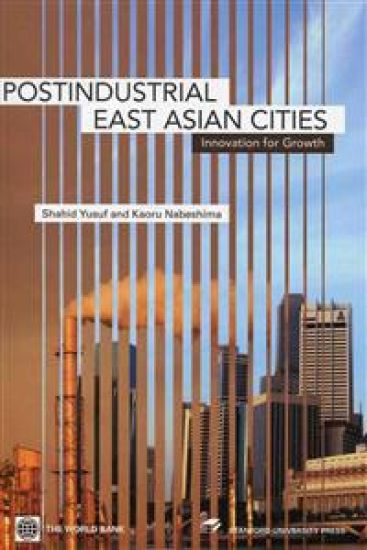
Post-Industrial East Asian Cities

Post-Industrial East Asian Cities

Shahid Yusuf; World Bank

Stanford University Press
2006
sidottu
Throughout East Asia, the growth process and its sources are changing in a number of important respects, especially for middle- and high-income economies. Growth is increasingly coming from the strength of innovative activities in these economies rather than from factor accumulation as in the past. Such innovative activities especially in producer services and the creative industries are concentrated in high-tech clusters in globally linked cities. Drawing on a wide range of literature and on interviews with firms, this book explores these issues with a focus on six East Asian cities: Bangkok, Beijing, Seoul, Shanghai, Singapore, and Tokyo. It suggests how policies and institutions can induce and furnish an urban environment that supports innovative activities. A valuable resource for researchers, urban planners, urban geographers, and policy makers interested in East Asia, "Post-Industrial East Asian Cities" presents the latest findings on creative industries in East Asia and their effect on economic growth. "
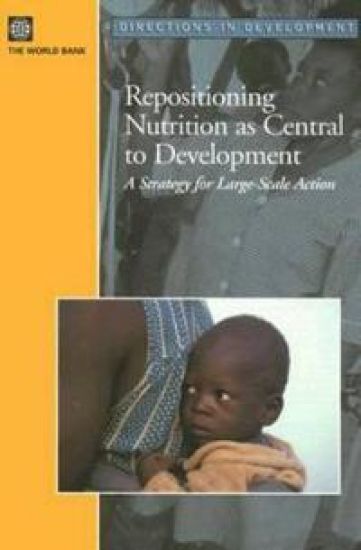
Repositioning Nutrition as Central to Development

Repositioning Nutrition as Central to Development

World Bank

World Bank Publications
2005
nidottu
Persistent malnutrition is contributing not only to widespread failure to meet the first MDG - to halve poverty and hunger - but also to meet other goals in maternal and child health, HIV/AIDS, education, and gender equity. The choice is now between continuing to fail, or to finally make nutrition central to development. Underweight prevalence among children is the key indicator for measuring progress on non-income poverty and malnutrition remains the world's most serious health problem and the single biggest contributor to child mortality. Nearly a third of children in the developing world are either underweight or stunted, and more than 30 percent of the developing world's population suffers from micronutrient deficiencies. There are also new dimensions to malnutrition. The epidemic of obesity and diet-related noncommunicable diseases (NCDs) is spreading to the developing world and malnutrition is also linked to the growing HIV/AIDS pandemic. This report makes the case for development partners and developing countries to focus on nutrition, and to fund nutrition investments much more heavily than has been the case in the past. This case is based on evidence that such programs are excellent economic investments and essential for faster progress in reducing poverty; and on program experience showing that they can improve nutrition much faster than relying on economic growth alone. The report sets out a global strategy for stepped-up action in nutrition, for discussion in the international development community.
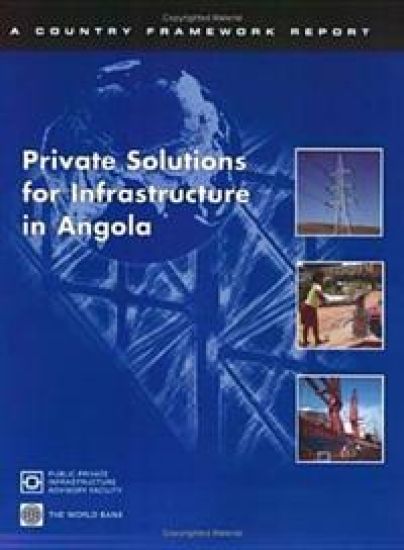
Private Solutions for Infrastructure in Angola

Private Solutions for Infrastructure in Angola

World Bank

World Bank Publications
2005
nidottu
This book provides an objective assessment of Angola's general environment for private sector participation in infrastructure. Its main purpose is to assist the government of Angola in developing policies and a framework for the promotion of private participation in the rebuilding and development of the country's infrastructure. The book focuses on maximizing the role and contribution of the private sector in infrastructure and analyzes and documents the barriers, opportunities, and measures to promote private participation in infrastructure over the period 2005-2020. The book also provides a summary of the action plan of the short, medium, and long-term steps to facilitate private sector participation.
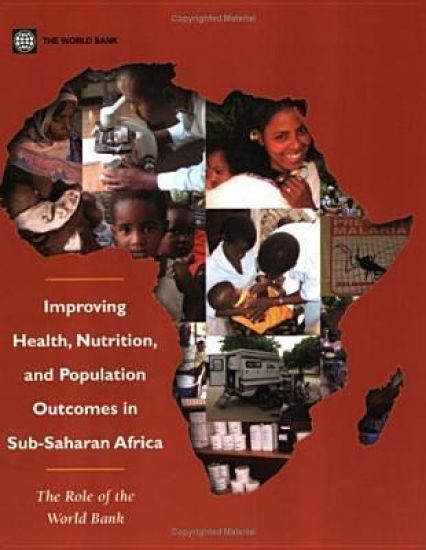
Improving Health, Nutrition and Population Outcomes in Sub-Saharan Africa
In recent years, the focus in many developing regions is increasingly moving away from communicable disease, where as Africa continues to face a high burden of communicable disease, malnutrition, and fertility. At the same time, the ways in which the World Bank operates are changing - increasingly countries define their own priorities, resources are provided through programmatic approaches, and the Bank is focusing more on sharing knowledge, policy advice, research and analysis. This book takes an in-depth look at health, nutrition, and population (HNP) challenges faced by Sub-Saharan Africa, particularly how disease, malnutrition, and high fertility affect poverty reduction. The authors contend that the World Bank has a comparative advantage in contributing within four broad areas: 1) macroeconomics and health, 2) multisectoral action for health, 3) strengthening health systems, and 4) financing service delivery. They also address the opportunities and challenges within these four areas and conclude with suggestions of how the Bank can better operate within the sector and work effectively with partners.
Doing Business in 2005

Doing Business in 2005

World Bank

World Bank Publications
2004
nidottu
Doing Business in 2005: Obstacles to Growth is the second in a series of annual reports investigating the scope and manner of regulations that enhance business activity and those that constrain it. New quantitative indicators on business regulations and their enforcement can be compared across more than 130 countries, and over time. The indicators are used to analyze economic outcomes and identify what reforms have worked, where and why. Topics in Doing Business in 2005 include: Licensing and Inspections: Having registered a business, now what? In most countries, firms face a myriad of sector specific licenses as well as inspections to enforce compliance. The Doing Business database constructs two sets of indicators on the regulation of operations. One measures the steps, time and costs of complying with licensing and permit requirements for ongoing. The other assesses the enforcement of regulations through two of the most common types of inspections-labor and tax. Registering Property: Property registries were first developed to help raise tax revenue. What was good for the tax authorities has since proven to be good for strengthening property rights-the registries strengthen incentives to invest, facilitate trade, and expand access to credit. New indicators cover the steps, time and cost to register property. Measures of the legal provisions that strengthen property rights and the efficiency of property registries are also developed. Protecting Investors: Corporate governance issues are often thought to affect only publicly listed companies in developed countries. In fact, corporate governance is relevant for every large privately held company that has more than one owner. New indicators examine several possible types of shareholder expropriation, including related-party transactions, guarantees and loans to company managers and directors, mergers and acquisitions, disclosure of ownership information, and treatment of conflicts of interest. Including a new emphasis on gender, Doing Business not only provides insights into business constraints throughout the world but highlights particular barriers faced by women. Doing Business is a comprehensive resource that no investor, economic adviser, business developer, or economic policymaker should be without.

World Development Report 1978-2004 With Selected World Development Indicators 2003
The World Development Report, published by the World Bank annually since 1978, contains a wealth of information on the economic and social state of the world. This omnibus CD-ROM edition includes the text of all 26 editions. Contents are fully indexed and cross-referenced for easy searching across volumes. Selected indicators from World Development Indicators 2003 with multiple display and data export options are also included.
Doing Business in 2004

Doing Business in 2004

World Bank

World Bank Publications
2004
nidottu
An important new annual publication from the World Bank, Doing Business in 2004 provides both qualitative and quantitative information on the business climate in over 130 countries. Doing Business constructs a new set of indicators on the regulatory environment for private sector development and provides a collection of informative case studies of real-life experiences. Doing Business in 2004 covers the fundamental aspects of a business life cycle, from starting a business to bankruptcy. Topics include access to credit, bankruptcy, entry regulations, contract enforcement, and labour regulations. Unique in its approach, Doing Business provides both the accurate data and in-depth analysis necessary to assess the environment for doing business, and offers answers to these critical questions:Which is the most expensive country for starting a new business? Which countries have the most rigid regulations on hiring and firing? Which countries have the most extensive business entry procedures? Why does heavy regulation lead to inefficiency and corruption? What countries are most efficient in the area of contract enforcement? How do clearly-defined property rights enhance prosperity? What are the most successful regulatory models? Why? Through its ambitious agenda, Doing Business will provide an understanding of business environments throughout the world, the factors that influence them, and how conducive they are to private sector development. Doing Business is a comprehensive resource for investors, economic advisers, business developers and policymakers.
World Development Report-Making Services Work for Poor People
The World Development Report 2004 investigates how countries can accelerate progress towards the Millennium Development Goals (MDGs) by making services work for poor people. Success in reaching the MDGs will depend not just on faster economic growth and the flow of sources, but on our ability to translate those resources into basic services, especially in health, education, water, and sanitation. Too often, the delivery of services falls far short of what could be achieved, due to issues such as weak incentives for performance, corruption, imperfect monitoring, and administrative logjams. Some countries have addressed the problem by involving poor people in service delivery; the results have been impressive. Giving parents input into their children's education, patients a say over hospital management, and making agency budgets transparent all contribute to improving outcomes in human development. Celebrating the successful innovations-while taking a hard look at some of the failures-this Report offers guidance to policymakers, donors, and citizens on improving the delivery of basic services. It serves to deepen understanding and highlight the importance of empowering and investing in poor people.
Empowerment and Poverty Reduction

Empowerment and Poverty Reduction

World Bank; Deepa Narayan

World Bank Publications
2002
nidottu
Empowerment and Poverty Reduction: A Sourcebook is an outcome of World Development Report 2000/2001: Attacking Poverty, which highlighted opportunity, empowerment, and security as key elements in the creation and implementation of poverty reduction strategies. This book provides a framework for empowerment that concentrates on increasing poor people's freedom of choice and action to shape their own lives. This framework pertains to five areas of action to improve development effectiveness - provision of basic services, improved local governance, improved national governance, access to justice and legal aid, and pro-poor market development. This Sourcebook gives 20 ""Tools and Practices,"" which concentrate on a wide-range of topics to encourage the empowerment of the poor from poor people's enterprises, information and communication technologies to diagnostic tools including corruption surveys and citizen report cards.
Kyrgyz Republic

Kyrgyz Republic

World Bank

World Bank Publications
2002
nidottu
After the break-up of the Soviet Union, the economic contraction in the Kyrgyz Republic was among the worst experienced in the Commonwealth of Independent States (CIS). Their output declined by fifty percent between the years 1991 and 1995. The fiscal costs to the country were nothing short of disastrous. Just as the Kyrgyz Republic was about to decisively restore growth and macroeconomic stability, a series of natural disasters and a regional crisis caused another fiscal setback. This report details a set of measures which, if implemented, will restore fiscal stability to the country. It focuses on reforming public utilities and the tax system, citing these as in the most need of reform.
Information Infrastructure

Information Infrastructure

Alain Barbu; Rafael Dominguez; William Melody; World Bank

World Bank Publications
2001
nidottu
This study updates the 1993 telecommunications review published by the World Bank's Operations Evaluation Department. It recommends that the World Bank reaffirm its strategy in the broader information infrastructure. This study also recommends that gaps in the current monitoring and evaluations systems be filled at both the project and global level in order to provide the necessary framework to evaluate the future effectiveness of the revised strategy.
China

China

World Bank

World Bank Publications
2001
nidottu
'China: Overcoming Rural Poverty' assesses the state of poverty in China at the end of the 1990s. The book also evaluates the most effective and efficient means of overcoming the remaining absolute poverty in the new decade. It focuses on China's absolute poor who are increasingly concentrated in remote and mountainous townships and villages. The report places considerable emphasis on the macroeconomic context, and finds that the trends in poverty reduction in the 1990s have been partly determined by larger macroeconomic trends.