
Kirjailija
Xenophon
Kirjat ja teokset yhdessä paikassa: 417 kirjaa, julkaisuja vuosilta 1914–2026, suosituimpiin kuuluu Second Greek Reader. Vertaile teosten hintoja ja tarkista saatavuus suomalaisista kirjakaupoista.
Nimi esiintyy myös muodoissa: Xénophon
417 kirjaa
Kirjojen julkaisuvuodet: 1914–2026.
On Revenues by Xenophon. Translation by H. G. Dakyns. Xenophon the Athenian was born 431 B. C. He was a pupil of Socrates. He marched with the Spartans, and was exiled from Athens. Sparta gave him land and property in Scillus, where he lived for many years before having to move once more, to settle in Corinth. He died in 354 B. C. Revenues describes Xenophon's ideas to solve the problem of poverty in Athens, and thus remove an excuse to mistreat the Athenian allies.

Cyropaedia: The Education of Cyrus by Xenophon. The Cyropaedia is a largely fictional biography of Cyrus the Great, written around 370 BC by the Athenian gentleman-soldier, and student of Socrates, Xenophon of Athens. Aspects of it would become a model for medieval writers of the genre known as mirrors for princes. In turn it was a strong influence upon the most well-known but atypical of these, Machiavelli's The Prince, which was an important influence in the rejection of medieval political thinking, and the development of modern politics. A very few words may suffice by way of introduction to this translation of the Cyropaedia. Professor Jowett, whose Plato represents the high-water mark of classical translation, has given us the following reminders: "An English translation ought to be idiomatic and interesting, not only to the scholar, but also to the unlearned reader. It should read as an original work, and should also be the most faithful transcript which can be made of the language from which the translation is taken, consistently with the first requirement of all, that it be English. The excellence of a translation will consist, not merely in the faithful rendering of words, or in the composition of a sentence only, or yet of a single paragraph, but in the colour and style of the whole work."
The Economist by Xenophon. Translation by H. G. Dakyns. Xenophon the Athenian was born 431 B. C. He was a pupil of Socrates. He marched with the Spartans, and was exiled from Athens. Sparta gave him land and property in Scillus, where he lived for many years before having to move once more, to settle in Corinth. He died in 354 B. C. The Economist records Socrates and Critobulus in a talk about profitable estate management, and a lengthy recollection by Socrates of Ischomachus' discussion of the same topic.

The Memorabilia: Recollections of Socrates
Xenophon
Createspace Independent Publishing Platform
2017
nidottu
The Memorabilia - Recollections of Socrates by Xenophon. Translation by H. G. Dakyns. Xenophon the Athenian was born 431 B. C. He was a pupil of Socrates. He marched with the Spartans, and was exiled from Athens. Sparta gave him land and property in Scillus, where he lived for many years before having to move once more, to settle in Corinth. He died in 354 B. C. The Memorabilia is a recollection of Socrates in word and deed, to show his character as the best and happiest of men.

Hiero by Xenophon. Translation by H. G. Dakyns. Xenophon the Athenian was born 431 B. C. He was a pupil of Socrates. He marched with the Spartans, and was exiled from Athens. Sparta gave him land and property in Scillus, where he lived for many years before having to move once more, to settle in Corinth. He died in 354 B. C. Hiero is a minor work by Xenophon, set as a dialogue between Hiero, tyrant of Syracuse, and the lyric poet Simonides about 474 BC. The dialogue is a response to the assumption that a tyrant's life is more pleasant than a commoner. Having lived as both Hiero breaks down this misconception, arguing that a tyrant does not have any more access to happiness than a private person. The dialogue, like many of Xenophon's works, does not receive much scholarly attention today. However, it was the nominal subject of Leo Strauss' analysis On Tyranny, which initiated his famous dialogue with Alexandre Kojeve on the role of philosophy in politics.

The Economist by Xenophon. Translation by H. G. Dakyns. Xenophon the Athenian was born 431 B. C. He was a pupil of Socrates. He marched with the Spartans, and was exiled from Athens. Sparta gave him land and property in Scillus, where he lived for many years before having to move once more, to settle in Corinth. He died in 354 B. C. The Economist records Socrates and Critobulus in a talk about profitable estate management, and a lengthy recollection by Socrates of Ischomachus' discussion of the same topic.

Hellenica by Xenophon. Translation by H. G. Dakyns. COMPLETE 7 BOOKS. Xenophon the Athenian was born 431 B. C. He was a pupil of Socrates. He marched with the Spartans, and was exiled from Athens. Sparta gave him land and property in Scillus, where he lived for many years before having to move once more, to settle in Corinth. He died in 354 B. C. The Hellenica is his chronicle of the history of the Hellenes from 411 to 359 B. C., starting as a continuation of Thucydides, and becoming his own brand of work from Book III onwards.

The Cavalry General: Xenophon
Xenophon
Createspace Independent Publishing Platform
2017
nidottu
Halvin toimitettuna 14,50 €
The Cavalry General by Xenophon. Translation by H. G. Dakyns. Xenophon the Athenian was born 431 B. C. He was a pupil of Socrates. He marched with the Spartans, and was exiled from Athens. Sparta gave him land and property in Scillus, where he lived for many years before having to move once more, to settle in Corinth. He died in 354 B. C. The Cavalry General is a discourse on the merits a cavalry general, or hipparch, in Athens should have. Xenophon also describes the development of a cavalry force, and some tactical details to be applied in the field and in festival exhibition.

The First Four Books of Xenophon's Anabasis
Xenophon
Createspace Independent Publishing Platform
2017
nidottu
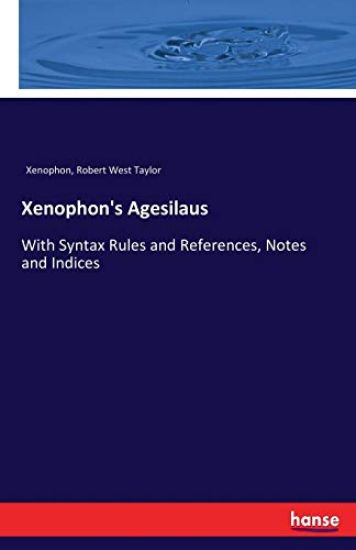
Xenophon's Agesilaus - With Syntax Rules and References, Notes and Indices is an unchanged, high-quality reprint of the original edition of 1880. Hansebooks is editor of the literature on different topic areas such as research and science, travel and expeditions, cooking and nutrition, medicine, and other genres. As a publisher we focus on the preservation of historical literature. Many works of historical writers and scientists are available today as antiques only. Hansebooks newly publishes these books and contributes to the preservation of literature which has become rare and historical knowledge for the future.