Kirjojen hintavertailu – 12 859 819 kirjaa ja 27 kauppaa
Kirjailija
Bernard Shaw
Kirjat ja teokset yhdessä paikassa: 669 kirjaa, julkaisuja vuosilta 1968–2026, suosituimpiin kuuluu Herra Byronin ammatti. Vertaile teosten hintoja ja tarkista saatavuus suomalaisista kirjakaupoista.
This collection of literature attempts to compile many of the classic works that have stood the test of time and offer them at a reduced, affordable price, in an attractive volume so that everyone can enjoy them.
This is the Preachment on Going to Church is an unchanged, high-quality reprint of the original edition of 1896. Hansebooks is editor of the literature on different topic areas such as research and science, travel and expeditions, cooking and nutrition, medicine, and other genres. As a publisher we focus on the preservation of historical literature. Many works of historical writers and scientists are available today as antiques only. Hansebooks newly publishes these books and contributes to the preservation of literature which has become rare and historical knowledge for the future.
John Bull's Other Island is a comedy about Ireland, written by George Bernard Shaw in 1904. Shaw himself was born in Dublin, yet this is one of only two plays of his where he thematically returned to his homeland, the other being O'Flaherty V. C.. The play was highly successful in its day, but is rarely revived, probably because of so much of the dialogue is specific to the politics of the day. Two London-based business partners, an Englishman and an Irishman, set out for the latter's hometown of Roscullen with the intention of developing some land. A satirical exposure of both Irish and English so-called national characteristics. "John Bull's Other Island was written in 1904 at the request of Mr William Butler Yeats as a patriotic contribution to the Repertory of the Irish Literary Theatre. Like most people who have asked me to write plays, Mr Yeats got rather more than he bargained for ... the play was at that time beyond the resources of the New Abbey Theatre ... There was another reason for changing the destination of John Bull's Other Island. It was uncongenial to the whole spirit of the neo-Gaelic movement, which is bent on creating a new Ireland after its own ideal, whereas my play is a very uncompromising presentment of the real old Ireland.
V sbornik voshli tri pesy Bernarda Shou. Sredi nikh samaja znamenitaja - "Pigmalion" (1912 g.), po kotoroj snjato mnozhestvo filmov i postavlen legendarnyj brodvejskij mjuzikl "Moja prekrasnaja ledi". V osnove sjuzheta - drevnegrecheskij mif o tom, kak skulptor staraetsja ozhivit sozdannuju im prekrasnuju statuju. A geroj pesy Shou iz prostoj tsvetochnitsy za 6 mesjatsev pytaetsja sdelat utonchennuju aristokratku. "Pigmalion"- eto nasmeshka nad poklonnikami "goluboj krovi"... kazhdaja moja pesa byla kamnem, kotoryj ja brosal v okna viktorianskogo blagopoluchija", - govoril Shou. V 1977 g. po etoj pese byl postavlen film-balet s E. Maksimovoj i M. Liepoj. "Pigmalion" i sejchas s uspekhom idet v teatrakh vsego mira. Takzhe v izdanie vkljucheny pesa "Kandida" (1895 g.) - o tom neponjatnom i zagadochnom, ne poddajuschemsja ratsionalnomu objasneniju, za chto zhenschina mozhet ljubit muzhchinu; i "Smuglaja ledi sonetov" (1910 g.) - svoeobraznaja instsenirovka skrytogo sjuzheta shekspirovskikh sonetov.
The Devil's Disciple is an 1897 play written by Irish dramatist George Bernard Shaw. The play is Shaw's eighth, and after Richard Mansfield's original 1897 American production it was his first financial success, which helped to affirm his career as a playwright. It was published in Shaw's 1901 collection Three Plays for Puritans together with Captain Brassbound's Conversion and Caesar and Cleopatra. Set in Colonial America during the Revolutionary era, the play tells the story of Richard Dudgeon, a local outcast and self-proclaimed "Devil's disciple." In a twist characteristic of Shaw's love of paradox, Dudgeon sacrifices himself in a Christ-like gesture despite his professed Infernal allegiance. Dick Dudgeon is an outcast from his family in colonial Websterbridge, New Hampshire. He returns their hatred with scorn. After the death of his father, Dick returns to his childhood home to hear the reading of his father's will, much to his family's dismay. Anthony Anderson, the local minister, treats him with courtesy despite Dick's self-proclaimed apostasy, but Dick's "wickedness" appalls Anderson's wife Judith. To everyone's surprise, it is revealed that Dick's father secretly changed his will just before he died, leaving the bulk of his estate to Dick. Dick promptly evicts his mother from her home, but also invites his cousin Essie (the illegitimate daughter of Dick's never-do-well uncle Peter), orphaned by the hanging of her father as a rebel by the British, to stay as long as she wants. At the end of the Act, Dick proclaims himself also a rebel against the British and scorns his family as cowards when they flee his home. He warns Anderson that the approaching army hanged his uncle in error, believing him to be a man of highest respect, unaware of his ill repute, and that Anderson will be the example set in Websterbridge.
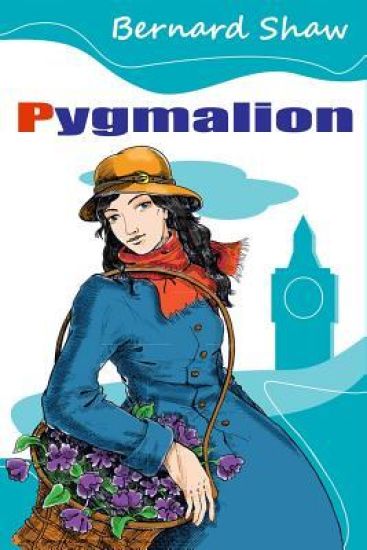
Pygmalion is a play by George Bernard Shaw, named after a Greek mythological character. It was first presented on stage to the public in 1913. Professor of phonetics Henry Higgins makes a bet that he can train a bedraggled Cockney flower girl, Eliza Doolittle, to pass for a duchess at an ambassador's garden party by teaching her to assume a veneer of gentility, the most important element of which, he believes, is impeccable speech. The play is a sharp lampoon of the rigid British class system of the day and a commentary on women's independence. In ancient Greek mythology, Pygmalion fell in love with one of his sculptures, which then came to life. The general idea of that myth was a popular subject for Victorian era English playwrights, including one of Shaw's influences, W. S. Gilbert, who wrote a successful play based on the story called Pygmalion and Galatea first presented in 1871. Shaw would also have been familiar with the burlesque version, Galatea, or Pygmalion Reversed. Shaw's play has been adapted numerous times, most notably as the musical My Fair Lady and the film of that name. Shaw was conscious of the difficulties involved in staging a complete representation of the play. Acknowledging in a "note for technicians" that such a thing would only be possible "on the cinema screen or on stages furnished with exceptionally elaborate machinery", he marked some scenes as candidates for omission if necessary. Of these, a short scene at the end of Act One in which Eliza goes home, and a scene in Act Two in which Eliza is unwilling to undress for her bath, are not described here. The others are the scene at the Embassy Ball in Act Three and the scene with Eliza and Freddy in Act Four. Neither the Gutenberg edition referenced throughout this page nor the Wikisource text linked below contain these sequences.
Candida, a comedy by playwright George Bernard Shaw, was written in 1894 and first published in 1898, as part of his Plays Pleasant. The central characters are clergyman James Morell, his wife Candida and a youthful poet, Eugene Marchbanks, who tries to win Candida's affections. The play questions Victorian notions of love and marriage, asking what a woman really desires from her husband. The cleric is a Christian Socialist, allowing Shaw-himself a Fabian Socialist-to weave political issues, current at the time, into the story. Shaw attempted but failed to have a London production of the play put on in the 1890s, but there were two small provincial productions. However, in late 1903 actor Arnold Daly had such a great success with the play that Shaw would write by 1904 that New York was seeing "an outbreak of Candidamania". The Royal Court Theatre in London performed the play in six matinees in 1904. The same theatre staged several other of Shaw's plays from 1904 to 1907, including further revivals of Candida. Candida presents a youthful figure whose informal moral reflections help other characters to understand their lives better. This youth is the nervous eighteen-year-old nobleman Eugene, who returns with Candida to her house and husband in London. Candida's husband is the socialist reverend Morell, a famous speaker who also runs his household in an egalitarian fashion; since there is only one maid, Morell, his wife, and his secretary assume some of the household chores. Morell seems very much in control of his world until Eugene tells him that he (Eugene) is in love with Candida and that she is probably repulsed by Morell. Eugene's revelation and reflections undermine Morell's apparent security and control and show his fragility. An additional complication arises when Morell's despised father-in-law, the unscrupulous businessman Burgess, comes to talk to Morell for the first time in three years. Burgess is appalled at Morell's suggestion that they would get along fine if they agreed to be honest with each other. Morell should openly consider Burgess a scoundrel and Burgess should openly call Morell a fool.
George Bernard Shaw (26 July 1856 - 2 November 1950), known at his insistence simply as Bernard Shaw, was an Irish playwright, critic and polemicist whose influence on Western theatre, culture and politics extended from the 1880s to his death and beyond. He wrote more than sixty plays, including major works such as Man and Superman (1902), Pygmalion (1912) and Saint Joan (1923). With a range incorporating both contemporary satire and historical allegory, Shaw became the leading dramatist of his generation, and in 1925 was awarded the Nobel Prize in Literature. Born in Dublin, Shaw moved to London in 1876, where he struggled to establish himself as a writer and novelist, and embarked on a rigorous process of self-education. By the mid-1880s he had become a respected theatre and music critic. Following a political awakening, he joined the gradualist Fabian Society and became its most prominent pamphleteer. Shaw had been writing plays for years before his first public success, Arms and the Man in 1894. Influenced by Henrik Ibsen, he sought to introduce a new realism into English-language drama, using his plays as vehicles to disseminate his political, social and religious ideas. By the early twentieth century his reputation as a dramatist was secured with a series of critical and popular successes that included Major Barbara, The Doctor's Dilemma and Caesar and Cleopatra. Shaw's expressed views were often contentious; he promoted eugenics and alphabet reform, and opposed vaccination and organised religion. He courted unpopularity by denouncing both sides in the First World War as equally culpable, and although not a republican, castigated British policy on Ireland in the postwar period. These stances had no lasting effect on his standing or productivity as a dramatist; the inter-war years saw a series of often ambitious plays, which achieved varying degrees of popular success. In 1938 he provided the screenplay for a filmed version of Pygmalion for which he received an Academy Award. His appetite for politics and controversy remained undiminished; by the late 1920s he had largely renounced Fabian gradualism and often wrote and spoke favourably of dictatorships of the right and left-he expressed admiration for both Mussolini and Stalin. In the final decade of his life he made fewer public statements, but continued to write prolifically until shortly before his death, aged ninety-four, having refused all state honours including the Order of Merit in 1946.