Kirjojen hintavertailu – 12 859 829 kirjaa ja 27 kauppaa

Kirjailija

Carl Schmitt

Kirjat ja teokset yhdessä paikassa: 67 kirjaa, julkaisuja vuosilta 1926–2025, suosituimpiin kuuluu Political Theology – Four Chapters on the Concept of Sovereignty. Vertaile teosten hintoja ja tarkista saatavuus suomalaisista kirjakaupoista.

67 kirjaa

Kirjojen julkaisuvuodet: 1926–2025.

Ex Captivitate Salus

Ex Captivitate Salus

Carl Schmitt

Polity Press
2017
sidottu
When Germany was defeated in 1945, both the Russians and the Americans undertook mass internments in the territories they occupied. The Americans called their approach “automatic arrest.” Carl Schmitt, although not belonging in the circles subject to automatic arrest, was held in one of these camps in the years 1945–6 and then, in March 1947, in the prison of the international tribunal in Nuremberg, as witness and “possible defendant.” A formal charge was never brought against him. Schmitt’s way of coping throughout the years of isolation was to write this book. In Ex Captivitate Salus, or Deliverance from Captivity, Schmitt considers a range of issues relating to history and political theory as well as recent events, including the Nazi defeat and the newly emerging Cold War. Schmitt often urged his readers to view the book as though ?it were a series of letters personally directed to each one of them. Hence there is a decidedly personal dimension to the text, as Schmitt expresses his thoughts on his own career trajectory with some pathos, while at the same time emphasising that “this is not romantic or heroic prison literature.” This reflective work sheds new light on Schmitt’s thought and personal situation at the beginning of a period of exile from public life that only ended with his death in 1985. It will be of great value to the many students and scholars in political theory and law who continue to study and appreciate this seminal theorist of the twentieth century.
Ex Captivitate Salus

Ex Captivitate Salus

Carl Schmitt

Polity Press
2017
nidottu
When Germany was defeated in 1945, both the Russians and the Americans undertook mass internments in the territories they occupied. The Americans called their approach “automatic arrest.” Carl Schmitt, although not belonging in the circles subject to automatic arrest, was held in one of these camps in the years 1945–6 and then, in March 1947, in the prison of the international tribunal in Nuremberg, as witness and “possible defendant.” A formal charge was never brought against him. Schmitt’s way of coping throughout the years of isolation was to write this book. In Ex Captivitate Salus, or Deliverance from Captivity, Schmitt considers a range of issues relating to history and political theory as well as recent events, including the Nazi defeat and the newly emerging Cold War. Schmitt often urged his readers to view the book as though ?it were a series of letters personally directed to each one of them. Hence there is a decidedly personal dimension to the text, as Schmitt expresses his thoughts on his own career trajectory with some pathos, while at the same time emphasising that “this is not romantic or heroic prison literature.” This reflective work sheds new light on Schmitt’s thought and personal situation at the beginning of a period of exile from public life that only ended with his death in 1985. It will be of great value to the many students and scholars in political theory and law who continue to study and appreciate this seminal theorist of the twentieth century.
Political Romanticism

Political Romanticism

Carl Schmitt

Routledge
2017
sidottu
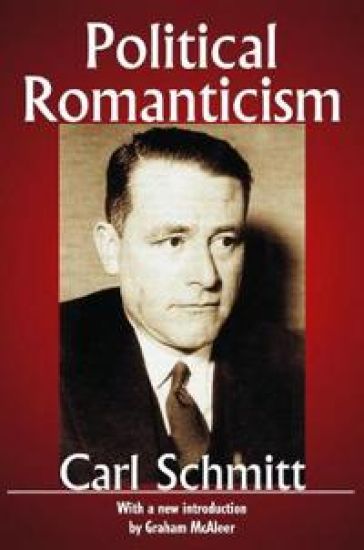
A pioneer in legal and political theory, Schmitt traces the prehistory of political romanticism by examining its relationship to revolutionary and reactionary tendencies in modern European history. Both the partisans of the French Revolution and its most embittered enemies were numbered among the romantics. During the movement for German national unity at the beginning of the nineteenth century, both revolutionaries and reactionaries counted themselves as romantics. According to Schmitt, the use of the concept to designate opposed political positions results from the character of political romanticism: its unpredictable quality and lack of commitment to any substantive political position. The romantic person acts in such a way that his imagination can be affected. He acts insofar as he is moved. Thus an action is not a performance or something one does, but rather an affect or a mood, something one feels. The product of an action is not a result that can be evaluated according to moral standards, but rather an emotional experience that can be judged only in aesthetic and emotive terms. These observations lead Schmitt to a profound reflection on the shortcomings of liberal politics. Apart from the liberal rule of law and its institution of an autonomous private sphere, the romantic inner sanctum of purely personal experience could not exist. Without the security of the private realm, the romantic imagination would be subject to unpredictable incursions. Only in a bourgeois world can the individual become both absolutely sovereign and thoroughly privatized: a master builder in the cathedral of his personality. An adequate political order cannot be maintained on such a tolerant individualism, concludes Schmitt.
Politische Theologie II: Die Legende Von Der Erledigung Jeder Politischen Theologie
In seinem Alterswerk setzt sich Carl Schmitt mit der These seines langjahrigen Bekannten und Kritikers Erik Peterson auseinander, der die Unmoglichkeit jeder politischen Theologie behauptet hatte. Er halt dem zum Katholizismus konvertierten Theologen entgegen, dass dessen Kritik das typische Produkt einer protestantischen Krisentheologie sei, die von der Fiktion sauberer Trennungen zwischen Politik und Religion ausgehe. Nach weiteren Widerlegungen geht Carl Schmitt in einem ausfuhrlichen Nachwort auf Hans Blumbergs Verteidigung der Legitimitat der Neuzeit ein und entwirft ein Bild von der Selbstzerstorung des modernen Menschen in einer ganzlich profanierten Welt mit neuen Feindschaften.
Parlamentarismens krise

Parlamentarismens krise

Carl Schmitt

Informations Forlag
2017
nidottu

Halvin toimitettuna 29,50 €

Den idéhistoriske klassiker Parlamentarismens krise er en kras kritik af det repræsentative demokrati og en skarp analyse af de på Carl Schmitts tid aktuelle alternativer til parlamentarismen – nemlig kommunisme og fascisme. Parlamentarismens krise, der udkom første gang i 1923 og anses for at være en klassiker inden for det 20. århundredes tænkning, er en kraftfuld og tankevækkende kritik af det, som Schmitt mener, er det repræsentative demokratis indre inkonsistens, og værket er derfor ofte blevet læst som et forsøg fra Carl Schmitts side på at ødelægge parlamentarismen. Men faktisk er teksten, som oversætter Lars Christiansen er inde på i sin introduktion til bogen, Schmitts forsøg på at forsvare Weimar-republikken og i det lys, er bogen også et historisk indblik ind i Weimar-Tysklands politiske kultur. ANMELDELSER"Hvorfor dog udgive og læse den ærkereaktionære Carl Schmitt i dag? Det er der rigtig gode grunde til... Carl Schmitt præsenterer i Parlamentarismens krise et livskrafigt stykke modoplysning, og hans antiuniversalisme har vel næppe haft større opbakning siden Anden Verdenskrig." - Weekendavisen ????? - Politiken ????? "Den snart 100 år gamle bog er både original og foruroligende i al sin dramatiske korthed." - Jyllands-Posten (5 stjerner)OM FORFATTERENCarl Schmitt (1888-1985) var en kontroversiel og genial tænker, der er blevet beskrevet både som ’vor tids Hobbes’ og som ’nazismens filosofiske godfather’, hvis skarpsindige kritik af liberal-demokratiske idealer har gjort ham til en af de mest originale intellektuelle bidragsydere til moderne politiske tænkning.
Land und Meer

Land und Meer

Carl Schmitt

Klett-Cotta Verlag
2016
nidottu
Erstmals 1942 erschienen, leitet dieses Buch das Spätwerk Carl Schmitts ein. Was ist der "Nomos der Erde", und gibt es die Chance für einen weltumspannenden Frieden? Geschichte wird uns hier als Auseinandersetzung zwischen "Landtretern" und "Seeschäumern" nahegebracht. Sie erreicht im Kampf zwischen England und Frankreich unter Napoleon ihren Höhepunkt. "Land und Meer" hat Carl Schmitt nicht nur als Theoretiker vorgetragen, sondern auch seiner Tochter Anima erzählt. So beschwört er das Ambiente der Piraterie ebenso, wie es ihm scharfsichtig gelingt, das Kalkül absolutistischer Feldherren zu erfassen.
Dialogues on Power and Space

Dialogues on Power and Space

Carl Schmitt

Polity Press
2015
sidottu
Written in the early stages of the Cold War by one of the most controversial political and legal thinkers of the twentieth century, Carl Schmitt?s two short dialogues on power and space bring together several dimensions of his work in new ways. The dialogues renew Schmitt?s engagement with the questions of political power and geo-politics that had been a persistent concern throughout his intellectual life. As a basis on which to think through the historical role of human agency in relation to power and its new geographies, the dialogues condense and rework key concepts in Schmitt?s political theory during a transitional period between his Weimar and fascist years to the post-war writings. In this book, Schmitt develops a new ?dialectics? of modern power and an original understanding of the global spatial transformations of the Cold War period. Equally important, the dialogues anticipate the debates on the new geo-political possibilities and threats related to cosmic spaces, overpowering technological advances, and the existential predicament of the human in an increasingly multipolar world.
Dialogues on Power and Space

Dialogues on Power and Space

Carl Schmitt

Polity Press
2015
nidottu
Written in the early stages of the Cold War by one of the most controversial political and legal thinkers of the twentieth century, Carl Schmitt?s two short dialogues on power and space bring together several dimensions of his work in new ways. The dialogues renew Schmitt?s engagement with the questions of political power and geo-politics that had been a persistent concern throughout his intellectual life. As a basis on which to think through the historical role of human agency in relation to power and its new geographies, the dialogues condense and rework key concepts in Schmitt?s political theory during a transitional period between his Weimar and fascist years to the post-war writings. In this book, Schmitt develops a new ?dialectics? of modern power and an original understanding of the global spatial transformations of the Cold War period. Equally important, the dialogues anticipate the debates on the new geo-political possibilities and threats related to cosmic spaces, overpowering technological advances, and the existential predicament of the human in an increasingly multipolar world.
Land og hav

Land og hav

Carl Schmitt

-
2014
nidottu
Carl Schmitt (1888-1985) er mest kendt for sine teser om det politiske som et ven-fjende-forhold og om suveræn autoritet eller ”decisionisme”, samt for sin kritik af vestlig liberalisme og vestligt demokrati – alt sammen teser, der er blevet til i de kaotiske år under Weimarrepublikken, og som nødvendigvis må forstås på denne baggrund. Mindre opmærksomhed har der været om hans senere arbejder, der klart adskiller sig fra Weimartidens, og som fokuserer på international ret og global geopolitik. En særlig plads blandt disse arbejder indtager Land og hav, skrevet under Anden Verdenskrig som en fortælling til datteren Anima, da Schmitt levede isoleret og marginaliseret i det krigshærgede Berlin. Bogen er blevet kaldt hans ”måske mest betydningsfulde og bestemt smukkeste” og præsenterer sig som en brillant, holistisk fortolkning af menneskehedens historie som historien om de rum, den har eksisteret i. I centrum står den fundamentale modsætning mellem ”elementerne” land og hav. I hurtige rids skitseres århundreders verdenshistorie med ”rummet” som den røde og næsten hemmelighedsfulde tråd, der binder de mest forskelligartede fænomener sammen: Politiske institutioner, krigskunst, videnskabelige gennembrud, tekniske opfindelser, retsopfattelser, kunstarter, mentalitetsformer. Af disse to elementers rum er Jordens nomos eller grundordning opstået og med den klodens to basale civilisationer – landets og havets. Schmitts geopolitiske teorier om en multipolær verdensorden bestående af ”storrum” har i de senere år tiltrukket sig stadig større international opmærksomhed, og i et Efterord gives der et indblik i deres tilblivelse og nutidige relevans, set i et internationalt politisk perspektiv. Nysgerrig efter at vide mere? Så prøv AI (kunstig intelligens). Brug: bing.com - Tryk øverst: Copilot - Spørg om: Fritz Wolder Carl Schmitt Helikon
Dictatorship

Dictatorship

Carl Schmitt

Polity Press
2013
nidottu

Halvin toimitettuna 29,40 €

Now available in English for the first time, Dictatorship is Carl Schmitt’s most scholarly book and arguably a paradigm for his entire work. Written shortly after the Russian Revolution and the First World War, Schmitt analyses the problem of the state of emergency and the power of the Reichspräsident in declaring it. Dictatorship, Schmitt argues, is a necessary legal institution in constitutional law and has been wrongly portrayed as just the arbitrary rule of a so-called dictator. Dictatorship is an essential book for understanding the work of Carl Schmitt and a major contribution to the modern theory of a democratic, constitutional state. And despite being written in the early part of the twentieth century, it speaks with remarkable prescience to our contemporary political concerns.