Kirjojen hintavertailu – 12 859 829 kirjaa ja 27 kauppaa

Kirjailija

Carl Schmitt

Kirjat ja teokset yhdessä paikassa: 67 kirjaa, julkaisuja vuosilta 1926–2025, suosituimpiin kuuluu Political Theology – Four Chapters on the Concept of Sovereignty. Vertaile teosten hintoja ja tarkista saatavuus suomalaisista kirjakaupoista.

67 kirjaa

Kirjojen julkaisuvuodet: 1926–2025.

Begrepet om det politiske

Begrepet om det politiske

Carl Schmitt

Vidarforlaget
2007
sidottu
Begrepet om det politiske er en av statsvitenskapens mest omstridte bøker - en klassiker fra det 20. århundrets politiske teori, ført i pennen av "Det tredje rikets kronjurist". Hva slags skrift er dette? En iskald analyse av det som er? En eksistensialistisk oppblåsning av krigens grusomhet til politikkens vesen? Grunntanken er at det er skillet eller distinksjonen mellom venn og fiende som kjennetegner det politiske, at alle politiske handlinger kan føres tilbake til dette. Dermed blir det å bestemme fienden, en mulig krigsmotstander, det politiskes grunnleggende operasjon. Blir noen definert som fiende, er krig - fysisk kamp på liv og død mellom kollektiver - alltid en reell mulighet. Carl Schmitts teorier var beryktet i sin samtid og provoserer i dag, men er de blitt mindre aktuelle? Det politiske, det potensielt voldelige skille mellom oss og de andre, henter gjerne sin kraft fra de forskjelligste motsetninger - religiøse, økonomiske, etniske, etiske, estetiske. Koker slike motsetninger opp til et visst intensitetsnivå, hvor fiendskap oppstår og krig er mulig, da har vi å gjøre med politikk i den primære betydning av uttrykket, ifølge Schmitt. Man kan være uenig med ham i denne definisjonen; men hvem kan nekte for at analysen har aktualitet i en verden der konflikt-eskalering og nye fiendebilder er blitt en del av hverdagen?

On the Three Types of Juristic Thought

On the Three Types of Juristic Thought

Carl Schmitt

Praeger Publishers Inc
2004
sidottu
Bendersky provides the only English-language translation of one of Carl Schmitt's most controversial works. At the time of its publication in 1934 and during the war and the post-war years, the treatise was seen as a rationalization of the Nazi legal order. With the renaissance of Schmitt studies beginning in the 1980s, the man and his work, and this volume in particular, was reinterpreted. While some maintained that it was a foundation of Nazi legal theory and practice, others see it as a failed attempt at a conservative counterweight to the most extreme tendencies in National Socialism. Most see it in the context of Schmitt's intellectual growth and the challenges of the era. An extended introduction and notes trace out the development of Schmitt's ideas as well as the various interpretations ehat have emerged to explain his work. Given the importance of Schmitt's ideas in modern political and judicial thought as well as its impact on constitution making, this translation will make this significant volume accessible to a wider readership of students and scholars of twentieth century political and legal theory.
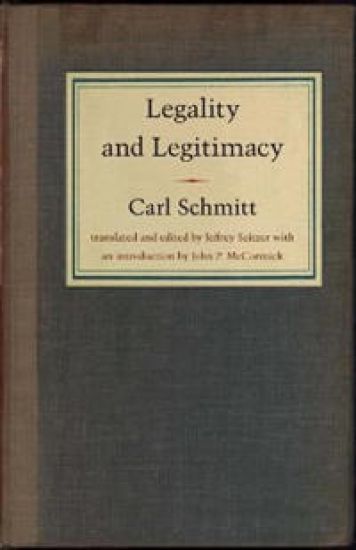
Legality and Legitimacy

Legality and Legitimacy

Carl Schmitt

Duke University Press
2004
pokkari
Carl Schmitt ranks among the most original and controversial political thinkers of the twentieth century. His incisive criticisms of Enlightenment political thought and liberal political practice remain as shocking and significant today as when they first appeared in Weimar Germany. Unavailable in English until now, Legality and Legitimacy was composed in 1932, in the midst of the crisis that would lead to the collapse of the Weimar Republic and only a matter of months before Schmitt’s collaboration with the Nazis. In this important work, Schmitt questions the political viability of liberal constitutionalism, parliamentary government, and the rule of law. Liberal governments, he argues, cannot respond effectively to challenges by radical groups like the Nazis or Communists. Only a presidential regime subject to few, if any, practical limitations can ensure domestic security in a highly pluralistic society. Legality and Legitimacy is sure to provide a compelling reference point in contemporary debates over the challenges facing constitutional democracies today. In addition to Jeffrey Seitzer’s translation of the 1932 text itself, this volume contains his translation of Schmitt’s 1958 commentary on the work, extensive explanatory notes, and an appendix including selected articles of the Weimar constitution. John P. McCormick’s introduction places Legality and Legitimacy in its historical context, clarifies some of the intricacies of the argument, and ultimately contests Schmitt’s claims regarding the inherent weakness of parliamentarism, constitutionalism, and the rule of law.
The Crisis of Parliamentary Democracy
The Crisis of Parliamentary Democracy offers a powerful criticism of the inconsistencies of representative democracy. Described both as "the Hobbes of our age" and as "the philosophical godfather of Nazism," Carl Schmitt was a brilliant and controversial political theorist whose doctrine of political leadership and critique of liberal democratic ideals distinguish him as one of the most original contributors to modern political theory. The Crisis of Parliamentary Democracy offers a powerful criticism of the inconsistencies of representative democracy. First published in 1923, it has often been viewed as an attempt to destroy parliamentarism; in fact, it was Schmitt's attempt to defend the Weimar constitution. The introduction to this new translation places the book in proper historical context and provides a useful guide to several aspects of Weimar political culture. The Crisis of Parliamentary Democracy is included in the series Studies in Contemporary German Social Thought, edited by Thomas McCarthy.