Kirjojen hintavertailu – 12 859 829 kirjaa ja 27 kauppaa

Kirjailija

Carl Schmitt

Kirjat ja teokset yhdessä paikassa: 67 kirjaa, julkaisuja vuosilta 1926–2025, suosituimpiin kuuluu Political Theology – Four Chapters on the Concept of Sovereignty. Vertaile teosten hintoja ja tarkista saatavuus suomalaisista kirjakaupoista.

67 kirjaa

Kirjojen julkaisuvuodet: 1926–2025.

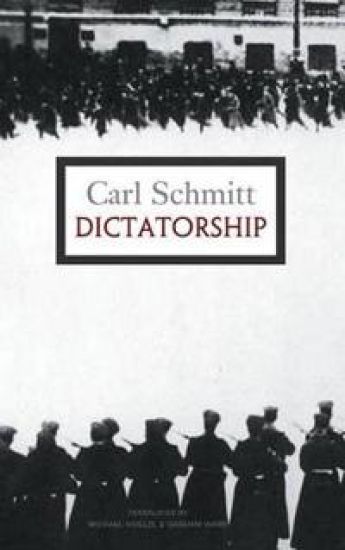
Dictatorship

Dictatorship

Carl Schmitt

Polity Press
2013
sidottu
Now available in English for the first time, Dictatorship is Carl Schmitt’s most scholarly book and arguably a paradigm for his entire work. Written shortly after the Russian Revolution and the First World War, Schmitt analyses the problem of the state of emergency and the power of the Reichspräsident in declaring it. Dictatorship, Schmitt argues, is a necessary legal institution in constitutional law and has been wrongly portrayed as just the arbitrary rule of a so-called dictator. Dictatorship is an essential book for understanding the work of Carl Schmitt and a major contribution to the modern theory of a democratic, constitutional state. And despite being written in the early part of the twentieth century, it speaks with remarkable prescience to our contemporary political concerns.
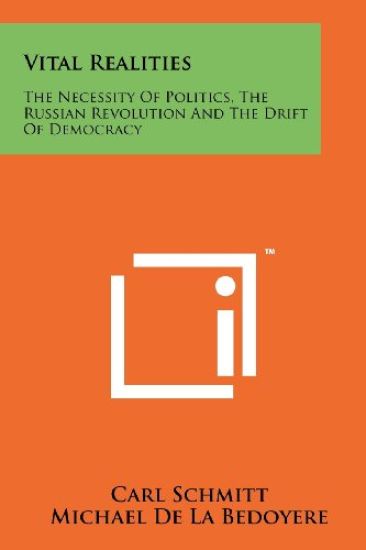
Vital Realities: The Necessity of Politics, the Russian Revolution and the Drift of Democracy

Vital Realities: The Necessity of Politics, the Russian Revolution and the Drift of Democracy

Carl Schmitt; Michael De La Bedoyere; Nicholas Berdyaev

Literary Licensing, LLC
2011
sidottu
Vital Realities: The Necessity Of Politics, The Russian Revolution And The Drift Of Democracy is a book written by Carl Schmitt, a German political philosopher and jurist. The book is a collection of essays that explore the importance of politics in society and the challenges faced by democracies in the aftermath of the Russian Revolution. In the book, Schmitt argues that politics is a necessary and fundamental aspect of human society, and that it is essential for individuals and communities to engage in political activity in order to achieve their goals and interests. He also examines the impact of the Russian Revolution on political thought and practice, arguing that it represented a radical departure from traditional political systems and had a profound influence on the development of modern democratic societies. Schmitt's analysis of the drift of democracy focuses on the challenges faced by democratic societies in the aftermath of the Russian Revolution. He argues that the rise of totalitarian regimes and the erosion of democratic institutions are symptoms of a deeper crisis in modern politics, and that democracies must confront these challenges in order to survive and thrive. Overall, Vital Realities: The Necessity Of Politics, The Russian Revolution And The Drift Of Democracy is a thought-provoking and insightful exploration of the role of politics in society and the challenges faced by modern democracies. Schmitt's analysis is both rigorous and accessible, making this book a valuable resource for anyone interested in political philosophy, history, or contemporary politics. Introduction To The Necessity Of Politics By Christopher Dawson. This scarce antiquarian book is a facsimile reprint of the old original and may contain some imperfections such as library marks and notations. Because we believe this work is culturally important, we have made it available as part of our commitment for protecting, preserving, and promoting the world's literature in affordable, high quality, modern editions, that are true to their original work.
Writings on War

Writings on War

Carl Schmitt

Polity Press
2011
nidottu

Halvin toimitettuna 30,00 €

Writings on War collects three of Carl Schmitt's most important and controversial texts, here appearing in English for the first time: The Turn to the Discriminating Concept of War, The Großraum Order of International Law, and The International Crime of the War of Aggression and the Principle "Nullum crimen, nulla poena sine lege". Written between 1937 and 1945, these works articulate Schmitt's concerns throughout this period of war and crisis, addressing the major failings of the League of Nations, and presenting Schmitt's own conceptual history of these years of disaster for international jurisprudence. For Schmitt, the jurisprudence of Versailles and Nuremberg both fail to provide for a stable international system, insofar as they attempt to impose universal standards of 'humanity' on a heterogeneous world, and treat efforts to revise the status quo as 'criminal' acts of war. In place of these flawed systems, Schmitt argues for a new planetary order in which neither collective security organizations nor 19th century empires, but Schmittian 'Reichs' will be the leading subject of international law. Writings on War will be essential reading for those seeking to understand the work of Carl Schmitt, the history of international law and the international system, and interwar European history. Not only do these writings offer an erudite point of entry into the dynamic and charged world of interwar European jurisprudence; they also speak with prescience to a 21st century world struggling with similar issues of global governance and international law.
Writings on War

Writings on War

Carl Schmitt

Polity Press
2011
sidottu
Writings on War collects three of Carl Schmitt's most important and controversial texts, here appearing in English for the first time: The Turn to the Discriminating Concept of War, The Großraum Order of International Law, and The International Crime of the War of Aggression and the Principle "Nullum crimen, nulla poena sine lege". Written between 1937 and 1945, these works articulate Schmitt's concerns throughout this period of war and crisis, addressing the major failings of the League of Nations, and presenting Schmitt's own conceptual history of these years of disaster for international jurisprudence. For Schmitt, the jurisprudence of Versailles and Nuremberg both fail to provide for a stable international system, insofar as they attempt to impose universal standards of 'humanity' on a heterogeneous world, and treat efforts to revise the status quo as 'criminal' acts of war. In place of these flawed systems, Schmitt argues for a new planetary order in which neither collective security organizations nor 19th century empires, but Schmittian 'Reichs' will be the leading subject of international law. Writings on War will be essential reading for those seeking to understand the work of Carl Schmitt, the history of international law and the international system, and interwar European history. Not only do these writings offer an erudite point of entry into the dynamic and charged world of interwar European jurisprudence; they also speak with prescience to a 21st century world struggling with similar issues of global governance and international law.
Political Romanticism

Political Romanticism

Carl Schmitt

AldineTransaction
2010
nidottu
A pioneer in legal and political theory, Schmitt traces the prehistory of political romanticism by examining its relationship to revolutionary and reactionary tendencies in modern European history. Both the partisans of the French Revolution and its most embittered enemies were numbered among the romantics. During the movement for German national unity at the beginning of the nineteenth century, both revolutionaries and reactionaries counted themselves as romantics. According to Schmitt, the use of the concept to designate opposed political positions results from the character of political romanticism: its unpredictable quality and lack of commitment to any substantive political position. The romantic person acts in such a way that his imagination can be affected. He acts insofar as he is moved. Thus an action is not a performance or something one does, but rather an affect or a mood, something one feels. The product of an action is not a result that can be evaluated according to moral standards, but rather an emotional experience that can be judged only in aesthetic and emotive terms. These observations lead Schmitt to a profound reflection on the shortcomings of liberal politics. Apart from the liberal rule of law and its institution of an autonomous private sphere, the romantic inner sanctum of purely personal experience could not exist. Without the security of the private realm, the romantic imagination would be subject to unpredictable incursions. Only in a bourgeois world can the individual become both absolutely sovereign and thoroughly privatized: a master builder in the cathedral of his personality. An adequate political order cannot be maintained on such a tolerant individualism, concludes Schmitt.
Det politiska som begrepp

Det politiska som begrepp

Carl Schmitt

Bokförlaget Daidalos
2010
nidottu
Det politiska som begrepp är en klassiker i 1900-talets politiska teori. Carl Schmitt (18881985) var en berömd statsrättsjurist och politisk tänkare i Weimar-republiken som senare blev för evigt komprometterad genom sitt inträde i nazistpartiet 1933 och sin ställning som »kronjurist» i Det tredje riket. Hans kompromisslösa tänkande har emellertid fascinerat många, också till vänster, och de senaste decennierna har det stått strid om vem han egentligen var. Den berömda och beryktade grundtesen i Det politiska som begrepp är att det är åtskillnaden mellan vän och fiende som konstituerar »det politiska». Utan fienden, fientligheten, konflikten och ytterst kriget existerar inte det politiska. Alla »egentliga» politiska teorier kännetecknas enligt Schmitt av att de utgår från att människan av naturen är ond. Människor vill i allmänhet inte varandra väl, och man gör klokt i att rusta sig för angrepp och försvar, att söka efter vänner och bundsförvanter. Den politiska åtskillnaden mellan vän och fiende får, menar Schmitt, inte blandas samman med andra tänkbara skillnader: god eller ond, vacker eller ful, lönsam eller olönsam etc. Den politiska fienden behöver inte vara moraliskt förkastlig, heller inte i ekonomiskt avseende en konkurrent, utan det kan tvärtom kanske vara lönsamt att göra affärer med honom. Den politiska fienden är rätt och slätt den andre, den främmande, den vars sätt att vara, vars livsform, är oförenlig med det egna sättet att vara. En privat fejd är inte politisk. En politisk fiendskap föreligger först när en grupp människor i all offentlighet konfronterar en annan grupp människor, det vill säga när en vän-fiende-gruppering föreligger. Carl-Göran Heidegren sätter i en inledning in boken i sitt idéhistoriska sammanhang, och i en efterskrift läser Ernst-Wolfgang Böcken­förde, professor emeritus i juridik och före detta domare i den tyska Författningsdomstolen, Det politiska som begrepp som en nyckel till Carl Schmitts författarskap.

Volkerrechtliche Grossraumordnung: Mit Interventionsverbot Fur Raumfremde Machte. Ein Beitrag Zum Reichsbegriff Im Volkerrecht
Die vorliegende Ausgabe der Volkerrechtlichen Grossraumordnung enthalt ausser kleineren Verbesserungen ein neues Schlusskapitel uber den Raumbegriff in der Rechtswissenschaft. ...] Im ubrigen muss die Abhandlung bleiben, was sie ist. Sie entstand im Fruhjahr 1939 mit bestimmten Thesen und Gesichtspunkten in einer bestimmten Situation. Durch den Gang der Ereignisse hat sie manche bedeutende Bestatigung erfahren. Darin liegt ihr Wert als Dokument. Nicht aber soll sie sich mit den Ereignissen in einen Wettlauf einlassen. Daher kann ich die Ergebnisse weiterer Forschungen nicht einfach an sie anhangen. Grosse neue Fragen, wie das neue Problem der westlichen Hemisphare und das Verhaltnis von Land und Meer im Volkerrecht, bedurfen eines eigenen Ansatzes. Hierfur kann ich, als auf einen ersten Beginn, auf die Ausfuhrungen verweisen, die ich vor Hochschullehrern der Geschichte am 8. Februar 1941 in Nurnberg gemacht habe und die inzwischen in dem Sammelwerk Das Reich und Europa bei Koehler und Amelang (Leipzig 1941) erschienen sind. Moge der Leser es recht verstehen, wenn ich der Schrift das Motto gebe: Wir gleichen Seeleuten auf ununterbrochener Fahrt und jedes Buch kann nicht mehr als ein Logbuch sein. Berlin, den 28. Juli 1941 Aus: Vorbemerkung zur Ausgabe von 1941
Political Theology II

Political Theology II

Carl Schmitt

Polity Press
2008
sidottu
Political Theology II is Carl Schmitt's last book. Part polemic, part self-vindication for his involvement in the National Socialist German Workers' Party (NSDAP), this is Schmitt's most theological reflection on Christianity and its concept of sovereignty following the Second Vatican Council. At a time of increasing visibility of religion in public debates and a realization that Schmitt is the major and most controversial political theorist of the twentieth century, this last book sets a new agenda for political theology today. The crisis at the beginning of the twenty-first century led to an increased interest in the study of crises in an age of extremes - an age upon which Carl Schmitt left his indelible watermark. In Political Theology II, first published in 1970, a long journey comes to an end which began in 1923 with Political Theology. This translation makes available for the first time to the English-speaking world Schmitt's understanding of Political Theology and what it implies theologically and politically.
Political Theology II

Political Theology II

Carl Schmitt

Polity Press
2008
nidottu

Halvin toimitettuna 29,80 €

Political Theology II is Carl Schmitt's last book. Part polemic, part self-vindication for his involvement in the National Socialist German Workers' Party (NSDAP), this is Schmitt's most theological reflection on Christianity and its concept of sovereignty following the Second Vatican Council. At a time of increasing visibility of religion in public debates and a realization that Schmitt is the major and most controversial political theorist of the twentieth century, this last book sets a new agenda for political theology today. The crisis at the beginning of the twenty-first century led to an increased interest in the study of crises in an age of extremes - an age upon which Carl Schmitt left his indelible watermark. In Political Theology II, first published in 1970, a long journey comes to an end which began in 1923 with Political Theology. This translation makes available for the first time to the English-speaking world Schmitt's understanding of Political Theology and what it implies theologically and politically.
Gespräch über die Macht und den Zugang zum Machthaber
In glänzend lakonischem Stil geschrieben handelt es sich um die Form eines fiktiven Gesprächs. Sein Thema: die moderne Macht unter verwaltungstechnischen Bedingungen. Macht definierte Schmitt als "soziales Geflecht" und "eigenständige Größe". Jeder Machthaber ist, so Carl Schmitt, "auf Berichte und Informationen angewiesen und von seinen Beratern abhängig. Eine Unmenge von Tatsachen und Meldungen, Vorschlägen und Vermutungen dringt Tag für Tag und Stunde für Stunde auf ihn ein. Aus diesem flutenden, unendlichen Meer von Wahrheit und Lüge, Wirklichkeiten und Möglichkeiten kann auch der klügste und mächtigste Mensch höchstens einige Tropfen herausschöpfen." Schmitts Denken kreiste um Fragen der Macht, der Gewalt und der Verwirklichung des Rechts. Sein umfangreiches Werk ist von politischen Philosophen und Staatsdenkern wie Hobbes, Machiavelli, Rousseau, Donoso Cort?s, Sorel und Pareto prägend beeinflusst. Das "Gespräch über die Macht" nimmt eine herausragende Stellung durch seine nachhaltige Wirkung ein.
Constitutional Theory

Constitutional Theory

Carl Schmitt

Duke University Press
2008
sidottu
Carl Schmitt’s magnum opus, Constitutional Theory, was originally published in 1928 and has been in print in German ever since. This volume makes Schmitt’s masterpiece of comparative constitutionalism available to English-language readers for the first time. Schmitt is considered by many to be one of the most original-and, because of his collaboration with the Nazi party, controversial-political thinkers of the twentieth century. In Constitutional Theory, Schmitt provides a highly distinctive and provocative interpretation of the Weimar Constitution. At the center of this interpretation lies his famous argument that the legitimacy of a constitution depends on a sovereign decision of the people. In addition to being subject to long-standing debate among legal and political theorists in Western Europe and the United States, this theory of constitution-making as decision has profoundly influenced constitutional theorists and designers in Asia, Latin America, and Eastern Europe. Constitutional Theory is a significant departure from Schmitt’s more polemical Weimar-era works not just in terms of its moderate tone. Through a comparative history of constitutional government in Europe and the United States, Schmitt develops an understanding of liberal constitutionalism that makes room for a strong, independent state. This edition includes an introduction by Jeffrey Seitzer and Christopher Thornhill outlining the cultural, intellectual, and political contexts in which Schmitt wrote Constitutional Theory; they point out what is distinctive about the work, examine its reception in the postwar era, and consider its larger theoretical ramifications. This volume also contains extensive editorial notes and a translation of the Weimar Constitution.
Constitutional Theory

Constitutional Theory

Carl Schmitt

Duke University Press
2008
pokkari

Halvin toimitettuna 42,90 €

Carl Schmitt’s magnum opus, Constitutional Theory, was originally published in 1928 and has been in print in German ever since. This volume makes Schmitt’s masterpiece of comparative constitutionalism available to English-language readers for the first time. Schmitt is considered by many to be one of the most original-and, because of his collaboration with the Nazi party, controversial-political thinkers of the twentieth century. In Constitutional Theory, Schmitt provides a highly distinctive and provocative interpretation of the Weimar Constitution. At the center of this interpretation lies his famous argument that the legitimacy of a constitution depends on a sovereign decision of the people. In addition to being subject to long-standing debate among legal and political theorists in Western Europe and the United States, this theory of constitution-making as decision has profoundly influenced constitutional theorists and designers in Asia, Latin America, and Eastern Europe. Constitutional Theory is a significant departure from Schmitt’s more polemical Weimar-era works not just in terms of its moderate tone. Through a comparative history of constitutional government in Europe and the United States, Schmitt develops an understanding of liberal constitutionalism that makes room for a strong, independent state. This edition includes an introduction by Jeffrey Seitzer and Christopher Thornhill outlining the cultural, intellectual, and political contexts in which Schmitt wrote Constitutional Theory; they point out what is distinctive about the work, examine its reception in the postwar era, and consider its larger theoretical ramifications. This volume also contains extensive editorial notes and a translation of the Weimar Constitution.