Kirjojen hintavertailu – 12 903 727 kirjaa ja 27 kauppaa

Kirjailija

Charles River

Kirjat ja teokset yhdessä paikassa: 4 673 kirjaa, julkaisuja vuosilta 2013–2022, suosituimpiin kuuluu William Powell and Myrna Loy: The Lives and Careers of One of Classical Hollywood's Most Iconic Duos. Vertaile teosten hintoja ja tarkista saatavuus suomalaisista kirjakaupoista.

4 673 kirjaa

Kirjojen julkaisuvuodet: 2013–2022.

The Rothschild Family: The History and Legacy of the International Banking Dynas

The Rothschild Family: The History and Legacy of the International Banking Dynas

Charles River

Createspace Independent Publishing Platform
2018
nidottu
*Includes pictures *Includes online resources and a bibliography for further reading "I have not the nerve for his operations. They are well-planned, with great cleverness and adroitness in execution - but he is in money and funds what Napoleon was in war." - Baron Baring on Nathan Rothschild" The mere mention of banks is enough to crinkle the noses and furrow the brows of most. The thought of these fat cats conjures up an image of corporate types sporting snazzy suits and jaunty top hats with bulky bags of cash swinging in their hands. They are often portrayed as greedy money-grubbers who puppeteer the system, siphoning money off the public with interest rates and the like. Many seem to view them as the cause of many, if not all, financial disasters. A few bad apples seemed to have spoiled the reputations of the rest of the bunch. Scandal has almost become expected of these institutions. Banks around the globe have become subject to accusations of discriminatory practices, rogue and insider trading, and increased shadow banking, among others. These days, one would be hard-pressed to find media coverage that paints these institutions in good light. But where did it all begin? Throughout the following centuries, the systems of banking institutions continued to develop, and the art of money persisted well on to the 18th century. One of these money changers was a German-Jewish man by the name of Amschel Moses Rothschild. He lived in the Jewish ghetto of Frankfurt, home to the largest Jewish community in early modern Europe. Beyond perhaps the wildest dreams of the oppressed and their oppressors, this small-scale money changer, along with his wife, would give birth to the forefather of one of the most powerful families the world has ever seen: the Rothschilds. The Rothschild dynasty of power and wealth would not only become a force to be reckoned with in the banking industry, but they would also become the ceaseless subject of scandal, conspiracy theories, and awe. Descriptions full of hyperbole have been on public display for centuries, such as the family description that appeared in the Niles' Weekly Register in 1836, "The Rothschilds are the wonders of modern banking ... Not a cabinet moves without their advice. They stretch their hand, with equal ease, from Petersburgh to Vienna, from Vienna to Paris, from Paris to London, from London to Washington... They are the brokers and counselors of the kings of Europe and of the republican chiefs of America. What more can they desire?" The Rothschild Family: The History and Legacy of the International Banking Dynasty looks at one of the richest families in history. Along with pictures depicting important people, places, and events, you will learn about the Rothschilds like never before.
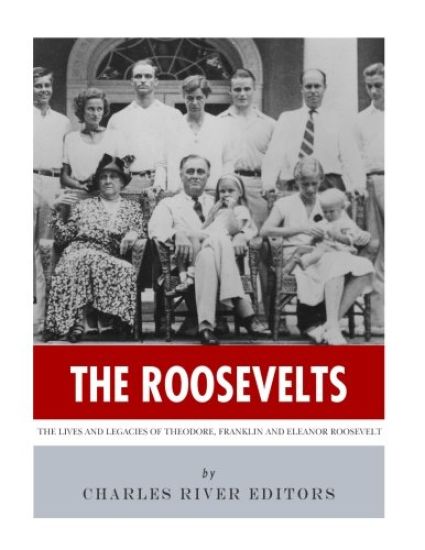
The Roosevelts: The Lives and Legacies of Theodore, Franklin and Eleanor Roosevelt

The Roosevelts: The Lives and Legacies of Theodore, Franklin and Eleanor Roosevelt

Charles River

Createspace Independent Publishing Platform
2018
nidottu
*Includes pictures of Teddy, FDR, Eleanor, and important people, places and events in their lives. *Explains the relationships among the Roosevelts and their family history. They were American legends who revolutionized the roles in the White House and the way the government deals with its citizens. They also happened to be related. For a man who grew up to become the "Bull Moose", Theodore Roosevelt was a sickly child, suffering from asthma and other maladies. But his physical weakness actually drove him to be more active, which also fostered an interest in nature. It also helped that Teddy's family was wealthy, allowing him privileges including home school and the ability to attend Harvard, where he was an athlete and took an interest in naval affairs. After finishing at Harvard, Teddy entered politics, but it didn't stop him from writing The Naval War of 1812 in 1882, establishing himself as a professional writer and historian. In the 1890s, it was Teddy's turn to make history, leading the Rough Riders during the Spanish-American War and being decorated for his service with a Medal of Honor. He parlayed his glory into the governorship of New York and then the Vice Presidency under William McKinley. When McKinley was assassinated in 1901, young Teddy was thrust into the presidency, one that would earn him a place on Mount Rushmore, Roosevelt's "Square Deal" domestic policies favored average citizens while busting trusts and monopolies. Roosevelt also promoted conservation as an environmental stance, while his "speak softly and carry a big stick" foreign policy is still an oft used phrase today. Roosevelt even earned a Nobel Prize during his presidency. If Teddy wasn't the greatest president of the 20th century, it might be due to his own relative. FDR was certainly the most unique. A well-connected relative of Theodore Roosevelt, FDR was groomed for greatness until he was struck down by what was widely believed to be polio at the time. Nevertheless, he persevered, rising through New York politics to reach the White House just as the country faced its greatest challenge since the Civil War, beginning his presidency with one of the most iconic lines ever spoken during an inaugural address. For over a decade, President Roosevelt threw everything he had at the Great Depression, and then threw everything the country had at the Axis powers during World War II. Ultimately, he succumbed to illness in the middle of his fourth term, just before the Allies won the war. If Dolley Madison was instrumental in molding the role of First Lady in the 19th century, credit can be given to Eleanor Roosevelt for revolutionizing the political nature of the role in the 20th and 21st centuries and making it possible for presidents like Bill Clinton to enlist their wives to handle political duties. At the same time, history might remember Eleanor more for what she did outside of the White House, as she became a critically acclaimed and world famous international author and advocate of civil rights, women's rights. By the time she had finished working for the United Nations, working on the Universal Declaration of Human Rights, President Truman rightly called her "The First Lady of the World." The Roosevelts chronicles the amazing lives and careers of the Teddy, FDR and Eleanor and analyzes their relationships and legacies, but it also humanizes the Bull Moose, the man who was doggedly determined to conquer his enemies, and the dutiful wife who persevered through her husband's marital infidelities to become one of his most important political allies and spokesmen. Along with pictures of important people, places, and events, you will learn about the Roosevelts like you never have before.
The Roman Siege of Jerusalem in 70 CE: The History and Legacy of Rome's Destruction of Jerusalem and the Second Temple
*Includes pictures *Includes ancient accounts of the siege *Includes online resources and a bibliography for further reading *Includes a table of contents " T]hey ran every one through whom they met with, and obstructed the very lanes with their dead bodies, and made the whole city run down with blood, to such a degree indeed that the fire of many of the houses was quenched with these men's blood. And truly so it happened, that though the slayers left off at the evening, yet did the fire greatly prevail in the night, and as all was burning, came that eighth day of the month Gorpieus Elul] upon Jerusalem; a city that had been liable to so many miseries during the siege, that, had it always enjoyed as much happiness from its first foundation, it would certainly have been the envy of the world. Nor did it on any other account so much deserve these sore misfortunes, as by producing such a generation of men as were the occasions of this its overthrow." - Josephus The Siege of Jerusalem in 70 CE is arguably the most important event in Jewish history. First, it was the central battle in the First Jewish-Roman war. Second, the failure of the siege on the Jewish side resulted in the destruction of the Second Temple of Jerusalem, a disaster that would eventually prove both permanent and catastrophic, since it was never rebuilt. Third, it permanently altered the diaspora of Judaism in the Ancient World. Fourth, because it was indecisive in breaking the power of the Jewish revolt permanently, it was also inconclusive and led to further, inevitable revolts that broke Judean identity completely. The siege of Jerusalem was a classic case of two opposing and incompatible worldviews. It was not the first time the Romans had conquered the capital of the kingdom, nor was it the first time Jerusalem had been sacked by a foreign power. It was unusual for the Romans, however, because it was not the final act that such a conquest generally was. With few exceptions, such as the Carthaginians and the Celts, the Romans had not encountered an opponent who refused to remain defeated. Roman generals and governors found this stubborn resistance unnerving and that may have contributed to an increased cruelty toward the local Jewish population, not that the Romans generally required an excuse to be brutal. However, the Romans were inclined to be tolerant of local religious customs as long as the local population paid lip service to Roman religious domination, such as in the very politically motivated Cult of the Emperor. To the Romans' bewilderment, the Jews were absolutely, adamantly opposed to worshiping any deity above God (in the universal form of Yahweh), or even alongside or beneath God. At this point in their theological history, the Jews had become strict monotheists. Worshiping the Emperor as a deity would imperil their immortal souls. Therefore, they absolutely refused to do this and were willing to die for their faith. The Jewish refusal to tolerate the Cult of the Emperor in their main place of worship was a direct challenge to Roman political power. The Roman refusal to recognize Jewish monotheism was a direct challenge to Jewish theology. The clash of ideologies would result in many casualties. Josephus, a primary source for the revolt, would calculate the death toll at over 1,000,000. The Roman Siege of Jerusalem in 70 CE: The History of the Roman Emperor's Mysterious Luxury Boats chronicles one of the most influential military campaigns of antiquity. Along with pictures of important people, places, and events, you will learn about the siege of Jerusalem like never before, in no time at all.
The Roman Gladiators and the Colosseum: The History and Legacy of Ancient Rome's Most Famous Arena and Fighters
*Includes pictures. *Includes ancient accounts of gladiatorial games and other spectacles. *Explains how the Colosseum was designed and built, as well as how seating was arranged. *Describes the different classes of Roman gladiators and the armor and weaponry they used. *Includes footnotes and a bibliography for further reading. "He vows to endure to be burned, to be bound, to be beaten, and to be killed by the sword." - The gladiator's oath, according to Petronius in the Satyricon. When the Colosseum was built in the late 1st century A. D., the Romans, a people known for their architectural acumen, managed to amaze themselves. Martial, a Roman poet writing during the inauguration of the Colosseum, clearly believed the Colosseum was so grand a monument that it was even greater than the other Wonders of the Ancient World, which had been written about and visited endlessly by the Romans and Greeks in antiquity. Indeed, although the Wonders were wondrous to behold, the Colosseum was a spectacular achievement in architecture, something new and innovative, and therefore an amazing "Wonder" in its own way. The Colosseum was designed to be both a symbol and show of strength by the famous Flavian emperors, most notably Vespasian and his sons Titus and Domitian. Vespasian had started the construction of the Colosseum shortly after becoming emperor in 69 A. D., but he died before he could present any spectacles in his giant amphitheatre. That honor went to his son Titus, who celebrated the inaugural opening in 80 A. D. with 100 days of games, despite the fact that the Colosseum was not completely finished. When his brother Domitian came to power in 81 A. D., he finished the amphitheatre, but not without making some changes to the overall design. By the time it was truly finished, the Colosseum stood about 150 feet tall, with the oval in the center stretching nearly two football fields long and over 500 feet across. The Colosseum is a large stadium even by today's standards, and its great size conveys the power of the empire as it dominates the landscape and towers over nearby buildings. Of course, the main events in the Colosseum were gladiator fights. Gladiators are somewhat synonymous with ancient Rome, and even thousands of years after they performed on the sands, when people are asked about Roman culture, many think about and refer to the bloody spectacles of men fighting to the death in the arena. Gladiatorial combat is often regarded as barbaric, and most find it very difficult to comprehend how people could have enjoyed watching something so violent, but nevertheless, the spectacle still intrigues and fascinates people today, whether in movies like Gladiator or television shows about Spartacus. Each match usually pitted one type of gladiator against a different type of gladiator, with each having their own kind of armor, weaponry and fighting style. For example, the retiarius was a gladiator that used a net, dagger and trident as his offensive weapons, while only wearing a protective guard over his left arm for protection. The retiarius would typically fight against the secutor, a gladiator armed with a sword, large shield, helmet and protective covering on his right arm and left leg. Therefore, a retiarius sacrificed armor for quickness in battle, while the secutor did the opposite. Although people often think of gladiators fighting to the death, the outcome of gladiatorial combats was not always fatal for one of the participants. If a gladiator fought well, the sponsor of the show could spare him, particularly if the crowd desired it. The fact that the outcome of matches was never the same and the crowd could help determine the result of the match certainly added to the Roman public's pleasure, making it a lot less surprising that such an abhorrent spectacle still fascinated the modern world.
The Race to the Top of New York City's Skyline: The History of the Empire State Building and Chrysler Building
*Includes pictures *Explains the competition between the two projects to produce the tallest building *Includes accounts of the construction written by workers *Includes a bibliography for further reading *Includes a table of contents Of all the great cities in the world, few personify their country like New York City. As America's largest city and best known immigration gateway into the country, the Big Apple represents the beauty, diversity and sheer strength of the United States, a global financial center that has enticed people chasing the "American Dream" for centuries. Given that history, it's no surprise that New Yorkers have always wanted to construct the biggest and best structures possible, even in the early 1930s at the height of the Great Depression. Indeed, those years produced the Empire State Building, which remains the city's most iconic building, but New York's most famous skyscraper wouldn't have been possible without the Chrysler Building, a landmark in its own right that was the tallest building in the world for nearly a year before its more famous counterpart's completion. In fact, the spirit of competition between the groups working on the two buildings helped ensure that both look like they do today, and the Chrysler Building only reached the height it did because a large skyscraper at 40 Wall Street was also trying to claim the mantle of tallest building at the same time. The Chrysler Building was the first man-made object to surpass 1,000 feet in height, and while it has been surpassed by considerably taller projects since, it remains the largest steel-supported brick building in the world. As its name suggests, the Chrysler Building was named after Walter P. Chrysler, who ran the car company at the time, and yet his corporation never owned the building because he cherished it so much that he personally paid for the skyscraper and kept it in his family. Although it has since been sold to new groups, the name has remained, and the Chrysler Building continues to be a conspicuous part of the skyline in Midtown. It's fitting that the Empire State Building is the city's most famous building, a soaring skyscraper that has been one of the tallest buildings in the world for nearly a century and the most recognizable landmark in New York. The Empire State Building was constructed using the Art Deco style, which was trendy during the era and had been used for other skyscrapers like the Chrysler Building, but that's where the comparisons end, because the Empire State Building was unprecedented in almost every aspect at the time of its creation. With a race for dizzying heights underway, ground was broken on the Empire State Building on St. Patrick's Day 1930, and the ceremony marking its completion would come just a little more than a year later. Employing thousands of workers and somehow managing only to lose 5, the gargantuan building soared to nearly 1500 feet tall before topping out. Ironically, it took awhile for the Empire State Building to attract businesses, in large measure due to the fact it was built at the height of the Great Depression, but before long it became synonymous with New York City itself. The building has generated notorious headlines, such as when a B-25 bomber crashed into the building in 1945, and it has been featured in too many movies to count, including its most famous role in King Kong (1933) just a few years after its completion. Indeed, the Empire State Building continues to be not just an instantly identifiable landmark in New York City but also a crucially valuable one that is still visited and used by thousands of people a day. The Race to the Top of New York City's Skyline chronicles the construction and history of the Big Apple's most famous building. Along with pictures of important people, places, and events, you will learn about the Empire State Building like never before, in no time at all.
The Roman Forum: The History and Legacy of the Center of Rome's Empire

The Roman Forum: The History and Legacy of the Center of Rome's Empire

Charles River

Createspace Independent Publishing Platform
2018
nidottu
*Includes pictures. *Includes ancient descriptions of the Forum. *Includes footnotes for further reading. "A circular trench was dug around what is now the Comitium, and in this were deposited first-fruits of all things the use of which was sanctioned by custom as good and by nature as necessary; and finally, every man brought a small portion of the soil of his native land, and these were cast in among the first-fruits and mingled with them. They call this trench, as they do the heavens, by the name of 'mundus' 'the world']. Then, taking this as a center, they marked out the city in a circle round it." - Plutarch The Roman Empire is the most famous in history, and the center of the far-reaching empire's activities were located in the Forum, a low area between the Capitoline and Palatine hills in Rome. The topography held a great deal of significance for Romans, and consequently so many layers of myth were laid on top of the landscape and buildings that it is difficult to separate legend from actual historical fact. As a low-lying area near the Tiber river, the Forum was subject to much flooding, and even into the 20th century, the Forum area could flood upwards of over 40 feet above sea level. This would factor significantly in the imagination of Romans, who later ascribed the flooding with saving the city's founders, Romulus and Remus, from execution. However, in the 8th and 7th centuries B. C., this did not make for a good area for construction. Previous generations of excavators have concluded that in the beginning, there were waddle and daub huts in the Forum, as indicated by remains of organic food material, fragments of daub, and evidence of post holes dug in the ground for these structures. However, a recent environmental study has shown that such structures could not survive the flooding that was endemic to the Forum, suggesting that it took a few hundred years (during the period of the Roman kings) for the Romans to move up to 20,000 square meters of earth in order to reclaim land in the Forum, and a gravel pavement was placed on top of the landfill. If true, this project shows a high degree of organization and central planning. What is clear is that for well over a thousand years, the Forum was the scene of intense construction, as well as social, political, and commercial activity, making the Forum a boon for the study of Roman history, even though some buildings in the Forum are of such importance that they cannot be disassembled in order to discover the older layers underneath and thus find more evidence about the origins of this area. Ultimately, the Forum transformed from being a backwater used for grazing livestock into the religious and political center of Roman life, and it has long been an inspiration for subsequent generations, influencing the Renaissance, Romanticism, and even Fascism. Of course, it was just as important to generations of Romans, who witnessed everything from political meetings to military triumphal processions, funeral orations, and festival celebrations by the most famous Roman leaders, like Caesar and Augustus. The Roman Forum: The History and Legacy of the Center of Rome's Empire comprehensively covers the history and evolution of Rome's heart. Along with a bibliography and pictures, you will learn about the Forum like you never have before, in no time at all.
The Pueblo of Yesterday and Today: The History and Culture of the Anasazi and Hopi

The Pueblo of Yesterday and Today: The History and Culture of the Anasazi and Hopi

Charles River

Createspace Independent Publishing Platform
2018
nidottu
*Includes pictures of art, artifacts, ruins, and more. *Explains the origins, history, religion, and social structure of the Ancient Pueblo and the Hopi. *Includes a Bibliography for further reading. When European settlers and later American settlers came into contact with Native American tribes on the continent, they were frequently unable to differentiate between the subcultures within individual tribes, leading to all kinds of misunderstandings. When the Spanish came into contact with different tribes in the Southwest, they categorized several of them as Pueblo. Thus, while most Americans have heard of the Pueblo and Navajo, many remain unfamiliar with distinctions within the tribes. The Pueblo fascinated those who came across their settlements, especially those located in desert regions and the sides of cliffs that involved the use of adobe mud, stone, carving homes out of cliffs. One such settlement, Oraibi, was created around 1100 A. D. and remains one of the oldest continuously inhabited settlements in North America. The Spanish were so intrigued by the structure of the communities that they gave the natives the name Pueblo, a term they used to measure certain sizes for their own settlements. Today's Puebloan tribes are descended from tribes known as the "Ancestral Puebloan People", one of which was the Anasazi. The name Anasazi came from their enemies; it is a Navajo word that means "enemy ancestor". While that name understandably continues to offend the descendants of the Anasazi, it also underscores that there is still a lot of uncertainty regarding the history of the Anasazi. It is still unclear what the Anasazi called themselves, and though they resided near the "Four Corners" area of Utah, Arizona, Colorado and New Mexico for more than 700 years, they mysteriously abandoned their settlements shortly after they truly began to flourish around 1050-1150 A. D. Despite the unknowns, it is likely that all of the Puebloan tribes today are at least partially descended from the Anasazi, including the Hopi. Occupying a large portion of what is essentially the Navajo Nation Reservation, spanning Navajo and Coconino Counties on the edge of the Painted Desert, the Hopi (Ho-pee, a shortened form of Hopituh-Shi-nu-mu, meaning "peaceful people") are the westernmost of the Pueblo Native American groups. Perhaps most importantly, the location of the Hopi, and all the contact between them and European settlers, have helped create a thorough understanding of their culture. Explorers and anthropologists who came to Oraibi also learned enough about the culture there to come to understand the links between the Hopi and other tribes. While they ultimately suffered a similar fate to other tribes and were settled onto a reservation, there are still over 10,000 Hopi today, and their history continues to fascinate researchers. The Pueblo of Yesterday and Today comprehensively covers the culture and history of the Pueblo, profiling their origins, their way of life, their famous leaders, and their lasting legacy. Along with pictures of important people, places, and events, you will learn about the Anasazi and Hopi like never before.
The Philistines: The History of the Ancient Israelites' Most Notorious Enemy

The Philistines: The History of the Ancient Israelites' Most Notorious Enemy

Charles River

Createspace Independent Publishing Platform
2018
nidottu
*Includes pictures *Includes Biblical accounts and other primary source accounts of the Philistines *Includes online resources and a bibliography for further reading *Includes a table of contents "Goliath stood and shouted to the ranks of Israel, 'Why do you come out and line up for battle? Am I not a Philistine, and are you not the servants of Saul? Choose a man and have him come down to me. If he is able to fight and kill me, we will become your subjects; but if I overcome him and kill him, you will become our subjects and serve us.' Then the Philistine said, 'This day I defy the armies of Israel Give me a man and let us fight each other.'... David said to the Philistine, 'You come against me with sword and spear and javelin, but I come against you in the name of the Lord Almighty, the God of the armies of Israel, whom you have defied. This day the Lord will deliver you into my hands, and I'll strike you down and cut off your head. This very day I will give the carcasses of the Philistine army to the birds and the wild animals, and the whole world will know that there is a God in Israel.'" - 1 Samuel 17 Today, the term "Philistine" is often used as a euphemism for a person who is particularly uncouth, uncultured, ignorant, and possibly violent. Most people probably do not know the etymology of the word when they use it, and those that do probably only know the Philistines as villains from the Old Testament who were the eternal enemies of the Hebrews prior to and immediately after the latter formed the kingdom of Israel. Others may know the Philistines from the Biblical story of David and Goliath, as the "giant" was not only much larger than David but also a Philistine leader who commanded a large host of men. Although the Old Testament provides a credible source for some aspects of Philistine culture, it naturally paints a picture of them as a group of bloodthirsty warriors whose one purpose was to oppress the Hebrews/Israelites. When corroborated with ancient Egyptian and Mesopotamian sources, along with modern archaeological studies, an examination reveals that the reputation that the Philistines earned from the Old Testament was partially warranted, but that there was also much more to Philistine culture. In fact, evidence indicates that while the Philistines were a warrior society who fought with the Israelites for a number of years, they also developed advanced aspects of their culture, including sophisticated government, a unique religion, and art (especially pottery). The Philistines may not have developed an extensive empire as the Egyptians, Babylonians, and Assyrians did, but their contributions to the history of the Ancient Near East was not minimal either. The Philistines' presence and influence on the history of the ancient Near East was brief, and their departure from the historical record was especially quick, but while they were around they were a force to be reckoned with in the region. The Philistines: The History of the Ancient Israelites' Most Notorious Enemy looks at the history of one of the most famous societies mentioned in the Bible. Along with pictures of important people, places, and events, you will learn about the Philistines like never before, in no time at all.
The Philippines Campaigns of World War II: The History of the Japanese Invasion in 1941-1942 and the Allied Liberation in 1944-1945
*Includes pictures *Includes bibliographies for further reading *Includes a table of contents "I came through and I shall return." - General Douglas MacArthur Those who had decoded and seen the Japanese communications in early December 1941 would not be surprised when they heard about an attack on December 7, 1941. They would, however, be astonished when they heard where that attack took place. Posted on the other side of the world, it was early on the morning of December 8 in the Philippines when American general Douglas MacArthur received news of the Japanese attack on Pearl Harbor hours earlier. With that, it could only be a matter of time before the Japanese attacked the Philippines. Although MacArthur and Allied forces tried to hold out, they could only fight a delaying action, and the Japanese managed to subdue all resistance by the spring of 1942. However, in the aftermath of Japan's successful invasion, as the nation's military strategists began preparations for the next phase of military actions in the theater, their forces had to deal with a critical logistical problem they had not foreseen. The Japanese had to deal with large numbers of Filipino and American soldiers who had surrendered after a lengthy defense in the Bataan peninsula, but they were not prepared for so many prisoners of war because their own military philosophy emphasized rigid discipline and fighting until the end. They could not imagine a situation in which Japanese soldiers would willingly surrender, so they assumed that no other combatants would do so either. On the night of March 12, 1942, MacArthur, his family and closest advisors were smuggled out of Corregidor on PT boats. From there they surged across the black ocean to Mindanao and were picked up by American B-17 bombers. They stealthily flew to northern Australia, a dangerous flight over Japanese-held territory, during which MacArthur casually remarked to General Sutherland, "It was close; but that's the way it is in war. You win or lose, live or die, and the difference is just an eyelash." At Adelaide on March 18, 1942 that MacArthur met the assembled press and told them, "I came through and I shall return." The words would go down in history, and MacArthur would eventually fulfill the vow. In the wake of the 1941-1942 campaign, Japan occupied the country and went on to expand their territory in the Pacific, while at the same time destroying the American presence in that region, but by the spring of 1943, American military planners had begun to create a plan to dislodge Japan from east and southeast Asia. To do so, parts of the Philippines were considered main strategic points in the potential Allied attack in the Pacific. The end goal of the Allied plan was an invasion of the Japanese home islands, in which heavy aerial bombardment would precede a ground assault. In order for this to occur, Allied forces would have to occupy areas surrounding Japan, with China adding to Luzon (the largest island in the Philippines) and Formosa (a large island off the coast of China) to create a triangle from which they could launch their bombers. By the time the campaign started, Japan was on the defensive, but as they would prove in other places like Iwo Jima and Okinawa, Japanese soldiers would act fanatically before admitting defeat or surrendering. During this second major Philippines campaign, an estimated 330,000 Japanese died, and only a bit more than 10,000 were willing to be taken prisoner. In fact, some Japanese soldiers engaged in guerrilla warfare on the Philippines well after the campaign had ended and even after Japan had formally surrendered, prompting the Japanese emperor to personally make a visit and intervene to end the fighting. The Philippines Campaigns chronicles the 1944-1945 campaign from the start to its aftermath. Along with pictures of important people, places, and events, you will learn about the campaign like never before.
The Philippines Campaign of 1944-1945: The History of MacArthur's Return and the Allied Liberation of the Philippines
*Includes pictures *Includes a bibliography for further reading *Includes a table of contents "I came through and I shall return." - General Douglas MacArthur As American and Filipino troops were in the process of being defeated in the Philippines, on the night of March 12, 1942, General Douglas MacArthur, his family and closest advisors were smuggled out of the Philippines on PT boats. From there they surged across the black ocean to Mindanao and were picked up by American B-17 bombers. They stealthily flew to northern Australia, a dangerous flight over Japanese-held territory, and at Adelaide on March 18, 1942 that MacArthur met the assembled press and told them, "I came through and I shall return." The words would go down in history, and MacArthur would eventually fulfill the vow. In the wake of the campaign, Japan occupied the country and went on to expand their territory in the Pacific, while at the same time destroying the American presence in that region, but by the spring of 1943, American military planners had begun to create a plan to dislodge Japan from east and southeast Asia. To do so, parts of the Philippines were considered main strategic points in the potential Allied attack in the Pacific. The end goal of the Allied plan was an invasion of the Japanese home islands, in which heavy aerial bombardment would precede a ground assault. In order for this to occur, Allied forces would have to occupy areas surrounding Japan, with China adding to Luzon (the largest island in the Philippines) and Formosa (a large island off the coast of China) to create a triangle from which they could launch their bombers. The Allied advance across the Pacific was based on this 1943 plan, with General MacArthur and his forces moving to the north through New Guinea, then Morotai Island, and then to Mindanao, which was the southernmost major island in the Philippines chain. At the same time, Admiral Chester Nimitz sent his fleet through the central Pacific, where they engaged Japanese forces at the Gilbert, Marshall, Marianas and Palau Islands en route to Mindanao. As the Allies advanced, American strategists became embroiled in a discussion over whether to stick to the 1943 plan, or whether to focus their efforts on seizing Formosa, from which they would be able to create a supply link to China and would also be able to cut Japanese communication lines to the south. By the time the campaign started, Japan was on the defensive, but as they would prove in other places like Iwo Jima and Okinawa, Japanese soldiers would act fanatically before admitting defeat or surrendering. During this second major Philippines campaign, an estimated 330,000 Japanese died, and only a bit more than 10,000 were willing to be taken prisoner. In fact, some Japanese soldiers engaged in guerrilla warfare on the Philippines well after the campaign had ended and even after Japan had formally surrendered, prompting the Japanese emperor to personally make a visit and intervene to end the fighting. The Philippines Campaign of 1944-1945: The History of MacArthur's Return and the Allied Liberation of the Philippines chronicles the campaign from the start to its aftermath. Along with pictures of important people, places, and events, you will learn about the campaign like never before.
The Persian Wars and the Punic Wars: The History of the Ancient Greek and Roman Victories that Preserved Western Civilization
*Includes pictures *Includes ancient accounts of the fighting *Includes online resources and a bibliography for further reading The Ancient Greeks have long been considered the forefathers of modern Western civilization, but the Golden Age of Athens and the spread of Greek influence across much of the known world only occurred due to one of the most crucial battles of antiquity: the Battle of Marathon. In 491 B. C., following a successful invasion of Thrace over the Hellespont, the Persian emperor Darius sent envoys to the main Greek city-states, including Sparta and Athens, demanding tokens of earth and water as symbols of submission, but Darius didn't exactly get the reply he sought. According to Herodotus in his famous Histories, "Xerxes however had not sent to Athens or to Sparta heralds to demand the gift of earth, and for this reason, namely because at the former time when Dareios had sent for this very purpose, the one people threw the men who made the demand into the pit and the others into a well, and bade them take from thence earth and water and bear them to the king." Somewhat ironically, the Battle of Marathon has been best commemorated by the race that bears its name, a tradition that started based on a legend that a Greek man named Pheidippides ran the 26.2 miles back to Athens in order to announce the Greek victory and subsequently collapsed and died as soon as he had done so. However, the importance of the battle itself cannot be overstated. The Battle of Marathon proved to be one of the biggest sources of enmity between the Greeks and Persians, and Darius's son Xerxes would seek to undo the results with his own invasion just years later. There are few battles in history in which the vanquished are better remembered and celebrated than the victors, and even fewer where a defeat is considered a victory. But that has become the enduring legacy of the Battle of Thermopylae, a battle as unique as it is famous. The story of the battle and the willing sacrifice of the Greek defenders to buy the rest of the retreating Greeks time is well known across the world and still resonates with audiences to this day. Last stands are the stuff of martial legends, and Thermopylae is the greatest of them all. In the wake of Thermopylae, the Athenians watched in horror as Xerxes' troops plundered the defenseless city, set it aflame, and razed the Acropolis. However, the Athenians remained belligerent, in part because according to the oracle at Delphi, "only the wooden wall shall save you." Indeed, this would prove true when Themistocles managed to lure the Persian fleet into the straits of Salamis. There, on a warm day in September 480 BCE, hundreds of Greek and Persian ships faced each other in a narrow strait between the Attic peninsula of Greece and the island of Salamis. Certain foreign policy decisions led to continuing enmity between Carthage and the burgeoning power of Rome, and what followed was a series of wars which turned from a battle for Mediterranean hegemony into an all-out struggle for survival. Although the Romans gained the upper hand in the wake of the First Punic War, Hannibal brought the Romans to their knees for over a decade during the Second Punic War. While military historians are still amazed that he was able to maintain his army in Italy near Rome for nearly 15 years, scholars are still puzzled over some of his decisions, including why he never attempted to march on Rome in the first place. After the serious threat Hannibal posed during the Second Punic War, the Romans didn't wait much longer to take the fight to the Carthaginians in the Third Punic War, which ended with Roman legions smashing Carthage to rubble. As legend has it, the Romans literally salted the ground upon which Carthage stood to ensure its destruction once and for all.
The Patty Hearst Kidnapping: The History of the Controversial Abduction, Crimes, and Trial that Shocked America
*Includes pictures *Includes Heart's own accounts of her kidnapping and case *Includes online resources and a bibliography for further reading *Includes a table of contents "For me, my awakening came when I was kidnapped." - Patty Hearst "I finally figured out what my crime was. I lived. Big mistake." - Patty Hearst For most of the 20th century, the name Hearst was most closely associated with one of America's most famous (and infamous) newspaper magnates, William Garrison Hearst, whose life was the inspiration for Citizen Kane. But in the 1970s, his granddaughter Patricia made headlines thanks to a series of events that would wind up being one of the most bizarre chapters of the 20th century. In 1974, Hearst was a 19 year old college student at Berkeley when she was kidnapped by members of the Symbionese Liberation Army (SLA), an obscure left-wing group with ties to the local area. In fact, the SLA abducted Hearst in part because she lived nearby, and it was hoped that her famous lineage would help them ransom her, either in exchange for imprisoned members of their group or for money that could be donated throughout the community. Those plans would never come to fruition, and as the SLA got more and more frustrated, they continued threatening their captive. Hearst recalled that the group's leader, Donald DeFreeze, "told me that the war council had decided or was thinking about killing me or me staying with them, and that I better start thinking about that as a possibility." The Heart kidnapping helped propel the SLA into the headlines, but what followed was almost too much for anyone to believe. Whether through coercion or some other factors, Hearst became the SLA's most high profile member, and she was involved in the group's robbery of the Sunset District branch of the Hibernia Bank in San Francisco. Surveillance photos of Hearst carrying a gun shocked the nation, and Patty immediately became one of the country's most notorious fugitives. When she was caught in 1975, Hearst called herself an "Urban Guerilla" and continued to be an advocate of the SLA, but within weeks, within weeks she had disavowed the group. As a result, the trial would hinge on issues like Stockholm Syndrome, coercion, rape, and even the belief that Hearst had been brainwashed. While the prosecution tried to depict her as being a willing bank robber, her defense argued, "There was talk about her dying, and she wanted to survive." Eventually, she was convicted and sentenced to 7 years in jail by a judge, who asserted "rebellious young people who, for whatever reason, become revolutionaries and voluntarily commit criminal acts, will be punished." However, her sentence was commuted by President Carter a few years later, and President Clinton pardoned her altogether decades later. To this day, the Hearst case remains controversial and is still the subject of debate. Through it all, Hearst has claimed she had virtually no free will: "I had been, you know, held in the closet for two months and, you know, abused in all manner of ways. I was very good at doing what I was told." The Patty Hearst Kidnapping: The History of the Controversial Abduction, Crimes, and Trial that Shocked America looks at the unbelievable events that riveted America in the 1970s. Along with pictures of important people, places, and events, you will learn about Patty Hearst like never before.
The Parthian Empire: The History and Culture of One of Ancient Rome's Most Famous Enemies
*Includes pictures *Includes accounts of the Parthians written by ancient historians *Includes online resources and a bibliography for further reading *Includes a table of contents "The Parthians in whose hands the empire of the east now is, having divided the world, as it were, with the Romans, were originally exiles from Scythia. This is apparent from their very name; for in the Scythian language exiles are called Parthi. During the time of the Assyrians and Medes, they were the most obscure of all the people of the east. Subsequently, too, when the empire of the east was transferred from the Medes to the Persians, they were but as a herd without a name, and fell under the power of the stronger. At last they became subject to the Macedonians, w hen they conquered the east; so that it must seem wonderful to every one, that they should have reached such a height of good fortune as to rule over those nations under whose sway they had been merely slaves. Being assailed by the Romans, also, in three wars, under the conduct of the greatest generals, and at the most flourishing period of the republic, they alone, of all nations, were not only a match for them, but came off victorious; though it may have been a greater glory to them, indeed, to have been able to rise amidst the Assyrian, Median, and Persian empires, so celebrated of o]d, and the most powerful dominion of Bactria, peopled with a thousand cities, than to have been victorious in war against a people that came from a distance; especially when they were continually harassed by severe wars with the Scythians and other neighboring nations, and pressed with various other formidable contests." - An ancient Roman account of the Parthians The Parthian people created an empire that lasted almost 500 years, from the mid-3rd century BCE until 224 CE, and it stretched from the Euphrates River in the west to Central Asia and the borders of Bactria in the east (Brosius 2010, 83). In fact, the expansive empire challenged the Romans on numerous occasions for supremacy in the Near East, created the first sustainable link between the peoples of Europe and East Asia, and followed a religion that many consider to be the oldest form of monotheism in the world; but despite these accomplishments the Parthians are often overlooked in favor of the Achaemenid and Sassanid Persians who came before and after them respectively, not to mention the Romans themselves. Although the Parthians may not get top billing in most popular histories of the period, they left an indelible mark on the world that cannot be overstated. Perhaps part of the reason why the Parthians have been overshadowed by other peoples is due to the nature of the primary sources used to reconstruct their history. Although the Parthians were literate, they wrote no histories of their dynasty and most of the extant ancient historical sources are somewhat biased since they were written by Roman and Greek historians. The Greek and Roman historians provide excellent accounts of some of the battles between the Romans and Parthians, but they are for the most part limited to warfare and view the situations almost totally from the Roman perspective. The Parthians built a number of monuments, temples, and tombs so modern archaeological excavations help scholars reconstruct some aspects of their city and court life, but again the evidence is limited and only of limited use alone. Thus, to construct an accurate chronology of the Parthian dynasty, modern scholars are forced to combine the Roman and Greek historians with the available numismatic evidence from the Parthian period since the Parthians made different coins for the reigns of most of their kings (Brosius 2010, 80). All that said, when historians combine all of the available primary sources concerning the Parthians, not only can an accurate chronology of their dynasty be compiled, but various aspects of their culture, such as economics and religion, are also made clear.
The Parthenon: The History of Ancient Athens' Most Famous Temple

The Parthenon: The History of Ancient Athens' Most Famous Temple

Charles River

Createspace Independent Publishing Platform
2018
nidottu
*Includes pictures *Includes ancient accounts describing the Parthenon *Includes online resources and a bibliography for further reading *Includes a table of contents "What I would prefer is that you should fix your eyes every day on the greatness of Athens as she really is, and should fall in love with her. When you realize her greatness, then reflect that what made her great was men with a spirit of adventure, men who knew their duty, men who were ashamed to fall below a certain standard. If they ever failed in an enterprise, they made up their minds that at any rate the city should not find their courage lacking to her, and they gave to her the best contribution that they could." - The Funeral Oration of Pericles, quoted by Thucydides The Acropolis, which literally means "a city on the heights," is a citadel whose currently surviving structures were mostly built during the 5th century BCE. in honor of Athena, the patron goddess of Athens. It functioned as a sacred precinct that contained the city's most important religious and municipal structures, many of which have remained relatively intact for over 2,000 years. The Propylaea (the gateway to the Acropolis), the Parthenon (the principal shrine to the goddess), the Erechtheion (a shrine that supposedly houses the burial grounds of mythical Athenian kings), and the Temple of Athena Nike all survive to this day, and for these reasons, the Acropolis is perhaps the definitive and most eloquent expression of classical architecture, if not of the classical form itself. Naturally, like many other works of its type and influence, the structures on the Acropolis embody certain traditions, but they also depart from some traditions and also transformed others. Indeed, just as the Acropolis is Athens' most striking feature, it is also a perfect representative of the city's golden age, both in terms of classical style and civilization as a whole. It's no wonder that people continue to view the Acropolis as both a portal to antiquity but also a spot with living structures whose importance continues to reverberate to this day. The architectural complex on the Athenian Acropolis is universally acclaimed as one of the most outstanding achievements of Western Civilization, but within that group of iconic buildings there is no doubt that the Parthenon is the most famous and impressive. The Doric and Ionic forms that are the basis of classical architecture, and as applied to the Parthenon, still resonate in the modern world today, as it has done throughout the centuries since its completion. It was built to the highest possible standards at the time, and no expense was spared on either the constituent parts or its decoration. Of course, given the care and the costs, people have inevitably wondered why the Athenians put so much treasure and effort into the construction of this masterpiece, and why the temple still has such an impact on those who see it today. To fully understand this most beautiful and subtle of buildings it is necessary to contextualize its construction and its use within the Athenian religious tradition. The Parthenon has to be seen from numerous perspectives, including its historical context, its mathematical sophistication, and the myths and legends told in its sculptures and friezes. Ultimately, however, the Parthenon has to be recognised for what it was at the time, not only as a place of worship but a celebration of a momentous victory over a mighty foreign power, linked to a conscious glorification of Athens as a "cosmopolis". There is no ambiguity; the temple was the deliberate articulation of Pericles' vision of Athens at the height of all its glory. The Parthenon: The History of Ancient Athens' Most Famous Temple looks at the history of the famous building, from its construction to its use. Along with pictures depicting important people, places, and events, you will learn about the Parthenon like never before.
The Oregon Trail: America's Most Famous Path to the Western Frontier

The Oregon Trail: America's Most Famous Path to the Western Frontier

Charles River

Createspace Independent Publishing Platform
2018
nidottu
*Includes pictures. *Includes accounts of people who traveled on the Oregon Trail. *Includes a bibliography for further reading. "My greatest pleasure in travelling through the country is derived from the knowledge that it has seldom been traversed, or at least never been described by any hackneyed tourist, that everything I see or look upon has been seen by me before it has become common by the vulgar gaze or description of others." - Dr. James Middleton The westward movement of Americans in the 19th century was one of the largest and most consequential migrations in history, and among the paths that blazed west, the most well-known is the Oregon Trail, which was not a single trail but a network of paths that began at one of four "jumping off" points. The eastern section of the Oregon Trail, which followed the Missouri River through Kansas, Nebraska, and Wyoming, was shared by people traveling along the California, Bozeman, and Mormon Trails. These trails branched off at various points, and the California Trail diverged from the Oregon Trail at Fort Hall in southern Idaho. From there, the Oregon Trail moved northward, along the Snake River, then through the Blue Mountains to Fort Walla Walla. From there, travelers would cross the prairie before reaching the Methodist mission at The Dalles, which roughly marked the end of the Trail. The Trail stretched roughly half the country, and hundreds of thousands of settlers would use it, yet the Oregon Trail is famous not so much for its physical dimensions but for what it represented. As many who used the Oregon Trail described in memoirs, the West represented opportunities for adventure, independence, and fortune, and fittingly, the ever popular game named after the Oregon Trail captures that mentality and spirit by requiring players to safely move a party west to the end of the trail. Perhaps most famously, the game that helped popularize current generations' interest in the Oregon Trail highlighted the obstacles the pioneers faced in moving West. Indeed, as all too many settlers discovered, traveling along the Trail was fraught with various kinds of obstacles and danger, including bitter weather, potentially deadly illnesses, and hostile Native Americans, not to mention an unforgiving landscape that famous American explorer Stephen Long deemed "unfit for human habitation." And while many would look back romantically at the Oregon Trail over time, 19th century Americans were all too happy and eager for the transcontinental railroad to help speed their passage west and render overland paths like the Oregon Trail obsolete. The Oregon Trail: America's Most Famous Path to the Western Frontier comprehensively covers the history of the Trail and the settlers who moved west along it, including descriptions of the Trail in accounts written by settlers. Along with pictures depicting important people, places, and events, you will learn about the Oregon Trail like you never have before.
The Origins of Ancient Greek Mythology: The History of the Titans and the Greeks' Creation Story
*Includes pictures *Includes ancient Greek accounts of the mythology *Includes online resources and a bibliography for further reading *Includes a table of contents "Even Cronus, the Titan who literally had his kids for breakfast, would find these facts hard to swallow." - Tai, Cupid's Academy: Argus' Big Fat Greek Wedding Ring "The sole art that suits me is that which, rising from unrest, tends toward serenity." This quote by Andr Gide perfectly encapsulates the story of the Titans. Most commonly known as the antagonists of the pantheon of gods led by Zeus, the Titans embody "unrest" and "transience" for the modern reader, but for reasons less than the obvious. History, after all, is the story of the winners, and the world of the ancient Greeks was a world of a very real, highly querulous pantheon that would behoove ancient writers to glorify in their works. Unlike the other gods, the Titans' appearance in ancient Greek writing is limited, and the full treatment of their "history" appears, predominantly, in just two works: Hesiod's Theogony and Works and Days. The story of the Titans appears in both works in different degrees of detail, and for that reason, any work about their story has to incorporate references from each. Rather than becoming ensnared in source criticism, it's necessary to combine the works to create a fuller picture of the mythology Hesiod expounds. For example, it's worth noting that the Theogony, at least, has all of the hallmarks of a "hymn to glory of Zeus the King." The reason for this is that, throughout the work, Zeus is lauded as being the progenitor of "order" in the cosmos, once he had defeated his enemies and ceased to battle monsters. It will soon become apparent that Zeus is not only the "lord of gods and men," but also the revolutionary leader of a new power system. This understanding of the cosmos as a political arena is vital to the interpretation of the myth of the Titans. By looking at these works of Hesiod, it's possible to get a better understanding of how the ancient Greeks viewed their cosmos, their pantheon of gods, and the power struggles their deities went through in order to become dominant celestial beings. The Titans play a much larger part in this process than they are often given credit for, and the importance of their lasting effect upon the cosmos, the mythology, and the ancient Greek psyche cannot be overstated. The Origins of Ancient Greek Mythology: The History of the Titans and the Greeks' Creation Story looks at the Titans and their role in the ancient Greeks' creation story. Along with pictures depicting important people, places, and events, you will learn about the origins of Greek mythology like never before.
The Oracle of Delphi: The Ancient World's Most Famous Seer

The Oracle of Delphi: The Ancient World's Most Famous Seer

Charles River

Createspace Independent Publishing Platform
2018
nidottu
*Includes pictures *Includes ancient descriptions of the oracle *Includes a bibliography for further reading "Not often nor regularly, but occasionally and fortuitously, the room in which they seat the god's consultants is filled with a fragrance and breeze, as if the adyton were sending forth the essences of the sweetest and most expensive perfumes from a spring." - Plutarch " T]he seat of the oracle is a cavern hollowed down in the depths...from which arises pneuma breath, vapor, gas] that inspires a divine state of possession." - Strabo, Geography 9.3.5 The Oracle of Delphi was one of the greatest religious institutions in Ancient Greece and one which played a significant role not only in the formation and collective decisions of Hellenic localities and city-states but also in the personal lives of Greeks known and unknown. The site was dedicated to the god Apollo, and the Greeks believed the god spoke his oracles through his prophetess known as the Pythia. The judgments and decisions rendered by the oracle were so important to the Greeks that they often put them above all other interests, even security threats posed by the likes of the Persians, and Delphi was popular even amongst outsiders. The Pythia delivered the god's oracles to such famous persons as Midas and Croesus, and it provided consultations during such important historical moments as the Persian War and the Peloponnesian War. Many authors of antiquity mention the oracle for one reason or another, and there even survive epigraphic collections that preserve the god's words on stone. The ancient Greeks called Delphi the omphalos ("navel") of the Earth, and the black rock that symbolized this imagined center stands at the site to this very day. Sitting at the foot of Mt. Parnassos, Delphi overlooks the Gulf of Corinth, and it is no wonder why the setting mesmerized contemporaries. The majestic, almost magical, aspect of the site, bordered by precipitous cliffs and craggy footpaths on a hillside that is dotted with deep, dark caves and lined by gargling streams of pure water, never fails to inspire a sense of awe and wonder in its visitors, even to this very day. Despite the oracle's fame and popularity, however, modern knowledge of Delphi remains limited in certain respects. Cultic history has become so intertwined with cultic myth that the lines separating one from another have been nearly lost. Modern scholars studying the oracle of Delphi have tried to pull the shroud of mythology away from historical facts to illuminate the realities of the Apolline cult, but the job has often proved trickier than imagined. If anything, the work of scholars has deepened the mysticism of Delphi rather than dispel it, in large measure due to documenting fascinating and mysterious stories about the oracle. Certain aspects of the Delphic cult will likely always be impossible to describe with any degree of accuracy or certainty, despite scholars' best attempts at imaginative reconstruction, because its foundation and function depended entirely upon religious belief in Apollo and his prophetic gift, which no amount of scholarship can fully explain. The Oracle of Delphi: The Ancient World's Most Famous Seer examines the history and mysteries surrounding the influential Greek oracle, including the historical buildings of the site and the cultic traditions recorded by ancient writers, in an attempt to separate truth from fiction as much as possible. Along with pictures and a bibliography, you will learn about the Delphic Oracle like never before, in no time at all.
The New York City Blackout of 1977: The History of the Power Failure that Led to Looting and Arson Across the Big Apple
*Includes pictures *Includes accounts of the blackout by NYC residents *Includes online resources and a bibliography for further reading *Includes a table of contents "Perhaps the most significant effects of the blackout were those felt by public and private organizations with responsibility for the economic and social activities of New York City and its inhabitants. In many cases, these organizations were ill-prepared for the blackout and much of the chaos, economic loss and individual inconvenience resulted from this lack of preparedness." - The Federal Energy Regulatory Commission's "Impact Assessment of the 1977 New York Blackout Report" Throughout history, light has been associated with goodness and darkness has been a connotation for evil. This is no coincidence, given that many bad deeds that take place in the world under the cover of darkness. It's no surprise civilizations have always valued the ability to keep light present, even when the sun goes down and the world itself becomes dark. Beginning with the first discovery of fire, men and women have struggled with ways to tame it for their use so that they might have a sense of safety at night. Just as a roaring fire lit at the mouth of a cave would keep out four-legged predators, so it was widely believed that electric lights could discourage marauders of the two-legged kind. But what happens when the awesome - and occasionally awful - power of nature snatches light away from those who depend on it to feel safe? This question was answered in a most dismaying way in July 1977 when New York City was plunged into darkness for over 24 hours following a thunderstorm. New Yorkers across the city quickly learned that without the light, they could fall prey to looting and violence of just about every kind imaginable. It did not help that this disaster occurred at a time when the city was under more stress than usual due to a poor economy and frequent reports of a new murder by a serial killer calling himself the "Son of Sam." On the other side, for some, the opportunity to take things without much danger of getting caught was about survival, a chance to stock up on items that they felt they needed but could not afford to buy. For others, the looting was a way to blow off steam and strike back at what they perceived to be an unjust system that kept them from having the things they wanted in life. There was even a third group comprised of people who told themselves that what they were doing was not really stealing since the stores were left unguarded and someone else would take the items if they did not. Working near those bent on destruction during that terrible night were men and women trying to save and restore what was being lost. Police, firefighters and workers from Con Ed electric company toiled away to try to restore some semblance of order to the city, but unfortunately, by the time they accomplished their tasks, each group had lost more than it won. The police arrested thousands but knew that they missed thousands more. The firefighters put out many fires, but many more spread their destructive flames through homes and businesses of people just trying to make a living. And those men who worked through the night to restore power quickly found themselves accused of negligence for letting it go out in the first place. Overall, the blackout yielded many losers and few winners, for even those who got away with looting and arson would have to live with their own consciences. In the wake of the blackout, Mayor Abe Beame may have put it best when he complained, "We've seen our citizens subjected to violence, vandalism, theft and discomfort. The Blackout has threatened our safety and has seriously impacted our economy. We've been needlessly subjected to a night of terror in many communities that have been wantonly looted and burned. The costs when finally tallied will be enormous."
The Greatest Civil War Battles: The Vicksburg Campaign

The Greatest Civil War Battles: The Vicksburg Campaign

Charles River

Createspace Independent Publishing Platform
2018
nidottu
*Includes pictures. *Includes descriptions of the campaign by generals and some of Vicksburg's residents. *Includes footnotes and a bibliography for further reading. At the start of 1863, Robert E. Lee's Army of Northern Virginia had been frustrating the Union in the Eastern theater for several months, but the situation in the West was completely different. The Confederates had lost control of several important states throughout 1862, and after New Orleans was taken by the Union, the North controlled almost all of the Mississippi River, which Confederate general James Longstreet called "the lungs of the Confederacy". By taking control of that vital river, the North would virtually cut the Confederacy in two, putting the South in a dire situation. The only domino left to fall was the stronghold of Vicksburg, and both sides knew it. The Union Army of the Tennessee, led by Ulysses S. Grant, would spend months trying to encircle the army and eventually force John Pemberton's Confederate army to surrender. Grant eventually succeeded on July 4, 1863, but since it came a day after the climactic finish of the Battle of Gettysburg, Vicksburg was (and still is) frequently overlooked as one of the turning points of the Civil War. In fact, had the Confederate's military leadership listened to Longstreet, who advocated detaching soldiers from Lee's army to head west and help the Confederates deal with Grant or Rosecrans in that theater, the Battle of Gettysburg might never have happened. While many read about the siege of Vicksburg in the summer of 1863, as well as the desperate straits the Confederate soldiers and Vicksburg residents found themselves in, Grant's initial attempts to advance towards Vicksburg met with several miserable failures, and it took several months just to get to the point where the Union forces could start a siege. First, Grant's supply base at Holly Springs was captured, and then an assault launched by Union General Sherman at Chickasaw Bayou was easily repulsed by Confederate forces, with serious Union casualties resulting. Grant then attempted to have his men build canals north and west of the city to facilitate transportation, which included grueling work and disease in the bayous. On April 30, 1863, Grant finally launched the successful campaign against Vicksburg, marching down the western side of the Mississippi River while the navy covered his movements. He then crossed the river south of Vicksburg and quickly took Port Gibson on May 1, Grand Gulf on May 3, and Raymond on May 12. Realizing Vicksburg was the objective, the Confederate forces under the command of Pemberton gathered in that vicinity, but instead of going directly for Vicksburg, Grant took the state capital of Jackson instead, effectively isolating Vicksburg. Pemberton's garrison now had broken communication and supply lines. With Grant in command, his forces won a couple of battles outside Vicksburg at Champion Hill and Big Black River on May 16 and 17, forcing Pemberton's men into Vicksburg and completely enveloping it. When two frontal assaults were easily repulsed, Grant and his men settled into a nearly two month long siege that ultimately won the campaign. It was the largest troop surrender during the entire Civil War, and Vicksburg's residents were so embittered that popular folklore maintained Vicksburg didn't celebrate Independence Day for a generation. In any telling of military history, people can be easily seduced by straightforward explanations that say why one side won and the other was doomed, but in the Civil War, no greater epic of war tests that like the Vicksburg campaign. The Greatest Civil War Battles: The Vicksburg Campaign comprehensively covers the events that led up to the siege, the fighting itself, and the aftermath of the campaign.
The Greatest Civil War Battles: The Siege of Petersburg

The Greatest Civil War Battles: The Siege of Petersburg

Charles River

Createspace Independent Publishing Platform
2018
nidottu
*Includes pictures *Includes accounts of the campaign written by various generals and soldiers on both sides *Includes online resources and a bibliography for further reading *Includes a table of contents "I have seen your despatch expressing your unwillingness to break your hold where you are. Neither am I willing. Hold on with a bulldog grip, and chew and choke as much as possible." - President Abraham Lincoln to Ulysses S. Grant, August 1864 After the last major pitched battle of the Overland Campaign was fought at Cold Harbor in early June, Ulysses S. Grant's Army of the Potomac had suffered more casualties during the campaign than Robert E. Lee had in his entire Army of Northern Virginia at the start of May. Understandably, the American public was shocked by the carnage, and to this day Grant has been accused of being a butcher, but attrition had become a vital war aim for the North, and Grant remained undeterred. Refusing to attack Lee in frontal assaults, and aware that Lee dared not venture out to counterattack, Grant nearly captured Richmond in mid-June by stealing a march on Lee's army and crossing the James River. The fog of war, poor luck, and a skillful impromptu defense by P. G. T. Beauregard stopped Grant from taking Petersburg, which was a critical railroad hub and supply line for Richmond, before Lee's army could confront, thereby saving the Confederacy for the time being. The two armies began to dig in around Petersburg, and unbeknownst to them they would be there for the next 9 months, constructing elaborate trenches and engaging in the kind of warfare that would be the forerunner of World War I. Both sides engaged in innovative and unique attempts at mining underneath the enemy's siege lines, as well as countermining, which led to the famous Battle of the Crater that turned an ingenious engineering feat into a Union debacle. Lee's attempts to break the siege by threatening Washington and trying to fight Grant's army proved just as futile. Though the North couldn't have known it at the time, the siege of Petersburg was the beginning of the end. Grant would pin Lee's army down around that vital railroad hub for nearly 10 months, slowly extending the siege lines and overstretching the Confederates before finally breaking their line in early April. That would send Lee on the retreat that would bring the armies to Appomattox a week later. The Greatest Civil War Battles: The Siege of Petersburg comprehensively covers the campaign and the events that led up to the crucial battles, the fighting itself, and the aftermath of the campaign. Accounts of the fighting by important participants are also included, along with maps and pictures of important people, places, and events. You will learn about the Siege of Petersburg like you never have before, in no time at all.