Kirjojen hintavertailu – 12 903 727 kirjaa ja 27 kauppaa

Kirjailija

Charles River

Kirjat ja teokset yhdessä paikassa: 4 673 kirjaa, julkaisuja vuosilta 2013–2022, suosituimpiin kuuluu William Powell and Myrna Loy: The Lives and Careers of One of Classical Hollywood's Most Iconic Duos. Vertaile teosten hintoja ja tarkista saatavuus suomalaisista kirjakaupoista.

4 673 kirjaa

Kirjojen julkaisuvuodet: 2013–2022.

Legends of the Renaissance: The Life and Legacy of Raphael

Legends of the Renaissance: The Life and Legacy of Raphael

Charles River

Createspace Independent Publishing Platform
2018
nidottu
*Includes pictures of Raphael's most famous art and portraits of famous people. *Explains Raphael's artistic rivalries with Leonardo and Michelangelo, as well as comparisons and contrasts between his art and their art. *Includes a Bibliography for further reading. "Here lies that famous Raphael by whom Nature feared to be conquered while he lived, and when he was dying, feared herself to die." - Inscription on Raphael's sarcophagus Raffaello Sanzio da Urbino, known across the world simply by the name Raphael, stands as one of the main pillars of the High Renaissance, an iconic example of the balance between spirituality and Humanistic inquiry that characterized the time period. Although he lived just 37 years, his career produced an amazingly rich output, and he completed more works than many artists do over careers spanning twice the length. At the same time, Raphael's art combined central tropes associated with the Renaissance while remaining remarkably original. As such, his career is not only worth exploring in its own right, but also for the ways in which he typified contemporary artistic techniques, including a return to antiquity and the balance between mathematical accuracy, rational thought, and religious devotion. While Raphael's own themes did not vary greatly throughout his career, he led a relatively nomadic existence, and his life reflects the trends associated with late 15th century and early 16th century Italy. Born in Umbria and raised in the Umbria court, Raphael was exposed to a wealth of artistic influences and high culture, characteristic of the early Renaissance shift toward humanism and artistic appreciation. Although Raphael's talent was generational, his life did not involve the extreme poverty and destitution that often characterized the lives of other famous artists. This ensured Raphael's life represents a useful rubric through which to examine the cultural norms of the era. Although Raphael was perhaps the most favored artist of the Italian Renaissance, his reputation has since been surpassed by famous contemporaries like Leonardo da Vinci and Michelangelo. To this day, it is difficult to think of Raphael without considering his artistic rivals, and comparing the artwork between Raphael and his contemporaries illuminates Raphael's artistic style and the reception surrounding his work. In many ways, his art synthesized the styles of other artists; Raphael's artwork was not produced in a vacuum, and his career reflects the rise of the artist as a culturally significant figure while also preserving the grandeur of the church. Even if he lacked the innovation of Leonardo or Michelangelo, Raphael was every bit as renowned during the time period; it is hoped that through applying a contextual approach to studying his life and career, this analysis clarifies the artist's mass appeal and cultural significance. Legends of the Renaissance: The Life and Legacy of Raphael chronicles the famous artist's life and work, as well as his lasting legacy. Along with pictures of important people, places, and events in his life, you will learn about Raphael like you never have before, in no time at all.
Legends of the Renaissance: The Life and Legacy of Michelangelo

Legends of the Renaissance: The Life and Legacy of Michelangelo

Charles River

Createspace Independent Publishing Platform
2018
nidottu
*Includes pictures of Michelangelo and some of his most famous art. *Explains how Michelangelo made some of his most famous works, including the Pieta, David, and the Sistine Chapel. *Includes contemporaneous accounts of Michelangelo's life and his relationship with famous contemporaries like Raphael and Leonardo da Vinci. *Includes a Bibliography for further reading. "If people knew how hard I had to work to gain my mastery, it would not seem so wonderful at all." - Michelangelo A lot of ink has been spilled covering the lives of history's most influential figures, but how much of the forest is lost for the trees? When historians are asked to pick a point in history when Western civilization was transformed and guided down the path to modernity, most of them point to the Renaissance. Indeed, the Renaissance revolutionized art, philosophy, religion, sciences and math, with individuals like Galileo, Leonardo, Michelangelo, Raphael, Dante, and Petrarch bridging the past and modern society. In Charles River Editors' Legends of the Renaissance, readers can get caught up to speed on the lives of the most important men and women of the Renaissance in the time it takes to finish a commute, while learning interesting facts long forgotten or never known. It's possible that Michelangelo is the most famous artist in history, but it's also possible that he's an underrated artist. The vast influence of his career is reflected by the fact that he is not only known for his own art but has also come to embody an entire epoch of Western art. Along with Leonardo da Vinci, there are no other artists who so fully capture the spirit of scientific and artistic discovery that characterized art during the late 15th and early 16th centuries. Moreover, Michelangelo's career is distinguished from that of his peers through his seamless ability to work within different art forms, receiving acclaim regardless of the medium. After first rising to fame as a sculptor, he also painted and served as an architect, and since his death, Michelangelo has also become decorated for his prolific output as a poet. The diversity and high standard of his work, no matter the medium, make it difficult to even arrive at a most famous work. People can make a compelling argument for at least three works: the statue of David (1501-1504), the ceiling of the Sistine Chapel (1508-1512), or the design for St. Peter's Basilica (worked on from 1546 through his death). That the same artist produced these canonical monuments of Western art is remarkable, but that each was made through a different medium defines Michelangelo as a sui generis talent. To top it off, Michelangelo's work came at the height of a period in Western civilization known for its scientific and artistic exploration. As Michelangelo biographer George Bull noted, this period carries many titles: "The period of Michelangelo's lifetime has been variously characterized as the age of printing, the age of humanism, the Reformation, Counter-Reformation, Catholic Reform, the waning of the Middle Ages, the Renaissance, and the age of Discovery." The different titles reflect the sheer amount of activity that took place during this critical era of Western Civilization. Although the different labels can frustrate attempts to clearly define the era, each one of them is important to remember in the context of Michelangelo's career. Legends of the Renaissance: The Life and Legacy of Michelangelo chronicles the famous artist's life and work, as well as his lasting legacy. Along with pictures of important people, places, and events in his life, you will learn about Michelangelo like you never have before, in no time at all.
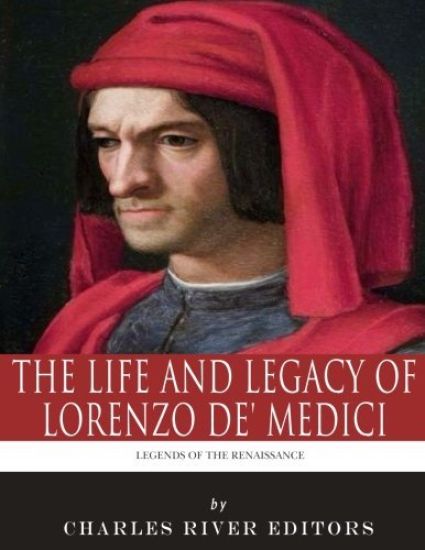
Legends of the Renaissance: The Life and Legacy of Lorenzo de' Medici

Legends of the Renaissance: The Life and Legacy of Lorenzo de' Medici

Charles River

Createspace Independent Publishing Platform
2018
nidottu
*Includes pictures of Lorenzo and important people and places in his life. *Discusses Lorenzo's relationships with other famous Renaissance legends, including Leonardo and Michelangelo. *Includes a Bibliography for further reading. "How beautiful is youth that is always slipping away." - Lorenzo de' Medici A lot of ink has been spilled covering the lives of history's most influential figures, but how much of the forest is lost for the trees? When historians are asked to pick a point in history when Western civilization was transformed and guided down the path to modernity, most of them point to the Renaissance. Indeed, the Renaissance revolutionized art, philosophy, religion, sciences and math, with individuals like Galileo, Leonardo, Michelangelo, Raphael, Dante, and Petrarch bridging the past and modern society. In Charles River Editors' Legends of the Renaissance, readers can get caught up to speed on the lives of the most important men and women of the Renaissance in the time it takes to finish a commute, while learning interesting facts long forgotten or never known. Most historians credit the city-state of Florence as the place that started and developed the Italian Renaissance, a process carried out through the patronage and commission of artists during the late 12th century. If Florence is receiving its due credit, much of it belongs to the Medicis, the family dynasty of Florence that ruled at the height of the Renaissance. The dynasty held such influence that some of its family members even became Pope. Among all of the Medicis, its most famous member ruled during the Golden Age of Florence at the apex of the Renaissance's artistic achievements. Lorenzo de Medici, commonly referred to as Lorenzo the Magnificent, was groomed both intellectually and politically to rule Venice, and he took the reins of power at just 20 years old. Of all the fields that were advanced during the Renaissance, the period's most famous works were art, with iconic paintings like Leonardo's Mona Lisa and timeless sculptures like Michelangelo's David. Thus it is fitting that both Leonardo and Michelangelo were at times members of Lorenzo's court, and the Florentian ruler, who also considered himself an artist and poet, became known for securing commissions for the most famous artists of the age, including the aforementioned legends, Piero and Antonio del Pollaiuolo, Andrea del Verrocchio, Sandro Botticelli and Domenico Ghirlandaio. When Lorenzo died in April 1492, he was buried in a chapel designed by Michelangelo. Legends of the Renaissance: The Life and Legacy of Lorenzo de' Medici chronicles the life and reign of Lorenzo the Magnificent, examines the relationships he had with other Renaissance legends, and analyzes his enduring legacy. Along with pictures of important people, places, and events in his life, you will learn about Lorenzo de' Medici like you never have before, in no time at all.

Legends of the Renaissance: The Life and Legacy of Leonardo da Vinci

Legends of the Renaissance: The Life and Legacy of Leonardo da Vinci

Charles River

Createspace Independent Publishing Platform
2018
nidottu
*Includes over 30 pictures of Leonardo, his work, and important people and places in his life. *Discusses Leonardo's most famous works, including the Mona Lisa, The Last Supper, the Vitruvian Man, and more. *Includes quotes from Leonardo's Notebooks. *Includes a Bibliography for further reading. "Iron rusts from disuse; stagnant water loses its purity and in cold weather becomes frozen; even so does inaction sap the vigor of the mind." - Leonardo A lot of ink has been spilled covering the lives of history's most influential figures, but how much of the forest is lost for the trees? When historians are asked to pick a point in history when Western civilization was transformed and guided down the path to modernity, most of them point to the Renaissance. Indeed, the Renaissance revolutionized art, philosophy, religion, sciences and math, with individuals like Galileo, Leonardo, Michelangelo, Raphael, Dante, and Petrarch bridging the past and modern society. In Charles River Editors' Legends of the Renaissance, readers can get caught up to speed on the lives of the most important men and women of the Renaissance in the time it takes to finish a commute, while learning interesting facts long forgotten or never known. The Renaissance also spawned the use of the label "Renaissance Man" to describe a person who is extremely talented in multiple fields, and no discussion of the Renaissance is complete without the original "Renaissance Man", Leonardo da Vinci. Indeed, if 100 people are asked to describe Leonardo in one word, they might give 100 answers. As the world's most famous polymath and genius, Leonardo found time to be a painter, sculptor, architect, musician, scientist, mathematician, engineer, inventor, anatomist, geologist, cartographer, botanist, and writer. It would be hard to determine which field Leonardo had the greatest influence in. His "Mona Lisa" and "The Last Supper" are among the most famous paintings of all time, standing up against even Michelangelo's work. But even if he was not the age's greatest artist, Leonardo may have conducted his most influential work was done in other fields. His emphasis on the importance of Nature would influence Enlightened philosophers centuries later, and he sketched speculative designs for gadgets like helicopters that would take another 4 centuries to create. Leonardo's vision and philosophy were made possible by his astounding work as a mathematician, engineer and scientist. At a time when much of science was dictated by Church teachings, Leonardo studied geology and anatomy long before they truly even became scientific fields, and he used his incredible artistic abilities to sketch the famous Vitruvian Man, linking art and science together. Leonardo also conducted scientific experiments using empirical methods nearly 150 years before Rene Descartes' "Discourse on Method." As Leonardo explained in his writings, "Many will think they may reasonably blame me by alleging that my proofs are opposed to the authority of certain men held in the highest reverence by their inexperienced judgments; not considering that my works are the issue of pure and simple experience, who is the one true mistress." Legends of the Renaissance: The Life and Legacy of Leonardo da Vinci chronicles Leonardo's amazing life and work, analyzing the lasting legacy he left across the arts and sciences. Along with pictures of important people, places, and events in his life, you will learn about Leonardo like you never have before, in no time at all.
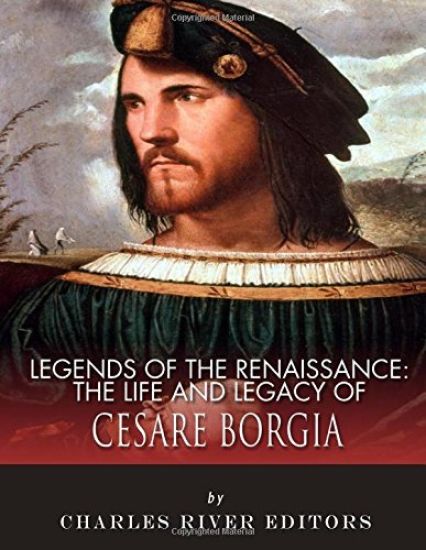
Legends of the Renaissance: The Life and Legacy of Cesare Borgia

Legends of the Renaissance: The Life and Legacy of Cesare Borgia

Charles River

Createspace Independent Publishing Platform
2018
nidottu
*Analyzes Cesare's legacy and how it endured over the centuries. *Examines the legends and rumors surrounding Cesare's life in an attempt to separate fact from fiction. *Includes pictures depicting Cesare and other important people in his life. *Includes a Bibliography for further reading. "Cesare Borgia was considered cruel; nonetheless, that cruelty united Romagna and brought it peace and stability. On careful reflection, he was more merciful than the Florentines, who, in order to avoid being seen as cruel, allowed Pistoia to be destroyed. Therefore a prince, so long as he keeps his subjects united and loyal, ought not to mind the reproach of cruelty; because with a few examples he will be more merciful than those who, through too much mercy, allow disorders to arise, from which follow murders or robberies." - Machiavelli, The Prince The Renaissance revolutionized art, philosophy, religion, sciences and math, with individuals like Galileo, Leonardo, Michelangelo, Raphael, Dante, and Petrarch bridging the past and modern society. But it also had its fair share of notorious villains and legendary characters, such as the Borgias. In Charles River Editors' Legends of the Renaissance, readers can get caught up to speed on the lives of the most important men and women of the Renaissance in the time it takes to finish a commute, while learning interesting facts long forgotten or never known. In one of the most famous political treatises in history, Niccolo Machiavelli famously advises those who hold power that it is better to be feared than loved. Though he uses Cesare as a cautionary tale about acquiring power through the good-will and powers of another person (his father, Pope Alexander VI), it is clear in The Prince that Machiavelli holds out Cesare as a skillful, effective ruler and administrator. In many ways, Cesare has been characterized as the "prince" Machiavelli tells his readers to be. As one translator of The Prince put it, Cesare is "cited as a type of the man who rises on the fortune of others, and falls with them; who takes every course that might be expected from a prudent man but the course which will save him; who is prepared for all eventualities but the one which happens; and who, when all his abilities fail to carry him through, exclaims that it was not his fault, but an extraordinary and unforeseen fatality." 500 years after Cesare's death, he and his family have come to be associated more with crime, specifically murder and state-sponsored violence. While 21st century TV series have cast the Borgias as the first organized crime family, the rumors spread by the family's political opponents in the late 15th century have taken hold among a fascinated public. Did Cesare really have an incestuous relationship with sister Lucrezia? Did he really kill his own brother Giovanni (Juan)? While Cesare may not have been as colorful or criminal as the enduring legends, there is no question he was manipulative, ruthless and, for a short time at least, effective. He helped make his father's papacy a success, but his rise was as dramatic as his fall. To the extent that the Borgias are still associated with murder and mayhem, Cesare's actions can be credited with the lion's share of the perception. Not surprisingly, almost everything about Cesare's life is still up for debate, even one long-held assertion by the likes of Alexandre Dumas that Cesare's likeness was used by Renaissance artists to paint images of Jesus Christ during and after his life. Legends of the Renaissance: The Life and Legacy of Cesare Borgia chronicles Cesare's life and discusses the legends and myths about his life in an attempt to separate fact from fiction. Along with pictures of important people in his life, you will learn about Cesare like you never have before, in no time at all.

The Ancient World's Most Mysterious Religious Cults: The History of the Cult of the Apis Bull, the Eleusinian Mysteries, and the Mysteries of Mithras
*Includes pictures *Includes ancient accounts *Includes online resources and a bibliography for further reading Africa may have given rise to the first human beings, and Egypt probably gave rise to the first great civilizations, which continue to fascinate modern societies across the globe nearly 5,000 years later. From the Library and Lighthouse of Alexandria to the Great Pyramid at Giza, the Ancient Egyptians produced several wonders of the world, revolutionized architecture and construction, created some of the world's first systems of mathematics and medicine, and established language and art that spread across the known world. With world-famous leaders like King Tut and Cleopatra, it's no wonder that today's world has so many Egyptologists. To the ancient Egyptians, the gods and goddesses were all around them and could be seen daily in nature. Nearly every animal found in ancient Egypt, both domestic and wild, were associated with a god or goddess, which can be seen in Egyptian art where deities are often depicted with human bodies and animal heads. The Apis cult began early in Egyptian history and gradually rose to prominence until, like the other animal cults, it became the object of popular veneration for all Egyptians. Despite gaining popularity with Egyptians of the lower classes, the Apis cult was also patronized by all of Egypt's kings, which included foreign kings who wanted to legitimize their rule in the eyes of the Egyptian people. Ancient Greece and its mythology has fascinated people for thousands of years, and few elements have intrigued people quite like the Eleusinian Mysteries, which the Greeks believed transformed the initiates and gave them knowledge that eased both the living of life on earth and allayed fears of death, allowing an acceptance of their ultimate fate. The influence of the Eleusinian Mysteries was also far reaching; for example, the Telesterion is reminiscent of the labyrinthine, symbolic structures that can be found all over pre-historic Europe, ranging from those in Ireland to Malta and Crete to the Shetlands. The larger precinct of Eleusis, combining as it did caves, terraces and buildings carved into the rock again, all echo that ancient past. The external journey of the initiate is mirrored in his internal journey, and what can be seen is that the spiritual torch of classical Greece, as exemplified in these rites, hides the much older worship of deities. It was the spirit of those older gods and goddesses that ultimately pervaded Eleusis. In the early Roman Empire, as Christianity struggled to gain a foothold and survive in the polytheistic pool of Roman theology, its greatest rivals weren't the Caesars or the Roman aristocracy but rather the faith and devotion of the common Roman legionary. The faith of these men was centered on the god Mithras, who, they believed, led them to victory upon the field of battle and had done so for nearly four centuries. Despite this widespread belief among soldiers, the cult of Mithras was not a creation of the Romans, although they would eventually add their own rituals and mysteries to the ancient religion. In fact, the Mithraic religion was an Indo-Persian creation, a theology which managed to travel from India and back into the Hellenic and Roman world by way of Alexander the Great's conquest of the Persian Empire. Of course, if the Mithras cult began as a Roman interpretation of some elements of Zoroastrian theology, then new questions are raised. Perhaps the most obvious question is why the Romans would adopt one of their biggest enemies' gods. The answer to this question may never be revealed, but the fact that the Romans worshiped Mithra demonstrates the strength and vitality of foreign cultures, even when Rome conquered them.
The History of France Under German Occupation During World War II

The History of France Under German Occupation During World War II

Charles River

Createspace Independent Publishing Platform
2018
nidottu
*Includes pictures *Includes online resources and a bibliography for further reading Emerging from France's catastrophic 1940 defeat like a bedraggled and rather sinister phoenix, the French State - better known to history as "Vichy France" or the "Vichy Regime" after its spa-town capital - stands in history as a unique and bizarre creation of German Fuhrer Adolf Hitler's European conquests. A patchwork of paradoxes and contradictions, the Vichy Regime maintained a quasi-independent French nation for some time after the Third Reich invasion until the Germans decided to include it in their occupation zone. Headed by a French war hero of World War I, Marshal Philippe Petain, and his later Prime Minister Pierre Laval, Vichy France displayed strong right-wing, conservative, and authoritarian tendencies. Nevertheless, it never lapsed fully into fascism until the Germans arrived to reduce its role to little more than a mask over their own dominion. Petain carried out several major initiatives in an effort to counteract the alleged "decadence" of modern life and to restore the strength and "virtues" of the French "race." Accordingly, he received willing support from more conservative elements of society, even some factions within the Catholic Church. Following Case Anton - the takeover of the unoccupied area by the Germans - native French fascist elements also emerged. While the French later disowned the Vichy government with considerable vehemence, evidence such as fairly broad-based popular support prior to Case Anton suggests a somewhat different story. The Petain government expressed one facet of French culture and thought. Its conservative, imperialistic nature did not represent the widespread love of "liberty, fraternity, and equality" also deeply ingrained in French thinking, but neither did it constitute a complete divergence from a national history that produced such famous authoritarians as Louis XIV and Napoleon Bonaparte. Of course, not all French people proved willing to surrender to the Nazi invaders, however. While large numbers "collaborated" - working for German or Vichy companies to provide for themselves or their families - and some wholeheartedly backed the new regime out of opportunism, fascist conviction, or other motivations, many courageous French resisted the Nazis and the quisling Vichy state. "De Gaulle described them as being bound together by a taste for risk and adventure ...] national pride sharpened by the suffering of their nation and 'an overwhelming confidence in the strength and cunning of their own plot'. ...] 'With him, it is ...] serving the Resistance and national honour, uncompromisingly demanding, ' wrote one. 'With him, we would have to get used to breathing the rarefied air of the summits.'" (Fenby, 2012, 109). At the same time, despite the legends, the French Resistance never grew into a single unified organization. Rather, it remained divided in several major and numerous minor factions, each with their own philosophy and agenda. While these factions all shared the same goal - opposition to the Germans their Vichy pawns - they viewed each other with some suspicion and sometimes cooperated only grudgingly. One of the biggest divides ran between the Gaullists (and those who favored de Gaulle simply as a convenient, but temporary, "banner" to provide a unifying influence) and the communists of the PCF (Partie Communiste Francais). De Gaulle and his followers viewed the communists with profound suspicion, believing they harbored a wish for violent revolution and a totalitarian Soviet-aligned state, but needed their paramilitary skills and extraordinarily large cache of weaponry. The History of France Under German Occupation during World War II looks at France after its downfall and the occupation that lasted until late 1944.
The History of France Under German Occupation During World War II

The History of France Under German Occupation During World War II

Charles River

Createspace Independent Publishing Platform
2018
nidottu
*Includes pictures *Includes online resources and a bibliography for further reading Emerging from France's catastrophic 1940 defeat like a bedraggled and rather sinister phoenix, the French State - better known to history as "Vichy France" or the "Vichy Regime" after its spa-town capital - stands in history as a unique and bizarre creation of German Fuhrer Adolf Hitler's European conquests. A patchwork of paradoxes and contradictions, the Vichy Regime maintained a quasi-independent French nation for some time after the Third Reich invasion until the Germans decided to include it in their occupation zone. Headed by a French war hero of World War I, Marshal Philippe Petain, and his later Prime Minister Pierre Laval, Vichy France displayed strong right-wing, conservative, and authoritarian tendencies. Nevertheless, it never lapsed fully into fascism until the Germans arrived to reduce its role to little more than a mask over their own dominion. Petain carried out several major initiatives in an effort to counteract the alleged "decadence" of modern life and to restore the strength and "virtues" of the French "race." Accordingly, he received willing support from more conservative elements of society, even some factions within the Catholic Church. Following Case Anton - the takeover of the unoccupied area by the Germans - native French fascist elements also emerged. While the French later disowned the Vichy government with considerable vehemence, evidence such as fairly broad-based popular support prior to Case Anton suggests a somewhat different story. The Petain government expressed one facet of French culture and thought. Its conservative, imperialistic nature did not represent the widespread love of "liberty, fraternity, and equality" also deeply ingrained in French thinking, but neither did it constitute a complete divergence from a national history that produced such famous authoritarians as Louis XIV and Napoleon Bonaparte. Of course, not all French people proved willing to surrender to the Nazi invaders, however. While large numbers "collaborated" - working for German or Vichy companies to provide for themselves or their families - and some wholeheartedly backed the new regime out of opportunism, fascist conviction, or other motivations, many courageous French resisted the Nazis and the quisling Vichy state. "De Gaulle described them as being bound together by a taste for risk and adventure ...] national pride sharpened by the suffering of their nation and 'an overwhelming confidence in the strength and cunning of their own plot'. ...] 'With him, it is ...] serving the Resistance and national honour, uncompromisingly demanding, ' wrote one. 'With him, we would have to get used to breathing the rarefied air of the summits.'" (Fenby, 2012, 109). At the same time, despite the legends, the French Resistance never grew into a single unified organization. Rather, it remained divided in several major and numerous minor factions, each with their own philosophy and agenda. While these factions all shared the same goal - opposition to the Germans their Vichy pawns - they viewed each other with some suspicion and sometimes cooperated only grudgingly. One of the biggest divides ran between the Gaullists (and those who favored de Gaulle simply as a convenient, but temporary, "banner" to provide a unifying influence) and the communists of the PCF (Partie Communiste Francais). De Gaulle and his followers viewed the communists with profound suspicion, believing they harbored a wish for violent revolution and a totalitarian Soviet-aligned state, but needed their paramilitary skills and extraordinarily large cache of weaponry. The History of France Under German Occupation during World War II looks at France after its downfall and the occupation that lasted until late 1944.
The Ghosts of London: A Collection of Ghost Stories from the British Capital

The Ghosts of London: A Collection of Ghost Stories from the British Capital

Charles River

Createspace Independent Publishing Platform
2018
nidottu
*Includes pictures *Includes online resources and a bibliography for further reading England is an ancient land steeped in history and tradition, filled with prehistoric ruins, majestic castles, and a countryside sculpted from millennia of human habitation.. Its rolling countryside is dotted with prehistoric burial mounds and stone circles. Brooding castles hold tales of bloodshed and honor. Medieval churches have elaborate stained glass windows and gruesome carvings, reflecting a mixture of hope and darkness. Every hamlet and village has tales that go back centuries, and folk festivals with roots in pagan times. Thus, it is not surprising that many believe England is a land filled with ghosts. For centuries, people have told tales of ghosts stalking its historic buildings, strange creatures lurking in its primeval forests, and unexplained paths linking its ancient sites. And naturally, as one of the world's most historic capitals, every step in London takes visitors through hundreds of years of history laden with stories of political intrigue, war, romance, and the inspiration of artistic and scientific geniuses. From the most magnificent avenues and monuments to the humbler minor streets and private homes, it seems every brick and cobblestone has a story to tell. The English are enchanted with the spirits of the dead. They are woven into the legends of historic buildings and take a prominent place in English literature, from Shakespeare and Dickens to modern writers such as Peter Ackroyd. So many buildings, streets, and even Tube stations have resident ghosts. Here is a collection of such tales, from among the hundreds of local legends and modern sightings that make England one of the most haunted countries in the world. The Ghosts of London: A Collection of Ghost Stories from the British Capital offers a sampling of the many strange ghost stories and unexplained phenomena that make London such an intriguing place. Along with pictures of important people, places, and events, you will learn about the ghosts of London like never before.
The Thuggee: The History of the Thugs, the World's First Organized Gang of Professional Assassins
*Includes pictures *Includes accounts of the Thuggee *Includes online resources and a bibliography for further reading "In the reign of that sultan about 1290], some Thugs were taken in Delhi, and a man belonging to that fraternity was the means of about a thousand being captured. But not one of these did the sultan have killed. He gave orders for them to be put into boats and to be conveyed into the lower country, to the neighbourhood of Lakhnauti, where they were to be set free. The Thugs would thus have to dwell about Lakhnauti and would not trouble the neighbourhood of Delhi any more." - Sir H. M. Elliot, History of India To most people, the typical "thug" in this day and age lurks on a shadowy street corner, toting ready-to-sell packets of "product," and is more often than not, packing a glinting, unlicensed pistol under his shirt. One might even describe the bully that relentlessly terrorizes peers they deem weaker as such, or perhaps a young hoodlum that ventures out in the dead of the night, tagging their initials or the insignia of their "crew" on public property, and pursuing other kinds of petty mischief. Thugs, a term used interchangeably with "gangsters" at times, are hardcore outlaws of the street, and like most criminals, tend to find strength in numbers. Thugs who have claimed hold on a certain territory are known to harass unfortunate passersby, usually walking down dimly-lit alleys unaccompanied. The most organized syndicates target vulnerable small, family-owned businesses, some so formidably powerful they hold even local authorities hostage under their thumbs. As it turns out, the Thuggee, the group that influenced this now controversial word, is far more fascinating than one could have imagined. The Thuggee: The History of the Thugs, the World's First Organized Gang of Professional Assassins explores both the etiological myth and origin story of this prolific cult of murderous bandits, takes an in-depth look into its practices and their ultimate demise. Along with pictures of important people, places, and events, you will learn about the thugs like never before.
The Thuggee: The History of the Thugs, the World's First Organized Gang of Professional Assassins
*Includes pictures *Includes accounts of the Thuggee *Includes online resources and a bibliography for further reading "In the reign of that sultan about 1290], some Thugs were taken in Delhi, and a man belonging to that fraternity was the means of about a thousand being captured. But not one of these did the sultan have killed. He gave orders for them to be put into boats and to be conveyed into the lower country, to the neighbourhood of Lakhnauti, where they were to be set free. The Thugs would thus have to dwell about Lakhnauti and would not trouble the neighbourhood of Delhi any more." - Sir H. M. Elliot, History of India To most people, the typical "thug" in this day and age lurks on a shadowy street corner, toting ready-to-sell packets of "product," and is more often than not, packing a glinting, unlicensed pistol under his shirt. One might even describe the bully that relentlessly terrorizes peers they deem weaker as such, or perhaps a young hoodlum that ventures out in the dead of the night, tagging their initials or the insignia of their "crew" on public property, and pursuing other kinds of petty mischief. Thugs, a term used interchangeably with "gangsters" at times, are hardcore outlaws of the street, and like most criminals, tend to find strength in numbers. Thugs who have claimed hold on a certain territory are known to harass unfortunate passersby, usually walking down dimly-lit alleys unaccompanied. The most organized syndicates target vulnerable small, family-owned businesses, some so formidably powerful they hold even local authorities hostage under their thumbs. As it turns out, the Thuggee, the group that influenced this now controversial word, is far more fascinating than one could have imagined. The Thuggee: The History of the Thugs, the World's First Organized Gang of Professional Assassins explores both the etiological myth and origin story of this prolific cult of murderous bandits, takes an in-depth look into its practices and their ultimate demise. Along with pictures of important people, places, and events, you will learn about the thugs like never before.
The Rise and Fall of the Ottoman Empire: The History of the Turkish Empire's Creation and Its Destruction Over 600 Years Later

The Rise and Fall of the Ottoman Empire: The History of the Turkish Empire's Creation and Its Destruction Over 600 Years Later

Charles River

Createspace Independent Publishing Platform
2018
nidottu

Halvin toimitettuna 21,00 €

*Includes pictures *Includes online resources and a bibliography for further reading In terms of geopolitics, perhaps the most seminal event of the Middle Ages was the successful Ottoman siege of Constantinople in 1453. The city had been an imperial capital as far back as the 4th century, when Constantine the Great shifted the power center of the Roman Empire there, effectively establishing two almost equally powerful halves of antiquity's greatest empire. Constantinople would continue to serve as the capital of the Byzantine Empire even after the Western half of the Roman Empire collapsed in the late 5th century. Naturally, the Ottoman Empire would also use Constantinople as the capital of its empire after their conquest effectively ended the Byzantine Empire, and thanks to its strategic location, it has been a trading center for years and remains one today under the Turkish name of Istanbul. The end of the Byzantine Empire had a profound effect not only on the Middle East but Europe as well. Constantinople had played a crucial part in the Crusades, and the fall of the Byzantines meant that the Ottomans now shared a border with Europe. The Islamic empire was viewed as a threat by the predominantly Christian continent to their west, and it took little time for different European nations to start clashing with the powerful Turks. In fact, the Ottomans would clash with Russians, Austrians, Venetians, Polish, and more before collapsing as a result of World War I, when they were part of the Central powers. The Ottoman conquest of Constantinople also played a decisive role in fostering the Renaissance in Western Europe. The Byzantine Empire's influence had helped ensure that it was the custodian of various ancient texts, most notably from the ancient Greeks, and when Constantinople fell, Byzantine refugees flocked west to seek refuge in Europe. Those refugees brought books that helped spark an interest in antiquity that fueled the Italian Renaissance and essentially put an end to the Middle Ages altogether. The long agony of the "sick man of Europe," an expression used by the Tsar of Russia to depict the falling Ottomans, could almost blind people to its incredible power and history. Preserving its mixed heritage, coming from both its geographic position rising above the ashes of the Byzantine Empire and the tradition inherited from the Muslim Conquests, the Ottoman Empire lasted more than six centuries. Its soldiers fought, died, and conquered lands on three different continents, making it one of the few stable multi-ethnic empires in history - and likely one of the last. Thus, it's somewhat inevitable that the history of its dissolution is at the heart of complex geopolitical disputes, as well as sectarian tensions that are still key to understanding the Middle East, North Africa and the Balkans. When studying the fall of the Ottoman Empire, historians have argued over the breaking point that saw a leading global power slowly become a decadent empire. The failed Battle of Vienna in 1683 is certainly an important turning point for the expanding empire; the defeat of Grand Vizier Kara Mustafa Pasha at the hands of a coalition led by the Austrian Habsburg dynasty, Holy Roman Empire and Polish-Lithuanian commonwealth marked the end of Ottoman expansionism. It was also the beginning of a slow decline during which the Ottoman Empire suffered multiple military defeats, found itself mired by corruption, and had to deal with the increasingly mutinous Janissaries (the Empire's initial foot soldiers). Despite it all, the Ottoman Empire would survive for over 200 more years, and in the last century of its life it strove to reform its military, administration and economy until it was finally dissolved.
The Rise and Fall of the Ottoman Empire: The History of the Turkish Empire's Creation and Its Destruction Over 600 Years Later
*Includes pictures *Includes online resources and a bibliography for further reading In terms of geopolitics, perhaps the most seminal event of the Middle Ages was the successful Ottoman siege of Constantinople in 1453. The city had been an imperial capital as far back as the 4th century, when Constantine the Great shifted the power center of the Roman Empire there, effectively establishing two almost equally powerful halves of antiquity's greatest empire. Constantinople would continue to serve as the capital of the Byzantine Empire even after the Western half of the Roman Empire collapsed in the late 5th century. Naturally, the Ottoman Empire would also use Constantinople as the capital of its empire after their conquest effectively ended the Byzantine Empire, and thanks to its strategic location, it has been a trading center for years and remains one today under the Turkish name of Istanbul. The end of the Byzantine Empire had a profound effect not only on the Middle East but Europe as well. Constantinople had played a crucial part in the Crusades, and the fall of the Byzantines meant that the Ottomans now shared a border with Europe. The Islamic empire was viewed as a threat by the predominantly Christian continent to their west, and it took little time for different European nations to start clashing with the powerful Turks. In fact, the Ottomans would clash with Russians, Austrians, Venetians, Polish, and more before collapsing as a result of World War I, when they were part of the Central powers. The Ottoman conquest of Constantinople also played a decisive role in fostering the Renaissance in Western Europe. The Byzantine Empire's influence had helped ensure that it was the custodian of various ancient texts, most notably from the ancient Greeks, and when Constantinople fell, Byzantine refugees flocked west to seek refuge in Europe. Those refugees brought books that helped spark an interest in antiquity that fueled the Italian Renaissance and essentially put an end to the Middle Ages altogether. The long agony of the "sick man of Europe," an expression used by the Tsar of Russia to depict the falling Ottomans, could almost blind people to its incredible power and history. Preserving its mixed heritage, coming from both its geographic position rising above the ashes of the Byzantine Empire and the tradition inherited from the Muslim Conquests, the Ottoman Empire lasted more than six centuries. Its soldiers fought, died, and conquered lands on three different continents, making it one of the few stable multi-ethnic empires in history - and likely one of the last. Thus, it's somewhat inevitable that the history of its dissolution is at the heart of complex geopolitical disputes, as well as sectarian tensions that are still key to understanding the Middle East, North Africa and the Balkans. When studying the fall of the Ottoman Empire, historians have argued over the breaking point that saw a leading global power slowly become a decadent empire. The failed Battle of Vienna in 1683 is certainly an important turning point for the expanding empire; the defeat of Grand Vizier Kara Mustafa Pasha at the hands of a coalition led by the Austrian Habsburg dynasty, Holy Roman Empire and Polish-Lithuanian commonwealth marked the end of Ottoman expansionism. It was also the beginning of a slow decline during which the Ottoman Empire suffered multiple military defeats, found itself mired by corruption, and had to deal with the increasingly mutinous Janissaries (the Empire's initial foot soldiers). Despite it all, the Ottoman Empire would survive for over 200 more years, and in the last century of its life it strove to reform its military, administration and economy until it was finally dissolved.
William Penn: The Life and Legacy of the English Quaker Who Founded Pennsylvania

William Penn: The Life and Legacy of the English Quaker Who Founded Pennsylvania

Charles River

Createspace Independent Publishing Platform
2018
nidottu
*Includes pictures *Includes Penn's quotes *Includes online resources and a bibliography for further reading "Sense shines with a double luster when it is set in humility. An able yet humble man is a jewel worth a kingdom." - William Penn Of all the original 13 colonies in America, only one owes its conception to one man, and indeed, Pennsylvania was and still remains bound up in the life and character of its founder, William Penn. Here was a man born into a military family who saw his father rise through the ranks of the 17th century English court to become a friend of the king, and he even considered a military career for himself, only to leave it all behind to become a member of the "Society of Friends," known colloquially as the Quakers. Few today know much about the Quakers. Whenever the subject of Quakerism slips into conversation, most picture a rosy-cheeked fellow in a simple black overcoat, and a wide brim hat atop his thick, cloud-white hair, inspired by the famous logo of the Quaker Oats company. In spite of the stereotype, Quakers today come in all colors, shapes, and sizes, with the more liberal folk sporting trendy haircuts, tattoos, and various piercings. They call themselves "Friends," a starkly different but very devout following of God. They strive for a world empowered by peace and acceptance, an ambitious mission fueled by diversity, blind to race, gender, or creed. As amicably harmless as the Friends might appear, there was once a time when being a Quaker was at the very best an instant conviction, and at the very worst a death sentence. Their unorthodox ideals were considered poisonous and potentially dangerous by authorities, who would fight time and time again to stamp out the flames of their movement, but still, they weathered storm after storm. And while the peace-loving followers of Christ were famed for their views of harmony, by no means were they feeble opponents. Not only would they persevere in the face of persecution, theirs was a movement so powerful that it stood strong for centuries, and much of that was due to William Penn's work in North America. For all his love of the sect and its plain ways, he was himself quite a scholar, able to debate some of the greatest minds of his age and win. He was also an ambitious man who saw the answer to his people's persecution not in capitulation but in building a new society where all people could be free to worship God in the way each felt right. Along the way he befriended kings and scoundrels and suffered at the hands of each, only to triumph repeatedly, until finally he experienced what was, for the people of his faith, the ultimate triumph of death, knowing that the colony he had founded was thriving and would likely do so for generations to come. William Penn: The Life and Legacy of the English Quaker Who Founded Pennsylvania chronicles the life of one of colonial America's most important figures. Along with pictures of important people, places, and events, you will learn about William Penn like never before.
William Penn: The Life and Legacy of the English Quaker Who Founded Pennsylvania

William Penn: The Life and Legacy of the English Quaker Who Founded Pennsylvania

Charles River

Createspace Independent Publishing Platform
2018
nidottu
*Includes pictures *Includes Penn's quotes *Includes online resources and a bibliography for further reading "Sense shines with a double luster when it is set in humility. An able yet humble man is a jewel worth a kingdom." - William Penn Of all the original 13 colonies in America, only one owes its conception to one man, and indeed, Pennsylvania was and still remains bound up in the life and character of its founder, William Penn. Here was a man born into a military family who saw his father rise through the ranks of the 17th century English court to become a friend of the king, and he even considered a military career for himself, only to leave it all behind to become a member of the "Society of Friends," known colloquially as the Quakers. Few today know much about the Quakers. Whenever the subject of Quakerism slips into conversation, most picture a rosy-cheeked fellow in a simple black overcoat, and a wide brim hat atop his thick, cloud-white hair, inspired by the famous logo of the Quaker Oats company. In spite of the stereotype, Quakers today come in all colors, shapes, and sizes, with the more liberal folk sporting trendy haircuts, tattoos, and various piercings. They call themselves "Friends," a starkly different but very devout following of God. They strive for a world empowered by peace and acceptance, an ambitious mission fueled by diversity, blind to race, gender, or creed. As amicably harmless as the Friends might appear, there was once a time when being a Quaker was at the very best an instant conviction, and at the very worst a death sentence. Their unorthodox ideals were considered poisonous and potentially dangerous by authorities, who would fight time and time again to stamp out the flames of their movement, but still, they weathered storm after storm. And while the peace-loving followers of Christ were famed for their views of harmony, by no means were they feeble opponents. Not only would they persevere in the face of persecution, theirs was a movement so powerful that it stood strong for centuries, and much of that was due to William Penn's work in North America. For all his love of the sect and its plain ways, he was himself quite a scholar, able to debate some of the greatest minds of his age and win. He was also an ambitious man who saw the answer to his people's persecution not in capitulation but in building a new society where all people could be free to worship God in the way each felt right. Along the way he befriended kings and scoundrels and suffered at the hands of each, only to triumph repeatedly, until finally he experienced what was, for the people of his faith, the ultimate triumph of death, knowing that the colony he had founded was thriving and would likely do so for generations to come. William Penn: The Life and Legacy of the English Quaker Who Founded Pennsylvania chronicles the life of one of colonial America's most important figures. Along with pictures of important people, places, and events, you will learn about William Penn like never before.
Siberia: The History of Russia's Most Notorious Territory and Home of the Soviet Gulags
*Includes pictures *Details the history, climate, and geography of the region and the culture of its indigenous peoples *Includes footnotes, online resources and a bibliography for further reading *Includes a table of contents "Have you heard of the illness hysteria siberiana? Try to imagine this: You're a farmer, living all alone on the Siberian tundra. Day after day you plow your fields. As far as the eye can see, nothing. To the north, the horizon, to the east, the horizon, to the south, to the west, more of the same. Every morning, when the sun rises in the east, you go out to work in your fields. When it's directly overhead, you take a break for lunch. When it sinks in the west, you go home to sleep. And then one day, something inside you dies. Day after day you watch the sun rise in the east, pass across the sky, then sink in the west, and something breaks inside you and dies. You toss your plow aside and, your head completely empty of thought, begin walking toward the west. Heading toward a land that lies west of the sun. Like someone, possessed, you walk on, day after day, not eating or drinking, until you collapse on the ground and die. That's hysteria siberiana." - Haruki Murakami, South of the Border, West of the Sun Although Russia has long been considered part of Europe, it has always had a culture so distinct and a history so different that it is still foreign to Western Europe in many ways. Naturally, this sense of otherness has lent an aura of intrigue and mystique to Russia as people have struggled to understand it. Over the long course of Russian history, perhaps no aspect of the giant country has generated interest quite like Siberia, the easternmost part of Russia that lies in Asia. Generally speaking, all that is widely known about Siberia is that it is really big and really cold, which, to be fair, are good starting points for a deeper exploration of this fascinating region. The name "Siberia" comes to English from Russian and was originally from the word "Sibir," a fortress of the Tatar people which was located on the Tobol and Irtysh Rivers . However, it referred more generally to the Khanate of Sibir, the land just east of the Urals that served as the gateway to a network of rivers that stretched all the way to the Pacific in the far east. Hence, it eventually gave its name to that entire region. Despite making up nearly 66% of the country, Siberia is only inhabited by 40 million people, making it one of the most sparsely populated places on the planet. Given its brutal climate and the strategic depth offered by the region, it should perhaps come as no surprise that the region is best known today for being the location where political prisoners were sent to the infamous Russian labor camps. Siberia: The History of Russia's Most Notorious Territory and Home of the Soviet Gulags details the history of Siberia over the centuries. Along with pictures of important people, places, and events, you will learn about Siberia like never before, in no time at all.
Sigmund Freud: The Life and Legacy of History's Most Famous Psychiatrist

Sigmund Freud: The Life and Legacy of History's Most Famous Psychiatrist

Charles River

Createspace Independent Publishing Platform
2018
nidottu
Includes pictures of Freud and important people and places in his life. Discusses Freud's theories and criticism of them. Includes some of Freud's most famous quotes and a bibliography of his major works. "Only for the most select and most balanced minds does it seem possible to guard the perceived picture of external reality against the distortion to which it is otherwise subjected in its transit through the psychic individuality of the one perceiving it." - Sigmund Freud Sigmund Freud (1856-1939) is known around the world as the "Father of Psychoanalysis," and for good reason. If anything, Freud's first patient was himself. A sufferer of psychosomatic symptoms, Freud diagnosed himself as having a repressed antagonism against his father. From there, Freud began to build on his now famous concepts of the unconscious, infantile sexuality and repression. And of course, there's his famous theory on the structure of the mind, which has made Id and Ego a commonly used part of the English lexicon. In addition to all but creating a new field of science, Freud also contributed to entire industries. One of the first to try to analyze dreams, Freud's work has led patients in search of psychological explanations for various physical and mental symptoms and phenomena. The Interpretation of Dreams is Sigmund Freud's best known work, focusing on his theory of the unconscious with respect to dream interpretation. To Freud, dreams represented the unconscious attempt to fulfill some sort of wish, either by resolving a conflict or bringing certain memories to the surface. And as a practitioner for many years, Freud wrote voluminously about his theories during the early 20th century, and his work tied in to a countless number of aspects concerning life and the mind. Whether he was analyzing why people find things funny (Wit and Its Relation to the Unconscious), what causes hysteria and delusions (Delusion and Dream), death (Beyond the Pleasure Principle), and seemingly everything inbetween. As a result, Freud remains one of the most influential and famous thinkers and psychologists of the 20th century. Sigmund Freud: The Life and Legacy of History's Most Famous Psychiatrist profiles the amazing life and works of the influential thinker, examining is theories and analyzing his lasting legacy. Along with pictures of important people, places, and events, you will learn about Freud like you never have before, in no time at all.

Shiloh & Antietam: The 1862 Battles That Saved the Union

Shiloh & Antietam: The 1862 Battles That Saved the Union

Charles River

Createspace Independent Publishing Platform
2018
nidottu
*Includes pictures of important people, places, and events. *Includes maps of the battles. *Analyzes the generalship of the battles' most important leaders, including Lee and McClellan at Antietam, and Grant, Sherman and Johnston at Shiloh. *Includes descriptions of the fighting at both battles from the post-battle reports of some of the leading generals. *Includes a Bibliography of each Battle for further reading. After Union General Ulysses S. Grant captured Fort Henry and Fort Donelson in early 1862, Confederate General Albert Sidney Johnston, widely considered the Confederacy's best general, concentrated his forces in northern Georgia and prepared for a major offensive that culminated with the biggest battle of the war to that point, the Battle of Shiloh. On the morning of April 6, Johnston directed an all out attack on Grant's army around Shiloh Church, and though Grant's men had been encamped there, they had failed to create defensive fortifications or earthworks. They were also badly caught by surprise. With nearly 45,000 Confederates attacking, Johnston's army began to steadily push Grant's men back toward the river. As fate would have it, the Confederates may have been undone by friendly fire at Shiloh. Johnston advanced out ahead of his men on horseback while directing a charge near a peach orchard when he was hit in the lower leg by a bullet that historians now widely believe was fired by his own men. Nobody thought the wound was serious, including Johnston, who continued to aggressively lead his men and even sent his personal physician to treat wounded Union soldiers taken captive. But the bullet had clipped an artery, and shortly after being wounded Johnston began to feel faint in the saddle. With blood filling up his boot, Johnston unwittingly bled to death. The delay caused by his death, and the transfer of command to subordinate P. G. T. Beauregard, bought the Union defenders critical time on April 6, and the following day Grant's reinforced army struck back and pushed the Confederate army off the field. The bloodiest day in American history took place on the 75th anniversary of the signing of the Constitution. On September 17, 1862, Robert E. Lee's Confederate Army of Northern Virginia fought George McClellan's Union Army of the Potomac outside Sharpsburg along Antietam Creek. That day, nearly 25,000 would become casualties, and Lee's army would barely survive fighting the much bigger Northern army. Although the battle was tactically a draw, it resulted in forcing Lee's army out of Maryland and back into Virginia, making it a strategic victory for the North and an opportune time for President Abraham Lincoln to issue the Emancipation Proclamation, freeing all slaves in the rebellious states. Shiloh & Antietam explains the two crucial campaigns of 1862, including the events that led up to the decisive battles, what went right and wrong on both sides, and the aftermath of the battles. Accounts of the battles by important leaders like Lee, McClellan, Sherman, Grant, Beauregard and others are included, along with analysis of the generals and fighting. Along with maps of the battles and pictures of important people, places, and events, you will learn about Antietam and Shiloh like you never have before.
Sherman's March to the Sea: The History of the Savannah Campaign that Subdued Georgia

Sherman's March to the Sea: The History of the Savannah Campaign that Subdued Georgia

Charles River

Createspace Independent Publishing Platform
2018
nidottu
*Includes pictures of the battle's important generals. *Includes accounts of the march written by important participants. *Includes a Bibliography for further reading. "I can make this march, and I will make Georgia howl " - William Tecumseh Sherman " N]o Civil War commander possessed a more astute appraisal of the nature of the contemporary warfare, how to form and pursue grand strategy, and the critical nexus between war, civil society, popular support, and electoral politics, And few American generals have since." - Victor Davis Hanson, The Savior Generals William Tecumseh Sherman holds a unique position in American history. Synonymous with barbarity in the South, Sherman is lauded as a war hero in the North, and modern historians consider him the harbinger of total war. As a Union general, Sherman was recognized for his outstanding command of military strategy but criticized for the harshness of the "scorched earth" policies that he implemented in conducting total war against the Confederate States, especially in 1864 and 1865. Military historian B. H. Liddell Hart famously declared that Sherman was "the first modern general." Both Grant and Sherman shared the same theory of war: anything that might help the enemy's war effort should be considered a military target. Grant explained to Sherman that the Confederates must be "demoralized and left without hope," and he instructed Sherman, "Take all provisions, forage and stock wanted for the use of your command. Such as cannot be consumed, destroy. Leave the valley so barren that crows flying over it...will have to carry their provender with them." This strategy sought the total economic collapse of the South, as well as completely disabling the South's capability of fielding armies. In addition to the wholesale plundering of Southern resources, including taking them from civilians, the Union reversed its policy of swapping prisoners, realizing it had a far bigger reserve of manpower than the South. The Atlanta Campaign was a perfect example of this, as both sides lost about the same number of casualties. By September 1864, however, Sherman still had about 80,000 men, while Hood's army was reduced to about 30,000. Thus, with his remaining forces, about 60,000 strong, Sherman decided to take the unprecedented step of cutting his own communication and supply lines and commencing a widespread march across Georgia, destroying Southern infrastructure and living off the land until his forces reached the coast and linked up with the Union navy. Aside from those plans, Sherman did not appoint a fixed time for his arrival, and the concept of the march greatly concerned the Lincoln Administration, since his men would virtually be on their own without any contact with the rest of the North as they marched straight through the heart of the Confederacy. Grant expressed his own concerns but eventually gave Sherman a simple go-ahead: "Go as you propose." Foragers known as "bummers" (a group comprised of deserters, criminals, and other miscreants) were assigned to seize food from local farms, while the troops (both left and right wings) moved along the railroad lines, ripping up and burning the track as they advanced, leaving miles of severed telegraph lines in their wake. The troops also adopted the habit of heating the train rails over fires and then wrapping them around tree trunks, which became known as "Sherman's neckties." Ultimately, Sherman's armies cut a path of abject destruction 60 miles wide and 300 hundred miles long from Atlanta to Savannah, which some likened to a Biblical blight. And as Sherman had intended, he did indeed made Georgia "howl." Sherman's March to the Sea comprehensively covers the campaign, including the fighting and the aftermath of the results. You will learn about Sherman's March to the Sea like you never have before.
Sherman Makes Georgia Howl: The Atlanta Campaign and Sherman's March to the Sea

Sherman Makes Georgia Howl: The Atlanta Campaign and Sherman's March to the Sea

J. D. Mitchell; Charles River

Createspace Independent Publishing Platform
2018
nidottu
*Includes pictures of the battle's important generals. *Includes several maps of the battle. *Includes accounts of the fighting written by important generals. *Includes a Bibliography for further reading. After successfully breaking the Confederate siege at Chattanooga near the end of 1863, William Tecumseh Sherman united several Union armies in the Western theater for the Atlanta Campaign, forming one of the biggest armies in American history. After detaching troops for essential garrisons and minor operations, Sherman assembled his nearly 100,000 men and in May 1864 began his invasion of Georgia from Chattanooga, Tennessee, where his forces spanned a line roughly 500 miles wide. Sherman set his sights on the Confederacy's last major industrial city in the West and General Joseph E. Johnston's Army of Tennessee, which aimed to protect it. Atlanta's use to the Confederacy lay in its terminus for three major railroad lines that traveled across the South: the Georgia Railroad, Macon and Western, and the Western & Atlantic. U. S. Lieutenant General Ulysses S. Grant knew this, sending Major General William Tecumseh Sherman's Division of the Mississippi towards Atlanta, with specific instructions, "get into the country as far as you can, inflicting all the damage you can against the war revenues." The city's ability to send supplies to Lee's Army of Northern Virginia made Atlanta all the more important. In August 1864, Sherman moved his forces west across Atlanta and then south of it, positioning his men to cut off Atlanta's supply lines and railroads. When the Confederate attempts to stop the maneuvering failed, the writing was on the wall. On September 1, 1864, Hood and the Army of Tennessee evacuated Atlanta and torched everything of military value. On September 3, 1864, Sherman famously telegrammed Lincoln, "Atlanta is ours and fairly won." Two months later, so was Lincoln's reelection. After the Atlanta campaign, Grant explained to Sherman that the Confederates must be "demoralized and left without hope," and he instructed Sherman, "Take all provisions, forage and stock wanted for the use of your command. Such as cannot be consumed, destroy. Leave the valley so barren that crows flying over it...will have to carry their provender with them." This strategy sought the total economic collapse of the South, as well as completely disabling the South's capability of fielding armies. In addition to the wholesale plundering of Southern resources, including taking them from civilians, the Union reversed its policy of swapping prisoners, realizing it had a far bigger reserve of manpower than the South. The Atlanta Campaign was a perfect example of this, as both sides lost about the same number of casualties. By September 1864, however, Sherman still had about 80,000 men, while Hood's army was reduced to about 30,000. Thus, with his remaining forces, about 60,000 strong, Sherman decided to take the unprecedented step of cutting his own communication and supply lines and commencing a widespread march across Georgia, destroying Southern infrastructure and living off the land until his forces reached the coast and linked up with the Union navy. Aside from those plans, Sherman did not appoint a fixed time for his arrival, and the concept of the march greatly concerned the Lincoln Administration, since his men would virtually be on their own without any contact with the rest of the North as they marched straight through the heart of the Confederacy. Grant expressed his own concerns but eventually gave Sherman a simple go-ahead: "Go as you propose." Ultimately, Sherman's armies cut a path of abject destruction 60 miles wide and 300 hundred miles long from Atlanta to Savannah, which some likened to a Biblical blight. And as Sherman had intended, he did indeed made Georgia "howl."