Kirjojen hintavertailu – 12 859 824 kirjaa ja 27 kauppaa

Kirjailija

G. K. Chesterton

Kirjat ja teokset yhdessä paikassa: 2 054 kirjaa, julkaisuja vuosilta 1900–2026, suosituimpiin kuuluu A Miscellany of Poems by G. K. Chesterton. Vertaile teosten hintoja ja tarkista saatavuus suomalaisista kirjakaupoista.

Nimi esiintyy myös muodoissa: G K Chesterton, G.K. Chesterton, G.K Chesterton, G. K Chesterton

2 054 kirjaa

Kirjojen julkaisuvuodet: 1900–2026.

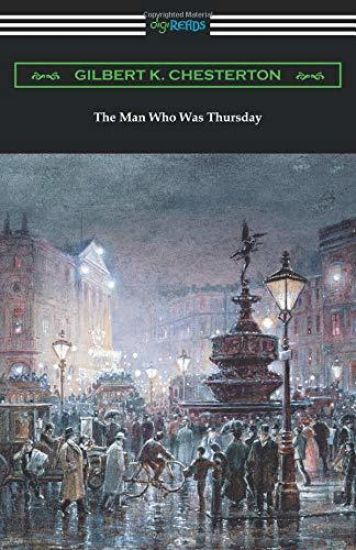
The Man Who Was Thursday

The Man Who Was Thursday

G K Chesterton

Digireads.com
2018
pokkari
First published in 1908, G. K. Chesterton's "The Man Who Was Thursday" has been described as a metaphysical thriller. It is the story of Gabriel Syme, who is recruited by Scotland Yard as part of an anti-anarchist task force. When he meets Lucian Gregory, a poet and member of a secret society of anarchists, he gains access to the underground movement. The group is lead by a central council of seven men, each named for a day of the week. Gabriel convinces the local chapter to elect him to the vacant position of "Thursday" and he soon discovers that he is not the only one pretending to be something that he is not. What follows is one of the most absurd and clever plots to ever have been written, one in which Chesterton's wonderfully high-spirited prose carries the reader along in a boisterous rush. Arguably the author's finest work, certainly his most popular, "The Man Who Was Thursday" is a wild, mad, hilarious and profoundly moving tale that ultimately defies classification. This edition is printed on premium acid-free paper.
What I Saw in America

What I Saw in America

G. K. Chesterton

Createspace Independent Publishing Platform
2018
nidottu
I have never managed to lose my old conviction that travel narrows the mind. At least a man must make a double effort of moral humility and imaginative energy to prevent it from narrowing his mind. Indeed there is something touching and even tragic about the thought of the thoughtless tourist, who might have stayed at home loving Laplanders, embracing Chinamen, and clasping Patagonians to his heart in Hampstead or Surbiton, but for his blind and suicidal impulse to go and see what they looked like. This is not meant for nonsense; still less is it meant for the silliest sort of nonsense, which is cynicism. The human bond that he feels at home is not an illusion. On the contrary, it is rather an inner reality. Man is inside all men. In a real sense any man may be inside any men. But to travel is to leave the inside and draw dangerously near the outside. So long as he thought of men in the abstract, like naked toiling figures in some classic frieze, merely as those who labour and love their children and die, he was thinking the fundamental truth about them. By going to look at their unfamiliar manners and customs he is inviting them to disguise themselves in fantastic masks and costumes. Many modern internationalists talk as if men of different nationalities had only to meet and mix and understand each other. In reality that is the moment of supreme danger-the moment when they meet. We might shiver, as at the old euphemism by which a meeting meant a duel.