Kirjailija
G. K. Chesterton
Kirjat ja teokset yhdessä paikassa: 2 054 kirjaa, julkaisuja vuosilta 1900–2026, suosituimpiin kuuluu A Miscellany of Poems by G. K. Chesterton. Vertaile teosten hintoja ja tarkista saatavuus suomalaisista kirjakaupoista.
Nimi esiintyy myös muodoissa: G K Chesterton, G.K. Chesterton, G.K Chesterton, G. K Chesterton
2 054 kirjaa
Kirjojen julkaisuvuodet: 1900–2026.
This book is meant to be a companion to "Heretics," and to put the positive side in addition to the negative. Many critics complained of the book called "Heretics" because it merely criticised current philosophies without offering any alternative philosophy. This book is an attempt to answer the challenge. It is unavoidably affirmative and therefore unavoidably autobiographical. The writer has been driven back upon somewhat the same difficulty as that which beset Newman in writing his Apologia; he has been forced to be egotistical only in order to be sincere. While everything else may be different the motive in both cases is the same. It is the purpose of the writer to attempt an explanation, not of whether the Christian Faith can be believed, but of how he personally has come to believe it. The book is therefore arranged upon the positive principle of a riddle and its answer. It deals first with all the writer's own solitary and sincere speculations and then with all the startling style in which they were all suddenly satisfied by the Christian Theology. The writer regards it as amounting to a convincing creed. But if it is not that it is at least a repeated and surprising coincidence.

I publish these essays at the present time for a particular reason connected with the present situation; a reason which I should like briefly to emphasise and make clear. Though most of the conclusions, especially towards the end, are conceived with reference to recent events, the actual bulk of preliminary notes about the science of Eugenics were written before the war. It was a time when this theme was the topic of the hour; when eugenic babies (not visibly very distinguishable from other babies) sprawled all over the illustrated papers; when the evolutionary fancy of Nietzsche was the new cry among the intellectuals; and when Mr. Bernard Shaw and others were considering the idea that to breed a man like a cart-horse was the true way to attain that higher civilisation, of intellectual magnanimity and sympathetic insight, which may be found in cart-horses. It may therefore appear that I took the opinion too controversially, and it seems to me that I sometimes took it too seriously. But the criticism of Eugenics soon expanded of itself into a more general criticism of a modern craze for scientific officialism and strict social organisation.
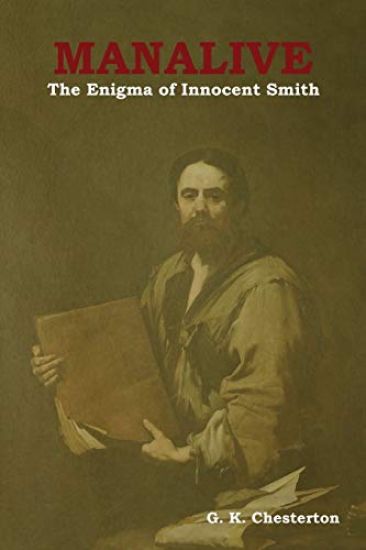
Perhaps the most light-hearted of all Chesterton's "serious" works, in Manalive we follow the madcap adventure of Innocent Smith. Innocent Smith is a man who keeps the commandments but breaks all the conventions, and while doing so he shows us just how absurd those conventions are. Follow him as he breaks into his own house, and then carries on a torrid affair with his own wife. Enjoy a picnic on the roof and then leave home just for the sake of returning home. A joyous and uplifting book
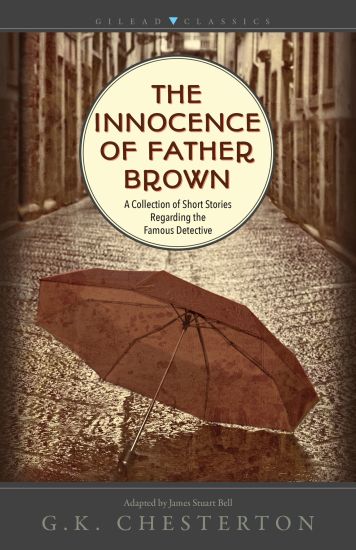
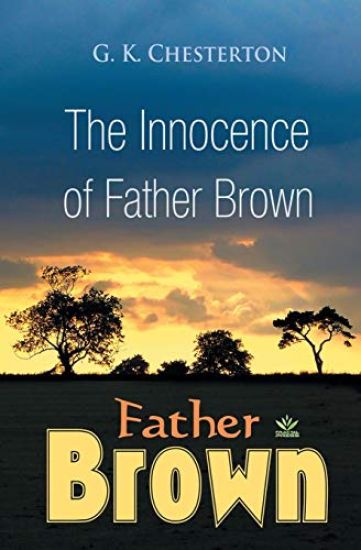
The Innocence Of Father Brown
G. K. Chesterton
Createspace Independent Publishing Platform
2018
nidottu
CONTENTS The Blue Cross 4 The Secret Garden 17 The Queer Feet 30 The Flying Stars 42 The Invisible Man 51 The Honour of Israel Gow 62 The Wrong Shape 72 The Sins of Prince Saradine 84 The Hammer of God 97 The Eye of Apollo 108 The Sign of the Broken Sword 119 The Three Tools of Death 131
This first volume of G. K. Chesterton's mysteries marks the debut of a most unusual detective: Father Paul Brown, a short, stumpy priest with an extraordinary and uncanny ability to spot the evil that lies in human hearts. In these twelve stories, Father Brown uses his wisdom, common sense, and experience as a confessor to solve baffling, fascinating crimes--and save lost souls along the way. Updated for the modern reader, The Innocence of Father Brown is primed to draw in new fans.
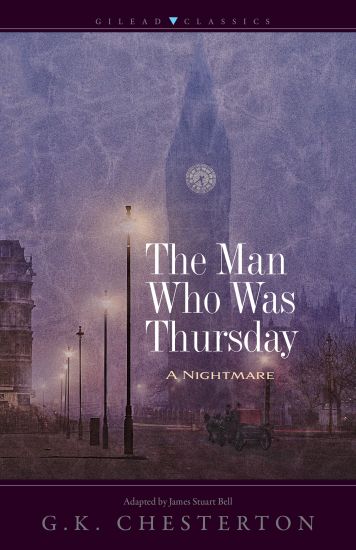
Gabriel Syme, a poet turned detective, infiltrates a secret meeting of anarchists in an attempt to derail a terrorist plot. But when he's elected Thursday--one of seven members of the Central Anarchist Council--the real nightmare begins. Gabriel discovers that he's not the only one in disguise. Rediscover G. K. Chesterton's 1908 masterpiece in which he challenges readers to consider how their faith plays out in a materialistic society. This new edition has been updated to make the text more accessible for the modern reader.
Farther Brown may be walking into a trap when he tries to save his soul as his precious Blue Cross is targeted by the notorious criminal Flambeau. Gilbert Keith Chesterton was an English writer, often referred to as the prince of paradox. Chesterton is well known for his fictional priest-detective Father Brown, and for his reasoned apologetics. Even some of those who disagree with him have recognized the wide appeal of such works as Orthodoxy and The Everlasting Man.
Flambeau, once the most famous criminal in France and later a very private detective in England, had long retired from both professions. Some say a career of crime had left him with too many scruples for a career of detection. Anyhow, after a life of romantic escapes and tricks of evasion, he had ended at what some might consider an appropriate address... Gilbert Keith Chesterton was an English writer, often referred to as the prince of paradox. Chesterton is well known for his fictional priest-detective Father Brown, and for his reasoned apologetics. Even some of those who disagree with him have recognized the wide appeal of such works as Orthodoxy and The Everlasting Man.
Father Brown is a short, stumpy Roman Catholic Church priest, formerly of Cobhole in Essex, and now working in London, with shapeless clothes and a large umbrella, and an uncanny insight into human evil. Gilbert Keith Chesterton was an English writer, often referred to as the prince of paradox. Chesterton is well known for his fictional priest-detective Father Brown, and for his reasoned apologetics. Even some of those who disagree with him have recognized the wide appeal of such works as Orthodoxy and The Everlasting Man.
Two men appeared simultaneously at the two ends of a sort of passage running along the side of the Apollo Theatre in the Adelphi. The evening daylight in the streets was large and luminous, opalescent and empty. The passage was comparatively long and dark, so each man could see the other as a mere black silhouette at the other end. Nevertheless, each man knew the other, even in that inky outline; for they were both men of striking appearance and they hated each other. Gilbert Keith Chesterton was an English writer, often referred to as the prince of paradox. Chesterton is well known for his fictional priest-detective Father Brown, and for his reasoned apologetics. Even some of those who disagree with him have recognized the wide appeal of such works as Orthodoxy and The Everlasting Man.
It would not be fair to record the adventures of Father Brown, without admitting that he was once involved in a grave scandal. There still are persons, perhaps even of his own community, who would say that there was a sort of blot upon his name. It happened in a picturesque Mexican road-house of rather loose repute, as appeared later; and to some it seemed that for once the priest had allowed a romantic streak in him, and his sympathy for human weakness, to lead him into loose and unorthodox action. Gilbert Keith Chesterton was an English writer, often referred to as the prince of paradox. Chesterton is well known for his fictional priest-detective Father Brown, and for his reasoned apologetics. Even some of those who disagree with him have recognized the wide appeal of such works as Orthodoxy and The Everlasting Man.
There was a brief period during which Father Brown enjoyed, or rather did not enjoy, something like fame. He was a nine days' wonder in the newspapers; he was even a common topic of controversy in the weekly reviews; his exploits were narrated eagerly and inaccurately in any number of clubs and drawing-rooms, especially in America. Incongruous and indeed incredible as it may seem to any one who knew him, his adventures as a detective were even made the subject of short stories appearing in magazines. Gilbert Keith Chesterton was an English writer, often referred to as the prince of paradox. Chesterton is well known for his fictional priest-detective Father Brown, and for his reasoned apologetics. Even some of those who disagree with him have recognized the wide appeal of such works as Orthodoxy and The Everlasting Man.
Gilbert Keith Chesterton, KC*SG (29 May 1874 - 14 June 1936), was an English writer, poet, philosopher, dramatist, journalist, orator, lay theologian, biographer, and literary and art critic. Chesterton is often referred to as the "prince of paradox." Time magazine has observed of his writing style: "Whenever possible Chesterton made his points with popular sayings, proverbs, allegories--first carefully turning them inside out." Chesterton is well known for his fictional priest-detective Father Brown, and for his reasoned apologetics. Even some of those who disagree with him have recognised the wide appeal of such works as Orthodoxy and The Everlasting Man. Chesterton routinely referred to himself as an "orthodox" Christian, and came to identify this position more and more with Catholicism, eventually converting to Catholicism from High Church Anglicanism. George Bernard Shaw, his "friendly enemy," said of him, "He was a man of colossal genius." Biographers have identified him as a successor to such Victorian authors as Matthew Arnold, Thomas Carlyle, Cardinal John Henry Newman, and John Ruskin. (wikipedia.org)
A book by G. K. Chesterton detailing a popular theme both in his own philosophy, and in Christianity, of the 'holy fool', such as in Dostoevsky's The Idiot and Cervantes' Don Quixote. This is a book in two parts. The first, "The Enigma of Innocent Smith," concerns the arrival of a new tenant at Beacon House, a London boarding establishment. Like Mary Poppins, this man (who is tentatively identified by lodger Arthur Inglewood as an ex-schoolmate named Innocent Smith) is accompanied by a great wind, and he breathes new life into the household with his games and antics. During his first day in residence the eccentric Smith creates the High Court of Beacon; arranges to elope with Mary Gray, paid companion to heiress Rosamund Hunt; inspires Inglewood to declare his love for Diana Duke, the landlady's daughter; and prompts a reconciliation between jaded journalist Michael Moon and Rosamund. However, when the household is at its happiest two doctors appear with awful news: Smith is wanted on charges of burglary, desertion of a spouse, polygamy, and attempted murder. The fact that Smith almost immediately fires several shots from a revolver at Inglewood's friend Dr. Herbert Warner seems to confirm the worst. Before Smith can be taken to a jail or an asylum, Michael Moon declares that the case falls under the purview of the High Court of Beacon and suggests that the household investigate the matter before involving the authorities or the press. (wikipedia.org)
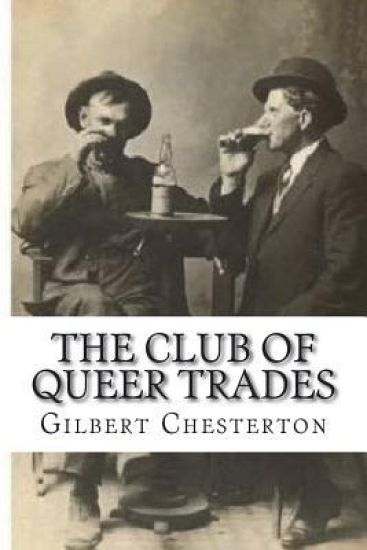
A collection of related short stories by British author G. K. Chesterton. Each story is centered on a person who is making his living by some novel and extraordinary means (a "queer trade"). To gain admittance to the Club, one must have a unique queer trade as principal source of income. "Cherub" Swinburne describes his quest for The Club of Queer Trades with his friend Basil Grant, a retired judge, and Rupert Grant, a private detective who is Basil's younger brother. Each of the stories describes their encounter with one of the trades. In the final story, Rupert Grant rescues a lady from her kidnappers but cannot understand why she refuses to be rescued. The answer leads to the unveiling of the mystery of The Club of Queer Trades. First published by Harper & Brothers, London, 1905.
The Wild Knight and Other Poems
G. K. Chesterton
Createspace Independent Publishing Platform
2018
nidottu
Gilbert Keith Chesterton, KC (29 May 1874 - 14 June 1936), was an English writer, poet, philosopher, dramatist, journalist, orator, lay theologian, biographer, and literary and art critic. Chesterton is often referred to as the "prince of paradox". Time magazine has observed of his writing style: "Whenever possible Chesterton made his points with popular sayings, proverbs, allegories-first carefully turning them inside out." Chesterton is well known for his fictional priest-detective Father Brown, and for his reasoned apologetics. Even some of those who disagree with him have recognised the wide appeal of such works as Orthodoxy and The Everlasting Man.