Kirjojen hintavertailu – 12 859 824 kirjaa ja 27 kauppaa

Kirjailija

G. K. Chesterton

Kirjat ja teokset yhdessä paikassa: 2 054 kirjaa, julkaisuja vuosilta 1900–2026, suosituimpiin kuuluu A Miscellany of Poems by G. K. Chesterton. Vertaile teosten hintoja ja tarkista saatavuus suomalaisista kirjakaupoista.

Nimi esiintyy myös muodoissa: G K Chesterton, G.K. Chesterton, G.K Chesterton, G. K Chesterton

2 054 kirjaa

Kirjojen julkaisuvuodet: 1900–2026.

Eugenics and Other Evils: Special Edition

Eugenics and Other Evils: Special Edition

G. K. Chesterton

Createspace Independent Publishing Platform
2018
nidottu
G. K. Chesterton was an early critic of the philosophy of eugenics, expressing this opinion in his book, Eugenics and Other Evils. Its advocates regarded eugenics as a social philosophy for the improvement of human hereditary traits through various forms of intervention. Today it is widely regarded as a brutal movement which inflicted massive human rights violations on millions of people. HIs criticism of Eugenics expands into a more general criticism of a modern craze for scientific officialism and strict social organization. Chesterton's writings consistently displayed wit and a sense of humour. He employed paradox, while making serious comments on the world, government, politics, economics, philosophy, theology and many other topics. We are delighted to publish this classic book as part of our extensive Classic Library collection. Many of the books in our collection have been out of print for decades, and therefore have not been accessible to the general public. The aim of our publishing program is to facilitate rapid access to this vast reservoir of literature, and our view is that this is a significant literary work, which deserves to be brought back into print after many decades. The contents of the vast majority of titles in the Classic Library have been scanned from the original works. To ensure a high quality product, each title has been meticulously hand curated by our staff. Our philosophy has been guided by a desire to provide the reader with a book that is as close as possible to ownership of the original work. We hope that you will enjoy this wonderful classic work, and that for you it becomes an enriching experience

The Innocence of Father Brown

The Innocence of Father Brown

G. K. Chesterton

Createspace Independent Publishing Platform
2018
nidottu
In his day, Flambeau was a legend of the underworld. Even now, his old confederates remember with pride the Tyrolean Dairy scheme, in which he built a thriving milk business despite owning not a single cow. But today the master thief finally meets his match. Attempting to steal a priceless cross, Flambeau runs afoul of Father Brown, an ordinary-looking priest with amazing insight into the criminal mind. With grace, logic, and good humor, the stout little clergyman soon reforms one of England's most notorious villains. In thrilling tales such as "The Blue Cross," "The Secret Garden," and "The Hammer of God," G. K. Chesterton's immortal priest-detective applies his extraordinary intuition to the most intricate of mysteries. No corner of the human soul is too dark for Father Brown, no villain too ingenious. The Innocence of Father Brown is a testament to the power of faith and the pleasure of a story well told.
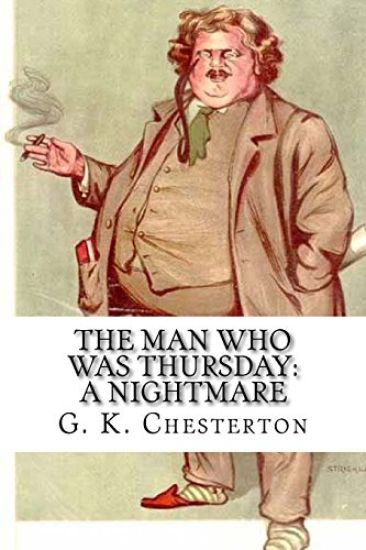
The Man Who Was Thursday: A Nightmare

The Man Who Was Thursday: A Nightmare

G. K. Chesterton

Createspace Independent Publishing Platform
2018
nidottu
Perhaps best known to the general public as creator of the "Father Brown" detective stories, G. K. Chesterton (1874-1936) was especially renowned for his wit, rhetorical brilliance and talent for ingenious and revealing paradox. Those qualities are richly brilliant in the present volume, a hilarious, fast-paced tale about a club of anarchists in turn-of-the-century London. The story begins when Gabriel Syme, a poet and member of a special group of philosophical policemen, attends a secret meeting of anarchists, whose leaders are named for the days of the week, and all of whom are sworn to destroy the world. Their chief is the mysterious Sunday - huge, boisterous, full of vitality, a wild personage who may be a Chestertonian vision of God or nature or both. When Syme, actually an undercover detective, is unexpectedly elected to fill a vacancy on the anarchists' Central Council, the plot takes the first of many surprising twists and turns.
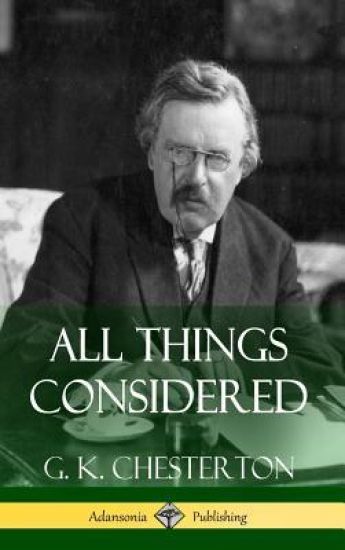
All Things Considered (Hardcover)

All Things Considered (Hardcover)

G K Chesterton

Lulu.com
2018
sidottu
This complete edition of All Things Considered by G. K. Chesterton sees the author show off his critical wit and poise with considerable aplomb. The topics herein range between discussions on human nature and behaviour, to the contemporary affairs which enveloped Edwardian Britain, and even to the practice of chasing one's hat. Ponderings on a scientific theme, together with discussions on Chesterton's favourite topic of religion. In all, these torrents and barbs offer the reader both entertainment and pause for thought. All Things Considered is a collection of highlights from various magazines Chesterton wrote in during the early 20th century. The skillful display of paradox in his pointed arguments for faith make for provocative reading. Characterized by the author's easily digestible and plainly written style, the works of G. K. Chesterton have generally aged well in the modern day, being both literate and straightforward in style.
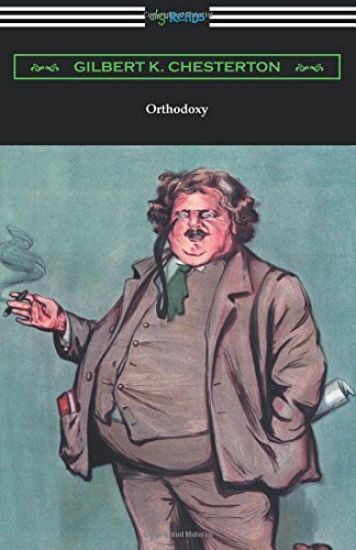
Orthodoxy

Orthodoxy

G K Chesterton

Digireads.com
2018
pokkari
A classic of Christian apologetics, the branch of Christian theology which seeks to offer reasoned defenses for Christianity against its objectors, G. K. Chesterton's "Orthodoxy" is one of the author's most enduring works. A self-described pagan and agnostic in his youth, Chesterton describes in this work how he came to believe in the importance of his own personal belief in Christianity. As he describes in his preface to the book, "It is the purpose of the writer to attempt an explanation, not of whether the Christian Faith can be believed, but of how he personally has come to believe it. The book is therefore arranged upon the positive principle of a riddle and its answer. It deals first with all the writer's own solitary and sincere speculations and then with all the startling style in which they were all suddenly satisfied by the Christian Theology." Meant as a companion to Chesterton's "Heretics" upon its first publication in 1908, this book makes the compelling argument that one needs faith to live happily in society. This edition is printed on premium acid-free paper.
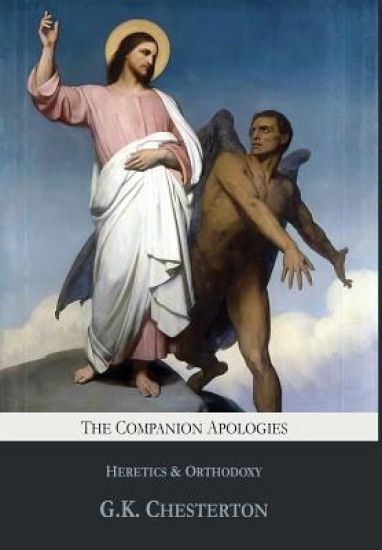
The Companion Apologies

The Companion Apologies

G K Chesterton

Mockingbird Press
2018
sidottu
Hardcover volume containing G. K. Chesterton's great companion apologies Heretics & Orthodoxy. Gilbert Keith Chesterton has become synonymous with modern Christian apologetics. But his impact goes beyond just those interested in a defense of Christian thought. His writings have influenced such diverse authors as C. S. Lewis, Marshall McLuhan, and Jorge Luis Borges, and remains a subtle and unseen presence in contemporary Catholic thought. At his funeral, Ronald Knox said "All of this generation has grown up under Chesterton's influence so completely that we do not even know when we are thinking Chesterton." Before his conversion from atheism to knowing God, C. S. Lewis, the author of Mere Christianity & The Great Divorce, said "in reading Chesterton, as in reading MacDonald, I did not know what I was letting myself in for. A young man who wishes to remain a sound atheist cannot be too careful of his reading. There are traps everywhere --"Chesterton wrote in a time when materialism and new forms of political theory were soon to cause havoc in the western world. His was a voice calling for restraint - pointing back to the fundamentals of Christian doctrine, the purpose and value of which was being lost in the noise and commotion of the post industrial age. Describing the rush towards less familiar and attractive ideologies, Chesterton wrote: "In the matter of reforming things, as distinct from deforming them, there is one plain and simple principle; a principle which will probably be called a paradox. There exists in such a case a certain institution or law; let us say, for the sake of simplicity, a fence or gate erected across a road. The more modern type of reformer goes gaily up to it and says, 'I don't see the use of this; let us clear it away.' To which the more intelligent type of reformer will do well to answer: 'If you don't see the use of it, I certainly won't let you clear it away. Go away and think. Then, when you can come back and tell me that you do see the use of it, I may allow you to destroy it.'"Chesterton was a man who continually showed us the use of orthodoxy in Christianity - most of all in his great companion apologies: Heretics & Orthodoxy. In Heretics, he first points to the flaws in the beliefs of the moderns. In Orthodoxy, he defends the values handed down through millennium of Christian dogma. Chesterton was a great debater, often trading blows with modern thinkers such as George Bernard Shaw, H. G. Wells, Bertrand Russell and Clarence Darrow. He became known as the "prince of paradox," He was also a prolific writer, producing biographies on St. Augustine and St. Francis, and touched on many of the varieties of religion in his writings. He wrote fiction as well, authoring the famous Father Brown books and the Man Who Was Thursday. Chesterton was certainly not the imitation of Christ in his personal life. A large man fond of food and drink, he was almost childlike in wonder of the magic of the world, while expressing the wit of an ancient. He gave no secret doctrine or systematic theology, but his "goodness" and basic "common sense" led many to the Church. One commenter stated: first you read C. S. Lewis, then Chesterton, then you become Catholic. Despite his less than temperate life, he is now under investigation by the Church for Beatification: such was his impact.
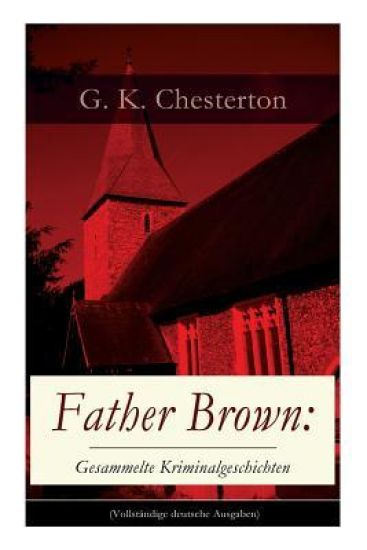
Father Brown

Father Brown

G K Chesterton

E-Artnow
2018
pokkari
Father Brown ist ein Geistlicher, der mit psychologischem Einf hlungsverm gen und durch logische Schl sse auch die scheinbar mysteri sesten Kriminalf lle l st. Im Gegensatz zu anderen bekannten Romanhelden wie Sherlock Holmes und Agatha Christies Hercule Poirot steht bei Brown nicht so sehr die u ere Logik des Tatherganges, sondern die innere Logik und Motivation des T ters im Vordergrund. Brown ist ein englischer katholischer Pfarrer, der als Hobby Kriminalf lle l st. Dies gelingt ihm, indem er sich in den T ter hineinversetzt, dabei das Verbrechen selbst begeht, wie er sagt. Dabei ist er aber weniger daran interessiert, Verbrecher der irdischen Gerechtigkeit auszuliefern, sondern er will sie zu Gott f hren; eine freiwillige Beichte des T ters gen gt ihm. Dabei spielt es f r ihn keine Rolle, welches Amt diese Person bekleidet. Inhalt: - Das blaue Kreuz - Das Hundeorakel - Der geheime Garten - Israel Gows Ehre - Der Unsichtbare - Mi gestaltet - Die verd chtigen Tritte - Die Sternschnuppen - Die S nden des Prinzen Saradin - Der Hammer Gottes - Das Zeichen des zerbrochenen Schwertes - Die drei Todeswerkzeuge - Ein Pfeil vom Himmel - Der gefl gelte Dolch - Das Verh ngnis der Darnaways - Das Wunder in der Mondstra e - Das goldene Kreuz - Gilbert Keith Chesterton (1874-1936) war ein englischer Schriftsteller und Journalist. In seinen Romanen, Essays und Kriminalgeschichten setzte sich Chesterton intensiv mit modernen Philosophien und Denkrichtungen auseinander.
Der Mann, der Donnerstag war (Politthriller)
The Man Who Was Thursday von 1908 (Der Mann, der Donnerstag war) ist eine politische Satire, die der Phantastischen Literatur zugerechnet werden kann: Ein Komplott anarchistischer Terroristen am Anfang des 20. Jahrhunderts entwickelt sich darin, unter zunehmender Verfremdung der Wirklichkeit, in ein verr ckt-g ttliches Spektakel. Wie in anderen seiner Schriften wendet sich Chesterton auch in diesem Roman theologisch-philosophischen Fragen zu. Gilbert Keith Chesterton ( 1874-1936) war ein englischer Schriftsteller und Journalist. In seinen Romanen, Essays und Kurzgeschichten setzte sich Chesterton intensiv mit modernen Philosophien und Denkrichtungen auseinander. Bekannt sind seine oft gewagten Gedankenspr nge und sein Zusammenbringen scheinbar unvereinbarer Ideen, oft mit berraschenden Ergebnissen. Seine typische Argumentationsweise ist plakativ als "geistiger Husarenritt" bezeichnet worden.
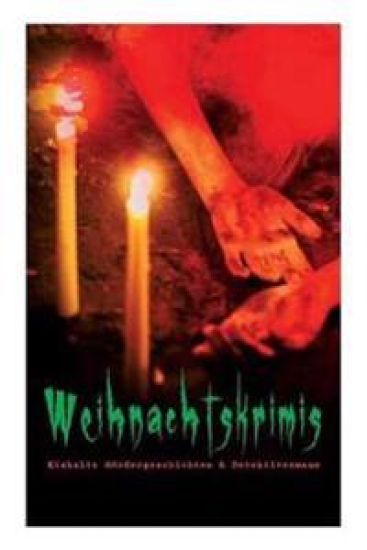
Weihnachtskrimis

Weihnachtskrimis

Arthur Conan Doyle; Edgar Wallace; G K Chesterton

E-Artnow
2018
pokkari
Tannenbaum, heise Schokolade, Schnee drau en und eine spannende Krimi-Sammlung, die Sie in Ihrem warmen Sessel lesen k nnen. Gibt es berhaupt eine bessere Art und Weise, die Feiertage zu verbringen? Inhalt: - Der blaue Karfunkel (Arthur Conan Doyle) - Holmes' erstes Abenteuer (Arthur Conan Doyle) - Das Diamantenklavier (Edgar Wallace) - Neues vom Hexer (Edgar Wallace) - Die Sternschnuppen (G. K. Chesterton) - Der vierte Mann (Sven Elvestad) - Die Lahore-Vase (Walther Kabel) - Markheim (Robert Louis Stevenson)
The Wisdom of Father Brown

The Wisdom of Father Brown

G K Chesterton

Black Curtain Press
2018
sidottu
From London to Cornwall, then to Italy and France, a short, shabby priest runs to earth bandits, traitors, killers. Why is he so successful? The reason is that after years spent in the priesthood, Father Brown knows human nature and is not afraid of its dark side. Thus he understands criminal motivation and how to deal with it. The stories included are "The Paradise of Thieves," "The Duel of Dr. Hirsch," "The Man in the Passage," "The Mistakes of the Machine," "The Head of the Caesar," "The Purple Wig," "The Perishing of the Pendragons," "The God of the Gongs," "The Salad of the Colonel Cray," "The Strange Crime of John Boulnois" and "The Fairy Tale of Father Brown."
The Man Who Knew Too Much

The Man Who Knew Too Much

G K Chesterton

Wilder Publications
2018
sidottu
The book contains eight connected short stories about "The Man Who Knew Too Much," and additional unconnected stories featuring separate heroes/detectives. The United States edition contained one of these additional stories: "The Trees of Pride," while the United Kingdom edition contained "Trees of Pride" and three more, shorter stories: "The Garden of Smoke," "The Five of Swords" and "The Tower of Treason."
Orthodoxy

Orthodoxy

G K Chesterton

Wilder Publications
2018
sidottu
The Christian Classic ORTHODOXY by G. K. Chesterton A self-described agnostic in his youth, Chesterton reveals how he came to believe in the Christianity message. As he describes in his preface to the book: "It is the purpose of the writer to attempt an explanation, not of whether the Christian Faith can be believed, but of how he personally has come to believe it. The book is therefore arranged upon the positive principle of a riddle and its answer. It deals first with all the writer's own solitary and sincere speculations and then with all the startling style in which they were all suddenly satisfied by the Christian Theology." In Orthodoxy, G. K. Chesterton applies his prodigious intellect to dismantle modern thought and expose it for its utter emptiness.
Orthodoxy

Orthodoxy

G K Chesterton

Wilder Publications
2018
sidottu
This book is meant to be a companion to "Heretics," and to put the positive side in addition to the negative. Many critics complained of the book called "Heretics" because it merely criticised current philosophies without offering any alternative philosophy. This book is an attempt to answer the challenge. It is unavoidably affirmative and therefore unavoidably autobiographical. The writer has been driven back upon somewhat the same difficulty as that which beset Newman in writing his Apologia; he has been forced to be egotistical only in order to be sincere. While everything else may be different the motive in both cases is the same. It is the purpose of the writer to attempt an explanation, not of whether the Christian Faith can be believed, but of how he personally has come to believe it. The book is therefore arranged upon the positive principle of a riddle and its answer. It deals first with all the writer's own solitary and sincere speculations and then with all the startling style in which they were all suddenly satisfied by the Christian Theology. The writer regards it as amounting to a convincing creed. But if it is not that it is at least a repeated and surprising coincidence. We are delighted to publish this classic book as part of our extensive Classic Library collection. Many of the books in our collection have been out of print for decades, and therefore have not been accessible to the general public. The aim of our publishing program is to facilitate rapid access to this vast reservoir of literature, and our view is that this is a significant literary work, which deserves to be brought back into print after many decades. The contents of the vast majority of titles in the Classic Library have been scanned from the original works. To ensure a high quality product, each title has been meticulously hand curated by our staff. Our philosophy has been guided by a desire to provide the reader with a book that is as close as possible to ownership of the original work. We hope that you will enjoy this wonderful classic work, and that for you it becomes an enriching experience
The Companion Apologies: Heretics & Orthodoxy

The Companion Apologies: Heretics & Orthodoxy

G. K. Chesterton

Mockingbird Press
2018
nidottu
Paperback volume containing G. K. Chesterton's great companion apologies Heretics & Orthodoxy. Gilbert Keith Chesterton has become synonymous with modern Christian apologetics. But his impact goes beyond just those interested in a defense of Christian thought. His writings have influenced such diverse authors as C. S. Lewis, Marshall McLuhan, and Jorge Luis Borges, and remains a subtle and unseen presence in contemporary Catholic thought. At his funeral, Ronald Knox said "All of this generation has grown up under Chesterton's influence so completely that we do not even know when we are thinking Chesterton." Before his conversion from atheism to knowing God, C. S. Lewis, the author of Mere Christianity & The Great Divorce, said "in reading Chesterton, as in reading MacDonald, I did not know what I was letting myself in for. A young man who wishes to remain a sound atheist cannot be too careful of his reading. There are traps everywhere -" Chesterton wrote in a time when materialism and new forms of political theory were soon to cause havoc in the western world. His was a voice calling for restraint - pointing back to the fundamentals of Christian doctrine, the purpose and value of which was being lost in the noise and commotion of the post industrial age. Describing the rush towards less familiar and attractive ideologies, Chesterton wrote: "In the matter of reforming things, as distinct from deforming them, there is one plain and simple principle; a principle which will probably be called a paradox. There exists in such a case a certain institution or law; let us say, for the sake of simplicity, a fence or gate erected across a road. The more modern type of reformer goes gaily up to it and says, 'I don't see the use of this; let us clear it away.' To which the more intelligent type of reformer will do well to answer: 'If you don't see the use of it, I certainly won't let you clear it away. Go away and think. Then, when you can come back and tell me that you do see the use of it, I may allow you to destroy it.'" Chesterton was a man who continually showed us the use of orthodoxy in Christianity - most of all in his three great apologies: Heretics, Orthodoxy & The Everlasting Man. In Heretics, he first points to the flaws in the beliefs of the moderns. In Orthodoxy, he defends the values handed down through millennium of Christian dogma. In The Everlasting Man, he tells the grand story of Christianity itself and the often ignored miracle of its appearance in the life of man. Chesterton was a great debater, often trading blows with modern thinkers such as George Bernard Shaw, H. G. Wells, Bertrand Russell and Clarence Darrow. He became known as the "prince of paradox," He was also a prolific writer, producing biographies on St. Augustine and St. Francis, and touched on many of the varieties of religion in his writings. He wrote fiction as well, authoring the famous Father Brown books and the Man Who Was Thursday. Chesterton was certainly not the imitation of Christ in his personal life. A large man fond of food and drink, he was almost childlike in wonder of the magic of the world, while expressing the wit of an ancient. He gave no secret doctrine or systematic theology, but his "goodness" and basic "common sense" led many to the Church. One commenter stated: first you read C. S. Lewis, then Chesterton, then you become Catholic. Despite his less than temperate life, he is now under investigation by the Church for Beatification: such was his impact.
The Man Who Was Thursday: A Nightmare

The Man Who Was Thursday: A Nightmare

G. K. Chesterton

Createspace Independent Publishing Platform
2018
nidottu
It is very difficult to classify THE MAN WHO WAS THURSDAY. It is possible to say that it is a gripping adventure story of murderous criminals and brilliant policemen; but it was to be expected that the author of the Father Brown stories should tell a detective story like no-one else. On this level, therefore, THE MAN WHO WAS THURSDAY succeeds superbly; if nothing else, it is a magnificent tour-de-force of suspense-writing. However, the reader will soon discover that it is much more than that. Carried along on the boisterous rush of the narrative by Chesterton's wonderful high-spirited style, he will soon see that he is being carried into much deeper waters than he had planned on; and the totally unforeseeable denouement will prove for the modern reader, as it has for thousands of others since 1908 when the book was first published, an inevitable and moving experience, as the investigators finally discover who Sunday is.
Saint Francis of Assisi: Large Print Edition

Saint Francis of Assisi: Large Print Edition

G. K. Chesterton

Createspace Independent Publishing Platform
2018
nidottu
Excerpt: FRANCIS THE BUILDER We have now reached the great break in the life of Francis of Assisi; the point at which something happened to him that must remain greatly dark to most of us, who are ordinary and selfish men whom God has not broken to make anew. In dealing with this difficult passage, especially for my own purpose of making things moderately easy for the more secular sympathiser, I have hesitated as to the more proper course; and have eventually decided to state first of all what happened, with little more of a hint of what I imagine to have been the meaning of what happened. The fuller meaning may be debated more easily afterwards, when it was unfolded in the full Franciscan life. Anyway, what happened was this. The story very largely revolves around the ruins of the Church of St. Damien, an old shrine in Assisi which was apparently neglected and falling to pieces. Here Francis was in the habit of praying before the crucifix during those dark and aimless days of transition which followed the tragic collapse of all his military ambitions, probably made bitter by some loss of social prestige terrible to his sensitive spirit. As he did so he heard a voice saying to him, "Francis, seest thou not that my house is in ruins? Go and restore it for me." Francis sprang up and went. To go and do something was one of the driving demands of his nature; probably he had gone and done it before he had at all thoroughly thought out what he had done. In any case what he had done was something very decisive and immediately very disastrous for his singular social career. In the coarse conventional language of the uncomprehending world, he stole. From his own enthusiastic point of view, he extended to his venerable father Peter Bernadone the exquisite excitement and inestimable privilege of assisting, more or less unconsciously, in the rebuilding of St. Damiens Church. In point of fact what he did first was to sell his own horse and then go off and sell several bales of his father's cloth, making the sign of the cross over them to indicate their pious and charitable destination. Peter Bernadone did not see things in this light. Peter Bernadone indeed had not very much light to see by, so far as understanding the genius and temperament of his extraordinary son was concerned. Instead of understanding in what sort of a wind and flame of abstract appetites the lad was living, instead of simply telling him (as the priest practically did later) that he done an indefensible thing with the best intentions, old Bernadone took up the matter in the hardest style; in a legal and literal fashion. He used absolute political powers like a heathen father, and himself put his son under lock and key as a vulgar thief. It would appear that the cry was caught up among many with whom the unlucky Francis had once been popular; and altogether, in his efforts to build up the house of God he had only succeeded in bringing his own house about his ears and lying buried under the ruins. The quarrel dragged drearily through several stages; at one time the wretched young man seems to have disappeared underground, so to speak, into some cavern or cellar where he remained huddled hopelessly in the darkness. Anyhow, it was his blackest moment; the whole world had turned over; the whole world was on top of him.