Kirjojen hintavertailu – 12 859 819 kirjaa ja 27 kauppaa

Kirjailija

Jean-Paul Sartre

Kirjat ja teokset yhdessä paikassa: 225 kirjaa, julkaisuja vuosilta 1952–2026, suosituimpiin kuuluu Réussir son Bac de français 2025 : Analyse de la pièce Les Mains sales de Jean-Paul Sartre. Vertaile teosten hintoja ja tarkista saatavuus suomalaisista kirjakaupoista.

Nimi esiintyy myös muodoissa: Jean Paul Sartre, Jean–paul Sartre

225 kirjaa

Kirjojen julkaisuvuodet: 1952–2026.

Sketch for a Theory of the Emotions

Sketch for a Theory of the Emotions

Jean-Paul Sartre

Routledge
2013
nidottu
Philosopher, novelist, dramatist and existentialist Jean-Paul Sartre is one of the greatest writers of all time. He was fascinated by the role played by the emotions in human life and placed them at the heart of his philosophy. This brilliant short work - which contains some of the principal ideas later to appear in his masterpiece Being and Nothingness - is Sartre at his best: insightful, engaging and controversial. Far from constraining one's freedom, as we often think, Sartre argues that emotions are fundamental to it and that an emotion is nothing less than 'a transformation of the world'. With a new foreword by Sebastian Gardner.
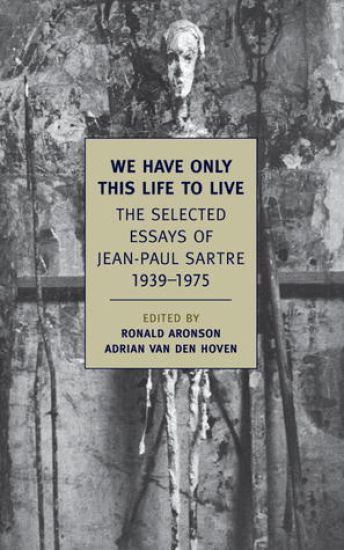
We Have Only This Life To Live

We Have Only This Life To Live

Jean-Paul Sartre

NYRB Classics
2013
nidottu
Jean-Paul Sartre was a man of staggering gifts, whose accomplishments as philosopher, novelist, playwright, biographer, and activist still command attention and inspire debate. Sartre's restless intelligence may have found its most characteristic outlet in the open-ended form of the essay. For Sartre the essay was an essentially dramatic form, the record of an encounter, the framing of a choice. Whether writing about literature, art, politics, or his own life, he seizes our attention and drives us to grapple with the living issues that are at stake. We Have Only This Life to Live is the first gathering of Sartre's essays in English to draw on all ten volumes of Situations, the title under which Sartre collected his essays during his life, while also featuring previously uncollected work, including the reports Sartre filed during his 1945 trip to America. Here Sartre writes about Faulkner, Bataille, Giacometti, Fanon, the liberation of France, torture in Algeria, existentialism and Marxism, friends lost and found, and much else. We Have Only This Life to Live provides an indispensable, panoramic view of the world of Jean-Paul Sartre.
The Freud Scenario

The Freud Scenario

Jean-Paul Sartre

Verso Books
2013
nidottu
In 1958, the US director John Huston asked Jean-Paul Sartre to write a scenario for a film about Sigmund Freud. Huston wanted Sartre to concentrate on the conflict-ridden period of Freud's life when he abandoned hypnosis and invented psychoanalysis. The Freud Scenario, discovered in Sartre's papers after his death, is the result-a deft portrait of a man engaged in a personal and intellectual struggle that would prove a turning point in twentieth-century thought. Sartre did not regard this script as a diversion from his larger intellectual project. Freud's preoccupations with female hysteria and the father relationship touched on major themes in his own work, and Loser Wins, The Family Idiot and Words, some of Sartre's most celebrated publications, are all in some way derived from his work for Huston. Written for a Hollywood audience, The Freud Scenario demonstrates that, in addition to a towering intellect, Sartre enjoyed a genuine popular touch. Already widely acclaimed in France, The Freud Scenario stands as a valuable testament to two of the most influential minds in modern history.
Nausea

Nausea

Jean-Paul Sartre; Lloyd (TRN) Alexander; Richard (FRW) Howard

New Directions Publishing Corporation
2013
pokkari

Halvin toimitettuna 18,60 €

Nausea is the story of Antoine Roquentin, a French writer who is horrified at his own existence. In impressionistic, diary form he ruthlessly catalogs his every feeling and sensation. His thoughts culminate in a pervasive, overpowering feeling of nausea which spreads at the bottom of the viscous puddle, at the bottom of our time the time of purple suspenders and broken chair seats; it is made of wide, soft instants, spreading at the edge, like an oil stain. Winner of the 1964 Nobel Prize in Literature (though he declined to accept it), Jean-Paul Sartre, philosopher, critic, novelist, and dramatist, holds a position of singular eminence in the world of French letters. La Naus e, his first and best novel, is a landmark in Existential fiction and a key work of the twentieth century.
The Imagination

The Imagination

Jean-Paul Sartre

Routledge
2012
nidottu
‘No matter how long I may look at an image, I shall never find anything in it but what I put there. It is in this fact that we find the distinction between an image and a perception.' - Jean-Paul SartreL’Imagination was published in 1936 when Jean-Paul Sartre was thirty years old. Long out of print, this is the first English translation in many years. The Imagination is Sartre’s first full philosophical work, presenting some of the basic arguments concerning phenomenology, consciousness and intentionality that were to later appear in his master works and be so influential in the course of twentieth-century philosophy. Sartre begins by criticising philosophical theories of the imagination, particularly those of Descartes, Leibniz and Hume, before establishing his central thesis. Imagination does not involve the perception of ‘mental images’ in any literal sense, Sartre argues, yet reveals some of the fundamental capacities of consciousness. He then reviews psychological theories of the imagination, including a fascinating discussion of the work of Henri Bergson. Sartre argues that the ‘classical conception’ is fundamentally flawed because it begins by conceiving of the imagination as being like perception and then seeks, in vain, to re-establish the difference between the two. Sartre concludes with an important chapter on Husserl’s theory of the imagination which, despite sharing the flaws of earlier approaches, signals a new phenomenological way forward in understanding the imagination. The Imagination is essential reading for anyone interested in the philosophy of Jean-Paul Sartre, phenomenology, and the history of twentieth-century philosophy. This new translation includes a helpful historical and philosophical introduction by Kenneth Williford and David Rudrauf. Also included is Maurice Merleau-Ponty’s important review of L’Imagination upon its publication in French in 1936. Translated by Kenneth Williford and David Rudrauf.
The Imagination

The Imagination

Jean-Paul Sartre

Routledge
2012
sidottu
‘No matter how long I may look at an image, I shall never find anything in it but what I put there. It is in this fact that we find the distinction between an image and a perception.' - Jean-Paul SartreL’Imagination was published in 1936 when Jean-Paul Sartre was thirty years old. Long out of print, this is the first English translation in many years. The Imagination is Sartre’s first full philosophical work, presenting some of the basic arguments concerning phenomenology, consciousness and intentionality that were to later appear in his master works and be so influential in the course of twentieth-century philosophy. Sartre begins by criticising philosophical theories of the imagination, particularly those of Descartes, Leibniz and Hume, before establishing his central thesis. Imagination does not involve the perception of ‘mental images’ in any literal sense, Sartre argues, yet reveals some of the fundamental capacities of consciousness. He then reviews psychological theories of the imagination, including a fascinating discussion of the work of Henri Bergson. Sartre argues that the ‘classical conception’ is fundamentally flawed because it begins by conceiving of the imagination as being like perception and then seeks, in vain, to re-establish the difference between the two. Sartre concludes with an important chapter on Husserl’s theory of the imagination which, despite sharing the flaws of earlier approaches, signals a new phenomenological way forward in understanding the imagination. The Imagination is essential reading for anyone interested in the philosophy of Jean-Paul Sartre, phenomenology, and the history of twentieth-century philosophy. This new translation includes a helpful historical and philosophical introduction by Kenneth Williford and David Rudrauf. Also included is Maurice Merleau-Ponty’s important review of L’Imagination upon its publication in French in 1936. Translated by Kenneth Williford and David Rudrauf.
Äcklet

Äcklet

Jean-Paul Sartre

Bonnier Pocket
2012
pokkari
Efter ett kringflackande liv har Antoine Roquentin slagit sig ned i en liten fransk hamnstad. För att fördriva tiden sysslar han med att fullborda ett historiskt arbete, men det inger honom ingen tillfredsställelse. Historien är död för honom, även hans eget förflutna, och han är oförmögen att upprätta kontakt med det närvarande. Lösryckt ur alla sammanhang grips han av ett oemotståndligt äcket inför sitt eget kroppsliga jag, inför själva existensen av människor och ting. Äcklet är en bok utan nåd, en av de stora tolkningarna av den moderna människans främlingsskap. Med etsande inlevelse skildrar Jean-Paul Sartre en livssituation där identitetsförlust och overklighetskänsla blir till en kväljande upplevelse av tillvarons absurditet.
War Diaries

War Diaries

Jean-Paul Sartre

Verso Books
2012
nidottu
During the phony war that preceded the invasion of France, between late 1939 and the summer of 1940, the young Jean-Paul Sartre was stationed in his native Alsace as part of a meteorological unit. He used his considerable periods of spare time, between mundane duties like watching weather balloons, to make a series of notes on philosophy, literature, politics, history and autobiography that anticipate the themes of his later masterpieces, and often surpass them in literary verve and directness. These War Diaries form a portrait of Sartre in his most intense and brilliant phase. With them the twentieth century's most remarkable and public philosopher has provided us with a fitting posthumous monument to his honest and creativity.
The Conspiracy

The Conspiracy

Jean-Paul Sartre; Paul Nizan

Verso Books
2012
nidottu
The Conspiracy is the last and most acclaimed novel by French writer and activist Paul Nizan, who died two years after its publication fighting the Germans at the Battle of Dunkirk. Hailed by Jean-Paul Sartre as Nizan's masterpiece, the book centers upon the figure of Bertrand Rosenthal, a misguided philosophy student studying in pre-war Paris. Eager to foment a revolution and having little grasp of his own motives, Rosenthal draws a small group of disciples into a conspiracy both fatuous and deadly. Simultaneously, he plunges into a forbidden-and ultimately tragic-love affair as the intertwined plots move inexorably toward their twin destinations of betrayal and death. The Conspiracy won the coveted Prix Interallié in 1938. This new edition includes Walter Benjamin's critique of the book, available here for the first time in English.
The Transcendence of the Ego

The Transcendence of the Ego

Jean-Paul Sartre

Routledge
2011
nidottu
‘I should like to show here that the Ego is neither formally or materially in consciousness: it is outside, in the world.’ Jean-Paul Sartre The Transcendence of the Ego is one of Jean-Paul Sartre's earliest philosophical publications and essential for understanding the trajectory of his work as a whole. When it first appeared in France in 1937 Sartre was still largely unknown, working as a school teacher in a provincial French town. Attacking prevailing philosophical theories head on, Sartre offers a brilliant and radical account of the self as a product of consciousness, situated in the world. He introduces many of the themes central to his major work, Being and Nothingness: the nature of consciousness, the problem of self-knowledge, other minds, and anguish. This translation includes a thorough and illuminating introduction by Sarah Richmond, placing Sartre's essay in its philosophical and historical context. Jean-Paul Sartre (1905-1980). The foremost French thinker and writer of the early post-war years. His books, which include Being and Nothingness, Nausea, The Age of Reason and No Exit have exerted enormous influence in philosophy, literature, politics and drama.
The Imaginary

The Imaginary

Jean-Paul Sartre

Routledge
2010
nidottu
A cornerstone of Sartre’s philosophy, The Imaginary was first published in 1940. Sartre had become acquainted with the philosophy of Edmund Husserl in Berlin and was fascinated by his idea of the 'intentionality of consciousness' as a key to the puzzle of existence. Against this background, The Imaginary crystallized Sartre's worldview and artistic vision. The book is an extended examination of the concepts of nothingness and freedom, both of which are derived from the ability of consciousness to imagine objects both as they are and as they are not – ideas that would drive Sartre's existentialism and entire theory of human freedom.
The Last Chance

The Last Chance

Jean-Paul Sartre

Continuum International Publishing Group Ltd.
2009
sidottu
This is the first English translation of Sartre's unfinished fourth volume of "Roads to Freedom", exploring the interrelations of politics, responsibility; friendship and freedom - themes central to Sartrean existentialism. "Last Chance" brings to an English-speaking audience for the first time the unfinished fourth volume of Jean-Paul Sartre's hugely important "Roads to Freedom cycle". "Sartre's Roads to Freedom" is generally read and regarded as a trilogy, made up of "Age of Reason", "The Reprieve" and "Troubled Sleep". In fact, Sartre began a fourth volume and, although he never finished the work, two chapters, "Strange Friendship" and "Last Chance", were published in French by Gallimard after his death. Set in a German prisoner of war camp, these chapters continue the story of Roads to Freedom, exploring the interrelations of politics, responsibility, friendship and freedom - themes central to Sartrean existentialism. The Pleiade edition published by Gallimard included a previously unpublished interview with Sartre, Simone de Beauvoir's account of his plans for the unfinished fourth volume, and an introduction to the unfinished fragments by the editor, Michel Contat. All this material is translated and published here in this, the first English-language edition of a work that makes an enormous contribution to our understanding of Sartre's hugely influential "Roads to Freedom" cycle.
The Last Chance

The Last Chance

Jean-Paul Sartre

Continuum International Publishing Group Ltd.
2009
nidottu
This is the first English translation of Sartre's unfinished fourth volume of "Roads to Freedom", exploring the interrelations of politics, responsibility; friendship and freedom - themes central to Sartrean existentialism. "Last Chance" brings to an English-speaking audience for the first time the unfinished fourth volume of Jean-Paul Sartre's hugely important "Roads to Freedom cycle". "Sartre's Roads to Freedom" is generally read and regarded as a trilogy, made up of "Age of Reason", "The Reprieve" and "Troubled Sleep". In fact, Sartre began a fourth volume and, although he never finished the work, two chapters, "Strange Friendship" and "Last Chance", were published in French by Gallimard after his death. Set in a German prisoner of war camp, these chapters continue the story of Roads to Freedom, exploring the interrelations of politics, responsibility, friendship and freedom - themes central to Sartrean existentialism. The Pleiade edition published by Gallimard included a previously unpublished interview with Sartre, Simone de Beauvoir's account of his plans for the unfinished fourth volume, and an introduction to the unfinished fragments by the editor, Michel Contat. All this material is translated and published here in this, the first English-language edition of a work that makes an enormous contribution to our understanding of Sartre's hugely influential "Roads to Freedom" cycle.
Huis clos. Lektüreschlüssel für Schüler

Huis clos. Lektüreschlüssel für Schüler

Jean-Paul Sartre; Bernd Krauss

Reclam Philipp Jun.
2008
pokkari
Reclams "Fremdsprachen-Lektüreschlüssel" folgen dem bewährten Aufbau- und Darstellungsprinzip der Lektüreschlüssel zur deutschen Literatur. Sie beziehen sich auf den fremdsprachigen Originaltext (wenn möglich in Reclams Roter Reihe), sind aber auf Deutsch verfasst und unterstützen ebenso die Lektüre der deutschen Übersetzung. Eine "Checkliste" enthält Aufgaben zur Verständniskontrolle in der Fremdsprache. Unter dem Darstellungstext stehen Übersetzungshilfen und Schlüsselbegriffe in der Fremdsprache, um die Bearbeitung dieser Aufgaben und ein fremdsprachiges Referieren über das Werk zu erleichtern. Lektüreschlüssel für Schüler erschließen einzelne literarische Werke. Um eine Interpretation als Zentrum gruppieren sich 10 wichtige Verständniszugänge: Erstinformation zum Werk - Inhaltsangabe - Personen (Konstellationen) - Werk-Aufbau (Strukturskizze) - Wortkommentar - Interpretation - Autor und Zeit - Rezeption - "Checkliste" zur Verständniskontrolle - Lektüretipps mit Filmempfehlungen - Raum für Notizen
The Aftermath of War

The Aftermath of War

Jean–paul Sartre; Chris Turner

Seagull Books London Ltd
2008
sidottu
"The Aftermath of War" brings together essays written in Sartre's most creative period, just after World War II. Sartre's extraordinary range of engagement is manifest, with writings on post-war America, the social impact of war in Europe, contemporary philosophy, race, and avant garde art. Carefully structured into sections, the essays range across Sartre's reflections on collaboration, resistance and liberation in post-war Europe, his thoughts and observations after his extended trip to the USA in 1945, an examination of the failings of philosophical materialism, his analysis of the new revolutionary poetry of 'negritude', and his meditations on the visual arts, with essays on the work of Giacometti and Calder, both of whom Sartre knew well.