Kirjojen hintavertailu – 12 859 818 kirjaa ja 27 kauppaa

Kirjailija

Jean-Paul Sartre

Kirjat ja teokset yhdessä paikassa: 225 kirjaa, julkaisuja vuosilta 1952–2026, suosituimpiin kuuluu Réussir son Bac de français 2025 : Analyse de la pièce Les Mains sales de Jean-Paul Sartre. Vertaile teosten hintoja ja tarkista saatavuus suomalaisista kirjakaupoista.

Nimi esiintyy myös muodoissa: Jean Paul Sartre, Jean–paul Sartre

225 kirjaa

Kirjojen julkaisuvuodet: 1952–2026.

Between Existentialism and Marxism

Between Existentialism and Marxism

Jean-Paul Sartre

Verso Books
2008
nidottu

Halvin toimitettuna 28,50 €

This book presents a full decade of Sartre's work, from the publication of the Critique of Dialectical Reason in 1960, the basic philosophical turning-point in his postwar development, to the inception of his major study on Flaubert, the first volumes of which appeared in 1971. The essays and interviews collected here form a vivid panorama of the range and unity of Sartre's interests, since his deliberate attempt to wed his original existentialism to a rethought Marxism. A long and brilliant autobiographical interview, given to New Left Review in 1969, constitutes the best single overview of Sartre's whole intellectual evolution. Three analytic texts on the US war in Vietnam, the Soviet invasion of Czechoslovakia, and the lessons of the May Revolt in France, define his political positions as a revolutionary socialist. Questions of philosophy and aesthetics are explored in essays on Kierkegaard, Mallarme and Tintoretto. Another section of the collection explores Sartre's critical attitude to orthodox psychoanalysis as a therapy, and is accompanied by rejoinders from colleagues on his journal Les Temps Modernes. The volume concludes with a prolonged reflection on the nature and role of intellectuals and writers in advanced capitalism, and their relationship to the struggles of the exploited and oppressed classes. Between Existentialism and Marxism is an impressive demonstration of the breadth and vitality of Sartre's thought, and its capacity to respond to political and cultural changes in the contemporary world.
Existentialism Is a Humanism

Existentialism Is a Humanism

Jean-Paul Sartre

YALE UNIVERSITY PRESS
2007
nidottu

Halvin toimitettuna 16,80 €

A fresh translation of two seminal works of existentialism "To understand Jean-Paul Sartre is to understand something important about the present time."--Iris Murdoch "Sartre matters because so many fundamental points of his analysis of the human reality are right and true, and because their accuracy and veracity entail real consequences for our lives as individuals and in social groups."--Benedict O'Donohoe, Philosophy Now It was to correct common misconceptions about his thought that Jean-Paul Sartre, the dominant European intellectual of the post-World War II decades, accepted an invitation to speak on October 29, 1945, at the Club Maintenant in Paris. The unstated objective of his lecture ("Existentialism Is a Humanism") was to expound his philosophy as a form of "existentialism," a term much bandied about at the time. Sartre asserted that existentialism was essentially a doctrine for philosophers, though, ironically, he was about to make it accessible to a general audience. The published text of his lecture quickly became one of the bibles of existentialism and made Sartre an international celebrity. The idea of freedom occupies the center of Sartre's doctrine. Man, born into an empty, godless universe, is nothing to begin with. He creates his essence--his self, his being--through the choices he freely makes ("existence precedes essence"). Were it not for the contingency of his death, he would never end. Choosing to be this or that is to affirm the value of what we choose. In choosing, therefore, we commit not only ourselves but all of mankind. This book presents a new English translation of Sartre's 1945 lecture and his analysis of Camus's The Stranger, along with a discussion of these works by acclaimed Sartre biographer Annie Cohen-Solal. This edition is a translation of the 1996 French edition, which includes Arlette Elka m-Sartre's introduction and a Q&A with Sartre about his lecture.
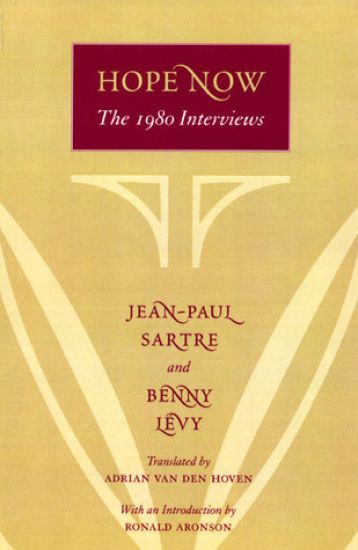
Hope Now

Hope Now

Jean-Paul Sartre; Benny Levy

University of Chicago Press
2007
nidottu
In March of 1980, Le Nouvel Observateur published the final interviews between the philosopher Jean-Paul Sartre, then blind and debilitated, and his young assistant, Benny Levy. Readers immediately denounced the interviews as distorted and fraudulent for portraying a Sartre who had abandoned his leftist convictions, rejected his most intimate friends, and cast aside his fundamental beliefs in favor of a messianic Judaism. Sartre's supporters argued that it was his orthodox interlocutor, Levy, who had twisted the words of the ailing philosopher. Yet, shortly before his death, Sartre confirmed the authenticity of the interviews and their puzzling content. Here, presented in translation, the interviews are framed by two provocative essays by Benny Levy, accompanied by a comprehensive introduction from noted Sartre authority Ronald Aronson, which places the interviews in biographical and philosophical perspective to demonstrate how they confirm and contribute to Sartre's overall philosophy. This absorbing volume at last contextualizes and elucidates the final thoughts of a brilliant and influential mind.
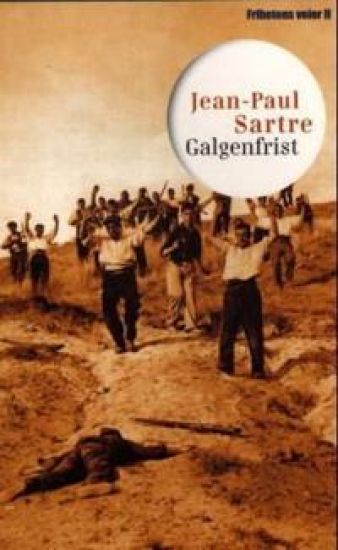
Galgenfrist

Galgenfrist

Jean-Paul Sartre

Pax
2007
pokkari
Romanen følger opp Skjels år og alder og er annet bind i Sartres filosofiske romanverk Frihetens veier. Vi er her kommet til året 1938, og historien om den intellektuelle pariseren Mathieu Delarue fortsetter. Romanen tar for seg den kaotiske tida før krigsutbruddet, med Munchen-forliket og ofringen av Tsjekkoslovakia. Sartre skildrer hvordan begivenhetene i en bestemt uke dette året oppleves i forskjellige miljøer, og uroen og handlingslammelsen folk opplever.
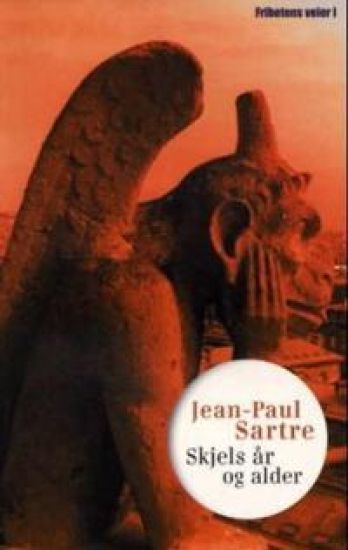
Skjels år og alder

Skjels år og alder

Jean-Paul Sartre

Pax
2007
pokkari
Frihetens veier (1945-49) er en uavsluttet triologi. Med den ønsket Sartre å forklare hvilke forhold som førte til krigen og hvordan de kan forstås filosofisk, psykologisk, politisk og historisk i lys av den senere utvikling. Hovedpersonen i dette første bindet er gymnaslæreren Mathieu Delaure, som lever på sin "øy" i et snevert intellektuelt Paris-miljø, mens verdenspolitikken trenger seg på med borgerkrigen i Spania. Han har på en måte frihet til å handle, men kan ikke. Mot ham står den naivt-optimistiske kommunisten Brunet, som ikke ser konsekvensene av sine valg.
Eksistensialisme er humanisme

Eksistensialisme er humanisme

Jean-Paul Sartre

Cappelen
2007
nidottu
Hva vil det si å eksistere? Hva er frihet? Sartre svarer på disse og flere spørsmål i denne klassikeren fra 1946. En gjennomgang av grunntankene i den moderne eksistensfilosofi. Oversatt av Carl Hambro. Nr. 13 i Cappelens upopulære skrifter.
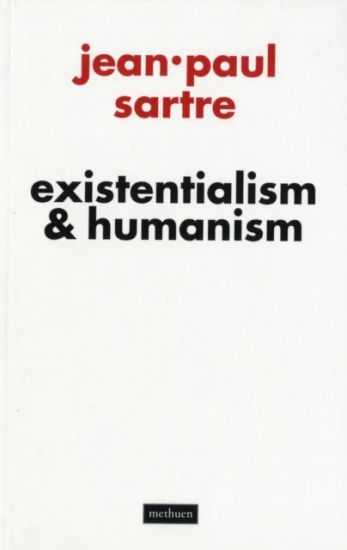
Existentialism and Humanism

Existentialism and Humanism

Jean-Paul Sartre

Methuen Publishing Ltd
2007
nidottu

Halvin toimitettuna 19,40 €

Over the past sixty years the writings of Jean-Paul Sartre have probably been more influential in the West than those of any other philosopher and literary figure. In his theoretical writings, Sartre laid the foundation for an original doctrine of Existentialism. His concern, however, was to relate his theory to human response and the practical demands of living. To achieve this, he carried his philosophical concepts into his novels and plays, and there subjected them to the test of imagined experience. His uniqueness lies in the success with which he demonstrated the utility of Existentialist doctrine while creating, at the same time, works of the highest literary merit. Thus Sartre became the populariser of his own literary thought. Originally delivered as a lecture in Paris in 1945, "Existentialism and Humanism" is Jean-Paul Sartre's seminal defence of Existentialism as a doctrine true to Humanism, as opposed to a purely nihilistic creed, and a plan for its practical application to everyday human life. This exploration of one of the central tenets of his philosophical thought has become the essential introduction to his work, and a fundamental text for all students of philosophy.
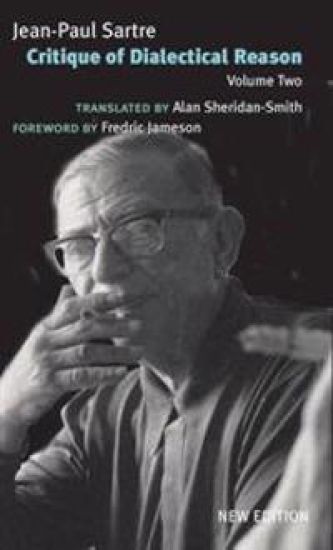
Critique of Dialectical Reason, Vol. 2

Critique of Dialectical Reason, Vol. 2

Jean-Paul Sartre; Fredric Jameson

Verso Books
2006
nidottu

Halvin toimitettuna 31,10 €

Does history produce discernible meaning? Are human struggles intelligible? These questions form the starting-point for the second volume of Sartre's Critique of Dialectical Reason. Drafted in 1958 and published in France in 1985, this magisterial work first appeared in English in 1991 and now reappears with a major new introduction by Fredric Jameson. Volume Two's theoretical framework is a logical extension of the predecessor's. As in Volume One, Sartre proceeds by moving from the simple to the complex: from individual combat (through a perceptive study of boxing) to the struggle of subgroups within an organized group form and, finally, to social struggle, with an extended analysis of the Bolshevik Revolution. The book concludes with a forceful reaffirmation of dialectical reason: of the dialectic as 'that which is truly irreducible in action'.
Colonialism and Neocolonialism

Colonialism and Neocolonialism

Jean-Paul Sartre

Routledge
2006
nidottu
Nearly forty years after its first publication in French, this collection of Sartre’s writings on colonialism remains a supremely powerful, and relevant, polemical work. Over a series of thirteen essays Sartre brings the full force of his remarkable intellect relentlessly to bear on his own country’s conduct in Algeria, and by extension, the West’s conduct in the Third World in general. Whether one agrees with his every conclusion or not, Colonialism and Neo-Colonialism shows a philosopher passionately engaged in using philosophy as a force for change in the world. An important influence on postcolonial thought ever since, this book takes on added resonance in the light of the West’s most recent bout of interference in the non-Western world.
Eksistentialisme er en humanisme

Eksistentialisme er en humanisme

Jean-Paul Sartre

Gyldendal
2005
nidottu
Eksistentialisme er en humanisme foreligger nu i en ny udgave. Skriftet udkom første gang i 1946. Oversat fra fransk efter L'existensialisme et un humanisme af Anders Thuborg med forord af Jacob Dahl Rendtorff. 5. udgave indeholder desuden et efterskrift af Arlette Elkaïm-Sartre.
Conversations with Jean–Paul Sartre

Conversations with Jean–Paul Sartre

Jean–paul Sartre; Ronald Fraser; Perry Anderson; Quintin Hoare

Seagull Books London Ltd
2005
sidottu
Jean-Paul Sartre was undoubtedly one of the greatest and most popular philosophers of the 20th Century. Also a prominent novelist, playwright and biographer, Sartre was, above all, the embodiment of the engaged intellectual, active in a variety of political causes, as well as an individual who attempted to live his life in accordance with the philosophy he professed. It was this that gave his lifelong preoccupation with freedom, choice and what he came to refer to as social conditioning, its cutting edge. Sartre's life was in many ways an illustration of his brand of existentialism in action. In these two interviews, the Marxist historian and scholar Perry Anderson takes Sartre on a wide-ranging tour of his philosophy and politics. The skilful and part chronological interrogation of various fundamental Satrean concepts, and the detailed and complex elucidations of them by the philosopher, make these interviews a must for anyone interested in Sartre's philosophical, political and ethical development. The wide range of topics discussed also includes 'freedom of choice', his uneasy relationship with Freudian concepts, his debates with Marx, and his acute observations on drama, the Cultural Revolution, Stalinism, the May 'Events' and of course, the US war on Vietnam. Their breadth remains a testimony to one man's attempt to make philosophical sense of the tumultuous world around him.
Critique of Dialectical Reason, Vol. 1

Critique of Dialectical Reason, Vol. 1

Jean-Paul Sartre; Fredric Jameson

Verso Books
2004
nidottu

Halvin toimitettuna 37,50 €

At the height of the Algerian war, Jean-Paul Sartre embarked on a fundamental reappraisal of his philosophical and political thought. The result was the Critique of Dialectical Reason, an intellectual masterpiece of the twentieth century, now republished with a major original introduction by Fredric Jameson. In it, Sartre set out the basic categories for the renovated theory of history that he believed was necessary for post-war Marxism. Sartre's formal aim was to establish the dialectical intelligibility of history itself, as what he called 'a totalisation without a totaliser'. But, at the same time, his substantive concern was the structure of class struggle and the fate of mass movements of popular revolt, from the French Revolution at the end of the eighteenth century to the Russian and Chinese revolutions in the twentieth: their ascent, stabilisation, petrification and decline, in a world still overwhelmingly dominated by scarcity.
The Transcendence of the Ego

The Transcendence of the Ego

Jean-Paul Sartre

Routledge
2004
sidottu
First published in France in 1936 as a journal article, The Transcendence of the Ego was one of Jean-Paul Sartre's earliest philosophical publications. When it appeared, Sartre was still largely unknown, working as a school teacher in provincial France and struggling to find a publisher for his most famous fictional work, Nausea. The Transcendence of the Ego is the outcome of Sartre's intense engagement with the philosophy of Edmund Husserl, the founder of phenomenology. Here, as in many subsequent writings, Sartre embraces Husserl's vision of phenomenology as the proper method for philosophy. But he argues that Husserl's conception of the self as an inner entity, 'behind' conscious experience is mistaken and phenomenologically unfounded. The Transcendence of the Ego offers a brilliant diagnosis of where Husserl went wrong, and a radical alternative account of the self as a product of consciousness, situated in the world. This essay introduces many of the themes central to Sartre's major work, Being and Nothingness: the nature of consciousness, the problem of self-knowledge, other minds, anguish. It demonstrates their presence and importance in Sartre's thinking from the very outset of his career. This fresh translation makes this classic work available again to students of Sartre, phenomenology, existentialism, and twentieth century philosophy. It includes a thorough and illuminating introduction by Sarah Richmond, placing Sartre's essay in its philosophical and historical context.
The Transcendence of the Ego

The Transcendence of the Ego

Jean-Paul Sartre

Routledge
2004
nidottu
First published in France in 1936 as a journal article, The Transcendence of the Ego was one of Jean-Paul Sartre's earliest philosophical publications. When it appeared, Sartre was still largely unknown, working as a school teacher in provincial France and struggling to find a publisher for his most famous fictional work, Nausea. The Transcendence of the Ego is the outcome of Sartre's intense engagement with the philosophy of Edmund Husserl, the founder of phenomenology. Here, as in many subsequent writings, Sartre embraces Husserl's vision of phenomenology as the proper method for philosophy. But he argues that Husserl's conception of the self as an inner entity, 'behind' conscious experience is mistaken and phenomenologically unfounded. The Transcendence of the Ego offers a brilliant diagnosis of where Husserl went wrong, and a radical alternative account of the self as a product of consciousness, situated in the world. This essay introduces many of the themes central to Sartre's major work, Being and Nothingness: the nature of consciousness, the problem of self-knowledge, other minds, anguish. It demonstrates their presence and importance in Sartre's thinking from the very outset of his career. This fresh translation makes this classic work available again to students of Sartre, phenomenology, existentialism, and twentieth century philosophy. It includes a thorough and illuminating introduction by Sarah Richmond, placing Sartre's essay in its philosophical and historical context.
The Imaginary

The Imaginary

Jean-Paul Sartre; revised by Arlette Elkaim-Sartre

Routledge
2004
nidottu
First published in 1940, Sartre's The Imaginary is a cornerstone of his philosophy. Sartre had become acquainted with the philosophy of Edmund Husserl in Berlin and was fascinated by his idea of the intentionality of consciousness as a key to the puzzle of existence. Against this background, The Imaginary crystallized Sartre's worldview and artistic vision. Here he presented the first extended examination of the concepts of nothingness and freedom, both of which are derived from the ability of consciousness to imagine objects both as they are and as they are not. These ideas would drive Sartre's existentialism and his entire theory of human freedom, laying the foundation for his masterwork Being and Nothingness three years later. This new translation by Jonathan Webber rectifies flaws in the terminology of the first translation and recaptures the essence of Sartre's phenomenology. Webber's perceptive new introduction helps to decipher this challenging, seminal work, placing it in the context of the author's work and the history of philosophy.
The Imaginary

The Imaginary

Jean-Paul Sartre; revised by Arlette Elkaim-Sartre

Routledge
2004
sidottu
First published in 1940, Sartre's The Imaginary is a cornerstone of his philosophy. Sartre had become acquainted with the philosophy of Edmund Husserl in Berlin and was fascinated by his idea of the intentionality of consciousness as a key to the puzzle of existence. Against this background, The Imaginary crystallized Sartre's worldview and artistic vision. Here he presented the first extended examination of the concepts of nothingness and freedom, both of which are derived from the ability of consciousness to imagine objects both as they are and as they are not. These ideas would drive Sartre's existentialism and his entire theory of human freedom, laying the foundation for his masterwork Being and Nothingness three years later. This new translation by Jonathan Webber rectifies flaws in the terminology of the first translation and recaptures the essence of Sartre's phenomenology. Webber's perceptive new introduction helps to decipher this challenging, seminal work, placing it in the context of the author's work and the history of philosophy.
LA Trancendance De L'EGO

LA Trancendance De L'EGO

Jean-Paul Sartre

Librairie J Vrin
2003
nidottu
La transcendance de l'ego signe a la fois l'entree de Sartre en phenomenologie et la premiere mise en cause de l'idee de sujet au sein des philosophies du Cogito. En montrant que l'Ego se constitue comme illusion necessaire, Sartre libere un champ transcendantal deshumanise, allege du moi et du psychique, polarise par ses entours. C'est pourquoi son article sur l'intentionnalite precede cette reedition critique de la Transcendance: ce texte ne prepare pas L'etre et le neant mais scelle la redefinition sartrienne du moi, du monde et de la conscience, puisee dans une lecture rigoureuse de Husserl, mais aussi dirigee contre lui. Le troisieme texte de ce volume, Conscience de soi et connaissance de soi, une conference devenue presque introuvable ou se resume une bonne part de L'etre et le neant approfondit la visee anti-humaniste de cette theorie inedite du Cogito, qui jette la conscience dans le monde sans jamais les reconcilier.
Les Jeux Sont Faits

Les Jeux Sont Faits

Jean-Paul Sartre

Gallimard
2003
pokkari
Pierre and Eve, soulmates who never met while alive, must come to grips with their deaths and the afterlife, and when they get a second chance and are revived, they have twenty-four hours to fall completely in love with one another.