Kirjailija
John Dewey
Kirjat ja teokset yhdessä paikassa: 491 kirjaa, julkaisuja vuosilta 1931–2026, suosituimpiin kuuluu Demokratia ja kasvatus. Vertaile teosten hintoja ja tarkista saatavuus suomalaisista kirjakaupoista.
491 kirjaa
Kirjojen julkaisuvuodet: 1931–2026.
Den amerikanske filosof John Dewey (1859-1952) er en af pædagogikkens kendteste og mest indflydelsesrige tænkere. For Dewey var opdragelse og undervisning de vigtigste midler til i praksis at styrke og udvikle demokratiet som livsform, og hans pædagogiske tanker kan ses som et konsekvent resultat af hans opfattelse af mennesket og naturen som gensidigt forbundne. For at opdragelsen kan nå sine mål, må den tage udgangspunkt i den enkeltes individuelle erfaringer, samtidig med at den betoner betydningen af samarbejde. Erfaring og opdragelse bygger på en række foredrag, Dewey holdt i 1938, og har i dag status som en lille pædagogisk klassiker.
This antiquarian volume contains a fascinating and detailed treatise on experience and nature, written by John Dewey. This interesting and accessible text will greatly appeal to those with a keen interest in psychology and philosophy, and it is one not to be missed by collectors of such literature. The chapters of this book include: Experience and Philosophic Method; Existence as Precarious and as Stable; Nature, Ends and Histories; Nature, Means and Knowledge; Nature, Communication and Meaning; Nature, Mind an Subject; Nature, Life and Body-Mind, etcetera. John Dewey (1859 -1952) was an American psychologist, philosopher, and educational reformer who has been influential in education and social reform. Dewey is also one of the main people associated with philosophy of pragmatism and is widely hailed as one of the founders of functional psychology. This book is being republished in an affordable, modern edition complete with a new prefatory biography of the author.
The Child and the Curriculum Including, the School and Society
John Dewey
Cosimo Classics
2008
nidottu
Abandon the notion of subject-matter as something fixed and ready-made in itself, outside the child's experience; cease thinking of the child's experience as also something hard and fast; see it as something fluent, embryonic, vital; and we realize that the child and the curriculum are simply two limits which define a single process. --from The Child and the Curriculum In this single volume, readers will find two of John Dewey's insightful essays on education in America. He considered proper education to be fundamental to a functioning democracy. The problem, according to Dewey in The School and Society, with the old education model was that elementary schools did not encourage exploration and curiosity in their students. In The Child and the Curriculum, Dewey expands upon his definition of the ideal teaching method. A child's life, he says, is an integrated whole. A child will flow from one topic to another, taking a natural interest in subjects and dealing with a world of direct experience. School, on the other hand, addresses a world disconnected from a child's life. A more reasonable approach would be to strive to integrate their experience with the vast body of knowledge that society wishes them to know. By honoring the individual, both the student and the subject matter will come together in a process that produces a mature adult. American educator and philosopher JOHN DEWEY (1859-1952) helped found the American Association of University Professors. He served as professor of philosophy at Columbia University from 1904 to 1930 and authored numerous books, including How We Think (1910), Experience and Nature (1925), Experience and Education (1938), and Freedom and Culture (1939).
The Child and the Curriculum Including, the School and Society
John Dewey
Cosimo Classics
2008
sidottu
Though best remembered today as a philosopher of early-childhood education through his influential 1899 work The School and Society and the essay "The Child and the Curriculum," John Dewey also expended considerable thought on the progress of philosophy itself. In this striking book, first published just after the First World War in 1920, Dewey considers how, why, and when human affairs should prompt a new approach to concepts of morality and justice. How should the revelations of science in the 20th century, and its consequential technology, impact human thought? Is seeing knowledge as power philosophical supportable and desirable? Must we redefine what it means to be "idealist"? Where do politics and philosophy intersect? Dewey's bracing explorations of these questions, and others, continue to enthrall thinking people --and continue to be vitally relevant--nearly a century after they were written. American educator and philosopher JOHN DEWEY (1859-1952) helped found the American Association of University Professors. He served as professor of philosophy at Columbia University from 1904 to 1930 and authored numerous books, including Experience and Nature (1925), Experience and Education (1938), and Freedom and Culture (1939).
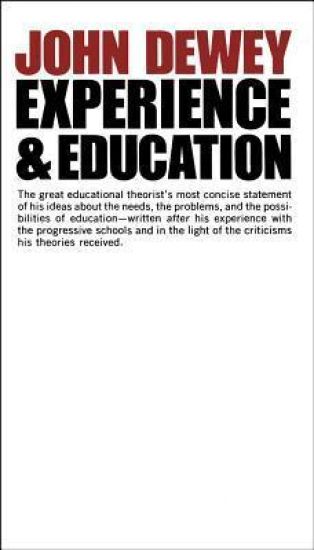
Experience and Educationis the best concise statement on education ever published by John Dewey, the man acknowledged to be the pre-eminent educational theorist of the twentieth century. Written more than two decades after Democracy and Education(Dewey's most comprehensive statement of his position in educational philosophy), this book demonstrates how Dewey reformulated his ideas as a result of his intervening experience with the progressive schools and in the light of the criticisms his theories had received. Analysing both "traditional" and "progressive" education, Dr. Dewey here insists that neither the old nor the new education is adequate and that each is miseducative because neither of them applies the principles of a carefully developed philosophy of experience. Many pages of this volume illustrate Dr. Dewey's ideas for a philosophy of experience and its relation to education. He particularly urges that all teachers and educators looking for a new movement in education should think in terms of the deeped and larger issues of education rather than in terms of some divisive "ism" about education, even such an "ism" as "progressivism." His philosophy, here expressed in its most essential, most readable form, predicates an American educational system that respects all sources of experience, on that offers a true learning situation that is both historical and social, both orderly and dynamic.
The Later Works of John Dewey, Volume 1, 1925 - 1953
John Dewey
Southern Illinois University Press
2008
nidottu
John Dewey’s Experience and Nature has been considered the fullest expression of his mature philosophy since its eagerly awaited publication in 1925. Irwin Edman wrote at that time that “with monumental care, detail and completeness, Professor Dewey has in this volume revealed the metaphysical heart that beats its unvarying alert tempo through all his writings, whatever their explicit themes.” In his introduction to this volume, Sidney Hook points out that “Dewey’s Experience and Nature is both the most suggestive and most difficult of his writings.” The meticulously edited text published here as the first volume in the series The Later Works of John Dewey, 1925–1953 spans that entire period in Dewey’s thought by including two important and previously unpublished documents from the book’s history: Dewey’s unfinished new introduction written between 1947 and 1949, edited by the late Joseph Ratner, and Dewey’s unedited final draft of that introduction written the year before his death. In the intervening years Dewey realized the impossibility of making his use of the word “experience” understood. He wrote in his 1951 draft for a new introduction: “Were I to write (or rewrite) Experience and Nature today I would entitle the book Culture and Nature and the treatment of specific subject-matters would be correspondingly modified. I would abandon the term ‘experience’ because of my growing realization that the historical obstacles which prevented understanding of my use of ‘experience’ are, for all practical purposes, insurmountable. I would substitute the term ‘culture’ because with its meanings as now firmly established it can fully and freely carry my philosophy of experience.”
The Later Works of John Dewey, Volume 12, 1925 - 1953
John Dewey
Southern Illinois University Press
2008
nidottu
Heralded as “the crowning work of a great career,” Logic: The Theory of Inquiry was widely reviewed. To Evander Bradley McGilvary, the work assured Dewey “a place among the world’s great logicians.” William Gruen thought “No treatise on logic ever written has had as direct and vital an impact on social life as Dewey’s will have.”