Kirjojen hintavertailu – 12 903 725 kirjaa ja 27 kauppaa
Kirjailija
Naval Postgraduate School
Kirjat ja teokset yhdessä paikassa: 495 kirjaa, julkaisuja vuosilta 2009–2017, suosituimpiin kuuluu Kurt Von Schleicher- The Soldier and Politics in the Run up to National Socialism: A Case Study of Civil- Military Relations. Vertaile teosten hintoja ja tarkista saatavuus suomalaisista kirjakaupoista.
The role of soft power in U. S. foreign policy has become a common theme amongst government agencies. International training and professional exchanges are a part of soft power. Since the egregious attacks on 9/11, many have argued for an increase in this tool of statecraft. This book reviews the role of soft power in U. S. foreign policy and how that pertains to homeland security. Specifically, the study notes the importance of international military and law enforcement training and how these exchanges can enhance U. S. security and advance foreign policy. Moreover, the research reviews models of current Department of Defense international training efforts for consideration by the Department of Homeland Security. The many professional exchanges and international training efforts from agencies such as U. S. Customs and Border Protection, U. S. Coast Guard, and the International Law Enforcement Academies are also reviewed. A model for an international program to take place at the Global Borders College is presented. In conclusion, the paper will argue that through attraction and influence, the U. S. will be better suited for security in the future. Furthermore, the encouraging of international training and exchanges will assist in improving U. S. multilateral relationships in the twenty-first century.
The dissolution of the Soviet Union left Russia without efficient military power and with a tumbled-down defense industry that are critically important to support its resurfaced superpower ambitions. This obstacle could be overcome by substituting military power with the economic one through domination as the leading energy supplier. Establishment of governmental control over the energy sector became a key element of the Russian domestic policy that would convert the energy resources into the instrument of the state's power. All major energy transportation routes between Russian energy producers and European consumers are in possession of the former Soviet republics. Russia has become heavily dependent on these countries as energy transit intermediaries. To ensure consistency of the energy supply flow and to lessen Russia's reliance on the transit states, Russia is seeking ways to diversify energy transportation routes to Europe. Russia is willing to pay a significantly higher cost for a complex construction of new pipelines that bypass intermediaries. The establishment of Russian monopolistic control over energy flow to Europe might be converted into a regional political dominance. Threatening the possibility of abrupt energy disruption and price manipulation could become an efficient tool of state power to achieve Russia's political objectives.
This book introduces an integer linear program called the Minimum Cost Flow with Congestion Assignment (MCFCA) model. MCF-CA is a multi-period evacuation model that uses a novel approach called congestion assignment to analyze clearing times during mass evacuations. Congestion assignment discretizes the nonlinear relationship between the number of vehicles on a road segment and the maximum speed at which those vehicles can travel. MCF-CA selects among three congestion levels (none, moderate, and high) for each road segment in each time epoch. Depending on the congestion level selected, MCF-CA limits the number of vehicles that are able to traverse the road segment and uses Ak elik's Time-Dependent Speed-Flow Function (Ak elik 2003) to determine the average travel speed of the vehicles for that time period. As a result, we are able to determine approximate evacuation clearing times under nonlinear congestion effects by solving an integer linear program. We limit residents' prior knowledge of traffic conditions by implementing MCF-CA in a rolling horizon fashion and book the impact of this limited knowledge on evacuation patterns. We also model the impact of sub-optimal routing decisions on the part of residents by artificially shifting residents toward their own shortest paths rather than a "socially optimal" route. Mass evacuation can more than double the clearing times of individual county evacuations. However, during both county and mass evacuations, resident routing choices significantly impact clearing times. As more residents choose suboptimal routes, clearing times are prolonged. Lastly, we find that more than 50% of residents will experience congestion at some point during the evacuation horizon. However, allowing some congestion improves evacuation clearing times by 20-36% over not congesting. Although congestion decreases vehicle travel speed by 70-80%, over 50% more residents are able to start or continue evacuating during each time epoch.
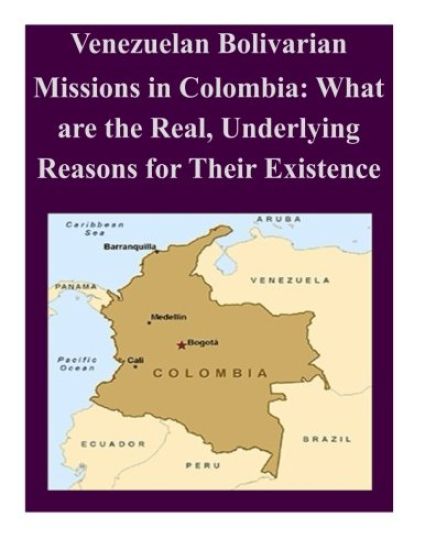
The Bolivarian government of Venezuela and the government of Cuba use the legitimate status of Bolivarian Missions in Colombia for both legitimate and illegitimate state activities. The overall aim is to undermine the Colombian state and increase the influence of political movements sympathetic to Bolivarianism in Colombian politics with the overall goal of weakening a historical international rival to Venezuela in Latin America. A comparative case study method is applied to four Venezuelan-sponsored Bolivarian missions in Colombia: Robinson, Milagro, Guacaipuro, and Identidad. A review of former Venezuelan President Hugo Ch vez's ideology of Bolivarianism is also included. The case study analysis is complemented by fieldwork in Colombia: interviews with many key figures including former insurgents, intelligence officials of both Venezuela and Colombia, as well as politicians and analysts who have direct and indirect knowledge of the missions. This constitutes a unique and up-close perspective on the true nature of Bolivarian missions in Colombia. The Bolivarian government of Venezuela and the government of Cuba consistently seek to expand their anti-U. S. influence throughout Latin America; understanding their ideology and mechanisms for doing so yields important policy implications for the U. S. and Colombian governments, as well as democracy proponents.
In the wake of the deteriorating relations between the former Allies of the Second World War, several European countries, the United States of America, and Canada came together to provide for their security and in 1949 formed a unique security alliance, the North Atlantic Treaty Organization. In addition to its collective defense function, the creators of NATO also paid attention to community building among the alliance members. After reconciliation with its former enemies, the re-armed Germany was allowed to join this community even though it had caused the Second World War. These observations lead to the question of the importance of community and reconciliation for the creation and success of NATO. On the other hand, Northeast Asia, which had also been severely affected by Japanese colonialism and the Pacific War, did not evolve into an area of peace and security. This situation might be even more surprising given the number of existing forums dealing with security issues. This book examines the possibility of NATO-like security cooperation in Northeast Asia that features community building aspects and reconciliation, both of which are assumed to be normative prerequisites of a security community.
This book reviews the Homeland Security Advisory System and the associated problems, looks at comparable international systems, and presents an alternative recommendation to provide timely and informative warnings of terrorist threats, and restores credibility by merging HSAS with the already existing DoD force protection conditions. After the events of 9/11, Homeland Security Presidential Directive-3 (HSPD-3) established the Homeland Security Advisory System (HSAS) to provide a comprehensive and effective means to disseminate information regarding the risk of terrorist acts to federal, state, and local authorities and the American people. Under HSAS, threat levels were raised or lowered 16 times, but never below Threat Level Yellow (Elevated Condition). HSAS should have been straightforward and easy to understand. What evolved was confusion over alerts, lack of specific threat information, concerns over costs to institute and maintain protective measures, and questions regarding what was expected of citizens. Government agencies, the private sector, and the general population became immune with the threat level remaining at or above Yellow. HSAS was woefully misunderstood not just by the general population, but also within federal, state, and local governments. Ridiculed by comedians, HSAS gradually began to disappear, to the point where it was necessary to search to find the current threat level, whereas it had once been prominently posted.
Since the events of September 11, 2001, there has been an increased emphasis on citizenpreparedness in the United States. But over 12 years later, the overall level of preparedness for individuals remains basically unchanged. Americans remain largely unprepared to take care of themselves and their families following a disaster or a terrorist event. There is evidence of success in citizen engagement and community outreach in other safety campaigns, such as fire prevention and safety, as well as seat belt safety. This book asks what strategies, methods and practices are used in these successful models toeffectively change individual behavior and prompt citizens to take action, and how can these models be applied successfully in the homeland security mission space in the area of community preparedness. In addition, the author examines a small set of best practices (fire prevention and safety and seat belt safety) and a comparative case study of community preparedness in the United Kingdom. These best practices are then applied to the United States homeland security discipline, specifically in the area of individual, family and community preparedness. Finally, this author provides recommendations for practical applications to increase citizen engagement in preparedness in the United States.