
Kirjailija
Plato
Kirjat ja teokset yhdessä paikassa: 1 115 kirjaa, julkaisuja vuosilta 1821–2026, suosituimpiin kuuluu Ion. Vertaile teosten hintoja ja tarkista saatavuus suomalaisista kirjakaupoista.
1 115 kirjaa
Kirjojen julkaisuvuodet: 1821–2026.

Geschichte Und System Der Platonischen Philosophie.
Carl Friedrich Hermann; Plato
Creative Media Partners, LLC
2018
pokkari
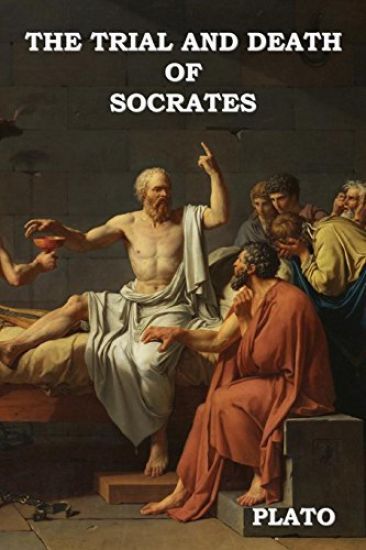
The trial of Socrates refers to the trial and the subsequent execution of the Athenian philosopher Socrates in 399 BC. Socrates was tried and convicted by the courts of democratic Athens on a charge of corrupting the youth and disbelieving in the ancestral gods. The trial was described by two of Socrates' contemporaries, Plato and Xenophon, and is one of the most famous trials of all time. The trial, last days, and death of Socrates are presented in this volume through four works of Plato. These works are the Euthyphro, Apology (i.e. Defense Speech), Crito and Phaedo (Socrates' Death scene).
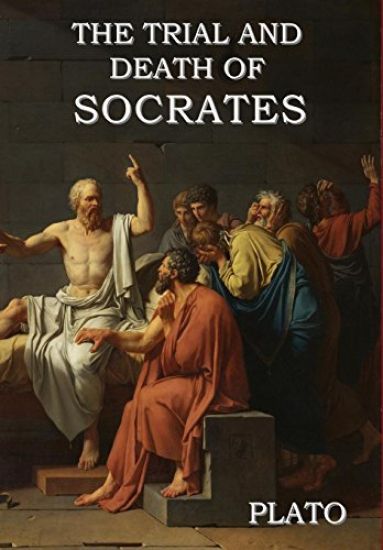
The trial of Socrates refers to the trial and the subsequent execution of the Athenian philosopher Socrates in 399 BC. Socrates was tried and convicted by the courts of democratic Athens on a charge of corrupting the youth and disbelieving in the ancestral gods. The trial was described by two of Socrates' contemporaries, Plato and Xenophon, and is one of the most famous trials of all time. The trial, last days, and death of Socrates are presented in this volume through four works of Plato. These works are the Euthyphro, Apology (i.e. Defense Speech), Crito and Phaedo (Socrates' Death scene).

Theaetetus by Plato. A Socratic Dialogue translated with an introduction by Benjamin Jowett. In this dialogue, Socrates and Theaetetus discuss three definitions of knowledge: knowledge as nothing but perception, knowledge as true judgment, and, finally, knowledge as a true judgment with an account. Each of these definitions is shown to be unsatisfactory. Socrates declares Theaetetus will have benefited from discovering what he does not know, and that he may be better able to approach the topic in the future. The conversation ends with Socrates' announcement that he has to go to court to face a criminal indictment. The dialogue is framed by a brief scene in which Euclid of Megara tells his friend Terpsion that he has a written record of a dialogue between Socrates and Theaetetus, which occurred when Theaetetus was quite a young man. This dialogue is then read aloud to the two men by a slave boy owned by Euclid.

Timaeus by Plato and translated with an introduction by Benjamin Jowett. Of all the writings of Plato the Timaeus is the most obscure and repulsive to the modern reader, and has nevertheless had the greatest influence over the ancient and mediaeval world. The obscurity arises in the infancy of physical science, out of the confusion of theological, mathematical, and physiological notions, out of the desire to conceive the whole of nature without any adequate knowledge of the parts, and from a greater perception of similarities which lie on the surface than of differences which are hidden from view. To bring sense under the control of reason; to find some way through the mist or labyrinth of appearances, either the highway of mathematics, or more devious paths suggested by the analogy of man with the world, and of the world with man; to see that all things have a cause and are tending towards an end - this is the spirit of the ancient physical philosopher.

Plato Greek: Pl ton, pronounced in Classical Attic; 428/427 or 424/423- 348/347 BC) was a philosopher in Classical Greece and the founder of the Academy in Athens, the first institution of higher learning in the Western world. He is widely considered the most pivotal figure in the development of philosophy, especially the Western tradition. Unlike nearly all of his philosophical contemporaries, Plato's entire work is believed to have survived intact for over 2,400 years. Along with his teacher, Socrates, and his most famous student, Aristotle, Plato laid the foundations of Western philosophy and science. Alfred North Whitehead once noted: "the safest general characterization of the European philosophical tradition is that it consists of a series of footnotes to Plato." In addition to being a foundational figure for Western science, philosophy, and mathematics, Plato has also often been cited as one of the founders of Western religion and spirituality.
Phaedo by Plato and translated with an introduction by Benjamin Jowett. Phaedo or Phaedo, also known to ancient readers as On The Soul, is one of the best-known dialogues of Plato's middle period, along with the Republic and the Symposium. After an interval of some months or years, and at Phlius, a town of Peloponnesus, the tale of the last hours of Socrates is narrated to Echecrates and other Phliasians by Phaedo the 'beloved disciple.' The Dialogue necessarily takes the form of a narrative, because Socrates has to be described acting as well as speaking. The minutest particulars of the event are interesting to distant friends, and the narrator has an equal interest in them. During the voyage of the sacred ship to and from Delos, which has occupied thirty days, the execution of Socrates has been deferred. (Compare Xen. Mem.) The time has been passed by him in conversation with a select company of disciples. But now the holy season is over, and the disciples meet earlier than usual in order that they may converse with Socrates for the last time.

Plato Greek: Pl ton, pronounced in Classical Attic; 428/427 or 424/423- 348/347 BC) was a philosopher in Classical Greece and the founder of the Academy in Athens, the first institution of higher learning in the Western world. He is widely considered the most pivotal figure in the development of philosophy, especially the Western tradition. Unlike nearly all of his philosophical contemporaries, Plato's entire work is believed to have survived intact for over 2,400 years. Along with his teacher, Socrates, and his most famous student, Aristotle, Plato laid the foundations of Western philosophy and science. Alfred North Whitehead once noted: "the safest general characterization of the European philosophical tradition is that it consists of a series of footnotes to Plato." In addition to being a foundational figure for Western science, philosophy, and mathematics, Plato has also often been cited as one of the founders of Western religion and spirituality.
Plato Greek: Pl ton, pronounced in Classical Attic; 428/427 or 424/423- 348/347 BC) was a philosopher in Classical Greece and the founder of the Academy in Athens, the first institution of higher learning in the Western world. He is widely considered the most pivotal figure in the development of philosophy, especially the Western tradition. Unlike nearly all of his philosophical contemporaries, Plato's entire work is believed to have survived intact for over 2,400 years. Along with his teacher, Socrates, and his most famous student, Aristotle, Plato laid the foundations of Western philosophy and science. Alfred North Whitehead once noted: "the safest general characterization of the European philosophical tradition is that it consists of a series of footnotes to Plato." In addition to being a foundational figure for Western science, philosophy, and mathematics, Plato has also often been cited as one of the founders of Western religion and spirituality.
Laws: The Complete 12 Books
Plato
Createspace Independent Publishing Platform
2018
nidottu
Halvin toimitettuna 18,30 €
Laws by Plato and translated with an introduction by Benjamin Jowett. The Laws is Plato's last and longest dialogue. The conversation depicted in the work's twelve books begins with the question of who is given the credit for establishing a civilization's laws. Its musings on the ethics of government and law have established it as a classic of political philosophy alongside Plato's more widely read Republic. The genuineness of the Laws is sufficiently proved by more than twenty citations of them in the writings of Aristotle, who was residing at Athens during the last twenty years of the life of Plato, and who, having left it after his death (B. C. 347), returned thither twelve years later (B. C. 335); by the allusion of Isocrates. The suspicion which has attached to the Laws of Plato in the judgment of some modern writers appears to rest partly on differences in the style and form of the work, and on differences of thought and opinion which they observe in them. Their suspicion is increased by the fact that these differences are accompanied by resemblances as striking to passages in other Platonic writings.
Parmenides by Plato and translated by Benjamin Jowett. Parmenides of Elea was a pre-Socratic Greek philosopher from Elea in Magna Graecia (Greater Greece, included Southern Italy). He was the founder of the Eleatic school of philosophy. The awe with which Plato regarded the character of 'the great' Parmenides has extended to the dialogue which he calls by his name. None of the writings of Plato have been more copiously illustrated, both in ancient and modern times, and in none of them have the interpreters been more at variance with one another. Nor is this surprising. For the Parmenides is more fragmentary and isolated than any other dialogue, and the design of the writer is not expressly stated. The date is uncertain; the relation to the other writings of Plato is also uncertain; the connexion between the two parts is at first sight extremely obscure; and in the latter of the two we are left in doubt as to whether Plato is speaking his own sentiments by the lips of Parmenides, and overthrowing him out of his own mouth, or whether he is propounding consequences which would have been admitted by Zeno and Parmenides themselves.

Philebus by Plato and translated with an introduction by Benjamin Jowett. A Socratic Dialogue. The Philebus, is one of the surviving Socratic dialogues written in the 4th century BC by the ancient Greek philosopher Plato. Apart from Socrates, the primary speaker in Philebus, the other speakers are Philebus and Protarchus. But Philebus, who wants to defend the life of pleasure, hedonism, which Socrates describes as the life of an oyster, hardly participates, and his position has to be defended by Protarchus, who has learnt argumentation from Sophists. The Philebus appears to be one of the later writings of Plato, in which the style has begun to alter, and the dramatic and poetical element has become subordinate to the speculative and philosophical. In the development of abstract thought great advances have been made on the Protagoras or the Phaedrus, and even on the Republic. But there is a corresponding diminution of artistic skill, a want of character in the persons, a laboured march in the dialogue, and a degree of confusion and incompleteness in the general design. As in the speeches of Thucydides, the multiplication of ideas seems to interfere with the power of expression. Instead of the equally diffused grace and ease of the earlier dialogues there occur two or three highly-wrought passages; instead of the ever-flowing play of humour, now appearing, now concealed, but always present, are inserted a good many bad jests, as we may venture to term them.
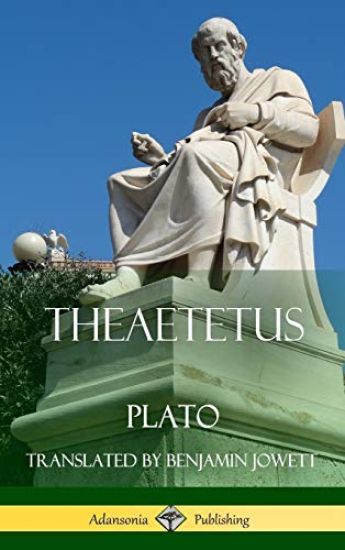
Theaetetus (Classics of Ancient Greek Philosophy) (Hardcover)
Plato; Benjamin Jowett
Lulu.com
2018
sidottu
Plato's dialogue Theaetetus asks the question of what knowledge is, how human beings acquire it, and how knowledge relates to both perception and judgement. This dialogue is told as a frame story, whereby Euclid and a friend are read a dialogue from the time Theaetetus was a young man. In it Theaetetus, a teacher of geometry, is talking with Socrates. At first they discuss the students, but soon move on to the core subject of knowledge and what it is to know things. It is in this dialogue that Socrates famously compares himself to a midwife, which was his mother's profession. Whereas she showed expertise in bringing a newborn child into the world, Socrates' rather is skilled at bringing new knowledge forth from the minds of those on the cusp of birthing such thoughts. A classic Platonic dialogue, this edition of Theaetetus is the translation of renowned classical scholar Benjamin Jowett.

Critias by Plato. Translated by Benjamin Jowett. Critias; c. 460 - 403 BCE, was an ancient Athenian political figure and author. Born in Athens, Critias was the son of Callaeschrus and a first cousin of Plato's mother Perictione. He became a leading and violent member of the Thirty Tyrants. He also was an associate of Socrates, a fact that did not endear Socrates to the Athenian public. Critias was noted in his day for his tragedies, elegies and prose works. Some, like Sextus Empiricus, believe that Critias wrote the Sisyphus fragment; others, however, attribute it to Euripides. His only known play is Peirithous, of which only a single 42-line fragment survives. In addition, eight shorter quotations from unidentified plays have come down to us. The Critias is a fragment which breaks off in the middle of a sentence. It was designed to be the second part of a trilogy, which, like the other great Platonic trilogy of the Sophist, Statesman, Philosopher, was never completed. Timaeus had brought down the origin of the world to the creation of man, and the dawn of history was now to succeed the philosophy of nature. The Critias is also connected with the Republic. Plato, as he has already told us (Tim.), intended to represent the ideal state engaged in a patriotic conflict. This mythical conflict is prophetic or symbolical of the struggle of Athens and Persia, perhaps in some degree also of the wars of the Greeks and Carthaginians, in the same way that the Persian is prefigured by the Trojan war to the mind of Herodotus, or as the narrative of the first part of the Aeneid is intended by Virgil to foreshadow the wars of Carthage and Rome.

The Dialogues of Plato: Cratylus by Plato. Translated by Benjamin Jowett. Cratylus is the name of a dialogue by Plato. Most modern scholars agree that it was written mostly during Plato's so-called middle period. In the dialogue, Socrates is asked by two men, Cratylus and Hermogenes, to tell them whether names are "conventional" or "natural", that is, whether language is a system of arbitrary signs or whether words have an intrinsic relation to the things they signify. The Cratylus has always been a source of perplexity to the student of Plato. While in fancy and humour, and perfection of style and metaphysical originality, this dialogue may be ranked with the best of the Platonic writings, there has been an uncertainty about the motive of the piece, which interpreters have hitherto not succeeded in dispelling. We need not suppose that Plato used words in order to conceal his thoughts, or that he would have been unintelligible to an educated contemporary. In the Phaedrus and Euthydemus we also find a difficulty in determining the precise aim of the author. Plato wrote satires in the form of dialogues, and his meaning, like that of other satirical writers, has often slept in the ear of posterity. Two causes may be assigned for this obscurity: 1st, the subtlety and allusiveness of this species of composition; 2nd, the difficulty of reproducing a state of life and literature which has passed away. A satire is unmeaning unless we can place ourselves back among the persons and thoughts of the age in which it was written. Had the treatise of Antisthenes upon words, or the speculations of Cratylus, or some other Heracleitean of the fourth century B. C., on the nature of language been preserved to us; or if we had lived at the time, and been 'rich enough to attend the fifty-drachma course of Prodicus, ' we should have understood Plato better, and many points which are now attributed to the extravagance of Socrates' humour would have been found, like the allusions of Aristophanes in the Clouds, to have gone home to the sophists and grammarians of the day

The Dialogues of Plato: Charmides or Temperance by Plato. Translated into English with Analyses and introductions by B. Jowett, M. A. The Charmides is a dialogue of Plato, in which Socrates engages a handsome and popular boy in a conversation about the meaning of sophrosyne, a Greek word usually translated into English as "temperance", "self-control", or "restraint". As is typical with Platonic early dialogues, the two never arrive at a completely satisfactory definition, but the discussion nevertheless raises many important points. The subject of the Charmides is Temperance or (Greek), a peculiarly Greek notion, which may also be rendered Moderation (Compare Cic. Tusc. '(Greek), quam soleo equidem tum temperantiam, tum moderationem appellare, nonnunquam etiam modestiam.'), Modesty, Discretion, Wisdom, without completely exhausting by all these terms the various associations of the word. It may be described as 'mens sana in corpore sano, ' the harmony or due proportion of the higher and lower elements of human nature which 'makes a man his own master, ' according to the definition of the Republic. In the accompanying translation the word has been rendered in different places either Temperance or Wisdom, as the connection seemed to require: for in the philosophy of Plato (Greek) still retains an intellectual element (as Socrates is also said to have identified (Greek) with (Greek): Xen. Mem.) and is not yet relegated to the sphere of moral virtue, as in the Nicomachean Ethics of Aristotl

Plato's Dialogues: Laws by Plato. Translated by Benjamin Jowett. THE COMPLETE 12 BOOKS. The Laws is Plato's last and longest dialogue. The conversation depicted in the work's twelve books begins with the question of who is given the credit for establishing a civilization's laws. Its musings on the ethics of government and law have established it as a classic of political philosophy alongside Plato's more widely read Republic. Scholars generally agree that Plato wrote this dialogue as an older man, having failed in his effort in Syracuse on the island of Sicily to guide a tyrant's rule, instead having been thrown in prison. These events are alluded to in the Seventh Letter. The text is noteworthy as Plato's only undisputed dialogue not to feature Socrates. Unlike most of Plato's dialogues, Socrates does not appear in the Laws: the dialogue takes place on the island of Crete, and Socrates appears outside of Athens in Plato's writings only twice, in the Phaedrus, where he is just outside the city's walls, and in the Republic, where he goes down to the seaport Piraeus five miles outside of Athens. The conversation is instead led by an Athenian Stranger and two other old men, the ordinary Spartan citizen Megillos and the Cretan politician and lawgiver Clinias from Knossos.