Kirjailija
Plato
Kirjat ja teokset yhdessä paikassa: 1 115 kirjaa, julkaisuja vuosilta 1821–2026, suosituimpiin kuuluu Ion. Vertaile teosten hintoja ja tarkista saatavuus suomalaisista kirjakaupoista.
1 115 kirjaa
Kirjojen julkaisuvuodet: 1821–2026.

It is thought that Plato, the Athenian philosopher, was born in 428 BCE, and died at the age of eighty or eighty-one. These calculations of the lifespan of Plato were produced by Eratosthenes, and are generally accepted by other historians as accurate, although it is still disputed. Plato's innate intellectual capabilities and incredible perspective on the world around him allowed him to become one of the world's greatest philosophers and contributors to western thought and understanding. He was born into an established family who were both wealthy and very politically involved. Certain family members of Plato's are reputed to have been involved in mischief involving the government. One of Plato's uncles, Charmides, was a member of "Thirty Tyrants", who overthrew the Athenian Democracy in 404 BCE, and Charmides uncle, Critias, was the actual leader of Thirty Tyrants. These relations with anarchy don't stretch far into the bloodline of Plato, however. Some of Plato's relatives, including Pyrilampes, were actually close with the leaders of the democratic faction in Athens.
INTRODUCTION AND ANALYSIS. The genuineness of the Laws is sufficiently proved (1) by more than twenty citations of them in the writings of Aristotle, who was residing at Athens during the last twenty years of the life of Plato, and who, having left it after his death (B. C. 347), returned thither twelve years later (B. C. 335); (2) by the allusion of Isocrates (Oratio ad Philippum missa, p.84: To men tais paneguresin enochlein kai pros apantas legein tous sunprechontas en autais pros oudena legein estin, all omoios oi toioutoi ton logon (sc. speeches in the assembly) akuroi tugchanousin ontes tois nomois kai tais politeiais tais upo ton sophiston gegrammenais.) -writing 346 B. C., a year after the death of Plato, and probably not more than three or four years after the composition of the Laws-who speaks of the Laws and Republics written by philosophers (upo ton sophiston); (3) by the reference (Athen.) of the comic poet Alexis, a younger contemporary of Plato (fl. B. C 356-306), to the enactment about prices, which occurs in Laws xi., viz that the same goods should not be offered at two prices on the same day (Ou gegone kreitton nomothetes tou plousiou Aristonikou tithesi gar nuni nomon, ton ichthuopolon ostis an polon tini ichthun upotimesas apodot elattonos es eipe times, eis to desmoterion euthus apagesthai touton, ina dedoikotes tes axias agaposin, e tes esperas saprous apantas apopherosin oikade. Meineke, Frag. Com. Graec.); (4) by the unanimous voice of later antiquity and the absence of any suspicion among ancient writers worth speaking of to the contrary; for it is not said of Philippus of Opus that he composed any part of the Laws, but only that he copied them out of the waxen tablets, and was thought by some to have written the Epinomis (Diog. Laert.) That the longest and one of the best writings bearing the name of Plato should be a forgery, even if its genuineness were unsupported by external testimony, would be a singular phenomenon in ancient literature; and although the critical worth of the consensus of late writers is generally not to be compared with the express testimony of contemporaries, yet a somewhat greater value may be attributed to their consent in the present instance, because the admission of the Laws is combined with doubts about the Epinomis, a spurious writing, which is a kind of epilogue to the larger work probably of a much later date. This shows that the reception of the Laws was not altogether undiscriminating.........
Sophist: Translated by Benjamin Jowett
Plato
Createspace Independent Publishing Platform
2017
nidottu
Theaetetus: Translated by Benjamin Jowett
Plato
Createspace Independent Publishing Platform
2017
nidottu
INTRODUCTION AND ANALYSIS. Some dialogues of Plato are of so various a character that their relation to the other dialogues cannot be determined with any degree of certainty. The Theaetetus, like the Parmenides, has points of similarity both with his earlier and his later writings. The perfection of style, the humour, the dramatic interest, the complexity of structure, the fertility of illustration, the shifting of the points of view, are characteristic of his best period of authorship. The vain search, the negative conclusion, the figure of the midwives, the constant profession of ignorance on the part of Socrates, also bear the stamp of the early dialogues, in which the original Socrates is not yet Platonized. Had we no other indications, we should be disposed to range the Theaetetus with the Apology and the Phaedrus, and perhaps even with the Protagoras and the Laches. But when we pass from the style to an examination of the subject, we trace a connection with the later rather than with the earlier dialogues. In the first place there is the connexion, indicated by Plato himself at the end of the dialogue, with the Sophist, to which in many respects the Theaetetus is so little akin. (1) The same persons reappear, including the younger Socrates, whose name is just mentioned in the Theaetetus;......
The Charmides is a dialogue of Plato, in which Socrates engages a handsome and popular boy in a conversation about the meaning of sophrosyne, a Greek word usually translated into English as "temperance", "self-control", or "restraint". As is typical with Platonic early dialogues, the two never arrive at a completely satisfactory definition, but the discussion nevertheless raises many important points. Socrates narrates the dialogue, and says that he has just returned from a battle at Potidaea, a city besieged and conquered by the Athenians at the beginning of the Peloponnesian War. Socrates says that, shortly after returning home, he again sought out his habitual conversations by heading to the palaestra of Taureas, a wrestling school where boys gathered. With the help of Chaerephon, who pushes him for details about the battle, he finds his way to Critias and asks him about affairs at home, the present state of philosophy, and whether any of the boys had distinguished himself for wisdom or beauty, or both. Critias answers that Socrates will soon get to know the beauties firsthand, for Charmides and his entourage have just arrived.
The Republic (Latin: De Re Publica) is a Socratic dialogue, written by Plato around 380 BCE, concerning justice, the order and character of the just city-state and the just man. It is Plato's best-known work, and has proven to be one of the world's most influential works of philosophy and political theory, both intellectually and historically. In the book's dialogue, Socrates discusses the meaning of justice and whether or not the just man is happier than the unjust man with various Athenians and foreigners. They consider the natures of existing regimes and then propose a series of different, hypothetical cities in comparison. This culminates in the discussion of Kallipolis, a hypothetical city-state ruled by a philosopher king. They also discuss the theory of forms, the immortality of the soul, and the role of the philosopher and that of poetry in society. The dialogues may have taken place during the Peloponnesian War.
Statesman: Translated by Benjamin Jowett
Plato
Createspace Independent Publishing Platform
2017
nidottu
INTRODUCTION AND ANALYSIS. In the Phaedrus, the Republic, the Philebus, the Parmenides, and the Sophist, we may observe the tendency of Plato to combine two or more subjects or different aspects of the same subject in a single dialogue. In the Sophist and Statesman especially we note that the discussion is partly regarded as an illustration of method, and that analogies are brought from afar which throw light on the main subject. And in his later writings generally we further remark a decline of style, and of dramatic power; the characters excite little or no interest, and the digressions are apt to overlay the main thesis; there is not the 'callida junctura' of an artistic whole. Both the serious discussions and the jests are sometimes out of place. The invincible Socrates is withdrawn from view; and new foes begin to appear under old names. Plato is now chiefly concerned, not with the original Sophist, but with the sophistry of the schools of philosophy, which are making reasoning impossible; and is driven by them out of the regions of transcendental speculation back into the path of common sense. A logical or psychological phase takes the place of the doctrine of Ideas in his mind.
Parmenides: Translated by Benjamin Jowett
Plato
Createspace Independent Publishing Platform
2017
nidottu
INTRODUCTION AND ANALYSIS. The awe with which Plato regarded the character of 'the great' Parmenides has extended to the dialogue which he calls by his name. None of the writings of Plato have been more copiously illustrated, both in ancient and modern times, and in none of them have the interpreters been more at variance with one another. Nor is this surprising. For the Parmenides is more fragmentary and isolated than any other dialogue, and the design of the writer is not expressly stated. The date is uncertain; the relation to the other writings of Plato is also uncertain; the connexion between the two parts is at first sight extremely obscure; and in the latter of the two we are left in doubt as to whether Plato is speaking his own sentiments by the lips of Parmenides, and overthrowing him out of his own mouth, or whether he is propounding consequences which would have been admitted by Zeno and Parmenides themselves. The contradictions which follow from the hypotheses of the one and many have been regarded by some as transcendental mysteries; by others as a mere illustration, taken at random, of a new method. They seem to have been inspired by a sort of dialectical frenzy, such as may be supposed to have prevailed in the Megarian School (compare Cratylus, etc.). The criticism on his own doctrine of Ideas has also been considered, not as a real criticism, but as an exuberance of the metaphysical imagination which enabled Plato to go beyond himself. To the latter part of the dialogue we may certainly apply the words in which he himself describes the earlier philosophers in the Sophist: 'They went on their way rather regardless of whether we understood them or not.' The Parmenides in point of style is one of the best of the Platonic writings; the first portion of the dialogue is in no way defective in ease and grace and dramatic interest; nor in the second part, where there was no room for such qualities, is there any want of clearness or precision....
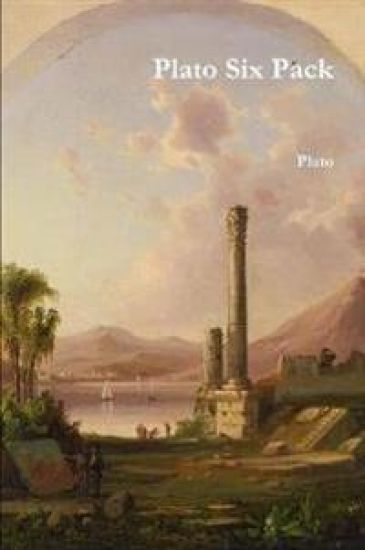
Plato Six Pack represents the full-range of Plato's philosophy. Included are six of his original works - Euthyphro, Apology, Crito, Phaedo, The Allegory of the Cave and Symposium
Plato Six Pack represents the full-range of Plato's philosophy. Included are six of his original works - Euthyphro, Apology, Crito, Phaedo, The Allegory of the Cave and Symposium
The Allegory of the Cave is a dialogue between Plato's brother Glaucon and his mentor Socrates, narrated by the latter, in which Plato elucidates his Theory of Forms. Plato's Allegory is considered one of Western philosophy's most important metaphors.
Plato's Allegory of the Cave is one of the most elegant and important metaphors in Western philosophy. It is a dialogue between Plato's brother Glaucon and his mentor Socrates, narrated by the latter, in which Plato elucidates his Theory of Forms.

The Republic PLATO (c. 428 BC - c. 347 BC) The Republic is a Socratic dialogue by Plato, written in approximately 380 BC. It is one of the most influential works of philosophy and political theory, and arguably Plato's best known work. In it, Socrates and various other Athenians and foreigners discuss the meaning of justice and whether the just man is happier than the unjust man by constructing an imaginary city ruled by philosopher-kings. The dialogue also discusses the nature of the philosopher, Plato's Theory of Forms, the conflict between philosophy and poetry, and the immortality of the soul.
In his brilliant dialogue, Symposium, Plato presents an imaginary dinner-party set in Athens in 416 BC where the guests include Aristophanes, Socrates and the most popular Athenian of his day, golden boy Alcibiades. The sequence of dazzling speeches culminates in Socrates' famous account of the views of Diotima, a prophetess who taught him that love is our means of trying to attain goodness.
In his brilliant dialogue, Symposium, Plato presents an imaginary dinner-party set in Athens in 416 BC where the guests include Aristophanes, Socrates and the most popular Athenian of his day, golden boy Alcibiades. The sequence of dazzling speeches culminates in Socrates' famous account of the views of Diotima, a prophetess who taught him that love is our means of trying to attain goodness.

The Republic is a Socratic dialogue, written by Plato around 380 BC, regarding the definition of justice, the social order and character of the just city and state, and the just and free man.