Kirjojen hintavertailu – 12 859 819 kirjaa ja 27 kauppaa
Kirjailija
Ralph Waldo Emerson
Kirjat ja teokset yhdessä paikassa: 994 kirjaa, julkaisuja vuosilta 1836–2026, suosituimpiin kuuluu Essays by Ralph Waldo Emerson. Vertaile teosten hintoja ja tarkista saatavuus suomalaisista kirjakaupoista.
Nimi esiintyy myös muodoissa: Ralph Waldo. Emerson
Ralph Waldo Emerson (May 25, 1803 - April 27, 1882), known professionally as Waldo Emerson, was an American essayist, lecturer, and poet who led the Transcendentalist movement of the mid-19th century. He was seen as a champion of individualism and a prescient critic of the countervailing pressures of society, and he disseminated his thoughts through dozens of published essays and more than 1,500 public lectures across the United States. Emerson gradually moved away from the religious and social beliefs of his contemporaries, formulating and expressing the philosophy of Transcendentalism in his 1836 essay, "Nature". Following this ground-breaking work, he gave a speech entitled "The American Scholar" in 1837, which Oliver Wendell Holmes Sr. considered to be America's "Intellectual Declaration of Independence".
Classics for Your Collection: goo.gl/U80LCr --------- Trust Thyself In a world where people are self-conscious and have lots of self-doubt, the legendary Ralph Waldo Emerson teaches us about Self-Reliance, the success secret of people who do well in life and get success of all kind and more importantly, people who are self-fulfilled. "Self-Reliance" is Ralph Waldo Emerson's compilation of many years' works and the archetype for his transcendental philosophies. Emerson presupposes that the mind is initially subject to an unhappy conformism. Throughout the essay he gives a defense for his famous catch-phrase "Trust thyself". This argument makes three major points: that each person has his own self-contained genius, that society and worldly influences must be resisted in favor of one's own individuality, and that self-worth has great importance and value. In the first section, Emerson argues that inside of each person is genius. He writes: "To believe your own thought, to believe that what is true for you in your private heart is true for all men, - that is genius." He says that only a man who is self-reliant will be successful and any outside influences would take away from personal satisfaction. Emerson claims that examples of people who trusted themselves above all else include Moses, Plato, and John Milton. He then goes on to highlight the value of individual expression. Emerson says that a man should not worry that he will be misunderstood or thought less of because his opinions changed. He writes, "To be great is to be misunderstood." A man must be willing, every day, to open his consciousness to his intuition, whether or not what it tells him is in conflict with his past conclusions. He also states how a man should still follow his own path even if other people feel offended by this idea. He writes, "My life is for itself", "and not for a spectacle" emphasizing the idea of not following what other people think, adding to the idea that this compromises their individual values. Emerson wrote that if a person were self-reliant, he would have "consistent access to survival." He mentions how family, work, and society can hinder the ability for a man to thrive. He says that they can only stimulate his own thinking, not teach him anything. He explains how in order to be happy and peaceful, one should not care about the consumerism but should focus on his own situation. He ends with "Nothing can bring you peace but yourself." Throughout this essay, Emerson argues against conformity with the world. He argues how people should not conform to what other people in society think, but instead he should transform society with his thoughts. He gives an archetype for his own transcendental beliefs, but also argues for his slogan "trust thyself". To follow Emerson's self-reliant credo fully, one must learn to hear and obey what is most true within one's heart, and both think and act independent of popular opinion and social pressure, in order to bring satisfaction to one's self. Scroll Up and Grab Your Copy Other Success Books for Your success: An Iron Will & Ambition and Success by Orison Swett Marden (2 books in 1) https: //www.createspace.com/6394329 The Twelve Powers of Man by Charles Fillmore https: //www.createspace.com/6346276 The Science of Getting Rich by Wallace D. Wattles https: //www.createspace.com/6423699 The Science of Being Great by Wallace D. Wattles https: //www.createspace.com/6423727 The Science of Being Well by Wallace D. Wattles https: //www.createspace.com/6423755
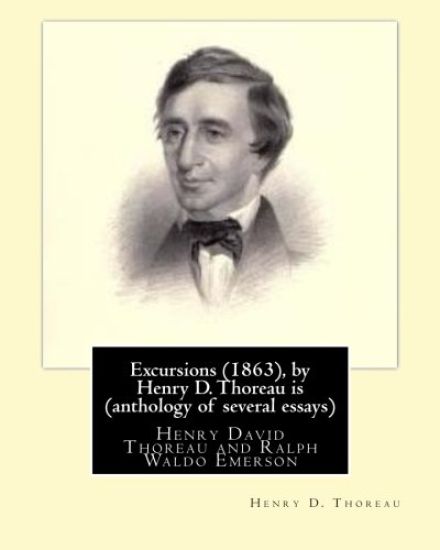
Excursions is an 1863 anthology of several essays by American transcendentalist Henry David Thoreau. The anthology contains an introduction entitled "Biographical Sketch" in which fellow transcendentalist Ralph Waldo Emerson provides a description of Thoreau.he book, other than R. W. Emerson's biography of Thoreau, contains nine of Thoreau's essays: Natural History of Massachusetts, A Walk to Wachusett, The Landlord, A Winter Walk, The Succession of Forest Trees, Walking, Autumnal Tints, Wild Apples, and Night and Moonlight. Henry David Thoreau (see name pronunciation; July 12, 1817 - May 6, 1862) was an American author, poet, philosopher, abolitionist, naturalist, tax resister, development critic, surveyor, and historian. A leading transcendentalist, Thoreau is best known for his book Walden, a reflection upon simple living in natural surroundings, and his essay Resistance to Civil Government (also known as Civil Disobedience), an argument for disobedience to an unjust state. Thoreau's books, articles, essays, journals, and poetry total over 20 volumes. Among his lasting contributions are his writings on natural history and philosophy, where he anticipated the methods and findings of ecology and environmental history, two sources of modern-day environmentalism. His literary style interweaves close natural observation, personal experience, pointed rhetoric, symbolic meanings, and historical lore, while displaying a poetic sensibility, philosophical austerity, and "Yankee" love of practical detail. He was also deeply interested in the idea of survival in the face of hostile elements, historical change, and natural decay; at the same time he advocated abandoning waste and illusion in order to discover life's true essential needs... Ralph Waldo Emerson (May 25, 1803 - April 27, 1882), known professionally as Waldo Emerson, was an American essayist, lecturer, and poet who led the Transcendentalist movement of the mid-19th century. He was seen as a champion of individualism and a prescient critic of the countervailing pressures of society, and he disseminated his thoughts through dozens of published essays and more than 1,500 public lectures across the United States. Emerson gradually moved away from the religious and social beliefs of his contemporaries, formulating and expressing the philosophy of Transcendentalism in his 1836 essay, "Nature". Following this ground-breaking work, he gave a speech entitled "The American Scholar" in 1837, which Oliver Wendell Holmes Sr. considered to be America's "Intellectual Declaration of Independence". Emerson wrote most of his important essays as lectures first, then revised them for print. His first two collections of essays Essays: First Series and Essays: Second Series, published respectively in 1841 and 1844-represent the core of his thinking, and include such well-known essays as "Self-Reliance", "The Over-Soul", "Circles", "The Poet" and "Experience". Together with "Nature", these essays made the decade from the mid-1830s to the mid-1840s Emerson's most fertile period.
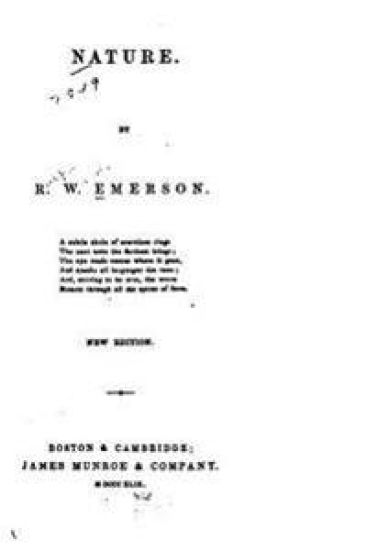
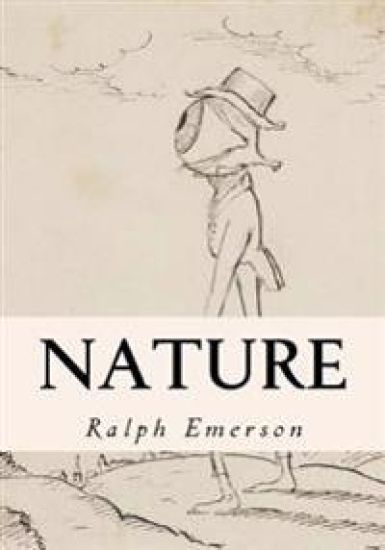
Nature by Ralph Waldo Emerson..... "Nature" is an essay written by Ralph Waldo Emerson, and published by James Munroe and Company in 1836. In this essay Emerson put forth the foundation of transcendentalism, a belief system that espouses a non-traditional appreciation of nature. In "Nature," Emerson lays out and attempts to solve an abstract problem: that humans do not fully accept nature