Kirjailija
Rudolf Steiner
Kirjat ja teokset yhdessä paikassa: 1 477 kirjaa, julkaisuja vuosilta 1910–2026, suosituimpiin kuuluu The Cosmic New Year: A Course of Lectures by Rudolf Steiner. Vertaile teosten hintoja ja tarkista saatavuus suomalaisista kirjakaupoista.
1 477 kirjaa
Kirjojen julkaisuvuodet: 1910–2026.
Rudolf Steiner draws a clear distinction between the spiritual meaning of the word Intuition and its ordinary definition. As the highest form of spiritual perception, Intuition has an existential significance for our process of knowledge. Through systematic schooling, thinking can be developed into an intuitive organ by means of which the spiritual can consciously be understood and penetrated. Intuition can reveal the essence of the spirit, the processes through which human beings and the world came into existence, and the events in our life after death. In his later works, Steiner spoke of Intuition as a form of supersensible knowledge that could provide direct insight into practical life, as exemplified here in his commentary on geometry, architecture, education, medicine, eurythmy, painting and the social organism. The concept of Intuition is fundamental to Rudolf Steiner’s spiritual philosophy. It denotes a clear, pure mode of comprehension akin to a mathematical concept. We meet it in his earliest writings on Goethe, in the development of his philosophical ideas and in his many lectures and addresses. Ably compiled and introduced by Edward de Boer, this volume clarifies a concept that evolved in Steiner’s thinking. By following the idea of Intuition in its gradual transformation and amplification throughout Steiner’s writing and lecturing career, the book offers not only inspiring paths to spiritual knowledge, but also insights into how anthroposophy developed. Chapters include: `The Perceptive Power of Judgement – Goethe’s Intuition’; `Moral Intuition – Experiencing Thinking’; `The Human Being – Intuition as a Bridge to the Spirit’; `The Schooling Path – Spiritual Development and the Power of Intuition’; `Intuition Exercises’; `Three Stages of Consciousness – Intuition in Relation to Imagination and Inspiration’; `Knowledge of Destiny – Intuition and Repeated Earth Lives’; `Intuition in Practice – Examples from Various Specialist Fields’.
Rudolf Steiner differentiated clearly between the spiritual concept of Imagination and our everyday understanding of the word. As living, pictorial thinking, Imagination is a primary aspect of the contemporary path of inner schooling – the first of three levels of initiate knowledge and cognition. Imagination leads us into a world of flowing, living pictures: a realm of soul and spirit in which everything is in continual movement. This anthology offers a survey of the diverse aspects of Imagination and imaginative cognition. As the thematically re-ordered texts reveal, Rudolf Steiner’s spiritual philosophy – anthroposophy – is itself often pictorial and imaginative in nature. Many of its fundamental concepts, such as the evolution of the world and the human being, were formulated by Steiner in vivid, living pictures. However, whilst imaginative perception leads us to the threshold of the spiritual world, we can also fall prey there to illusions, visions and hallucinations. This volume, expertly assembled by Edward de Boer, draws on the entirety of Rudolf Steiner’s collected works – from his earliest writings to passages from his many lectures. It is conceived as a stimulus to readers to practise, deepen and extend their own imaginative consciousness. Steiner’s commentary on `exemplary Imaginations’, in particular, encourages further study, contemplation and schooling of our own pictorial thinking. Chapters include `Imagination as Supersensible Cognition’; `The Rosicrucian Path of Schooling’; `Exercises to Develop Imagination’; `Understanding Imagination Through Inspiration and Intuition’; `Illusions, Hallucinations and Visions’; `Imaginative Perception as the Threshold to the Etheric World’; `Goethe’s Worldview’ and `Exemplary Imaginations’ (including commentary on `The Fairy-tale of the Green Snake and the Beautiful Lily’, The Mystery Plays; The Great Initiates; the `Apocalyptic Seals’; The Chymical Wedding of Christian Rosenkreutz and the `Michael Imagination’).
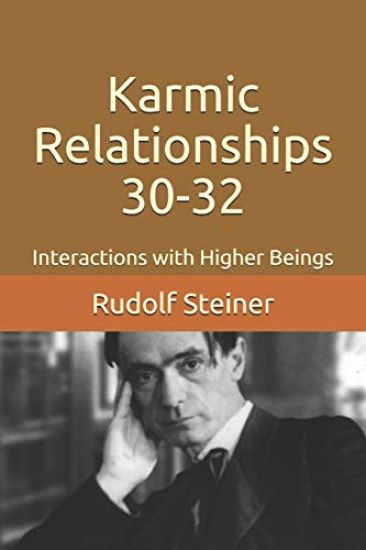
Karmic Relationships 30-32: Interactions with Higher Beings
Rudolf Steiner
Independently Published
2019
nidottu
These lectures begin with a vivid evocation of life after death. There we experience an extremely vivid retrospect of our lives that's not at all dreamlike, but rather filled with "supra-being." Moreover, we relive our lives from the perspective of the persons we affected. Raymond Lull understood that Aristotle's categories are an alphabet for spiritual thinking. Two figures are considered, including the prototype for Strader in Steiner's Mystery Dramas, whose biography after death is far more interesting than that before. The next lecture describes our encounters after death with the Angeloi, we never increase incarnated on Earth, and guide us from one incarnation to the next. Steiner addresses the vexed question of discrepancies between intention and outcome: Why do people with good intentions often fail to prosper in life, while those with evil intentions are often happy? These discrepancies can only be balanced out in the life after death, where only the good can be imported into the solar sphere. The third lecture offers an extremely complex account of our interactions with all three higher hierarchies in the course of our biography.
The Spiritual Guidance of Man and Mankind: Lectures
Rudolf Steiner
Independently Published
2019
nidottu
Rudolf Steiners' vast body of literary work includes not a small number of lectures and compilations of lectures such as this one. Primarily concerning itself with the evolution of mankind (and with the pre-modern theories of Blavatskys' time) it claims a sort of stage-by-stage descent away from the cosmic but towards an improved mankind increasingly able to reason and potentially grasp true spiritual principles. That is, that archaic man had direct help in the post-Atlantis period (as he deems it) from higher beings. It speaks in some degree of Galileo, Bruno, and Kepler, among other various figures.
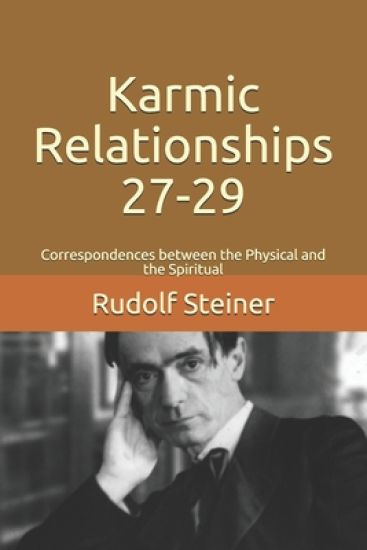
Karmic Relationships 27-29: Correspondences between the Physical and the Spiritual
Rudolf Steiner
Independently Published
2019
nidottu
Steiner now moves on from the considerations of exemplary biographies to a viewpoint that leads more into immediate human life. He explores various correspondences between the physical and the spiritual. Karmic balancing needs to be seen as the result of living inside the other person between incarnations. Thus what someone does to me in a subsequent incarnation was actually caused by us ourselves living in that person. Details are the key. Steiner noticed for example that Frank Wedekind possessed extraordinary hands, and this led back to his previous incarnation as an alchemist. We have to learn to see other people as transparent, so that Sun, Moon, and Saturn shine through. Waiting until an insight matures is necessary for all spiritual research. KR 28 contains the all-important karma exercise extending over three days. Readers will want to contemplate the contents of this lecture especially. KR 29 considers human physiognomy and play of gestures as revelations of previous incarnations. Our exteriors provide an image of how we behaved morally, of our spiritual behavior in a previous incarnation or in a series of previous incarnations. Contemplation of the head is actually imaginatively projected into the sensory world. A rhythmic consideration of human nature must be actually inspired, active within sensory observation, active in the sensory world. Consideration of the metabolic and limb system must be intuitive, supra-sensory in the sensory world.
Allgemeine Menschenkunde - Methodisch-Didaktisches - Seminar. Studienausgabe
Rudolf Steiner
Steiner Verlag, Dornach
2019
nidottu
Erziehung und Selbsterziehung des Kindes und Jugendlichen
Rudolf Steiner
Steiner Verlag, Dornach
2019
nidottu
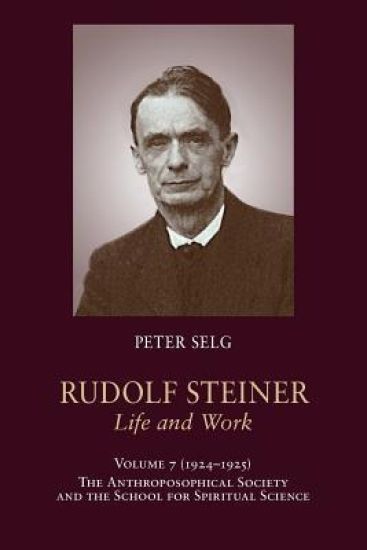
In the seventh and final volume in his comprehensive biography of Rudolf Steiner, Peter Selg describes Steiner's final months on Earth. Although his health was beginning to decline, 1924 was arguably his most productive and fruitful year. It saw a new beginning for the Anthroposophical Society, as well as the beginnings of the Esoteric School and the School for Spiritual Science, both of which continue to constitute the heart of the Society's core mission in the world. The year began with the "Christmas Conference," during which the new mystery stream of the Anthroposophical Society was reborn: "All those experiencing the Christmas Conference, the Michael Conference, in the right way felt transformed, felt how they became different persons, how the spiritual world drew very close--how we were, in fact, within it" (Ita Wegman). The year 1924 also witnessed Rudolf Steiner's series of "Karmic Relationships" lectures, as well as the serialized "Leading Thoughts" published in Das Goetheanum, the weekly newsletter to Anthroposophical Society members, in which he summarized the whole of Anthroposophy in a series of aphoristic food for thought and meditation, supplemented by essays on the Michaelic nature of Anthroposophy. Also serialized in the Goetheanum newsletter were Rudolf Steiner's Autobiography--seventy chapters in his life up to 1907. During that time, too, Steiner clearly defined his spiritual relationships with Ita Wegman, Marie Steiner, and Lili Kolisko and their significant connection to the Society and his spiritual legacy. New initiatives were also planted in the world during this time, including anthroposophically extended medicine and biodynamic agriculture. From his sickbed at the foot of his monumental sculpture--The Representative of Humanity--Steiner also formed plans and a model for rebuilding the Goetheanum in Dornach, Switzerland. Also included in this volume is a lecture by Rudolf Steiner on June 4, 1924, "The Festival of Pentecost."
Mystics of the Renaissance: Their Relation to Modern Thought
Rudolf Steiner
Independently Published
2019
nidottu
This work of Rudolf Steiner's creation is predominantly a collection of various mystic philosophy from the spiritual minds of the Renaissance (although it mentions and details some prior, Medieval work and a few contemporary figures as well.) From Boehme to Paracelsus, and from Agrippa to Eckhart, it speaks about the nature of mortality, of divinity, the nature of reality, and other occult topics. With numerous quotations of works from these individuals and plenty of secondary materials used to flesh the ideas expressed out, the relation between man and the divine is explored here in significant depth from Steiners' Theosophical and Anthroposophical perspective.
Allgemeine Menschenkunde als Grundlage der Pädagogik
Rudolf Steiner
Steiner Verlag, Dornach
2019
sidottu
Grundlinien einer Erkenntnistheorie der Goetheschen Weltanschauung
Rudolf Steiner
Hansebooks
2019
pokkari
The Education of Children - From the standpoint of Theosophy is an unchanged, high-quality reprint of the original edition . Hansebooks is editor of the literature on different topic areas such as research and science, travel and expeditions, cooking and nutrition, medicine, and other genres. As a publisher we focus on the preservation of historical literature. Many works of historical writers and scientists are available today as antiques only. Hansebooks newly publishes these books and contributes to the preservation of literature which has become rare and historical knowledge for the future.
Il mio compito, in questo ciclo di conferenze, sar? di gettare un ponte tra fatti relativamente consueti, tra esperienze che l'uomo pu? incontrare nella vita d'ogni giorno, e gli interessi supremi dell'umanit?. Cos? ci si aprir? un'altra delle vie che, dalla vita quotidiana, conducono a ci? che pu? essere per noi, per la nostra anima e il nostro spirito. Noi sappiamo che l'Antroposofia, quanto pi? ci approfondiamo in ci? che essa pu? darci, penetra nel nostro sentire, nel nostro volere, nelle forze di cui abbisogniamo per mostrarci idonei ad affrontare le molteplici vicende della vita. E sappiamo inoltre che cos? come possiamo sperimentarla ora, grazie agli influssi che appunto in quest'epoca giungono a noi dai mondi superiori, l'Antroposofia rappresenta in certo modo una necessit? per l'umanit? contemporanea. Sappiamo che in un tempo relativamente breve il genere umano dovrebbe perdere ogni sicurezza, ogni interiore tranquillit? se la rivelazione che chiamiamo Antroposofia non giungesse a quest'umanit?..
Kristinusko mystisenä tosiasiana ja vanhan ajan mysteerit
Rudolf Steiner; Sirpa Honko-Linde
SUOMEN ANTROPOSOFINEN LIITTO
2019
sidottu
Halvin toimitettuna 30,00 €
Varhaisteoksessaan Rudolf Steiner tuo kristillisyyden esiin ihmiskunnan hengenhistoriallisessa kehityskulussa. Vanhojen uskontojen ytimenä olivat salaiset mysteerit, joihin valitut ihmiset vihittiin. Myytit ja mytologinen tieto heijastavat niissä ilmennyttä tietoa. Mitä on kristinusko mystisenä tosiasiana Kristuksen elämän, kuoleman ja ylösnousemuksen kautta? Vanhan henkisyyden muuttuminen kristillisyyden myötä.
Kokemuksellinen kuvaus sielun tiestä fyysisen ruumiin ulkopuolella tapahtuvaan henkiseen kokemiseen ja tällä tiellä avautuvaan itsetietoisuuden suureen muutokseen henkiseen maailmaan astuttaessa. Samalla teos on meditatiivista syventymistä ihmisen olemuspuolien ominaisuuksiin, henkisen maailman kynnyksenvartijan kohtaamiseen sekä yliaistillisen maailman kokemisen tapoihin.
Monipuolisen kulttuurivaikuttajan, kasvattajan, filosofin ja henkisen opettajan Rudolf Steinerin laaja esitelmätoiminta huipentui niin sanottuihin karmaesitelmiin, jotka nyt julkaistaan kuusiosaisena sarjana. Jokaisen osan voi lukea myös itsenäisenä kokonaisuutena. Kuusitoista esitelmää käsittävässä viidennessä osassa Steiner tarkastelee ensin kohtalon voimien vaikutustapaa kuoleman jälkeisessä elämässä Kuun sfäärissä ja eri planeettapiirien alueella. Esimerkkinä vaikutusten siirtymisestä elämästä toiseen hän tarkastelee arabialaisen kulttuurin vaikutuksia edellisen elämän kautta sellaisilla läntisillä kulttuurivaikuttajilla kuin Francis Bacon ja Amos Comenius. Muita historiallisia esimerkkejä ovat mm. Voltaire, Victor Hugo ja Eliphas Levi. Kokonaisuutena kuusiosaisen sarjan yli 80 esitelmää luovat ainutlaatuisen näkymän jälleensyntymisen ja kohtalon todellisuuteen eri tasoilla. Jälleensyntymisen ja kohtalon dynamiikan ymmärtämistä nykyaikaan soveltuvalla tavalla voidaan pitää yhtenä Rudolf Steinerin elämäntyön keskeisenä peruspilarina.